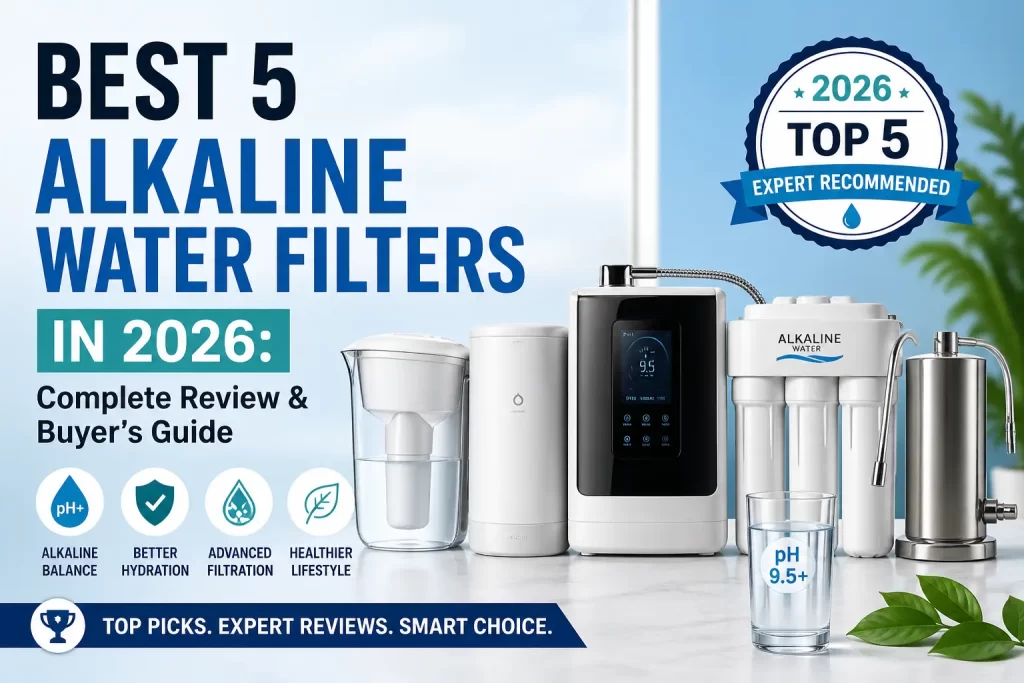
Drinking clean water is very important for staying healthy and feeling good every day. Tap water may look clean, but it sometimes contains chemicals, metals, and tiny dirt particles that are too small to see. Alkaline water helps balance your body’s pH, improves hydration, and gives you water that tastes fresh and pure. Using a good alkaline water filter ensures every sip you take is safe and healthy.
Alkaline water filters remove impurities while adding essential minerals, like calcium and magnesium, to your water. These filters are easy to use at home and help protect your body from harmful substances in tap water. With so many options available, it can be confusing to know which filter works best for your needs. This guide breaks down the top 5 alkaline water filters, showing their features, pros, and why they stand out.
Here are the five filters we will discuss in detail:
- iSpring RCC7AK
- Waterdrop WD-T4-A
- pH Recharge Glass Dispenser
- Express Water ROALK10D
- SimPure Y9A UV
Choosing the right alkaline water filter makes a big difference in your daily hydration and overall health. Each filter on this list is tested for performance, durability, and ease of use, so you can find one that fits your home perfectly. By the end of this guide, you will know which filter offers the cleanest, healthiest, and best-tasting water for you and your family.
1. iSpring RCC7AK Reverse Osmosis Alkaline System
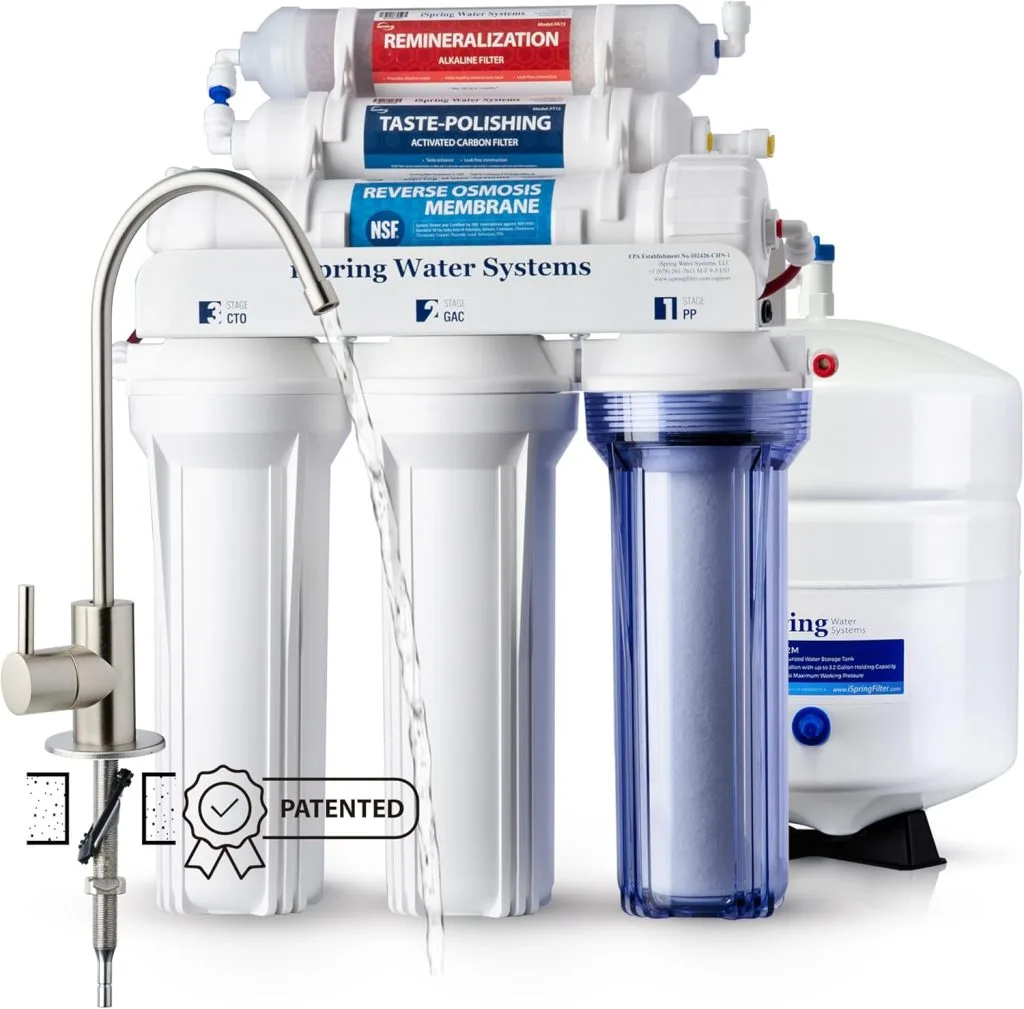
The iSpring RCC7AK is a widely popular, traditional 6-stage Reverse Osmosis (RO) system that includes a crucial Alkaline Remineralization stage. The core RO filter removes up to 99% of over 1,000 contaminants, providing an exceptionally high level of purification. The final alkaline stage then restores the healthy minerals (like calcium and magnesium) that the RO process removes, neutralizing the water’s acidity and improving its taste to a preferred natural spring-water quality. This system requires no electricity to operate and is fully certified for performance and safety.
Key Specifications
| Feature | Detail |
|---|---|
| Brand | iSpring |
| Amazon Rating | 4.7 out of 5 |
| Model Name | RCC7AK |
| Type/Design | Under-Sink RO with Storage Tank |
| Filtration Stages | 6-Stage (5 Purification + 1 Alkaline) |
| RO Capacity | 75 GPD (Gallons Per Day) |
| Min. Water Pressure | 45 psi (Booster Pump needed if lower) |
| Current Price | Check Price |
Filtration Technology and Performance
The iSpring RCC7AK cleans water through a powerful 6-stage layered process designed to eliminate nearly all contaminants before adding minerals back for optimal taste and pH:
- Stage 1: PP Sediment Filter
This pre-filter captures large particles like sand, rust, and dirt to protect the fine RO membrane from premature clogging.
- Stage 2: GAC Carbon Filter
This layer absorbs chlorine, odors, and tastes, improving the water’s initial aesthetics and protecting the RO membrane from chemical damage.
- Stage 3: CTO Carbon Block Filter
This second carbon filter provides further removal of any residual chlorine and volatile organic chemicals (VOCs).
- Stage 4: RO Membrane (The Core)
This is the heart of the system. Its microscopic 0.0001 micron pores reject up to 99% of dissolved solids, heavy metals, and chemicals, creating highly purified water.
- Stage 5: Post-Carbon Filter
This filter polishes the purified water, ensuring any lingering tastes or odors are eliminated before the water enters the alkaline stage.
- Stage 6: Alkaline Remineralization Filter
This final stage uses all-natural mineral stones to restore healthy minerals and raise the pH to a balanced alkaline level, which greatly enhances the water’s taste.
This water filter is highly effective for removing the following contaminants:
| Contaminants | Reduction Performance Range |
| TDS (Total Dissolved Solids) | 93%-98% |
| Lead, Arsenic, Cadmium | Reduces more than 98.9% |
| Fluoride | Reduces more than 97.4% |
| Chlorine, Tastes, & Odors | Reduces 95%-99% |
| pH Level | Neutralized to Alkaline pH |
Flow Rate and Pressure Assurance
As a traditional reverse osmosis system, the iSpring RCC7AK produces water slowly, achieving a capacity of 75 gallons per day (GPD). Because of this slow speed, the system uses a storage tank to ensure clean water is ready instantly when the faucet is opened. The system requires a minimum incoming water pressure of 45 psi to operate efficiently; if your home’s pressure is lower than this, the unit will produce water very slowly, and a booster pump must be installed separately to guarantee the full rated capacity.
Certification and Trust
The iSpring RCC7AK establishes exceptional trust through rigorous third-party testing, setting it apart from many competitors by being certified to NSF/ANSI Standard 58. This certification validates the entire system’s performance for its ability to reduce Total Dissolved Solids (TDS), confirming that it genuinely delivers on its core promise of superior purification. This high standard gives users confidence in the system’s ability to remove over 1,000 contaminants, including heavy metals like lead and fluoride. Furthermore, iSpring backs this reliability with dedicated, lifetime technical support from its U.S.-based team.
Cost of Ownership and Maintenance
The iSpring RCC7AK offers reasonable long-term operating costs and straightforward maintenance for a traditional tank-based RO system. The filter replacement schedule is staggered, meaning you only replace the high-cost membrane every few years, keeping annual costs low.
- Pre-Filter Replacement (Annual): The sediment, GAC, CTO, post-carbon, and alkaline filters (5 stages total) should be replaced every 6 to 12 months. The standard 1-year replacement pack (F9K) costs approximately $79.99.
- RO Membrane Replacement (Long-Term): The critical RO membrane (Stage 4) is designed to last much longer, typically requiring replacement only every 2 to 3 years, depending on your source water quality. The cost for the replacement membrane is low, averaging around $40.
- Maintenance Effort: Maintenance is simple; the system uses universal, standard-sized filter casings that require an included wrench to unscrew. This design is budget-friendly, as it prevents being locked into expensive proprietary cartridges.
- Wastewater Cost: As a traditional RO system, it generates wastewater during purification (average ratio is around 4:1). While this is normal for RO, it is an ongoing utility cost to consider for the life of the system.
Summary
| What We Like | What We Dislike |
| Certified Performance: The entire system is NSF/ANSI 58 certified for TDS reduction, guaranteeing reliable contaminant removal. | Slow Flow at Faucet: The RO process is inherently slow; water dispenses slowly once the storage tank is empty. |
| Alkaline Remineralization: The 6th stage successfully neutralizes acidic RO water and restores healthy minerals for a superior, balanced taste. | Wastewater Generation: As a traditional RO unit, it produces a significant amount of wastewater (brine) that goes down the drain. |
| Affordable Maintenance: Annual filter costs are low (around $80), and the system uses non-proprietary, standard-sized filters, allowing for price shopping. | Large Footprint: The multi-stage housing plus the separate pressurized storage tank requires substantial cabinet space under the sink. |
| High GPD Capacity: The 75 GPD membrane capacity is robust enough to serve the daily drinking and cooking needs of a medium-to-large family. | Requires High Pressure: The system needs a minimum of 45 psi; low-pressure homes must purchase and install an additional booster pump. |
| Reliable Support: The product is backed by iSpring’s highly praised lifetime technical support from its U.S.-based team. | Complex Installation: Requires mounting canisters, plumbing the drain saddle, and connecting the storage tank; not as simple as twist-on cartridge systems. |
Our Final Verdict: Who Is This Filter Best For?
The iSpring RCC7AK system is the ideal choice for people who meet the following criteria:
- TDS-Challenged Water Users: It is the best choice for water sources with very high Total Dissolved Solids (TDS) or tough contaminants, as its RO core provides the highest removal rate.
- Mineral and Taste Prioritizers: The dedicated AK (Alkaline Remineralization) stage ensures the purified water is neutrally pH-balanced and tastes clean, not flat or acidic.
- Budget-Conscious RO Shoppers: The system’s competitive purchase price, combined with its use of low-cost, non-proprietary filters, makes it one of the cheapest RO systems to maintain annually.
- Medium-to-Large Families: The 75 GPD capacity and the inclusion of a storage tank ensure that plenty of pure, alkaline water is readily available on demand.
2. Waterdrop WD-T4-A Alkaline pH
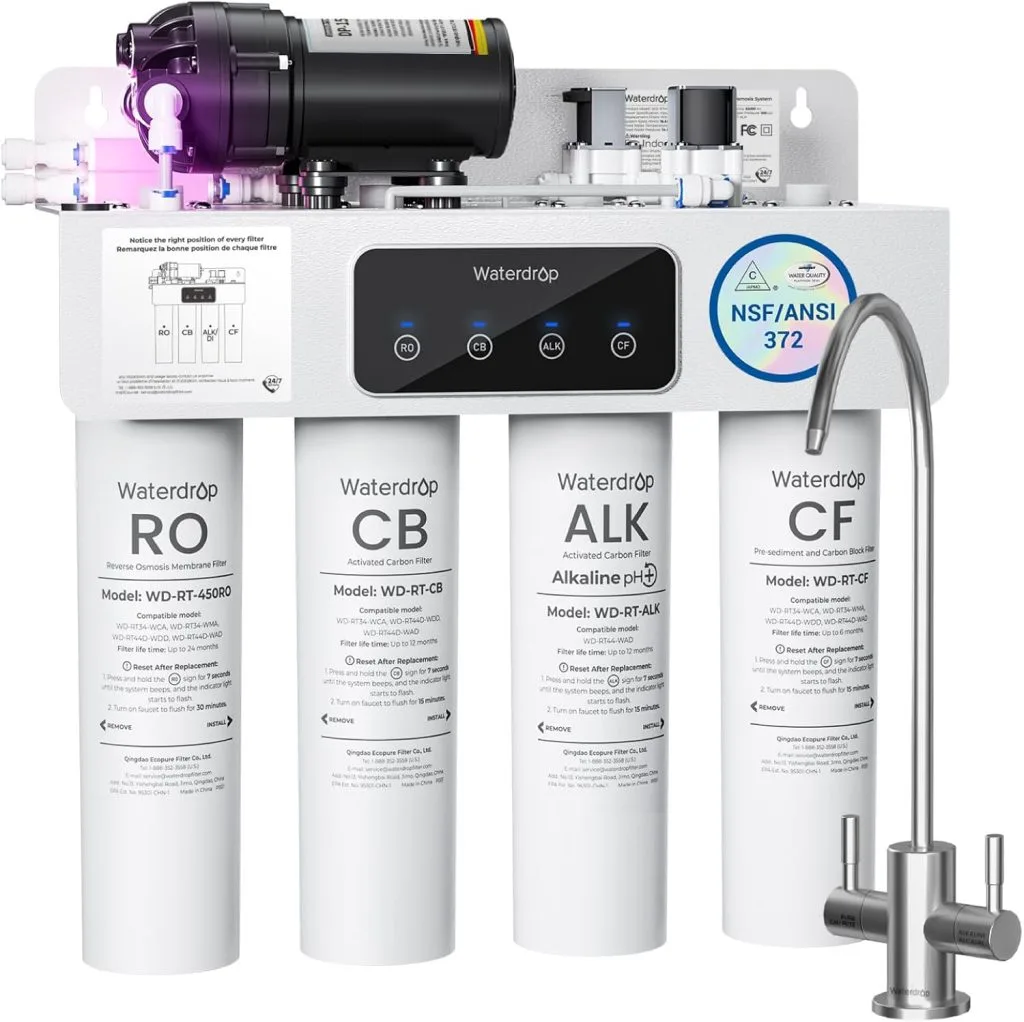
The Waterdrop WD-T4-A is a high-speed, tankless reverse osmosis system that excels in water efficiency and convenience. This modern unit uses a comprehensive 10-stage filtration process to remove over 1,000 contaminants while boasting a high 450 GPD capacity for instant water. Its primary feature is the dual water flow faucet, allowing users to choose between highly purified standard RO water or a mineral-enhanced alkaline stream. The tankless design not only saves space but also achieves a top-of-the-line 2:1 pure-to-drain waste ratio
Key specifications
| Feature | Detail |
|---|---|
| Brand | Waterdrop |
| Amazon Rating | 4.7 out of 5 |
| Model Name | WD-T4-A |
| Type/Design | Tankless Under-Sink RO |
| Filtration Stages | 10-Stage (including Alkaline) |
| RO Capacity | 450 GPD (Gallons Per Day) |
| Waste Ratio | 2:1 Pure-to-Drain (Highly Efficient) |
| Alkaline Feature | Alkaline Mineralizer (Dual Flow) |
| Power Source | Electric (Plug-in Required) |
| Current Price | Check Price |
Filtration Technology and Performance
The Waterdrop WD-T4-A employs a sophisticated, multi-layered filtration process condensed into compact cartridges, which it markets as 10 stages to ensure superior water purity and alkaline balance:
- CF Filter (Composite)
This single filter contains multiple layers to serve as both the primary sediment filter and the carbon block filter. It traps large particles and reduces chlorine and chemical contaminants, protecting the core RO membrane.
- RO Membrane (The Core)
This is the high-capacity 450 GPD reverse osmosis membrane. Its ultrafine 0.0001 micron pores provide the highest possible removal rate, effectively stripping water of heavy metals, salts, PFAS, and other dissolved solids.
- CB Filter (Post-Carbon)
This filter polishes the RO water, eliminating any trace flavors or odors that may have been created during the purification process.
- ALK Filter (Alkaline Mineralizer)
The final, dedicated stage infuses the purified water with beneficial minerals such as calcium, magnesium, potassium, and sodium to neutralize the water’s acidity and raise the pH to a healthy alkaline level.
This water filter is highly effective for removing the following contaminants:
| Contaminants | Reduction Performance Range |
| TDS (Total Dissolved Solids) | Highly Reduced (0.0001 micron) |
| Heavy Metals (Lead, Chromium, etc.) | Reduces over 99% |
| PFOA / PFOS (PFAS Chemicals) | Highly Reduced |
| Chlorine, Tastes, & Odors | Reduces over 99% |
| Alkalinity/pH | Raised to Alkaline pH |
Flow Rate and Pressure Assurance
The Waterdrop WD-T4-A is designed for speed, achieving an exceptional production capacity of 450 gallons per day (GPD) thanks to its built-in electric pump. Because it is tankless, this capacity translates into a rapid, on-demand flow rate of 0.42 gallons per minute (GPM) directly from the faucet, eliminating the waiting period common with tank systems. The required electric power drives the pump, which means the system can operate across a wide pressure range (14.5 to 87 psi) and achieves a highly water-efficient 2:1 pure-to-drain ratio, saving thousands of gallons of water per year compared to older RO models.
Certification and Trust
The Waterdrop WD-T4-A is built on the proven reliability of tankless RO technology, giving high confidence in its core performance claims. The system’s certification to NSF/ANSI 372 confirms that all water-contact materials are verified as lead-free and safe. Furthermore, Waterdrop backs up its powerful 10-stage contaminant reduction claims (including PFAS and heavy metals) with extensive independent lab testing, though the entire system does not carry the primary NSF/ANSI 58 performance seal. However, the compact design and the inclusion of a Smart Filter Life Reminder (indicator lights and buzzer alerts) are key modern trust factors, ensuring the system is maintained on schedule for peak efficiency.
Cost of Ownership and Maintenance
The Waterdrop WD-T4-A is designed to be highly cost-efficient due to its advanced waste ratio and manageable replacement schedule. The system uses compact, proprietary filters that are easy to change and monitor.
- Filter Change Schedule (Staggered): The system’s four filter cartridges have varied lifespans. The CF filter requires replacement every 6 months, the CB and alkaline filters are replaced every 12 months, and the main RO membrane lasts for an impressive 24 months (two years).
- Annual Cost Estimation: The estimated average cost for all replacement cartridges (including the annualized portion of the RO membrane) totals approximately $110 to $120 per year. This cost is slightly higher than basic RO systems but includes the essential alkaline stage.
- Smart Maintenance: The system uses indicator lights and buzzer alerts to automatically remind you when to replace each specific cartridge, simplifying maintenance tracking.
- Wastewater Efficiency: The electric pump helps achieve an industry-leading 2:1 pure-to-drain ratio, drastically reducing the amount of wastewater generated by 800% compared to older RO systems, which saves on water utility costs.
Summary
| What We Like | What We Dislike |
| Tankless & Space-Saving: Eliminates the large storage tank, freeing up significant under-sink space and preventing secondary contamination risk. | Requires Electricity: The built-in pump and smart features require a constant electrical outlet under the sink to operate. |
| Highest Water Efficiency: Achieves an excellent 2:1 pure-to-drain ratio, drastically reducing water waste compared to older RO systems. | Higher Upfront Cost: The advanced technology and tankless design result in a higher initial purchase price than a traditional tank-based RO system. |
| Fast, On-Demand Flow: The 450 GPD capacity provides purified water quickly (fast fill time) directly from the faucet, with no waiting. | Staggered Filter Schedule: Replacing three different cartridges (CF, CB/ALK, RO) at three separate intervals (6 mo, 12 mo, 24 mo) complicates maintenance tracking. |
| Dual Water Quality: The faucet provides the unique option to switch between standard, highly purified RO water and alkaline, mineral-enhanced water. | No NSF Performance Seal: The system is certified only to NSF/ANSI 372 (lead-free materials), lacking the primary NSF/ANSI 58 performance certification. |
| Smart Monitoring: Integrated indicator lights and buzzer alerts simplify maintenance by telling the user exactly when each filter cartridge is due for a change. | Proprietary Filters: The system requires specific Waterdrop twist-on cartridges, which limit shopping flexibility compared to universal filters. |
Our Final Verdict: Who Is This Filter Best For
The Waterdrop WD-T4-A is the prime choice for those looking for the ultimate convenience and efficiency in a modern alkaline system, without the hassle of a traditional tank. This innovative RO unit is the perfect fit for people who meet the following criteria:
- Space-Limited Households: The compact, tankless design is ideal for freeing up to 70% of under-sink storage space, making it perfect for small kitchens and apartments.
- Efficiency and Speed Prioritizers: It suits users who demand the highest filtration standard (RO) but require fast, instant flow and appreciate the water savings of the market-leading 2:1 pure-to-drain ratio.
- Dual Water Quality Users: This is the best option for households that want the flexibility to choose between pure, neutral RO water (for baby formula or coffee) and alkaline, mineral-enhanced water (for drinking).
- Smart Maintenance Seekers: The electronic filter life alerts and easy-twist cartridges eliminate the need for manual date tracking, making long-term maintenance simple and worry-free.
- Large Families with High Demand: The robust 450 GPD capacity ensures the system can easily keep up with the continuous water needs of large households.
3. pH Recharge Glass Alkaline Water Filter Dispenser
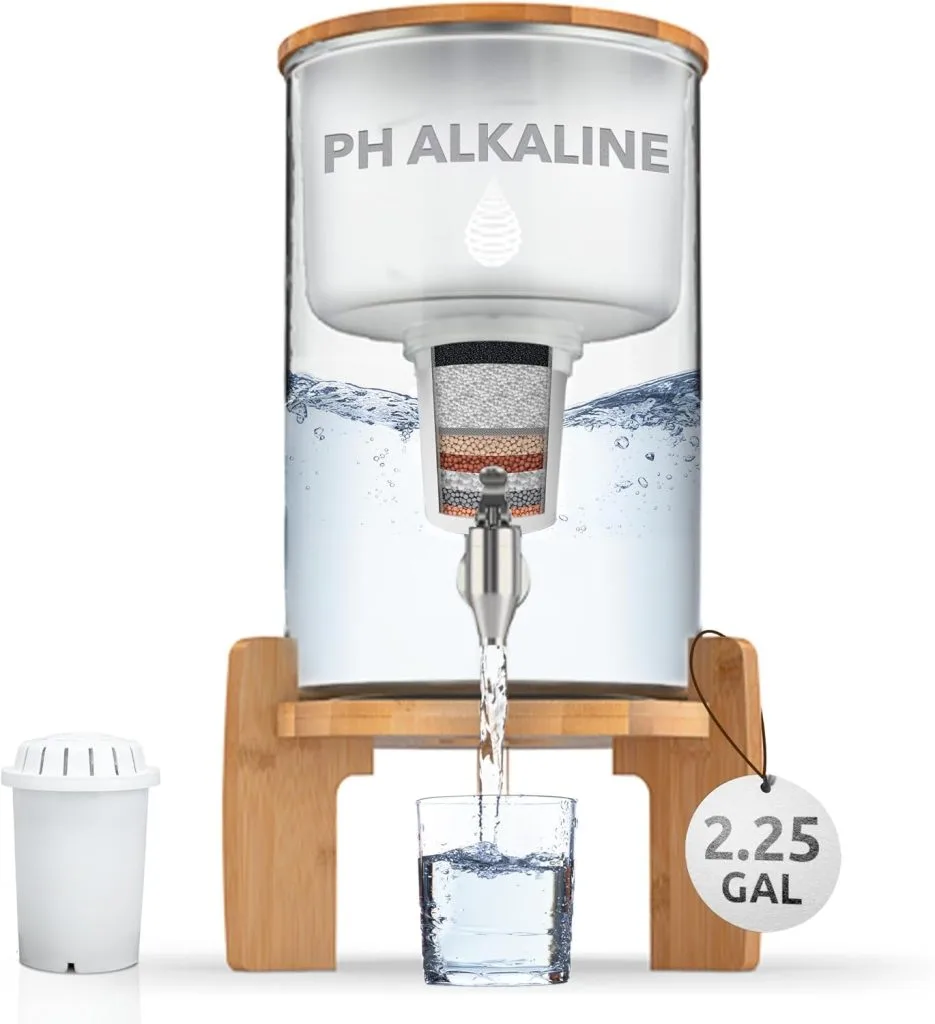
The pH recharge glass dispenser is a premium, non-electric, countertop filter that focuses heavily on aesthetics and alkaline water quality rather than comprehensive contaminant removal. It features a stunning, large-capacity borosilicate glass body set on a stylish wooden stand, making it a statement piece in any kitchen. The system works via gravity, passing tap water through a multi-stage alkaline filter to raise the pH to pH 9+ and infuse beneficial minerals, offering a simple and eco-friendly alternative to electric ionizers or plastic pitcher filters.
Key Specifications
| Feature | Detail |
|---|---|
| Brand | Invigorated Water |
| Amazon Rating | 4.0 out of 5 |
| Model Name | pH Recharge Glass Dispenser |
| Type/Design | Countertop Gravity Dispenser |
| Water Capacity (Total) | 2.25 Gallons (8.5 Liters) |
| Filtration Stages | Multi-Stage Alkaline Filter (pH001) |
| pH Output Claim | Up to pH 9+ |
| Power Source | Non-Electric (Gravity) |
| Filter Lifespan | 96 Gallons (360 Liters) |
| Current Price | Check Price |
Filtration Technology and Performance
The pH Recharge Dispenser focuses on enhancing water quality rather than stripping it completely, using a specialized multi-stage blend within its gravity-fed pH001 filter:
- Stage 1: Dual Micro Nets and Activated Carbon
This initial layer captures sediment, rust, and dirt, while the carbon actively eliminates chlorine and bad odors, providing the base taste improvement.
- Stage 2: Advanced KDF and Zeolite
The KDF material targets and removes heavy metals such as lead and mercury. The zeolite layer assists in reducing fluoride and ammonia compounds often found in tap water.
- Stage 3: Mineral and Alkaline Blend (Ceramic Balls)
The final stages include a mix of maifan, tourmaline, and far infrared ceramic balls. These mineral blends actively increase the water’s alkalinity, raising the pH to nine or higher and lowering the ORP (making it an antioxidant).
Water Cleaning Report
| Bad Stuff We Test For | Removal Extent |
| Chlorine, Tastes, & Odors | Reduces over 90% |
| Heavy Metals (Lead, Mercury) | Effectively Reduced |
| Fluoride | Reduced (Targeted in Zeolite) |
| TDS (Total Dissolved Solids) | Increased |
| pH Level | Boosted to pH 9+ |
Flow Rate and Pressure Assurance
As a gravity-fed system, the pH Recharge Dispenser requires absolutely zero pounds per square inch (psi) of water pressure and needs no electricity to operate, making it incredibly simple and mobile. The downside of gravity filtration is the slow flow rate, which is dictated by how quickly the water can drip through the dense alkaline filter media. Users must manually refill the top reservoir and wait for the filtering process to complete before dispensing, making it a system best suited for gradual consumption rather than instant high-volume needs.
Certification and Trust
The pH Recharge Glass Dispenser builds trust primarily on its premium, non-toxic construction, rather than major performance certifications. The system is made with BPA-free, food-grade glass, and its filters are certified by independent bodies like SGS and the WQA for material safety and quality. The company provides a 1-year limited warranty and lifetime technical support from its dedicated team. However, it is important to note that this dispenser does not carry the comprehensive NSF/ANSI performance seals that verify contaminant reduction claims for lead or chlorine, placing the focus squarely on pH enhancement and taste improvement.
Cost of Ownership and Maintenance
The pH Recharge Dispenser has a major cost advantage in its non-electric operation, but its low filter capacity results in one of the highest annual maintenance costs on our list.
- Filter Capacity: The main pH001 alkaline filter has a very limited lifespan, processing only 96 gallons before requiring replacement. This translates to frequent changes, potentially every 1 to 2 months for an active family.
- Annual Cost Estimation (High): Due to the high replacement frequency, the estimated annual cost for the pH001 filters averages approximately $200 to $265 per year, depending on purchasing filters in bulk and how often your household drinks water.
- Maintenance & Cleaning: As a gravity dispenser, it is a low-maintenance device, requiring only occasional disassembly of the chambers for hand-washing with warm, soapy water. No special tools are needed.
- Eco-Benefit: The system is non-electric and uses a reusable borosilicate glass reservoir, which significantly reduces the home’s plastic waste footprint compared to buying bottled alkaline water.
Summary
| What We Like | What We Dislike |
| Aesthetic Design: The borosilicate glass body and wooden stand create a visually stunning, premium look for any countertop. | Extremely High Annual Cost: The low 96-gallon filter life leads to frequent replacement and an estimated annual cost of \approx $200-$265. |
| Exceptional pH Boost: The specialized filter blend consistently raises water pH to 9 or higher, effectively neutralizing acidity. | Very Slow Filtration: As a gravity-fed system, you must wait for the water to slowly drip through the filter media, limiting instant access to large volumes. |
| Zero Installation/Power: Requires absolutely no plumbing or electricity, making it the simplest “plug-and-use” solution on the market. | No Health Certification: The system lacks the critical NSF/ANSI 53 or 58 seals for verified contaminant reduction (lead, fluoride, etc.). |
| Healthy Mineral Infusion: Actively adds beneficial minerals (zinc, selenium, magnesium) to the water, which improves taste and ORP. | Small Capacity: The 2.25-gallon capacity is small for active families, requiring several refills per day. |
| Non-Plastic Water Contact: The main reservoir is high-quality BPA-free glass, appealing to consumers who avoid plastic contact with their drinking water. | Risk of Spillage: The dispenser design can be prone to leaks or spills when refilling the top reservoir or when dispensing from the spigot. |
Our Final Verdict: Who Is This Filter Best For?
The pH Recharge Glass Dispenser is an excellent choice for a very specific type of user who prioritizes aesthetics and alkaline enhancement over raw purification power. This system is the perfect fit for people who meet the following criteria:
- Design-First Consumers: It is ideal for those who value an elegant countertop design, as the premium borosilicate glass and wooden base are visually superior to plastic pitchers or under-sink housing.
- Alkaline Enthusiasts: This system is best for users whose primary goal is to reliably and non-electrically raise their water’s pH to 9+ and boost its antioxidant properties (ORP).
- Renters or Dorm Residents: Since it requires zero installation or plumbing, it offers a massive capacity advantage over simple pitchers while remaining portable.
- Users with Confidence in Source Water: It is suitable for city water users who are mainly concerned with chlorine and flavor, but not with eliminating the deepest levels of heavy metals or complex contaminants like PFAS.
- Eco-Conscious Individuals: The glass construction and elimination of plastic water bottles make it a highly sustainable and environmentally friendly choice.
4. Express Water Reverse Osmosis Alkaline Water Filtration System: Review
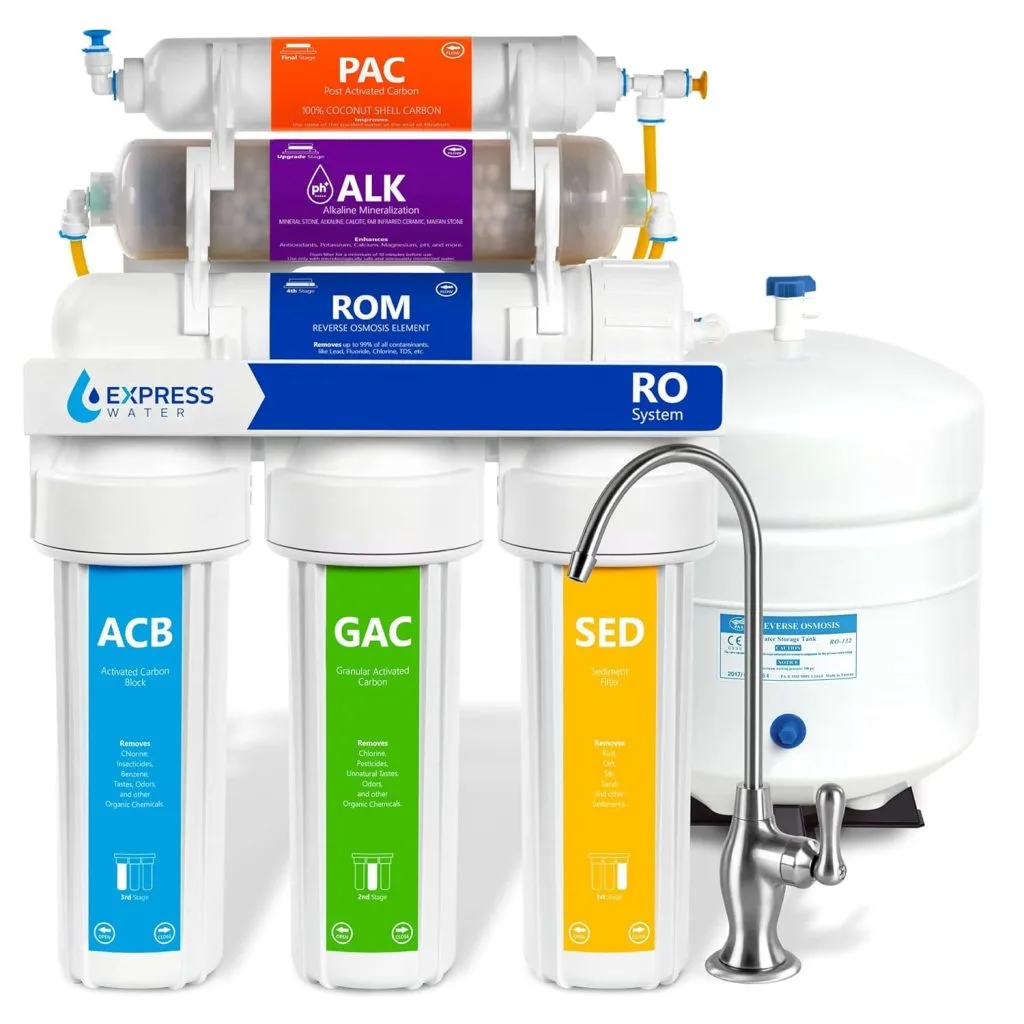
The Express Water Reverse Osmosis Alkaline System is a comprehensive, tank-based filtration unit designed for maximum water purity and pH balance. This system utilizes 10 powerful stages to ensure nearly 100% contaminant removal before passing the water through an alkaline remineralization filter, which restores essential minerals and raises the pH level. As a high-capacity RO system, it includes a large storage tank to guarantee a steady flow of clean, great-tasting water for large families, making it a reliable and highly-rated solution for tough water challenges.
Key specifications
| Feature | Detail |
|---|---|
| Brand | Express Water |
| Amazon Rating | 4.5 out of 5 |
| Model Name | ROALK10D |
| Type/Design | Under-Sink RO with Storage Tank |
| Filtration Stages | 10-Stage (Including Alkaline) |
| RO Capacity | 100 GPD (Gallons Per Day) |
| Min. Water Pressure | 40 psi (Booster Pump needed if lower) |
| Current Price | Check Price |
Filtration Technology and Performance
The Express Water system achieves industry-leading contaminant rejection through a robust, layered 10-stage process housed in transparent casings:
- Stages 1–3 (Pre-Filters)
A sediment filter, granular activated carbon (GAC), and activated carbon block (ACB) work sequentially.
- Stage 4 (RO Membrane)
The core filter. Its 0.0001 micron pores reject up to 99.99% of Total Dissolved Solids (TDS), fluoride, lead, arsenic, and nitrates, providing the highest level of purification.
- Stage 5 (Post-Carbon Filter)
This filter polishes the RO water right before it enters the tank, removing any residual flavor or odor.
- Stages 6-10 (Alkaline Remineralization)
These five layers of mineral stone and activated media constitute the alkaline filter. They add back essential minerals (calcium, magnesium) to neutralize the purified water’s acidity, boosting the pH and significantly improving taste.
This water filter is highly effective for removing the following contaminants:
| Contaminants | Reduction Performance Range |
| TDS (Total Dissolved Solids) | Reduces up to 99.99% |
| Heavy Metals (Lead, Arsenic) | Reduces up to 96% |
| Fluoride | Reduces up to 93% |
| Chlorine, Tastes, & Odors | Reduces 100% |
| pH Level | Neutralized to Alkaline pH |
Flow Rate and Pressure Assurance
The Express Water is a traditional RO system that operates on home water pressure, requiring a minimum of 40 pounds per square inch (psi) to function correctly. Its 100 Gallons Per Day (GPD) capacity is excellent for a tank-based unit, ensuring the 3.2 gallon storage tank is always refilled quickly. Because the purified water is stored, the system provides a continuous stream of water directly from the faucet, eliminating the low-flow bottleneck associated with older or low-pressure systems.
Certification and Trust
The Express Water Alkaline system establishes buyer confidence by being certified by an independent laboratory to NSF Standard 58, which is the official regulatory benchmark for reverse osmosis performance and TDS reduction. This verification confirms that the system effectively removes up to 99.99% of contaminants, including lead and cyanide. Furthermore, every unit includes an important emergency leak stop detector that automatically shuts off the water supply when moisture is detected, providing a crucial and highly reliable layer of protection against potential home water damage.
Cost of Ownership and Maintenance
The Express Water system is designed for convenient and cost-effective maintenance, largely due to its commitment to using universal standard-sized filters rather than expensive proprietary cartridges.
- Filter Change Schedule (Frequent): The Express Water system requires more frequent maintenance than some competitors. The alkaline filter, the three pre-filters, and the post-carbon filter must all be replaced every 6 months to protect the membrane.
- RO Membrane Replacement (Long-Term): The high-performance RO membrane is designed to last longer, with replacement recommended every 2 years, ensuring consistent high purity over time.
- Annual Cost Estimation: The estimated annual cost for all necessary replacement filters (excluding the RO membrane replacement every other year) is low, averaging approximately $143 per year for the full annual set (which includes six pre-filters and two post-filters for the 10-stage system).
- Wastewater Ratio: As a traditional tank RO system, it has a wastewater ratio of 1:1 to 1:3, meaning it produces 1 gallon of purified water for every 1–3 gallons sent to the drain.
Summary
| What We Like | What We Dislike |
| Highest Stages & Purification: With 10 stages, it offers maximum filtration power to remove the broadest spectrum of contaminants (99.99%). | Frequent Maintenance: The pre-filters, alkaline filter, and post-filter must be replaced every 6 months, requiring high-frequency maintenance. |
| Certified Performance & Safety: Certified to NSF Standard 58 and includes a built-in emergency leak detector for enhanced home safety. | High Waste Ratio: As a traditional RO system, it produces wastewater, increasing water utility costs. |
| Universal Filters: The system uses standard 10-inch filter cartridges, allowing the user to buy non-proprietary filters from any compatible manufacturer to save money. | Slow Flow at Faucet: The system relies on the storage tank, resulting in slower water flow once the tank pressure drops below maximum. |
| High Daily Capacity: The 100 GPD capacity is robust, ensuring the 3.2-gallon tank refills quickly enough for larger families. | Bulky Design: The multi-housing unit plus the separate pressure tank requires considerable space under the sink. |
Our Final Verdict: Who Is This Filter Best For?
The Express Water Reverse Osmosis Alkaline System is a powerhouse choice for maximum purification and customizable maintenance. This robust, tank-based RO filter is the perfect fit for people who meet the following criteria:
- Contamination Worriers: It is ideal for users with well water or municipal sources that require the absolute highest level of contaminant removal (99.99% TDS reduction) and strong certification (NSF 58).
- The Budget DIYer: Because it uses universal, standard-sized filters, it allows the buyer to shop for the cheapest replacement filters on the market, drastically reducing the system’s long-term cost.
- Large Families with High TDS: The 100 GPD capacity and the 4-gallon tank ensure plenty of highly purified, alkaline water is always available for a large household.
- Safety-Focused Homeowners: The inclusion of the emergency leak stop detector provides a valuable, low-cost safety feature that protects the area under the sink from water damage.
- Alkaline Water Seekers: The 10th-stage alkaline filter successfully neutralizes the water’s pH and improves taste by adding healthy minerals back into the RO-purified stream.
5. SimPure Y9A UV Countertop Reverse Osmosis Filter: Review
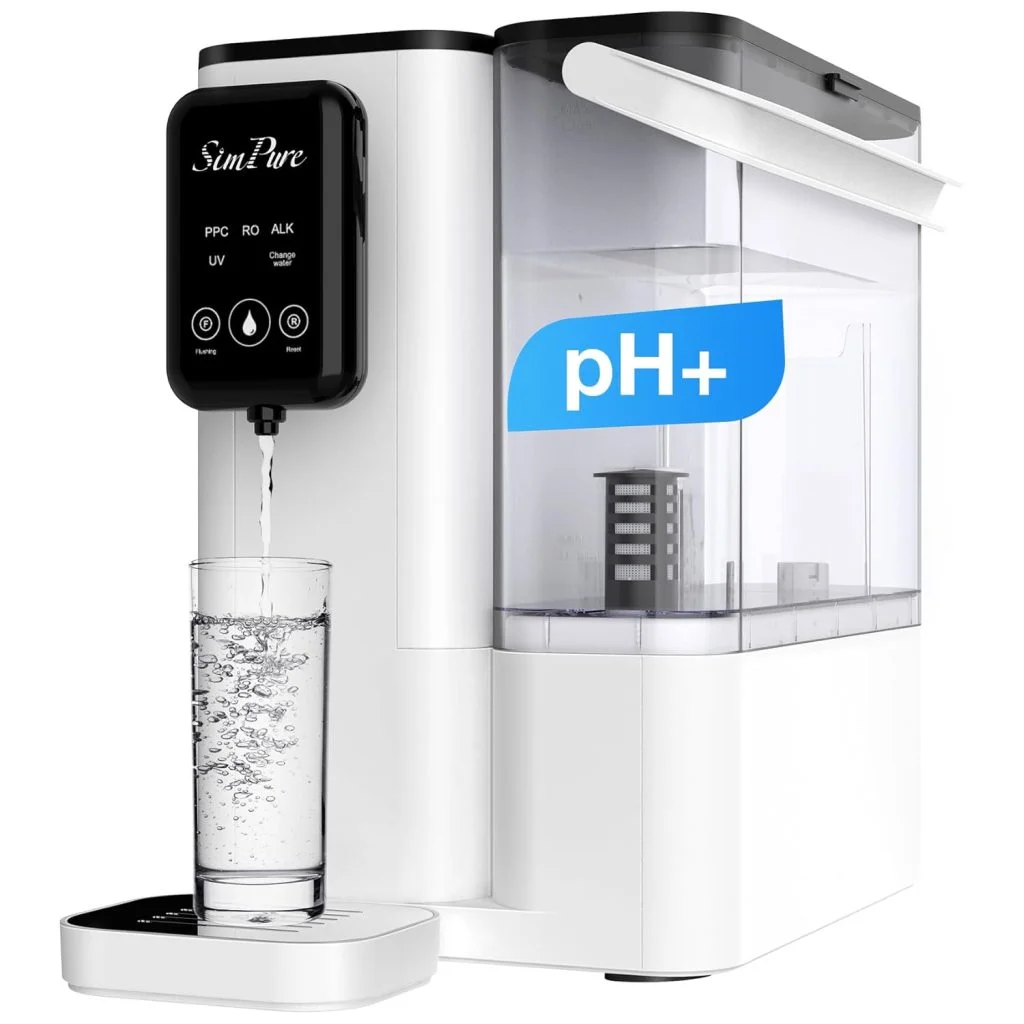
The SimPure Y9A is a state-of-the-art countertop reverse osmosis filter that combines advanced purification with ultimate convenience, requiring zero installation or plumbing. This powerful system uses a 6-stage filtration process, including a 300 GPD RO membrane for fast water, an alkaline remineralization stage, and a crucial built-in UV sterilization stage for maximum microbial safety. Designed for portability and ease of use, you simply plug it in and fill the side-access reservoir to get instant, purified, alkaline water with an excellent 3:1 pure-to-waste ratio.
Key Specifications
| Feature | Detail |
|---|---|
| Brand | SimPure |
| Amazon Rating | 4.4 out of 5 |
| Model Name | Y9A |
| Type/Design | Countertop/Zero-Installation |
| Filtration Stages | 6-Stage (Including UV & Alkaline) |
| RO Capacity | 300 GPD (Gallons Per Day) |
| Waste Ratio | 3:1 Pure-to-Waste |
| Special Feature | UV Sterilization + Alkaline Remineralization |
| Current Price | Check Price |
Filtration Technology and Performance
The SimPure Y9A uses a comprehensive 6-stage system designed specifically for non-plumbed, countertop operation, maximizing purification and adding safety layers:
- PPC/CTO Composite Filters
These multiple carbon and sediment layers capture coarse particles, rust, and chlorine, protecting the core membrane and ensuring water is clear for the UV light.
- RO Membrane (The Core)
The high-speed 300 GPD RO membrane purifies water down to 0.0001 microns, effectively removing up to 99.99% of TDS, heavy metals, nitrates, and PFAS chemicals.
- Alkaline Remineralization Filter
This post-filter adds essential minerals like calcium and magnesium back into the water, raising the pH to a balanced alkaline level (above 7.5) and improving the taste.
- UV Sterilization Module
The final, built-in ultraviolet (UV) light acts as a redundant safeguard, destroying the DNA of any remaining bacteria, viruses, or coliforms that could potentially breed in the reservoir.
This water filter is highly effective for removing the following contaminants:
| Contaminants | Reduction Performance Range |
| TDS (Total Dissolved Solids) | Removes 99.98% |
| Viruses and Bacteria | Removes 99.99% (UV Redundancy) |
| Heavy Metals (Lead, Arsenic) | Removes 99.88% |
| PFOA / PFOS (PFAS) | Removes 99.09% |
| pH Level | Raises to alkaline pH (>7.5) |
Flow Rate and Pressure Assurance
The SimPure Y9A is revolutionary because it requires absolutely zero plumbing or external water pressure to function. Instead, this countertop unit uses a corded electric pump to draw water from its internal reservoir, forcing it through the 300 GPD RO membrane. This high-capacity pump system provides a rapid flow of about 0.21 gallons per minute (GPM) directly to your cup, a speed fast enough to fill a glass in about 12 seconds. This design eliminates all flow problems associated with low home water pressure and ensures purified water is always dispensed quickly, unlike slow-drip gravity models.
Certification and Trust
The SimPure Y9A builds high confidence through its commitment to transparent, independent lab testing and its integrated safety features. While the system does not carry the primary NSF/ANSI certification, SimPure verifies performance through SGS testing, confirming that the system meets the criteria of the NSF/ANSI 58 standard for TDS and contaminant reduction, and EPA 537 for PFAS removal. The inclusion of an effective UV sterilization stage provides an extra layer of microbiological protection. Furthermore, the company offers a 1-year manufacturer’s warranty with an optional extension, supported by a U.S.-based team.
Cost of Ownership and Maintenance
The SimPure Y9A offers significant convenience by having zero plumbing installation, but its filter replacement schedule and cost are generally higher than those of tank-based systems.
- Filter Change Schedule (High Frequency): This model has a high-frequency maintenance schedule. The PPC and alkaline filters must be replaced every 6 months, and the main RO membrane has a short lifespan of only 9 months due to its fast flow rate.
- Annual Cost Estimation: The estimated annual cost for all necessary replacement filters (PPC, ALK, and the RO membrane) averages approximately $185 per year. This is the highest annual cost among the RO models we reviewed.
- Maintenance & Alerts: The unit uses a Smart Filter Lifespan Reminder to notify you when the cartridges need attention. Filter replacement is extremely easy due to the quick-change twist-in design and the convenient side-access feed water tank.
- Wastewater Efficiency: The system is relatively efficient for a countertop RO unit, achieving a 3:1 pure-to-waste ratio.
Summary
| What We Like | What We Dislike |
| Zero Installation: The true “plug-and-play” countertop design requires absolutely no plumbing or drain line connections, making it perfect for renters and RVs. | Highest Annual Cost: The high frequency of filter replacement results in the highest estimated running cost on our list (approx $185 per year). |
| UV Sterilization Safeguard: The built-in UV light provides a final, redundant layer of safety, destroying bacteria and viruses right before dispensing. | High Filter Frequency: The RO membrane has a short 9-month lifespan (compared to 24-36 months for others), requiring more frequent purchasing and swapping. |
| Rapid Countertop Flow: The 300 GPD capacity provides purified water quickly, filling a glass in about 12 seconds, which is fast for a non-plumbed unit. | Requires Manual Refilling: You must manually pour water into the raw water tank, and you must discard the internal wastewater manually. |
| Remineralization & pH Boost: The ALK filter successfully restores healthy minerals (Ca, Mg) and creates a balanced alkaline pH (>7.5). | Electrical Requirement: Unlike simple dispensers, the pump and smart features require a constant electrical outlet connection. |
| Smart Design & Easy Access: Features smart filter life alerts and a unique side-access feed tank for convenient, no-lift refilling. | No NSF Performance Seal: Relies on third-party SGS testing rather than the primary NSF/ANSI 58 certification seal. |
Our Final Verdict: Who Is This Filter Best For?
The SimPure Y9A is an exceptional, feature-packed choice that brings the power of full-sized RO filtration and UV safety to any surface. This system is the ideal fit for people who meet the following criteria:
- Apartment Dwellers and Renters: The Zero-Installation Purifier (ZIP) design means no drilling or plumbing is required, making it the most convenient RO option for temporary living situations.
- Safety Maximizers: The combination of the RO membrane (99.99% contaminant removal) and the redundant UV sterilization stage provides the highest level of microbiological safety available.
- Alkaline Water on the Go: It is the best choice for users who frequently move the filter between the kitchen, office, or RV and need instant, mineral-enhanced, purified water.
- Users with Low Water Consumption: The 1.3-gallon capacity and side-access feed tank are perfectly suited for singles, couples, or small offices who value convenience over high volume.
- Modern Design Fans: The sleek, compact unit with smart filter alerts and quick-change cartridges offers a premium, streamlined appearance on the countertop.
Comparative Analysis of Top 5 Alkaline Water Filters
| Feature / Specification | iSpring RCC7AK | Waterdrop WD-T4-A | pH Recharge Glass Dispenser | Express Water ROALK10D | SimPure Y9A UV Countertop RO |
|---|---|---|---|---|---|
| Type / Design | Under-sink RO with tank | Tankless RO (Under-sink) | Countertop / Gravity-fed | Under-sink RO with tank | Countertop / Zero-Installation |
| Filtration Stages | 6-stage (with alkaline) | 10-stage (with composite filters + alkaline) | 7-stage (ceramic + carbon + alkaline stones) | 10-stage (with alkaline) | 6-stage (includes UV + alkaline) |
| RO Membrane Capacity | 75 GPD | 600 GPD | N/A (gravity filter) | 100 GPD | 300 GPD |
| Filtration Core | RO membrane (0.0001 micron) + pre-carbon + alkaline | Composite pre-filters + 0.0001 micron RO membrane + post-carbon + alkaline filter | Ceramic + activated carbon + bio-ceramic stones | Sediment + GAC + ACB + RO + post-carbon + alkaline (multi-layer) | PPC/CTO composite + RO + alkaline + UV |
| pH / Alkaline Function | Adds calcium, magnesium, and potassium | Adds minerals via post-alkaline filter | Natural mineral stones raise pH | Adds calcium and magnesium | Raises pH >7.5 via alkaline filter |
| TDS / Contaminant Reduction | Up to 99% | Up to 99% | Up to 90% | Up to 99.99% | >99.98% |
| Certified Standards | NSF/ANSI 58 certified | NSF/ANSI 58 certified | BPA-free materials (no formal certification) | NSF/ANSI 58 certified | SGS-tested to NSF/ANSI 58 + EPA 537 (not official NSF seal) |
| Flow Rate / Pressure | Requires 45 psi; ~75 GPD flow | 0.42 GPM (instant) | Gravity-fed (slow flow) | Requires 40 psi; 100 GPD | 0.21 GPM (electric pump) |
| Wastewater Ratio | 1:3 | 2:1 (efficient) | None (gravity system) | 1:1 to 1:3 | 2.5–3:1 (efficient) |
| Tank Capacity | 3.2 gallons | Tankless (instant flow) | 1.3-gallon glass tank | 3.2 gallons | 1.3-gallons internal tank |
| Maintenance Frequency | Pre- and post-filters: 6 months; RO: 2–3 years | Filters: 6–12 months | Ceramic: 12 months; Mineral stones: 24 months | Pre- and post-filters: 6 months; RO: 2 years | PPC & Alkaline: 6 months; RO: 9 months |
| Power Requirement | None (manual pressure) | Electric (smart system) | None | None | Electric (built-in pump + UV) |
| Installation Requirement | Professional under-sink setup | DIY tankless install | None (countertop) | Under-sink plumbing | Plug-and-play; no plumbing |
| Build Material | BPA-free plastic housing | Sleek tankless design | Borosilicate glass + stainless spout | Multi-housing plastic unit + metal | Compact plastic body with smart alerts |
| Leak Detection | Absent | Smart leak guard | Absent | Emergency leak stop detector | Internal safety alert |
| Noise Level | Silent | Slight electric hum | Silent | Silent | Moderate (pump operation) |
| Best For (Users) | Families wanting a reliable certified alkaline RO | Smart homes wanting modern tankless filtration | Small families/eco users wanting glass & gravity | Large families; high-TDS areas | Renters / small households needing portable RO + UV |
| Current Price | Check Price | Check Price | Check Price | Check Price | Check Price |


Among all five, the Express Water ROALK10D stands out as the best overall alkaline reverse osmosis system because it delivers the highest purification level (99.99%), strong NSF 58 certification, universal filter compatibility, and a generous 100 GPD capacity suited for large families, offering premium performance without premium pricing. The iSpring RCC7AK ranks close behind for reliability and affordability, but lacks the advanced safety and capacity features of Express Water. The Waterdrop WD-T4-A excels in modern design and efficiency, yet it depends on electricity and has a higher upfront cost. The SimPure Y9A UV is ideal for renters or small households valuing portability and UV safety, though its high maintenance cost limits long-term value. Finally, the pH Recharge Glass Dispenser offers an eco-friendly, non-electric solution, but its gravity-based design cannot match RO-level purification.
How to Pick the Right Alkaline Water Filter For Your Needs?
To pick the right alkaline water filter, people should look for filters that remove harmful chemicals but keep good minerals. It is also important to check how long the filter lasts and if it is easy to use. Price matters, but the best filter is one that works well and keeps water safe for drinking. Before buying, understanding these key points helps people make a smart choice.
Things to focus on when choosing an alkaline water filter:
- Filtration Quality
Make sure the filter removes harmful substances like chlorine, lead, and other toxins. A good filter keeps the water safe without changing the natural taste too much. Reading product details and certifications helps ensure high-quality filtration.
- Mineral Balance
Alkaline water is healthy because of minerals like calcium and magnesium. Check that the filter preserves these minerals while removing impurities. This ensures water tastes fresh and supports good health.
- Filter Lifespan
Filters do not last forever. Look for how many liters or months the filter can clean before replacement. Choosing a longer-lasting filter saves money and reduces the hassle of frequent changes.
- Ease of Use
The filter should be simple to install and maintain. People often prefer filters that do not need special tools or extra plumbing. Easy cleaning and replacement make daily use stress-free.
- Water Flow
Some filters slow down water flow. Make sure the filter provides water quickly without long waiting times. Smooth flow makes it convenient for drinking, cooking, and filling bottles.
- Price vs. Value
A higher price does not always mean better quality. Compare costs with features like filter lifespan, filtration strength, and health benefits. Smart shopping finds the best filter for your budget.
- Brand Reputation
Trusted brands with good reviews usually deliver better quality and customer support. Checking ratings and reading user experiences helps avoid low-quality or fake products.
Selecting an alkaline water filter for your needs is one of the most important choices you make for yourself. To help you on your journey, Water Filter Way provides detailed, unbiased reviews, clear comparison charts, and straightforward buying guides. The experts make the technical details easy to understand, so you can confidently find
What is an alkaline water filter?
An alkaline water filter is a device that cleans water while keeping good minerals like calcium and magnesium. It helps remove harmful chemicals like chlorine and heavy metals. This filter makes water healthier, tastier, and better for the body. People use it at home to drink safe water every day, improving hydration and overall health without changing the natural taste too much.
How does an alkaline water filter work?
An alkaline water filter works by removing impurities from tap water while keeping healthy minerals. Its water filtration system uses layers of special materials, such as activated carbon and minerals, to clean water and increase its pH. This process reduces toxins and adds good minerals, producing water that is safe to drink and better for digestion, hydration, and overall well-being.
Why should I drink alkaline water?
Drinking alkaline water helps balance the body’s pH and keeps it healthy. It has minerals like calcium and magnesium that support bones and hydration. Alkaline water also tastes fresher and is free from harmful chemicals. People choose it because it is cleaner, safer, and may reduce acidity in the stomach. Using an alkaline water filter makes it easy to get these benefits every day.
How often should I replace my alkaline water filter?
The replacement of an alkaline water filter depends on the type and usage. Most filters last between 3 and 6 months or a certain number of liters. Timely replacement ensures water stays clean and healthy. Using a filter past its lifespan can reduce effectiveness and allow impurities to remain. Checking the product instructions helps maintain fresh, safe drinking water consistently.
Can an alkaline water filter remove bacteria and viruses?
Yes, an alkaline water filter removes bacteria and viruses, but this depends on the model in use. Some filters reduce harmful microorganisms, but not all filters can remove viruses completely. Most filters focus on chemicals, heavy metals, and impurities. For complete safety, people may need additional treatment or certified filters. Always check product details to ensure the filter meets your health and safety requirements.
What minerals does an alkaline water filter keep in water?
Alkaline water filters keep minerals like calcium, magnesium, and potassium. These minerals are healthy and help the body stay hydrated, support bones, and maintain energy. Filters remove contaminants and harmful substances while preserving good minerals. Drinking mineral-rich water from a quality filter helps maintain daily health and makes water taste fresher, ensuring people get the benefits without any harmful chemicals.
Is it safe to drink filtered alkaline water every day?
Yes, it is safe to drink filtered alkaline water every day. Alkaline filters remove harmful chemicals and add healthy minerals, making water cleaner and healthier. Daily consumption helps with hydration and supports the body’s natural functions. People of all ages can drink it safely, and using a trusted filter ensures the water is always clean and beneficial for regular use.
Can I use an alkaline water filter with any tap water?
Yes, most alkaline water filters can be used with regular tap water. They clean water by removing chemicals and impurities while keeping healthy minerals. People should check the filter’s instructions to ensure compatibility. Using tap water with a filter improves taste and safety. It works in homes, apartments, or offices to provide fresh, mineral-rich water daily.
How do I know if an alkaline water filter is working properly?
To know if an alkaline water filter is working properly, look at the water taste, clarity, and odor. If the water tastes clean and has no strange smell, the filter is working. Checking the filter for clogging or replacing it on schedule also ensures performance. Regular maintenance keeps water safe, healthy, and fresh for drinking every day.
What should I look for when buying an alkaline water filter?
When buying an alkaline water filter, focus on filtration quality, mineral balance, lifespan, ease of use, water flow, price, and brand reputation. A good filter removes harmful chemicals while keeping healthy minerals. It should last long, be simple to install, and provide smooth water flow. Comparing options helps people choose the best filter for clean, healthy, and tasty drinking water.

