Water Filter Way
RoundupReviews

Best Water Filters to Remove Heavy Metals

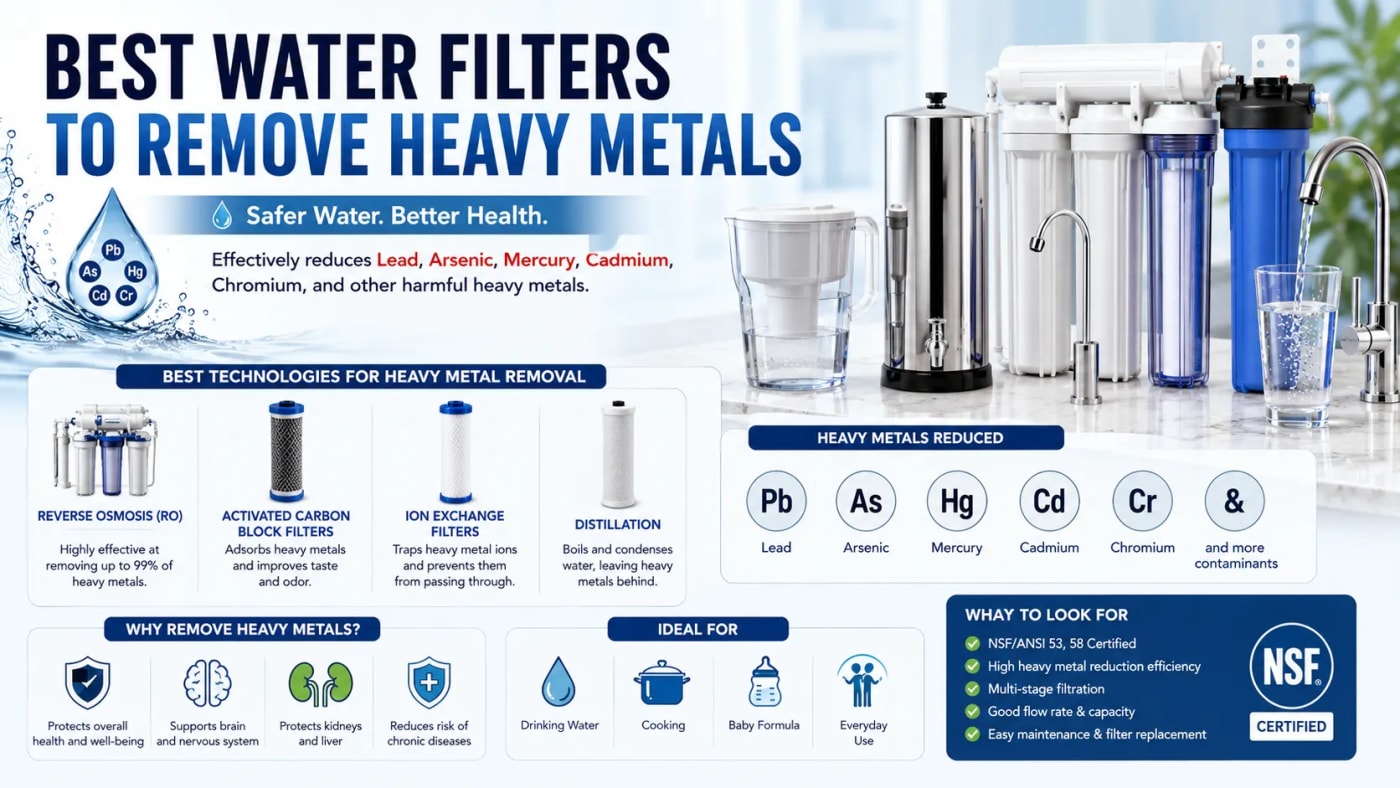
Infographic showing the best water filters for removing heavy metals, comparing reverse osmosis, activated carbon, ion exchange, and distillation, with coverage of lead, arsenic, mercury, cadmium, and chromium, plus selection criteria and ideal uses.

Share

Our Top Picks

The best water filters to remove heavy metals depend on the specific metal involved, the filtration technology used, and whether independent certification backs the claim.

Heavy metal filtration is not a single feature. Performance changes based on contaminant type, filtration technology, certification and testing, water source, installation type, maintenance, and operating cost. This page compares five specific products, reverse osmosis systems, a filtered pitcher, and a pitcher with ion exchange technology, across these same factors. Each product suits a different scenario, from lead in old plumbing to arsenic in well water to renters who cannot install anything permanent. The sections below give a fast comparison first, then a full review of each product, then a decision guide matched to specific water problems.

In-Depth Reviews

#1Best for High Household Demand

Waterdrop G3P800

$849.00

Key Features

A tankless reverse osmosis system rated for 800 gallons per day, with a built-in UV stage and a smart faucet that shows a live TDS reading. Delivers filtered water on demand rather than storing it in a tank.

Reasons to Buy

  • Independent testing (Water Filter Guru) reported complete removal of arsenic and lead in test water
  • Certified to NSF/ANSI 58 and 372
  • Low waste ratio (3:1) compared to older RO designs
  • Tankless design saves under-sink cabinet space

Reasons Not to Buy

  • Needs a nearby electrical outlet for the tankless design and smart display
  • Requires a drain connection for reject water
  • Incoming feed water pressure needs to meet the system's minimum requirement
  • Independent testing is supporting evidence, not a formal certification for every specific metal

Specs at a Glance

ProductionFiltrationCertificationDrain ratio
800 gallons per dayRO membrane plus UV stageNSF/ANSI 58 and 3723:1

The Waterdrop G3P800 is a tankless reverse osmosis system rated for 800 gallons per day production, certified under NSF/ANSI 58 and 372.

This system uses a tankless design, meaning it produces filtered water on demand rather than storing it in a tank. It carries a 3 to 1 drain ratio, which means less wastewater compared with older RO designs that waste more water per gallon produced. The system includes a UV stage for additional microbial treatment, along with a smart faucet that displays a live TDS reading. The manufacturer identifies this exact model as WD-G3P800-W, with NSF/ANSI 58 and 372 certification listed on the current product page.

Waterdrop G3P800 specifications:

  • Production: 800 gallons per day

  • Drain ratio: 3 to 1, reducing wastewater compared with older RO systems

  • Additional stage: Built in UV treatment for microbial protection

  • Display: Smart faucet with a live TDS reading

  • Certification: NSF/ANSI 58 and 372

  • Design: Tankless, does not need a separate storage tank

How does Waterdrop G3P800 handle heavy metals and dissolved contaminants?

The Waterdrop G3P800 handles heavy metals and dissolved contaminants through its reverse osmosis membrane, which physically blocks dissolved particles including many metals.Reverse osmosis as a technology generally performs well against dissolved heavy metals, since the membrane pore size is small enough to block most metal ions. Independent testing conducted by Water Filter Guru reported complete removal of several contaminants in its test water, including arsenic and lead. This result comes from independent testing rather than a formal certification claim, so it needs to be read as supporting evidence rather than a guaranteed outcome in every water condition. The formal certification under NSF/ANSI 58 and 372 covers specific tested reduction claims tied to that exact standard.

What are the installation and maintenance requirements of Waterdrop G3P800?

The Waterdrop G3P800 needs an under sink installation with access to electrical power, a drain connection, and adequate feed water pressure.

Installation requirements for the Waterdrop G3P800:

  • Electrical connection: The tankless design and smart display need a nearby power outlet

  • Feed water pressure: Incoming pressure needs to meet the system's minimum requirement for correct operation

  • Drain connection: Needed for the reject water produced during filtration

  • Cabinet space: The tankless design uses less under sink space than a system with a separate storage tank

Ongoing maintenance centers on replacing the filter stages according to the manufacturer's schedule, along with monitoring the built in filter life indicator. The tankless format simplifies installation compared with tank based systems, since there is no bulky tank to fit under the sink.

#2Best Value RO System

APEC ROES-50

$212.67

Key Features

A 5-stage RO system with a pressurized storage tank, rated for 50 gallons per day, built for DIY installation.

Reasons to Buy

  • Independent testing (TechGearLab) reported reduction of every heavy metal in its test panel
  • WQA certified
  • Storage tank gives immediate access to finished water at the faucet
  • DIY friendly with quick connect fittings

Reasons Not to Buy

  • Lower daily production (50 GPD) than tankless high-capacity systems
  • High sediment or iron in source water can shorten pre-filter life and affect the RO membrane downstream
  • Needs under-sink installation with drain access and space for the storage tank
  • Buyers still need to confirm exactly which contaminants the WQA certification covers for this model

Specs at a Glance

ProductionFiltrationCertificationInstallation
50 gallons per day5-stage ROWQA certifiedUnder sink, drain access, tank space

The APEC ROES-50 is a 5-stage reverse osmosis system with a storage tank, rated for 50 gallons per day production, and certified by the Water Quality Association.This system uses five separate filtration stages before water reaches the RO membrane, then stores finished water in a pressurized tank for immediate use at the faucet. The official product page identifies the exact ROES-50 model along with its 5-stage configuration and 50 GPD rated capacity.

APEC ROES-50 specifications:

  • Configuration: 5-stage filtration including sediment, carbon, and RO membrane stages

  • Production: 50 gallons per day

  • Storage: Pressurized storage tank included

  • Certification: Water Quality Association, known as WQA

  • Installation: Under sink, needs drain access and tank space

How does APEC ROES-50 perform against heavy metals?

The APEC ROES-50 performs well against heavy metals through its RO membrane stage, which independent testing found reduced all tested heavy metals in its sample water.TechGearLab's testing placed the ROES-50 among reverse osmosis systems that successfully reduced every heavy metal included in its test panel. This result reflects independent lab testing conducted on this specific product, separate from the WQA certification, which covers its own specific tested claims. Buyers still need to confirm which exact contaminants the WQA certification covers for this model before relying on it for a specific metal.

What water conditions and maintenance factors affect APEC ROES-50 performance?

Water pressure, incoming TDS level, and sediment or iron content all affect how well the APEC ROES-50 performs over time.High sediment or iron levels in the source water can shorten the life of the pre filter stages, which then affects how well the RO membrane performs downstream. Community discussions among well water users show that people with high TDS or iron containing water commonly weigh these factors before choosing an RO system, since heavier pre filter loads generally mean more frequent filter changes. Testing the source water before installation remains the most reliable way to know what maintenance schedule to expect.

#3Best for Taste and Mineral Retention

iSpring RCC7AK

$260.90

Key Features

A 6-stage RO system rated for 75 gallons per day, with an added alkaline stage that restores minerals stripped out during reverse osmosis, plus a transparent first-stage housing for visual inspection.

Reasons to Buy

  • Listed under NSF/ANSI 58 certification
  • Alkaline remineralization stage reduces the flat taste common in standard RO water
  • Transparent first-stage housing lets you visually check filter condition
  • Storage tank suited to households with steady daily demand

Reasons Not to Buy

  • The alkaline stage adds no extra contaminant reduction beyond the RO stage itself, it's purely for taste and mineral content
  • Individual anecdotal reports (e.g. arsenic tests shared online) are not a substitute for verified, repeatable lab testing
  • Needs under-sink installation with drain access and tank space
  • Specific metal concerns still need their own water test to confirm performance for that exact model

Specs at a Glance

ProductionFiltrationCertificationFirst stage housing
75 gallons per day6-stage RO + alkaline remineralizationNSF/ANSI 58Transparent, for visual inspection

The iSpring RCC7AK is a 6-stage reverse osmosis system with an added alkaline remineralization stage, rated for 75 gallons per day production and listed under NSF/ANSI 58.This system combines a standard 5-stage RO configuration with a sixth alkaline stage that adds minerals back into the water after the RO process. It includes a transparent first stage housing, which lets the user visually check the condition of the first filter. The official NSF listing currently includes the RCC7AK model under NSF/ANSI 58.

iSpring RCC7AK specifications:

  • Configuration: 6 stages, including RO membrane and a final alkaline remineralization stage

  • Production: 75 gallons per day

  • Certification: Listed under NSF/ANSI 58

  • First stage housing: Transparent, allows visual inspection

  • Installation: Under sink, needs drain access and tank space

How does iSpring RCC7AK address lead, arsenic and other heavy metals?

The iSpring RCC7AK addresses lead, arsenic, and other heavy metals through its RO membrane stage, which is the primary contaminant reduction mechanism in the system.The certified NSF/ANSI 58 listing covers the system's tested reduction claims under that standard. Individual user reports, including a personal arsenic test shared in an online community after installing this system, exist as anecdotal experience only. A single individual test does not represent verified, repeatable evidence across different water conditions, so any specific metal concern still needs its own water test and, where possible, confirmation against the certified claim for this exact model.

How does the alkaline remineralization stage affect iSpring RCC7AK?

The alkaline remineralization stage in the iSpring RCC7AK adds minerals back into the water after the RO membrane removes them along with the targeted contaminants.Standard RO membranes remove dissolved minerals along with contaminants, which can leave the finished water tasting flat to some people. The sixth stage in this system is designed specifically to restore some of these minerals after filtration, according to the manufacturer's documentation.

Practical implications of the alkaline stage:

  • Taste: Many users notice a less flat taste compared with standard RO water

  • Mineral content: Adds back minerals that plain RO filtration removes

  • Contaminant removal: Does not add extra contaminant reduction beyond the RO stage itself

  • Personal preference: Some households value this feature, while others use plain RO without remineralization

#4Best No-Installation Pick

Clearly Filtered Filtered Water Pitcher

$109.65

Key Features

A gravity-fed pitcher using proprietary Affinity filtration, designed to target lead, arsenic and other contaminants while leaving beneficial minerals in the water rather than stripping them out.

Reasons to Buy

  • No installation needed, fully portable, fits standard refrigerator shelves
  • Manufacturer states it targets contaminants like lead and arsenic while retaining beneficial minerals
  • NSF certified to NSF/ANSI 42 and 372
  • 80 oz (10 cup) capacity suits a family-size fill

Reasons Not to Buy

  • Manufacturer marketing claims (365+ contaminants) are broader than the specific formally certified list, check the certified list for your exact contaminant of concern
  • Requires manual refilling for higher daily volume needs
  • Filter life is capped at 100 gallons or 6 months, whichever comes first
  • Not backed by an under-sink RO system's broader dissolved-solids reduction

Specs at a Glance

CapacityFiltrationCertificationFilter life
80 oz (10 cups)Affinity filtration (proprietary media)NSF/ANSI 42 & 372100 gallons or 6 months

The Filtered Water Pitcher from Clearly Filtered is a gravity fed pitcher using Affinity filtration technology, holding 80 ounces across 10 cups, with a 100 gallon filter life.

This product is the manufacturer's current pitcher offering, and it uses a proprietary filtration media the company calls Affinity filtration. It targets specific contaminants, including lead and arsenic, according to the manufacturer, while stating that beneficial minerals remain in the water rather than being stripped out during filtration.

Filtered Water Pitcher specifications:

  • Capacity: 80 ounces, equal to 10 cups

  • Filter life: 100 gallons under normal use

  • Filtration technology: Affinity filtration

  • Materials: Pitcher body and filter housing built for household drinking water use

  • Installation: None needed, fully portable

How does Filtered Water Pitcher target heavy metals without removing beneficial minerals?

The Filtered Water Pitcher targets heavy metals through its Affinity filtration media, which the manufacturer states is designed to leave beneficial minerals in the water.

Clearly Filtered states that the pitcher targets lead, arsenic, and other contaminants specifically, while not targeting the minerals that contribute to water taste and mineral content. This claim needs to be separated into two parts. Formal certification covers specific tested contaminant claims under an exact standard, while independent testing and manufacturer statements cover a broader set of claims that may not carry the same formal certification. Both types of evidence matter, but they answer different questions about performance.

How long does the Filtered Water Pitcher filter last under normal use?

The Filtered Water Pitcher filter lasts 100 gallons or six months under normal use, whichever limit comes first.The manufacturer sets this dual limit because filtration media can lose effectiveness over time even if the full gallon capacity has not been used yet. A household drinking and cooking with filtered water daily reaches the 100 gallon mark faster than a single person using the pitcher occasionally, so actual replacement timing depends on real household usage rather than the calendar alone.

#5Best for Certified Metal-Specific Reduction

Culligan 10 Cup Pitcher

$26.97

Key Features

A gravity-fed pitcher using 5-stage ion exchange filtration, with certified reduction figures listed under NSF/ANSI 53 for several named metals, plus a built-in TDS meter for a live reading.

Reasons to Buy

  • Certified reduction figures listed under NSF/ANSI 53 for lead, mercury, cadmium, hexavalent chromium, and copper
  • IAPMO certified
  • No installation needed, fully portable
  • Built-in TDS meter gives a quick signal for when to change the filter

Reasons Not to Buy

  • TDS meter measures overall dissolved solids, it does not identify which specific contaminant is present or absent
  • A low TDS reading can be mistaken as proof the water is free of all harmful contaminants, which it is not
  • Certification figures apply specifically to this exact model and shouldn't be assumed to carry over to other ZeroWater-branded products
  • Requires manual refilling for higher daily volume needs, same limitation as any pitcher

The Culligan 10 Cup Pitcher with ZeroWater Technology is a gravity fed pitcher using 5-stage ion exchange filtration, holding 80 ounces across 10 cups, and certified under IAPMO.This product, listed under the exact model name ZEROP10, includes a built in TDS meter that gives a live reading of total dissolved solids in the water. Its five stage filtration process uses ion exchange technology, which differs from the carbon based Affinity technology used in the Clearly Filtered pitcher. The current Culligan product page lists specific contaminant reduction data under NSF/ANSI 53.

Culligan 10 Cup Pitcher specifications:

  • Capacity: 80 ounces, equal to 10 cups

  • Filtration technology: 5-stage ion exchange filtration

  • Certification: IAPMO certified

  • Built in feature: TDS meter for a live reading

  • Installation: None needed, fully portable

How does Culligan 10 Cup Pitcher with ZeroWater Technology reduce heavy metals?

The Culligan 10 Cup Pitcher reduces heavy metals through its 5-stage ion exchange filtration, with certified reduction figures listed under NSF/ANSI 53 for several specific metals.Culligan's current product page lists reduction figures for lead, mercury, cadmium, hexavalent chromium, and copper under NSF/ANSI 53 certification. These figures apply specifically to this exact model, the ZEROP10, and should not be assumed to apply automatically to other ZeroWater branded products, since certification is tied to the specific tested model.

How does the TDS meter help with Culligan 10 Cup Pitcher with ZeroWater Technology?

The TDS meter helps by giving a quick indicator of overall dissolved solids in the water, but it does not identify which specific contaminants are present.A low TDS reading suggests fewer dissolved particles overall, while a rising reading over time can signal that the filter needs replacement soon. It does not distinguish between beneficial minerals and harmful contaminants, and it cannot confirm whether a specific heavy metal is present or absent. Online discussions show this is a common point of confusion, since some users assume a low TDS reading alone proves the water is free of harmful contaminants, when it actually measures total dissolved solids as one combined number.

Which heavy-metal water filter is best for a specific water source or use case?

The best heavy metal water filter depends on the specific water source and use case, since municipal tap water, well water, and rental housing all call for different solutions.

Product fit by water source and use case:

  • Municipal tap water with general contaminant concern: Any of the five products can apply, depending on the specific contaminant found in local water reports

  • Old plumbing with lead concern: Reverse osmosis systems with independent lead testing evidence, such as the Waterdrop G3P800 and APEC ROES-50, offer strong reduction evidence

  • Well water with arsenic: Reverse osmosis systems remain the strongest documented option, alongside proper source water testing

  • Renters who cannot install anything permanent: The Filtered Water Pitcher and the Culligan 10 Cup Pitcher both need no installation

  • Families needing higher daily drinking water volume: The APEC ROES-50 and iSpring RCC7AK, both with storage tanks, or the Waterdrop G3P800 with its higher 800 GPD production, all suit higher volume needs

  • Users wanting a portable, no plumbing option: Either pitcher fits this need directly

  • Users needing point of use RO under the sink: All three RO systems, the Waterdrop G3P800, APEC ROES-50, and iSpring RCC7AK, fit this scenario

Which water filters are strongest for different heavy-metal removal needs?

The strongest water filters for heavy metal removal vary by product, since each one uses a different technology and carries different certification for specific metals.

Below is a table that compares all five products across the attributes that matter most for heavy metal removal.

Product

System Type

Filtration Technology

Lead Capability

Arsenic Capability

Certification

Installation

Waterdrop G3P800

Tankless reverse osmosis

RO membrane plus UV stage

Independent testing reports complete removal

Independent testing reports complete removal

NSF/ANSI 58 and 372

Under sink, needs drain and power

APEC ROES-50

Reverse osmosis with storage tank

5-stage RO, 50 GPD

Independent testing reports full reduction

Addressed through RO membrane stage

WQA certified

Under sink, needs drain and storage tank space

iSpring RCC7AK

Reverse osmosis with remineralization

6-stage RO plus alkaline stage

Addressed through RO membrane stage

Addressed through RO membrane stage, verify with lab testing

Listed under NSF/ANSI 58

Under sink, needs drain and storage tank space

Filtered Water Pitcher

Gravity fed pitcher

Affinity filtration

Manufacturer states lead reduction target

Manufacturer states arsenic reduction target

Certification and independent testing reported separately

Portable, no installation

Culligan 10 Cup Pitcher with ZeroWater Technology

Gravity fed pitcher with TDS meter

5-stage ion exchange filtration

NSF/ANSI 53 reduction figures listed for lead

Not a primary listed target, verify current data

IAPMO certified

Portable, no installation

Certification applies to specific contaminant claims tested under specific conditions. It does not mean any single product removes every possible heavy metal in every water source.

What should you verify before choosing a heavy-metal water filter?

Before choosing a heavy metal water filter, a buyer needs to verify actual water test results, the specific contaminants present, and whether independent certification backs the product's claims.

Criteria to check before choosing a heavy metal water filter:

  • Water test results: Know which metals are actually present before buying anything

  • Specific contaminants: Match the filter to the exact metal found, since not every filter targets every metal

  • Concentration: Higher contaminant levels may need a technology with stronger reduction evidence

  • Filtration technology: Reverse osmosis, ion exchange, and adsorptive media all work differently

  • Certification: Check the exact NSF/ANSI standard or other certification body tied to the claim

  • Independent testing: Look for lab results beyond the manufacturer's own marketing claims

  • Installation type: Confirm whether the system needs under sink plumbing, power, and drain access, or needs nothing at all

  • Filter capacity: Check how many gallons or months the filter lasts before replacement

  • Replacement cost: Calculate the ongoing cost of maintaining the system over a full year

  • Point of use: Confirm whether the system treats one faucet, one pitcher, or the entire home

The US EPA recommends independently certified filters specifically for lead reduction, since certification confirms tested performance rather than relying on marketing language alone.

Which heavy-metal filter is most appropriate for lead-contaminated drinking water?

The most appropriate filters for lead contaminated drinking water are the products with independently verified lead reduction evidence, rather than the products relying on marketing claims alone.

Below is a short comparison of the lead reduction evidence across the strongest candidates.

Product

Lead Reduction Evidence

Waterdrop G3P800

Independent testing reported complete removal in test water

APEC ROES-50

Independent testing reported full reduction across tested heavy metals

Culligan 10 Cup Pitcher with ZeroWater Technology

Certified reduction figures listed under NSF/ANSI 53

The US EPA specifically recommends independently certified products for lead reduction, since certification confirms tested performance under defined conditions rather than relying only on a manufacturer's own claims.

Which heavy-metal filter is more suitable for arsenic in well water?

The most suitable filters for arsenic in well water are reverse osmosis systems, since the membrane technology addresses a wide range of dissolved arsenic forms.The US EPA identifies reverse osmosis, ion exchange, and adsorptive media as recognized treatment approaches for arsenic. Arsenic exists in different chemical forms, known as speciation, and not every technology handles every form equally well. Testing the specific well water for arsenic type and concentration remains the necessary first step before choosing a treatment method, since a general assumption about arsenic removal does not replace an actual water test result.

Which heavy-metal filter works best when the user cannot install an under-sink system?

The heavy metal filters that work best without under sink installation are the two pitcher options, since both need no plumbing connection at all.The Filtered Water Pitcher and the Culligan 10 Cup Pitcher with ZeroWater Technology both sit on a counter or in a refrigerator, using gravity to filter water with no installation of any kind. Online discussions among renters show this is a common priority, since permanent plumbing changes are often restricted or impractical in rented housing. Portability, capacity per fill, and filter replacement frequency become the deciding factors between the two pitcher options rather than installation type, since neither needs installation.

Which heavy-metal filter is better for high daily drinking and cooking demand?

The heavy metal filters better suited for high daily drinking and cooking demand are the reverse osmosis systems with a storage tank or high production rate, rather than the pitcher options.

Capacity comparison for high demand households:

  • Waterdrop G3P800: 800 gallons per day production, tankless design delivers water on demand

  • APEC ROES-50: 50 gallons per day production, with a storage tank holding finished water for immediate use

  • iSpring RCC7AK: 75 gallons per day production, with a storage tank plus remineralization

  • Filtered Water Pitcher: 80 ounces per fill, requiring manual refilling for higher volume needs

  • Culligan 10 Cup Pitcher: 80 ounces per fill, also requiring manual refilling for higher volume needs

A household using large volumes of filtered water daily, for drinking, cooking, and refilling multiple containers, generally gets more practical value from an under sink RO system than from a pitcher that needs frequent manual refilling.

What should you do after choosing a heavy-metal water filter?

After choosing a heavy metal water filter, the next step is confirming the choice against an actual water test, the correct installation point, and a clear maintenance schedule.Selecting a product is only the first part of solving a heavy metal problem. The filter needs to match the specific contaminant and concentration found in an actual water test, get installed at the correct point in the home, whether that is one faucet or the whole house, and follow a maintenance schedule that keeps its performance at the certified level over time.

How should you test drinking water before relying on a heavy-metal filter?

Drinking water needs to be tested before relying on a heavy metal filter, since testing identifies the exact contaminant and concentration that the filter needs to address.Certification and performance data tell a buyer what a filter is designed to reduce, but only an actual water test confirms what is present in a specific home's water supply. For arsenic specifically, understanding the exact chemical form, known as speciation, can affect which treatment method performs best. A dedicated water testing guide explains how to get an accurate test and how to read the results.

How often should you replace a water filter?

A water filter needs replacement based on its rated gallons, its rated time period, and the actual water conditions it has been treating, whichever limit comes first.An expired filter can become less effective at reducing contaminants, including lead, even if water still flows through it normally. The US EPA specifically advises following the manufacturer's replacement instructions rather than guessing based on appearance or taste alone. A dedicated maintenance guide covers replacement schedules for different filter types.

What is the difference between reverse osmosis and activated carbon filtration?

The difference between reverse osmosis and activated carbon filtration is the treatment method. Reverse osmosis uses a membrane to block dissolved particles, while activated carbon uses adsorption to trap contaminants on its surface.Reverse osmosis generally reduces a broader range of heavy metals and dissolved solids, while removing beneficial minerals along with contaminants unless a remineralization stage is added. Activated carbon excels at chlorine, taste, and odor reduction, but it does not reduce dissolved metals the way a membrane does. A dedicated comparison guide covers this difference in full detail.

Can water filters remove arsenic, lead and other heavy metals?

Water filters can remove arsenic, lead, and other heavy metals, but only when the specific product carries verified certification or independent testing for that exact metal.A general claim that a filter removes heavy metals does not confirm which specific metals it addresses or at what concentration. A dedicated heavy metals education page explains the underlying chemistry and the treatment methods proven effective for each metal.

When should you choose whole-house filtration instead of a drinking-water filter?

Whole house filtration should be chosen instead of a drinking water filter when the concern involves water used at every tap in the home, not only water used for drinking and cooking.An under sink reverse osmosis system treats water at one faucet only. It does not automatically address water coming from a shower, a bathroom sink, or an outdoor tap. Online discussions show this exact confusion is common, with some users assuming an under sink system protects the whole home. A dedicated whole house filtration guide explains when this broader coverage becomes necessary.
Share