Water contaminants are any physical, chemical, biological, or radiological substances found in water, and they fall into four broad categories. This article explains what makes a substance a water contaminant, where each type of contaminant typically comes from, and how exposure can affect human health. Finding a contaminant in water does not automatically mean the water is unsafe, since actual risk depends on the specific contaminant, its concentration, how much of it a person consumes, and individual susceptibility. This guide walks through the science, the sources, the health considerations, and how drinking water contaminants are monitored in the United States.
What Makes a Substance a Water Contaminant?
A water contaminant is any physical, chemical, biological, or radiological substance or matter present in water, according to the Safe Drinking Water Act. This definition is much broader than the word "poison" or "pollutant," since it covers anything in water other than water molecules themselves, whether or not that substance causes harm.
Drinking water reasonably contains at least small amounts of some contaminants at all times. The presence of a contaminant does not automatically mean the water poses a health risk. Whether a contaminant matters depends on its identity, its concentration, and how it interacts with the human body over time. This distinction between simple presence and actual health risk is central to understanding water quality.
What Types of Contaminants Can Occur in Water?
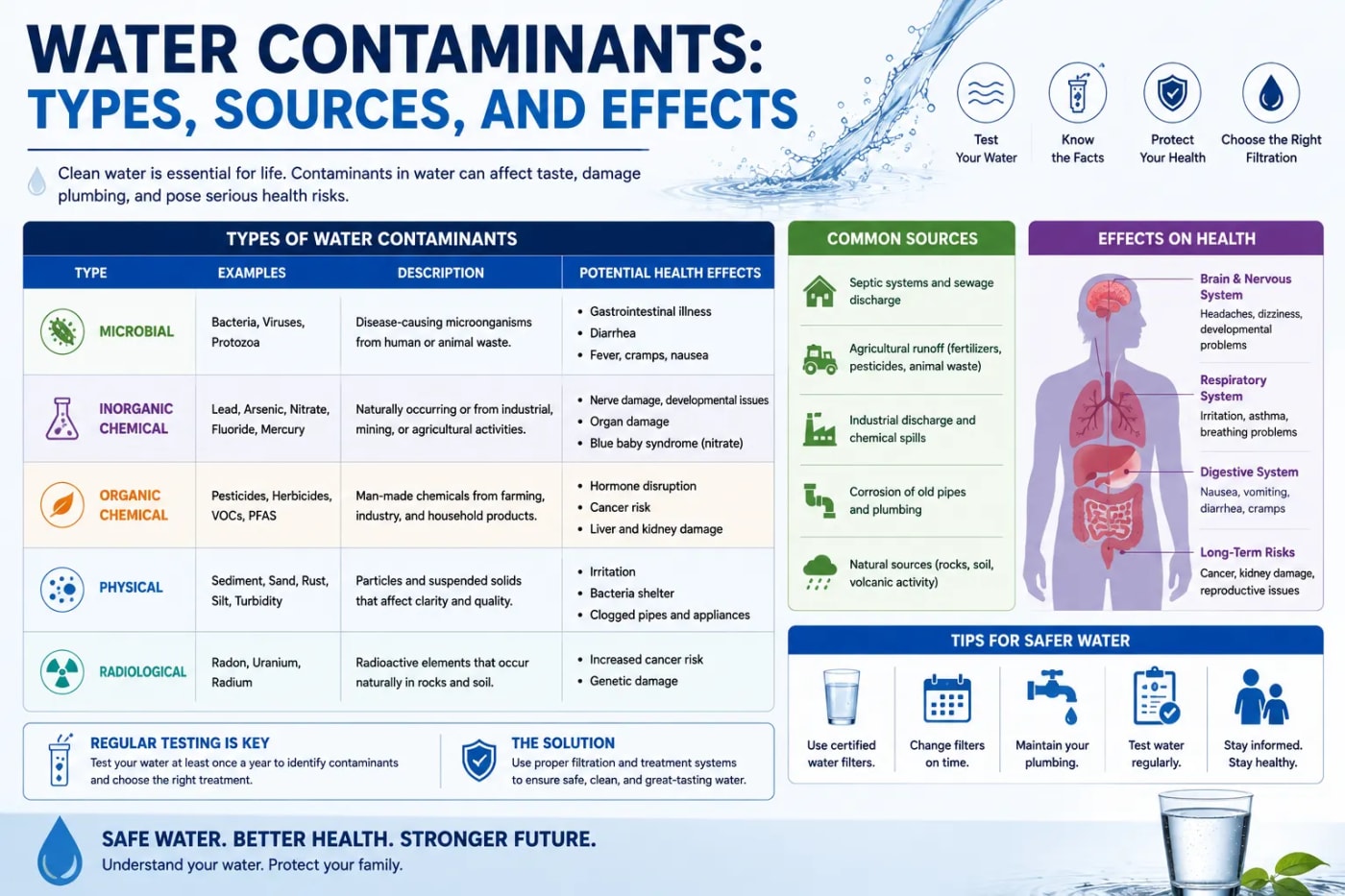
Water contaminants fall into four established categories, each defined by the nature of the substance rather than its source or its effect on health.
The table below shows the four contaminant categories, their defining characteristic, and representative examples:
Category | Defining characteristic | Representative examples |
Physical | Affects appearance and physical properties of water | Sediment, silt, suspended organic material |
Chemical | Elements or compounds, natural or man-made | Metals, pesticides, salts, PFAS |
Biological | Living organisms capable of causing disease | Bacteria, viruses, protozoa, parasites |
Radiological | Unstable elements that emit ionizing radiation | Uranium, radium, radon |
These four categories form the foundation for how water contaminants are classified and studied, and each one is explained in more detail below.
What Are Physical Contaminants in Water?
Physical contaminants are substances defined by their physical properties rather than by any specific health outcome. They primarily affect the appearance, clarity, and physical quality of water rather than its chemical composition.
Common examples of physical contaminants:
Sediment: Fine particles of soil or rock suspended in water.
Silt and sand: Larger particulate matter, often introduced through erosion.
Suspended organic material: Plant matter or decaying organic debris.
Turbidity-causing particles: General cloudiness caused by fine suspended matter.
Microplastics: Small plastic particles that can appear in water sources, though a full discussion of this topic belongs elsewhere.
Physical contaminants like sediment and suspended organic material are generally introduced through soil erosion into lakes, rivers, and streams. Their main effect is on how water looks and feels rather than on invisible chemical properties.
What Are Chemical Contaminants in Water?
Chemical contaminants are elements or compounds, and they may occur naturally or result from human activity. This category represents an enormous range of substances, since almost any element or chemical compound can, in principle, end up dissolved or suspended in water.
Representative groups of chemical contaminants:
Inorganic chemicals: Metals, salts, and mineral compounds.
Organic chemicals: Carbon-based compounds, including many pesticides and industrial chemicals.
Metals: Substances such as lead, arsenic, and copper.
Pesticides and herbicides: Chemicals used in agricultural and lawn care applications.
Salts: Including chloride and sulfate compounds.
Pharmaceuticals: Human or animal drugs that can enter water supplies.
PFAS: A group of manufactured chemicals recognized as an emerging contaminant concern.
Disinfection byproducts: Compounds formed when disinfectants react with organic matter in water.
Chemical contaminants are the broadest of the four categories, spanning substances that occur naturally in rock and soil as well as substances introduced through industrial, agricultural, and household activity.
What Are Biological Contaminants in Water?
Biological, or microbial, contaminants are living organisms present in water that are capable of causing disease. This category is distinct from the broader idea of a "pathogen," since not every biological organism found in water is harmful, but the biological contaminant category specifically refers to organisms with disease-causing potential.
Common examples of biological contaminants:
Bacteria: Including E. coli, a common indicator organism used to signal possible contamination.
Viruses: Microscopic pathogens that can be transmitted through water.
Protozoa: Single-celled organisms such as Giardia and Cryptosporidium.
Parasites: Larger organisms that can also be waterborne.
Legionella: A bacteria of particular concern in building water systems.
Biological contaminants are also referred to as microbes or microbiological contaminants, and they represent one of the oldest recognized threats to safe drinking water.
What Are Radiological Contaminants in Water?
Radiological contaminants are chemical elements with an unbalanced number of protons and neutrons, making them unstable atoms capable of emitting ionizing radiation. These substances, known as radionuclides, are distinct from ordinary chemical contaminants because their harmful potential comes from radioactive decay rather than chemical reactivity.
Examples of radiological contaminants:
Uranium: A naturally occurring radioactive element found in certain rock formations.
Radium: Another naturally occurring radionuclide sometimes found in groundwater.
Radon: A radioactive gas that can dissolve into groundwater.
What makes this category distinct is the mechanism of harm, ionizing radiation, rather than a chemical or biological process.
Where Do Water Contaminants Come From?
Water contaminants originate from two major source dimensions: naturally occurring processes and human-related activity. Which contaminants appear in a given water source depends heavily on local geology, land use, the specific water source, and nearby human activity.
The table below connects common source types to the contaminant classes they tend to introduce:
Source | Common contaminant classes introduced |
Natural geology and weathering | Metals, radionuclides, certain chemical compounds |
Agriculture | Nitrates, pesticides, herbicides, bacteria from manure |
Sewage and wastewater | Bacteria, viruses, protozoa, nutrients |
Industry, mining, and waste sites | Metals, solvents, petroleum compounds, industrial chemicals |
Urban runoff | Sediment, road chemicals, lawn chemicals, general debris |
Household plumbing | Lead, copper, and other metals from pipes and fixtures |
Each of these pathways is explained in more detail in the sections below.
How Do Natural Processes Introduce Contaminants Into Water?
Natural processes introduce contaminants into water primarily through the weathering of rocks and soil, geologic deposits, and the interaction between groundwater and the surrounding rock formations. As water moves through soil and rock, it can dissolve naturally occurring metals and radionuclides, carrying them into the water supply.
Erosion also plays a role, washing sediment and naturally occurring minerals into surface water sources. Groundwater is a particularly important context for these naturally occurring, or geogenic, contaminants, since water in contact with rock and soil for extended periods has more opportunity to pick up dissolved substances from its surroundings.
How Can Agriculture Contaminate Drinking Water Sources?
Agricultural activity contaminates drinking water primarily through fertilizers, pesticides, herbicides, and animal waste that reach water sources through runoff or infiltration.
Common agricultural source-to-contaminant relationships:
Fertilizers: Contribute nitrates, which can infiltrate groundwater or run off into surface water.
Pesticides and herbicides: Applied to crops and lawns, these chemicals can wash into nearby water sources.
Manure and animal waste: Introduce bacteria and nutrients into both surface water and groundwater.
Runoff from agricultural land: Carries a mix of these substances into nearby streams, rivers, and shallow groundwater.
Both runoff into surface water and infiltration into groundwater are important pathways for agricultural contamination, and the specific pathway depends on local soil type, rainfall patterns, and the depth of the water table.
How Do Sewage and Wastewater Introduce Contaminants?
Sewage and wastewater introduce contaminants through septic systems, wastewater treatment discharges, sewage leaks, and animal waste, and this pathway is distinct from agricultural runoff even though both can introduce similar biological contaminants.
Human sewage and failing septic systems are a direct pathway for microbes, including Giardia, Cryptosporidium, and E. coli, as well as nutrients and certain chemicals into both groundwater and surface water. Wastewater discharges from treatment facilities, when not fully effective, can also introduce contaminants downstream. This pathway is centered on human and wastewater sources specifically, separate from the runoff generated by farming operations.
How Do Industry, Mining, and Waste Sites Contaminate Water?
Industrial facilities, mining operations, and waste sites contaminate water through chemical storage, petroleum handling, and the general presence of hazardous materials at contaminated sites.
The table below connects these source types to the contaminant classes commonly associated with them:
Source type | Common contaminant class |
Industrial facilities | Industrial chemicals, solvents |
Chemical storage sites | Chemical spills and leaks |
Petroleum operations | Petroleum compounds |
Mining operations | Heavy metals |
Landfills and hazardous waste sites | A mix of metals, chemicals, and organic compounds |
These sources represent point-source contamination in many cases, meaning the contamination can often be traced back to a specific facility or site, unlike the more diffuse runoff associated with agriculture or urban surfaces.
How Can Urban Runoff Carry Contaminants Into Water?
Urban runoff carries contaminants into water when stormwater moves across roads, lawns, and other urban surfaces, picking up debris, chemicals, and residue along the way before reaching a nearby waterway.
Common sources of urban runoff contamination:
Roads: Contribute oil residue, road salt, and vehicle-related chemicals.
Lawns: Contribute fertilizer and pesticide residue.
General urban surfaces: Contribute a mix of debris and pollutants washed off during rain events.
Urban runoff is considered a nonpoint source of contamination, since it does not originate from a single identifiable facility but instead accumulates gradually across many surfaces before entering a waterway.
How Can Plumbing Add Contaminants After Water Treatment?
Plumbing can introduce contaminants into drinking water after it has already left the treatment facility, through corrosion of household or distribution system materials. This is an important distinction, since water can leave a treatment plant meeting all safety standards and still pick up contaminants on its way to the tap.
Lead service lines and lead-containing fixtures are a significant pathway for lead contamination, since lead can leach into water as it moves through aging pipes or fixtures. Copper and other plumbing materials can introduce their own metals into water through the same corrosion process. This distribution and household plumbing pathway is separate from anything happening at the treatment facility itself.
How Can Water Contaminants Affect Human Health?
The health effects of a water contaminant depend on a combination of factors rather than the mere presence of the substance. Contaminant type, concentration, the amount consumed, the duration of exposure, and individual susceptibility all influence whether and how a contaminant affects health.
The table below maps each contaminant class to the general type of health concern most commonly associated with it:
Contaminant class | Typical type of health concern |
Physical | Generally aesthetic, though some particles can carry other contaminants |
Chemical | Can range from organ effects to developmental or reproductive effects, depending on the specific chemical |
Biological | Commonly associated with gastrointestinal illness |
Radiological | Associated with long-term chronic health risks tied to radiation exposure |
This table reflects general tendencies rather than a rule that applies to every substance within a category, since specific health effects vary widely even within the same contaminant class.
What Health Effects Can Contaminated Water Cause?
Contaminated water can be associated with a range of outcomes, including gastrointestinal illness, nervous-system effects, developmental effects, reproductive effects, organ damage, and in some cases cancer. These outcomes differ between acute and chronic exposure.
Acute effects typically appear soon after exposure to a contaminant, such as gastrointestinal illness following exposure to certain bacteria or protozoa. Chronic effects develop over longer periods of repeated exposure, such as some of the organ or developmental effects associated with certain chemical contaminants. Not every contaminant causes every effect listed here, and the specific outcome depends on the exact substance involved.
What Determines the Health Risk From a Water Contaminant?
Several variables together determine the actual health risk posed by a given water contaminant, rather than any single factor acting alone.
Key risk determinants, in a general risk framework:
The identity of the specific contaminant involved.
The concentration of that contaminant in the water.
The duration of exposure to the contaminated water.
The amount of water consumed over that period.
The individual's personal susceptibility, which can vary based on age, health status, and other factors.
This list reflects a general risk framework rather than a clinical calculator, and it is not meant to replace guidance from a health professional or a water quality expert when evaluating a specific situation.
Why Can Contaminated Water Look Safe to Drink?
Contaminated water can look, taste, and smell completely normal, because many chemical and radiological contaminants cannot be reliably identified through the senses alone. Sensory water-quality issues, such as unusual color, cloudiness, or odor, often point to physical contaminants or certain chemical or biological issues, but their absence does not confirm the water is free of harmful substances.
This is a common misconception worth correcting directly: clear, good-tasting water is not automatically safe water. Many of the most concerning contaminants, including lead, arsenic, and radionuclides, produce no noticeable change in taste, color, or smell even at levels of health concern.
How Are Drinking Water Contaminants Monitored and Evaluated?
In the United States, drinking water contaminants are monitored and evaluated through a formal regulatory framework built around defined standards, required testing, and public reporting for community water systems.
The table below explains key terms used in this monitoring framework:
Term | Meaning |
MCL | Maximum Contaminant Level, the highest level of a contaminant legally allowed in drinking water |
MCLG | Maximum Contaminant Level Goal, the level below which there is no known or expected health risk, used as a non-enforceable public health goal |
CCR | Consumer Confidence Report, an annual report community water systems must provide showing detected contaminants and how they compare to MCLs |
CCL | Contaminant Candidate List, a list of unregulated contaminants under evaluation for potential future regulation |
Not every contaminant that can appear in water is regulated. Regulated contaminants have an established MCL and MCLG, while unregulated contaminants, including those on the Contaminant Candidate List, are monitored and studied without yet having an enforceable legal limit. Public water systems are required to test regularly and report results to customers, while private well owners are responsible for arranging their own testing, since private wells are not covered by these same public reporting requirements.
What Should You Investigate When Water Contamination Is Suspected?
The right investigation depends on your water source, your location, known local risks, and the specific contaminant you suspect. Public water users and private well owners face different starting points when contamination is suspected.
If you are on a public water system, your Consumer Confidence Report is a useful starting point, since it already contains information about detected contaminants and how they compare to legal limits. If you rely on a private well, the responsibility for testing and monitoring falls entirely on you, since no public agency automatically tests or reports on private well water quality. The CDC recommends annual testing of private wells for total coliforms, nitrates, total dissolved solids, and pH, with additional testing depending on local risks or specific concerns.
How Do You Test Drinking Water for Contaminants?
Testing drinking water starts with identifying your water source and any contaminants you specifically suspect, then arranging laboratory testing suited to those concerns. For private wells, the CDC's annual testing recommendation for total coliforms, nitrates, total dissolved solids, and pH provides a useful baseline. For the complete testing process and how to choose the right tests, see our water testing guide.
What Are the Most Common Contaminants in Drinking Water?
Some of the most commonly discussed drinking water contaminants include lead, arsenic, nitrate, various microbes, pesticides, PFAS, and disinfection byproducts. Each of these presents a different source pathway and a different health consideration. For a full breakdown of these and other common contaminants, see our guide on common drinking water contaminants.
How Can You Find Contaminants in Your Local Water Supply?
If you are served by a public water system, your Consumer Confidence Report is the most direct source of information about detected contaminants in your local supply, since community water systems are required to provide this report annually. Contacting your water supplier directly is another practical option if you have specific questions. For a full explanation of how to interpret this report, see our guide on how to read a water quality report.
How Can Water Contaminants Be Removed?
The right treatment approach depends entirely on the specific contaminant involved, since no single method removes every type of substance from water. Filtration, activated carbon, reverse osmosis, ion exchange, and disinfection are common treatment examples, each suited to different contaminant classes. For a complete overview of treatment options, see our water filtration and treatment guide.
Which Water Filters Remove Specific Contaminants?
Choosing the right water filter depends on the contaminant you need to address, not simply the marketing claims printed on a filter's packaging. A filter effective against sediment will not necessarily address dissolved chemicals or biological contaminants, and vice versa. For a detailed contaminant-to-filter compatibility breakdown, see our water filter contaminant removal guide.
What Are the Health Effects of Lead in Water?
Lead exposure through drinking water is commonly linked to plumbing and lead service lines rather than the water source itself, and it is associated with developmental and neurological health concerns, particularly in children. For a complete discussion of lead in drinking water, see our dedicated guide on lead in drinking water.
What Are the Health Effects of Arsenic in Water?
Arsenic is a naturally occurring chemical contaminant found in some groundwater sources, and long-term exposure is associated with a range of chronic health effects. For a complete overview, see our dedicated guide on arsenic in drinking water.
What Are PFAS in Drinking Water?
PFAS are a group of manufactured chemicals that have been used in a wide range of industrial and consumer products, and they are considered an emerging contaminant of concern in drinking water due to their persistence in the environment. For a complete explanation of PFAS and their health considerations, see our dedicated guide on PFAS in drinking water.
What Contaminants Can Affect Private Well Water?
Private well water can be affected by microbial contaminants, nitrates, heavy metals, and organic chemicals, with the specific risk depending heavily on local geology, nearby land use, and well construction. For a complete breakdown of contaminants relevant to private wells, see our guide on private well water contaminants.
Conclusion
Water contaminants cover an enormous range of substances, from naturally occurring minerals to man-made chemicals, disease-causing organisms, and radioactive elements. Understanding the four contaminant categories, where each type of contaminant tends to originate, and what determines actual health risk gives you a clearer picture of what "contaminated water" really means. Presence alone does not equal danger, but knowing your water source, reviewing available testing data, and testing directly when contamination is suspected are the practical steps that turn this understanding into real protection for your household.