Reverse osmosis membrane rejection rates for arsenic range from 90% to 99%, depending on the specific arsenic species and your local water chemistry. Reverse osmosis effectively reduces Arsenic V but struggles to filter Arsenic III without pre-treatment. The RO membrane uses a semi-permeable ionic rejection mechanism to block charged contaminants while allowing neutral compounds to pass through. Systems having an NSF/ANSI 58 certification provide verified arsenic removal under controlled laboratory conditions but it does not guarantee for all household water sources. This certification is a critical trust signal for drinking water safety.
The following table show the varying RO efficiency based on contaminant form and treatment setup:
| Contaminant Form | Treatment Setup | RO Membrane Rejection Rate |
| Arsenic V (Pentavalent) | Standard RO System (No Pre-treatment) | 95% – 99% |
| Arsenic III (Trivalent) | Standard RO System (No Pre-treatment) | 5% – 40% |
| Arsenic III (Trivalent) | RO System with Chlorine Pre-oxidation | 95% – 99% |
How Effective Is Reverse Osmosis for Arsenic Removal in Lab Tests?
Reverse osmosis shows a 90% to 99% arsenic rejection rate in controlled NSF/ANSI 58 lab testing. Lab tests check RO filters using water pressure of 50 PSI and a controlled Total Dissolved Solids (TDS) baseline. Water pressure and changes in incoming water affect the results directly. A system performance reduces because household water pressure falls below 40 PSI. You must match lab testing conditions to achieve the advertised filtration efficiency.
Why Does Arsenic III Pass Through RO Membranes?
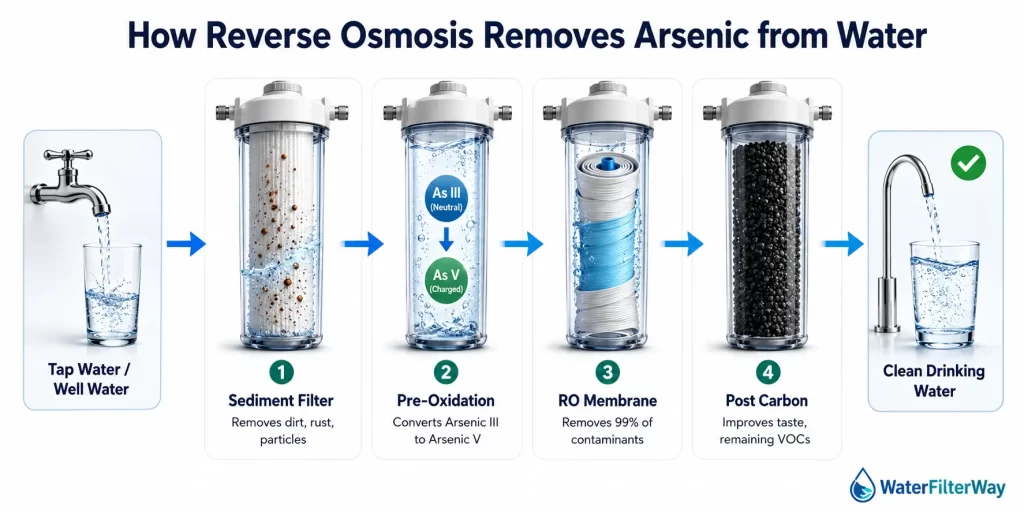
Arsenic III is a neutral, non-ionic compound that easily bypasses the electrostatic rejection mechanism of standard RO membranes. Molecular diffusion allows this neutral compound to pass through the membrane without resistance. The filtration physics of a reverse osmosis system need contaminants to hold an electrical charge for effective rejection. This membrane selective limitation explains why arsenic removal failure happens frequently with untreated well water.
Do You Need Pre-Oxidation Before Using RO for Arsenic?
Yes, you need pre-oxidation to convert neutral Arsenic III into charged Arsenic V for effective RO membrane rejection. Chlorination, aeration systems, and potassium permanganate provide this essential arsenic conversion. This conversion directly improves membrane rejection efficiency from under 40% to over 95%. Adding this water treatment process optimizes system efficiency and gives a reliable filtration outcome.
How Does Reverse Osmosis Compare to Other Arsenic Removal Methods?
Reverse osmosis provides 99% removal for Arsenic V at a single tap, while activated alumina and ion exchange handle high-volume whole-house filtration. Ion exchange resin systems provide high flow rates but need regular salt regeneration and higher maintenance. Activated alumina provides high removal efficiency for specialized commercial setups but need strict pH balancing. Your filtration choice depends on your required water volume, maintenance budget, and specific contaminant removal needs.
Does NSF Certification Guarantee Arsenic Removal Performance?
NSF certification does not guarantee arsenic removal performance universally. NSF/ANSI 58 certification is a water filter certification standard that verifies performance under controlled testing conditions, not all real-world water conditions. NSF 58 arsenic reduction standard measures reduction efficiency under standardised lab validation. It does not assume identical performance for all groundwater sources. Arsenic behaviour changes based on chemical form, especially arsenite III and arsenate V, which affect filtration outcomes. Certification standards differ from marketing-based filtration claims. Many products use “lab tested” statements, but only NSF certification confirms independent third-party compliance and filter validation under controlled testing rules. Verified performance under NSF compliance does not eliminate variation caused by real-world factors such as pressure fluctuation, membrane condition, or feed water composition. NSF certification confirms contaminant reduction capability in a controlled environment, not absolute removal in all household water.Top of Form
Is It a Myth That RO Removes All Arsenic Completely?
It is a myth that reverse osmosis eliminates 100% of all arsenic species under all water conditions. The reality of contaminant removal limits dictates that Arsenic III passes through the system without pre-treatment. Lab data proves that filtration truth depends entirely on arsenic speciation and membrane integrity. Thinking a filter removes everything completely is a dangerous misunderstanding.
Which RO Systems Are Designed for Arsenic Reduction?
The APEC ROES-50 and iSpring RCC7 are specific water filter models built and NSF-certified for arsenic reduction. Certified RO systems have membrane specs and designated flow restrictors according to the NSF 58 compliance standard. Finding a suitable product requires verifying the exact filtration system specs rather than relying on marketing claims. You must check the system selection manual for a verified heavy metal reduction rating.
| Image |  |  |
|---|---|---|
| Feature | APEC ROES-50 | iSpring RCC7 |
| Arsenic Reduction | Designed for arsenic reduction | Designed for arsenic reduction |
| NSF Certification | NSF 58 Certified | NSF 58 Certified Components |
| Filtration Stages | 5-Stage RO System | 5-Stage RO System |
| RO Membrane | High-performance membrane | High-performance membrane |
| Heavy Metal Reduction | Arsenic, lead, and other contaminants | Arsenic, lead, and other contaminants |
| Best For | Reliable long-term filtration | Value-focused homeowners |
| Key Consideration | Verify certification details | Verify certification details |
| Current Price | Check Price | Check Price |
What Setup Should You Choose Based on Your Water Profile?
Your arsenic filter setup depends on your water profile analysis, you need a standard RO system for Arsenic V and a pre-oxidation unit for Arsenic III. You must evaluate your contamination level to finalize your decision.
There are 4 different water profiles to guide your system configuration:
- Low Arsenic V Presence: A standard 5-stage under-sink RO system manages this water profile effectively.
- Arsenic III Presence: This treatment solution requires a chlorine injection or aeration system placed before the RO membrane.
- High Contamination Levels: Water with heavy arsenic levels need a dual-stage filtration setup utilizing ion exchange with point-of-use RO.
- Well Water Systems: Well water setups require thorough water testing to identify iron and manganese, which cause rapid membrane fouling.
Can Activated Carbon Filters Remove Arsenic Effectively?
No, activated carbon filters do not remove arsenic effectively due to their adsorption limitation. The carbon filter limits the capture of inorganic arsenic ions. The filtration capability of carbon applies strictly to organic contaminants; it cannot be used to filter heavy metals.
How Often Should RO Membranes Be Replaced When Treating Arsenic?
RO membranes need replacement every 2 to 3 years when treating heavy arsenic contamination. Arsenic fouling and hard water scaling accelerate membrane degradation. System maintenance increases performance and provides safe filtration upkeep.
What Water Test Confirms Arsenic Type Before Filtration?
A laboratory arsenic speciation test identifies the exact ratio of Arsenic III to Arsenic V in your water supply. This water analysis helps in accurate filtration planning and system selection. Standard contamination detection kits cannot provide this arsenic identification.
Does Water pH Affect Arsenic Removal Efficiency in RO?
Yes, water pH affects arsenic removal efficiency by changing the chemical behavior of the arsenic species. Higher pH levels shift the speciation, impacting the RO performance directly. Filtration science shows that pH levels outside the 6.5 to 8.5 range reduce system efficiency.
Is a Whole House System Needed for Arsenic Contamination?
Whole-house systems are only needed if your total arsenic contamination exceeds safety limits for bathing. Arsenic treatment focuses on the risk at drinking points. This helps avoid spending money on extra water purification equipment that is not needed.
FAQ’s:
Q1. Does reverse osmosis remove all types of arsenic?
No. Reverse osmosis removes 95%–99% of Arsenic V (pentavalent arsenic), but it is much less effective against Arsenic III (trivalent arsenic) unless the water is pre-treated with an oxidation process.
Q2. Why is Arsenic III difficult for RO systems to remove?
Arsenic III is electrically neutral, allowing it to pass through standard RO membranes more easily. Converting it into Arsenic V through pre-oxidation significantly improves removal efficiency.
Q3. Do I need pre-treatment before using reverse osmosis for arsenic?
If your water contains Arsenic III, yes. Pre-treatment methods such as chlorine injection or aeration convert Arsenic III into Arsenic V, enabling the RO membrane to achieve up to 99% removal.
Q4. Does NSF/ANSI 58 certification guarantee arsenic removal?
NSF/ANSI 58 certification verifies arsenic reduction under controlled laboratory conditions. However, actual performance may vary depending on water chemistry, pressure, membrane condition, and arsenic type.
Q5. Can activated carbon filters remove arsenic?
No. Activated carbon filters are not designed to remove inorganic arsenic effectively. They are primarily intended for improving taste, odor, chlorine, and certain organic contaminants.
Q6. How can I determine the best arsenic filtration system for my home?
Start with a laboratory arsenic speciation test to identify whether your water contains Arsenic III or Arsenic V. The test results will help determine whether a standard RO system is sufficient or if pre-oxidation or additional treatment is required.
