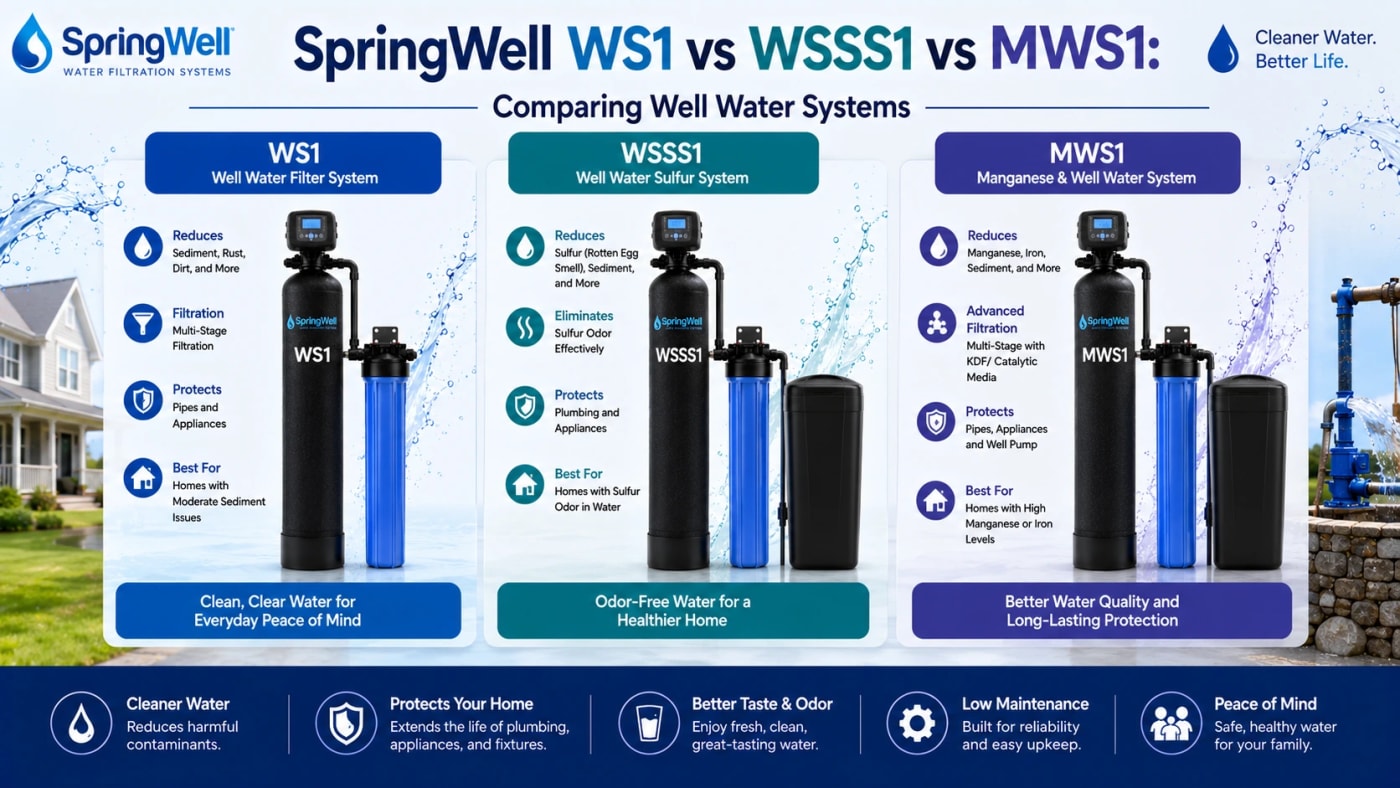
SpringWell offers three distinct well water systems, and this guide compares them across every attribute a well water owner needs to weigh before buying. It covers what each system is made of, which contaminants each one treats, how hard water treatment differs between them, flow rate and household capacity, maintenance and regeneration tasks, installation requirements, purchase price and ongoing ownership cost, practical limitations, and which system matches which well water profile. One naming note matters before starting. SpringWell currently lists its well water plus salt based softener combo as WSSS1 on its official site, while many readers search for this same system as WSS1. This guide uses WSSS1 as the current official name, while noting the WSS1 search term for clarity, so readers land on the correct product either way.
How do SpringWell WS1, WSSS1, and MWS1 differ at a glance?
SpringWell WS1, WSSS1 and MWS1 differ at a glance mainly in how many treatment functions each system combines into one purchase. WS1 stands alone as a well water filter. WSSS1 combines that same well water filter with a salt based softener. MWS1 combines the well water filter, a carbon filter, and a salt based softener together in one larger system.
This table shows a quick overview comparison of all three systems, based on current SpringWell documentation:
What components does each SpringWell system combine?
Each SpringWell system combines a different set of tanks and control heads, depending on how many water problems it is built to solve.
Component breakdown for each system:
WS1: One well water filter tank, using air injection oxidation and greensand media, with its own electronic control head and a 5 micron sediment pre filter.
WSSS1: The same WS well water filter tank, connected to a separate SS salt based softener tank with its own control head and a brine tank for salt storage.
MWS1: The WS well water filter tank, the CF carbon filter tank, and the SS salt based softener tank, all connected in sequence, each with its own control head, plus the brine tank for salt storage.
Which contaminants does each SpringWell system target?
Each SpringWell system targets a different scope of contaminants, since the added components in WSSS1 and MWS1 expand what the base WS1 system alone can address.
Contaminant targeting by system, based on current SpringWell specifications:
WS1: Targets iron up to 7 PPM, hydrogen sulfide up to 8 PPM, and manganese up to 1 PPM. This is a manufacturer stated limit rather than an independent certification for every well condition.
WSSS1: Targets the same iron, hydrogen sulfide, and manganese range as WS1, and adds hardness mineral reduction through the SS softener stage.
MWS1: Targets the same iron, hydrogen sulfide, and manganese range as WS1, adds hardness mineral reduction through the SS stage, and adds chlorine, chloramine, and select chemical contaminant reduction through the CF carbon stage.
MWS1 carries the broadest contaminant scope of the three, since it is the only configuration that adds a dedicated carbon filtration stage on top of the well water and softening functions.
How does the treatment technology differ between WS1, WSSS1, and MWS1?
The treatment technology differs between WS1, WSSS1, and MWS1 in the number of stages water passes through before reaching the home. In every configuration, well water first enters the WS tank, where an air pocket at the top of the tank oxidizes dissolved iron, sulfur, and manganese. The oxidized particles are then trapped in greensand media, and the tank periodically backwashes to flush the trapped material down a drain line.
Simplified treatment sequence for each system:
WS1: Well water flows through the WS tank only, then reaches the home.
WSSS1: Well water flows through the WS tank, then through the SS softener tank, where ion exchange resin removes calcium and magnesium, then reaches the home.
MWS1: Well water flows through the WS tank, then through the CF carbon tank, then through the SS softener tank, then reaches the home.
WSSS1 does not introduce a new filtration technology of its own. It simply pairs the existing WS filtration technology with the existing SS softening technology. MWS1 is the configuration that adds a genuinely new stage, the CF carbon filter, in addition to combining the other two.
How does hard-water treatment differ across the three SpringWell systems?
Hard water treatment differs sharply across the three SpringWell systems, since only two of them include a softener at all. WS1 on its own does not treat hardness. It removes iron, sulfur, and manganese, but calcium and magnesium pass through unchanged. WSSS1 and MWS1 both include the SS salt based softener, which uses ion exchange resin to remove calcium and magnesium from the water and replace them with sodium during a regeneration cycle.
Key distinction for hardness treatment:
Filtering contaminants: WS1 removes iron, sulfur, and manganese, which are separate from hardness minerals entirely.
Removing hardness: WSSS1 and MWS1 use true ion exchange softening, which actually removes calcium and magnesium from the water, rather than only conditioning their behavior.
Homeowners with iron or sulfur problems but normal hardness levels do not need the softener stage at all. Homeowners with both iron or sulfur problems and genuinely hard water need WSSS1 or MWS1 instead of WS1 alone.
What flow rate and household capacity does each SpringWell system support?
Flow rate and household capacity stay largely consistent across all three SpringWell systems at their standard size, since SpringWell matches tank sizing across the combined components.
Flow and sizing details:
Standard flow rate: All three systems are rated around 12 GPM at their standard WS1 based size, with larger sizes available for bigger households.
Bathroom coverage: The standard size fits homes with 1 to 4 bathrooms, based on SpringWell's sizing guidance.
Connection size: All three systems use a comparable connection size matched to the tank design.
Peak use consideration: Bathroom count alone does not decide sizing. A home that regularly runs a shower, a washing machine, and a dishwasher at the same time should count actual simultaneous fixture use rather than relying on bathroom count alone.
What maintenance and regeneration does each SpringWell system require?
Maintenance and regeneration requirements grow with each added component, since every added tank brings its own recurring task.
Maintenance tasks by system:
WS1: Runs an automatic nightly backwash cycle to clean the greensand media and reset the air pocket. The only manual task is replacing the 5 micron sediment pre filter every 6 to 9 months.
WSSS1: Includes the same WS backwash cycle and sediment filter replacement, plus the SS softener's automatic regeneration cycle, which uses stored salt from the brine tank. The homeowner needs to refill the brine tank with salt periodically.
MWS1: Includes the same WS backwash and sediment filter tasks, the same SS regeneration and salt refill task, plus the CF carbon stage, which needs its own sediment pre filter changed on a similar schedule and its main carbon media replaced after many years of service.
Backwashing and regeneration happen automatically once programmed. The main homeowner tasks across all three systems are sediment filter changes and, for WSSS1 and MWS1, keeping the brine tank stocked with salt.
What installation requirements differ between WS1, WSSS1, and MWS1?
Installation requirements differ between WS1, WSSS1, and MWS1 directly with the number of tanks in each system, since every additional component needs its own connection point.
Installation checklist by system:
A dedicated power outlet: Needed for the electronic control head on every tank in every configuration.
A drain line for each backwashing or regenerating tank: WS1 needs one drain line. WSSS1 needs two, one for the WS tank and one for the SS tank. MWS1 needs drain lines for the WS, CF, and SS tanks.
A brine tank connection: Required for WSSS1 and MWS1, since both include the SS salt based softener.
Adequate floor space: WS1 needs space for one tank. WSSS1 needs space for two tanks plus a brine tank. MWS1 needs space for three tanks plus a brine tank, making it the most space intensive of the three.
Bypass valves for each tank: Present in every configuration, allowing any single tank to be serviced without shutting off water to the whole house.
MWS1 carries the most complex installation of the three, simply because it combines three separate treatment functions into one connected system. Homeowners not confident with multi tank plumbing and electrical connections should plan on hiring a plumber for this configuration specifically.
How do the WS1, WSSS1, and MWS1 differ in price and ownership cost?
The WS1, WSSS1, and MWS1 differ in price and ownership cost in the same order as system complexity, since each added tank adds its own purchase cost and its own consumable.
Cost factors to compare, current at time of writing and subject to change on SpringWell's official site:
WS1: The standalone well water filter carries the lowest purchase price of the three, with ongoing cost limited mainly to sediment filter replacement every 6 to 9 months.
WSSS1: Priced higher than WS1 alone, since it adds the SS softener tank and brine tank. Ongoing cost adds regular salt purchases on top of the sediment filter schedule.
MWS1: Priced highest of the three, since it combines all three components. Ongoing cost includes sediment filter replacement for both the WS and CF stages, plus regular salt purchases for the SS stage.
Exact current pricing for each configuration should be confirmed directly on SpringWell's official product pages before ordering, since promotions and prices change over time.
What limitations should you consider before choosing each SpringWell system?
You should consider several limitations before choosing each SpringWell system, centered on what each one is not built to solve, separate from what it does solve well.
Limitations shared across WS1, WSSS1, and MWS1:
Not for microbiologically unsafe water: SpringWell states these systems should not be used where water is microbiologically unsafe. None of the three disinfects bacteria or viruses on its own.
Fixed contaminant limits: All three share the same WS1 based limits of 7 PPM iron, 8 PPM hydrogen sulfide, and 1 PPM manganese. Well water testing above these levels needs a different or additional treatment approach.
Well structural problems are separate: A filtration system treats water quality, not problems with the well itself, such as a failing casing or a contaminated water source. These need a well contractor, not a filtration upgrade.
WS1 specifically does not treat hardness: Homeowners who choose WS1 alone should not expect any reduction in hardness minerals, since that function only exists in WSSS1 and MWS1.
Which SpringWell system matches each well-water profile?
The SpringWell system that matches each well water profile comes down to what your water test actually shows, rather than price or a generic best pick.
Decision matrix based on water test results:
Iron, sulfur, or manganese problem, with normal hardness: WS1 fits this profile, since the softener stage would be unnecessary added cost.
Iron, sulfur, or manganese problem, combined with hard water: WSSS1 fits this profile, since it adds the softener stage needed for hardness alongside the same well water treatment.
Iron, sulfur, or manganese problem, combined with hard water and a need for chemical contaminant filtration: MWS1 fits this profile, since it is the only configuration that adds the CF carbon stage on top of the other two functions.
Every recommendation here depends on an actual water test result, not a guess based on symptoms alone, since two homes with similar staining or odor can still have different underlying contaminant levels.
What should you verify in your well water before choosing a SpringWell system?
You should verify several things in your well water before choosing a SpringWell system. Confirm your iron, manganese, and hydrogen sulfide levels, your water hardness in grains per gallon, your pH level, your sediment load, and whether coliform bacteria is present. This comparison becomes genuinely useful only once that lab test is done. SpringWell itself requires a well water test before approving certain orders, since these systems are built around specific contaminant limits rather than a one size fits all design.
How do you test well water before choosing a filtration system?
Testing well water before choosing a filtration system means sending a water sample to a lab that measures iron, manganese, hydrogen sulfide, hardness, pH, and bacteria presence. Lab results give exact numbers rather than guesses based on staining, smell, or taste alone, which matters since SpringWell's systems are rated to specific contaminant limits. See the full well water testing guide for a complete explanation of how to test your water correctly.
How does SpringWell WS1 compare with other well-water iron filters?
SpringWell WS1 compares with other well water iron filters across contaminant limits, media types, and maintenance schedules, since several competing brands offer their own versions of an iron filter. Readers still comparing WS1 against other brands should visit the dedicated best well water iron filters and SpringWell WS1 alternatives page for a broader look.
What is the difference between a water filter and a water softener?
The difference between a water filter and a water softener explains exactly why these three SpringWell configurations differ from each other. A filter removes specific contaminants, such as iron, sulfur, manganese, or chlorine. A softener removes hardness minerals, specifically calcium and magnesium, through ion exchange. This is why WS1 alone leaves hardness untouched, while WSSS1 and MWS1 add a true softening stage. See the full water filter versus water softener guide for a deeper explanation.
How does SpringWell WS1 work for iron, sulfur, and manganese?
SpringWell WS1 works for iron, sulfur, and manganese through air injection oxidation, where an air pocket at the top of the tank converts these dissolved contaminants into solid particles, which are then trapped in greensand media before an automatic backwash flushes them out. See the full SpringWell WS1 review for complete technology and performance details.
How does SpringWell MWS1 work as an all-in-one well-water system?
SpringWell MWS1 works as an all in one well water system by combining well water filtration, carbon filtration, and salt based softening in one connected setup. Water passes through all three stages in sequence before reaching the home. See the full SpringWell MWS1 review for complete specifications and installation details.
What is the SpringWell WSSS1 and who needs it?
The SpringWell WSSS1 combines the WS well water filter with the SS salt based softener into one system, and it is worth noting that some readers search for this same product as WSS1, though WSSS1 is the current official name. It fits homeowners who have iron, sulfur, or manganese in their well water alongside genuinely hard water, but who do not need the added carbon filtration stage found in MWS1. See the full SpringWell WSSS1 review for complete specifications and pricing.