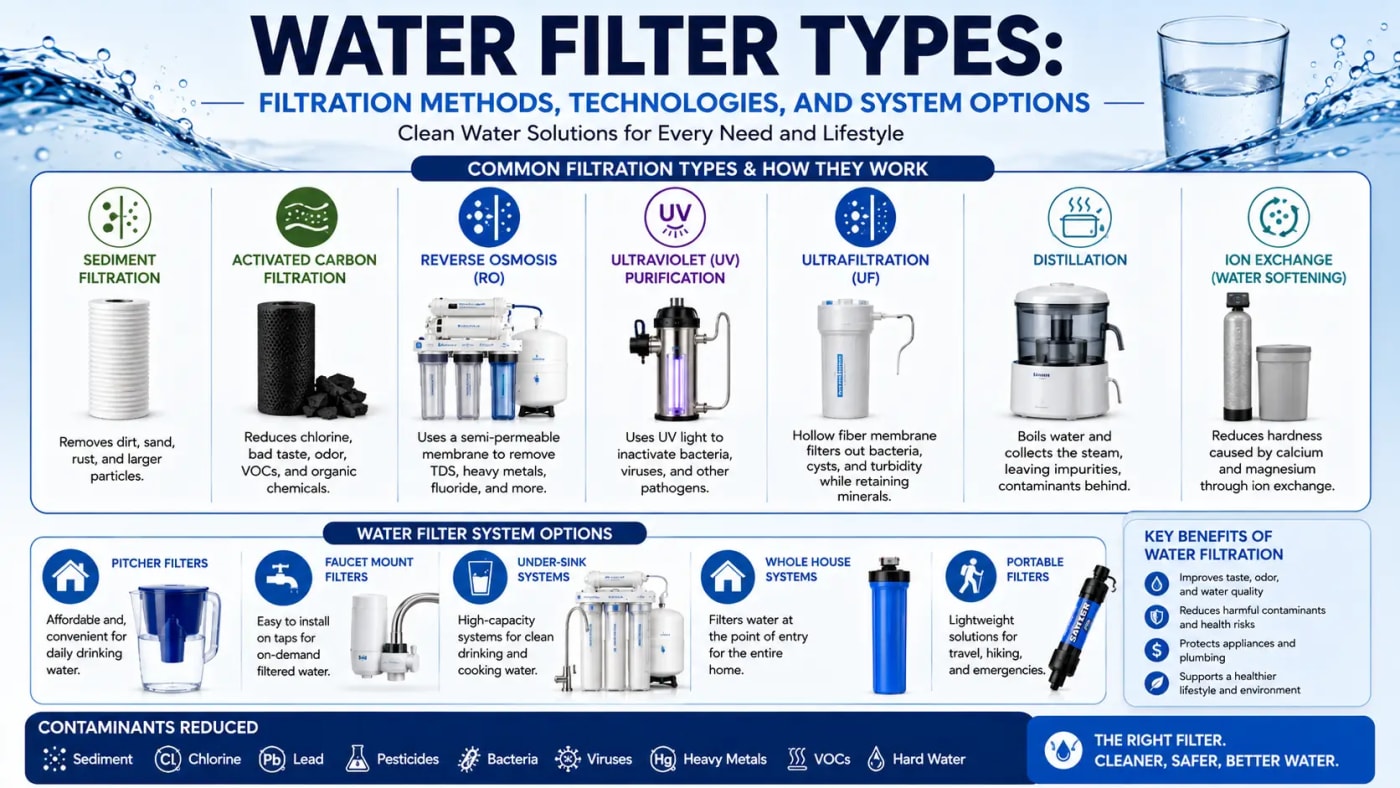
Water filter types fall into two groups. One group is filtration technology, and the other group is system configuration. Filtration technology is the method a filter uses to remove contaminants, such as activated carbon, reverse osmosis, or ion exchange. System configuration is where the treatment happens in a home, such as at one tap or at the main water line. Every home has different water and different goals, so no single filter type works for every situation. This guide explains the main filtration technologies, the main system configurations, and the basic steps for matching a filter type to a specific water problem.
What types of water filters are classified by their treatment method?
Water filters and treatment systems work through five main mechanisms. Each mechanism removes contaminants in a different way, and each one targets different substances in water. Physical filtration traps particles. Adsorption pulls chemicals onto a surface. Membrane separation blocks contaminants based on size. Ion exchange swaps unwanted ions for other ions. Disinfection destroys or inactivates microorganisms instead of removing them physically.
Main treatment mechanisms:
Physical filtration: Water passes through a screen or porous material, and particles get trapped based on their size.
Adsorption: Contaminants stick to the surface of a material, such as activated carbon, instead of passing through it.
Membrane separation: Water passes through a thin membrane, and the membrane blocks contaminants based on pore size.
Ion exchange: A resin swaps one type of ion for another, most commonly used to remove hardness minerals.
Disinfection: A method such as UV light destroys or inactivates microorganisms without physically removing them from the water.
How does mechanical or sediment filtration remove particles from water?
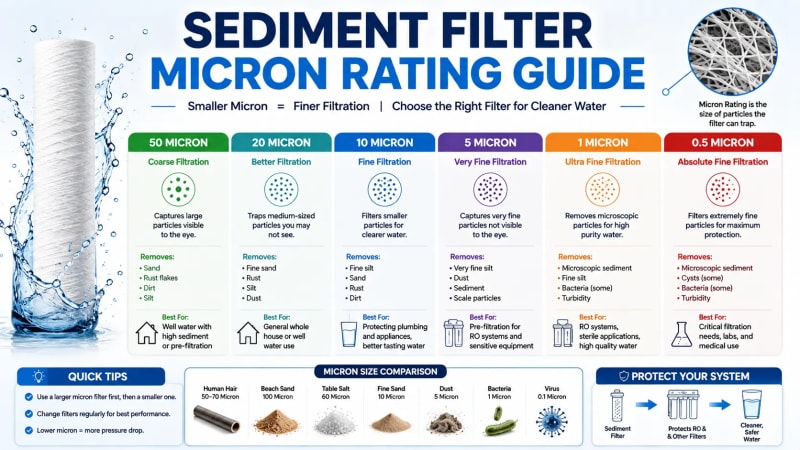
Mechanical filtration, also called sediment filtration, removes solid particles from water using a physical barrier. Water passes through a screen, mesh, or porous material, and particles larger than the openings get trapped. Common sediment filter materials include spun fiber cartridges and pleated cartridges. These filters catch dirt, sand, silt, rust, and other suspended solids before the water moves to the next stage of treatment.
Sediment filters use a rating called micron size to describe how small a particle they can catch. A nominal micron rating means the filter catches most particles of that size, but not all of them. An absolute micron rating means the filter catches nearly all particles at that size or larger. The CDC notes that filter pore size determines which particles and organisms a filter can physically block.Sediment filtration works well as a first stage in a multi-filter system. It protects downstream filters, such as carbon or membrane filters, from clogging too fast. On its own, sediment filtration does not remove dissolved chemicals, salts, or most microorganisms.
Below table shows the mechanism, target particles, and main limitation of sediment filtration.
Mechanism | Target Particles | Main Limitation |
Physical screening through mesh or cartridge | Dirt, sand, silt, rust, sediment | Does not remove dissolved substances |
Pore size blocking | Suspended solids above micron rating | Does not remove most microorganisms |
Pre-filtration stage | Larger particles before other treatment | Needs regular cartridge replacement |
How do activated carbon and carbon block filters remove chemicals and improve taste?
Activated carbon filters work through adsorption, not absorption. In adsorption, contaminants stick to the surface of the carbon material instead of soaking into it. Activated carbon has a large surface area full of tiny pores, and this structure gives it a strong ability to attract and hold certain chemicals. The EPA lists granular activated carbon as an established adsorption technology for drinking water treatment.Activated carbon filters commonly reduce chlorine taste and odor, along with certain volatile organic compounds. There are two common forms. Granular activated carbon, or GAC, uses loose carbon granules. Carbon block uses compressed carbon formed into a solid shape, often combined with a sediment filter function.
Performance depends on the type of carbon, the contact time between water and carbon, and product certification for specific contaminants. Activated carbon does not remove every heavy metal, every dissolved mineral, or PFAS unless the specific product is certified for that claim.
Below table shows the difference between GAC and carbon block filters.
Feature | Granular Activated Carbon (GAC) | Carbon Block |
Form | Loose carbon granules | Compressed solid carbon |
Water contact time | Shorter, water flows around granules | Longer, water flows through dense block |
Particle filtration | Limited on its own | Often filters fine sediment too |
Common use | Whole-house or large tank systems | Pitchers, faucet filters, under-sink units |
How do ceramic filters remove particles and microorganisms?
Ceramic filters use a porous ceramic shell to physically block particles and some microorganisms from passing through. Water moves through tiny pores in the ceramic material, and anything larger than the pore size stays behind. This mechanism is similar to sediment filtration, but ceramic material can achieve a finer pore structure.
Ceramic filters reduce sediment effectively. Many ceramic filters also reduce bacteria and protozoa, but this claim depends on the specific pore size and product certification. Not every ceramic filter performs the same, so a buyer needs to check the certification for the exact product.
Ceramic filter capabilities and limitations:
Sediment reduction: The ceramic shell blocks visible particles and reduces cloudiness in water.
Bacteria and protozoa reduction: Some certified ceramic filters block these organisms because their pore size is small enough to trap them.
Dissolved chemicals: Ceramic material does not address dissolved chemicals unless combined with another filter media, such as carbon.
Dissolved salts and minerals: Ceramic filtration does not reduce these substances because they pass through the pores along with the water.
Maintenance need: The outer ceramic surface needs periodic cleaning or scrubbing to remove trapped particles and keep water flowing at a normal rate.
How do microfiltration, ultrafiltration, and nanofiltration differ by pore size and contaminant removal?
Microfiltration, ultrafiltration, and nanofiltration are three membrane processes. Each one uses a membrane with a different pore size, and pore size determines which contaminants stay behind and which contaminants pass through. As the pore size gets smaller, the membrane blocks smaller and smaller particles.
Microfiltration has the largest pore size among the three. It removes suspended particles and some bacteria. Ultrafiltration has a smaller pore size and removes bacteria and many viruses. Nanofiltration has the smallest pore size of the three and removes some dissolved organic compounds and part of water hardness, along with viruses and bacteria. The CDC confirms that microfiltration, ultrafiltration, and nanofiltration remove germs at different rates because of their different pore sizes.
Below table shows how microfiltration, ultrafiltration, and nanofiltration compare.
Membrane Type | Approximate Pore Size | What It Removes |
Microfiltration (MF) | Largest of the three | Suspended particles, some bacteria |
Ultrafiltration (UF) | Smaller than MF | Bacteria, many viruses |
Nanofiltration (NF) | Smallest of the three | Viruses, bacteria, some organic compounds, part of hardness |
How does reverse osmosis remove dissolved contaminants from water?
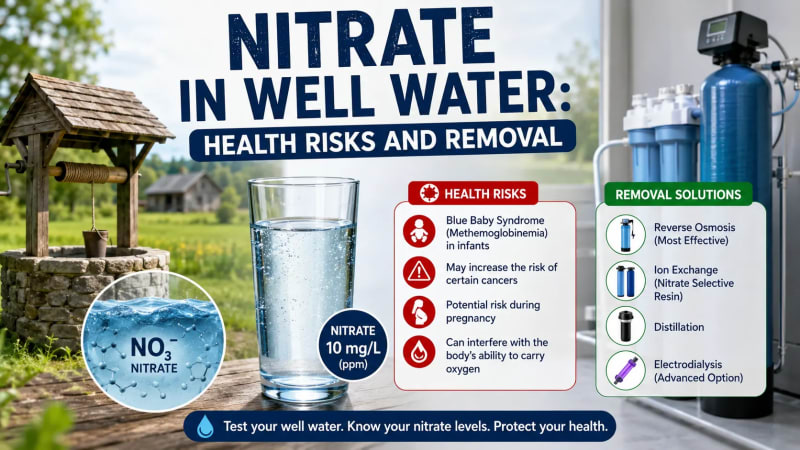
Reverse osmosis, often called RO, pushes water through a semipermeable membrane using pressure. The membrane has extremely small openings, so it blocks dissolved salts, many heavy metals, nitrate, fluoride, and other dissolved contaminants, while letting water molecules pass through. This process treats a wider range of dissolved substances than most single filter types.
During reverse osmosis, water splits into two streams. One stream is the treated water, called permeate. The other stream carries away the blocked contaminants, called concentrate or reject water. Because RO membranes are sensitive to sediment and chlorine, most RO systems include a sediment pre-filter and a carbon pre-filter before the membrane, along with a carbon post-filter after the membrane. The EPA and NSF both recognize reverse osmosis membrane technology as an effective method for reducing a broad range of dissolved contaminants when the full system is properly maintained.
How water moves through a typical RO system:
Feed water enters the system: Untreated tap water enters the RO unit from the cold water line.
Sediment pre-filter removes particles: This stage catches dirt and sediment so the membrane does not get clogged.
Carbon pre-filter removes chlorine: This stage protects the membrane material, because chlorine can damage it over time.
RO membrane separates dissolved contaminants: Pressure pushes water through the membrane, and dissolved substances stay behind.
Permeate exits as treated drinking water: This is the clean water stream that flows to the faucet or storage tank.
Reject water carries concentrated contaminants to the drain: This stream removes the blocked substances from the system.
Carbon post-filter polishes the taste of the final water: This last stage improves taste right before the water reaches the tap.
How does ion exchange change the concentration of hardness and other target ions?
Ion exchange treats water by swapping one type of ion for another. Inside the system, a resin bed holds ions that get released into the water in exchange for unwanted ions in the water. The most common use is water softening, where the resin swaps calcium and magnesium ions, the ions that cause hardness, for sodium or potassium ions.
Beyond softening, specialty ion exchange resins target specific contaminants. Some resins are designed to remove nitrate. Some resins are designed to remove certain forms of PFAS. The EPA lists anion exchange and cation exchange among established treatment technologies for specific contaminants. Ion exchange is a targeted process, so the resin type must match the specific ion a household wants to remove.
How ion exchange works, step by step:
Hard water enters the resin tank: Water containing calcium and magnesium flows into the tank holding the resin beads.
Resin beads hold sodium or potassium ions: Before use, the resin surface carries a supply of these replacement ions.
Calcium and magnesium ions attach to the resin: The resin surface bonds more strongly with these hardness minerals.
Sodium or potassium ions release into the water: As hardness minerals attach to the resin, the resin releases its ions in exchange.
Softened water exits the tank: The outgoing water now carries lower levels of calcium and magnesium.
How do activated alumina filters target fluoride, arsenic, and other specific contaminants?
Activated alumina is an adsorptive filter media made from aluminum oxide. It has a highly porous surface, and certain contaminants bond to that surface as water passes through. Activated alumina is not a general purpose filter. It is chosen for specific contaminants rather than broad filtration.
Forbes identifies fluoride and arsenic as two of the main contaminants activated alumina targets. Effectiveness depends on the water chemistry of the specific source, along with the certification of the specific product. Not every activated alumina filter removes every listed contaminant, so a buyer should confirm the certified claims for the exact product before relying on it.
Common target contaminants and limitations of activated alumina:
Fluoride reduction: Activated alumina binds fluoride ions to its surface, though the exact reduction rate depends on the specific product.
Arsenic reduction: The same adsorptive surface can also bind certain forms of arsenic present in water.
Selenium reduction: Some certified products list selenium as an additional target contaminant.
Water chemistry sensitivity: The pH and mineral content of the source water changes how well activated alumina performs.
Filtration gap: Activated alumina does not address sediment or microorganisms, so it is often paired with another filter stage.
How does ultraviolet treatment disinfect water without removing dissolved contaminants?
Ultraviolet treatment, or UV treatment, disinfects water using UV light instead of physical filtration. As water passes through a UV chamber, the light damages the genetic material of bacteria, viruses, and protozoa, so the microorganisms lose the ability to reproduce and cause illness. UV treatment does not physically remove anything from the water.
Because UV light needs a clear path through the water, cloudy or sediment filled water reduces its effectiveness. Most UV systems work best with pre-filtered water. UV treatment does not remove dissolved chemicals, dissolved salts, or sediment, so it is often combined with other filter types to address a broader range of water quality concerns. The CDC recognizes UV as a disinfection method separate from particle and chemical filtration.
Below table shows what UV treatment does and does not do.
UV Treatment Does | UV Treatment Does Not Do |
Disinfects bacteria, viruses, and protozoa | Remove dissolved chemicals |
Works without adding chemicals to water | Remove dissolved salts or minerals |
Treats water quickly as it flows through the chamber | Remove sediment or suspended particles |
Works best after pre-filtration | Replace the need for a sediment or carbon filter |
How does distillation separate water from many contaminants through vaporization and condensation?
Distillation treats water through a physical change of state. Water is heated until it boils and turns into vapor. Most nonvolatile contaminants, including many dissolved salts and heavy metals, stay behind in the boiling chamber because they do not turn into vapor at the same temperature. The vapor then moves into a separate chamber, where it cools and condenses back into liquid water, now separated from most of the original contaminants.
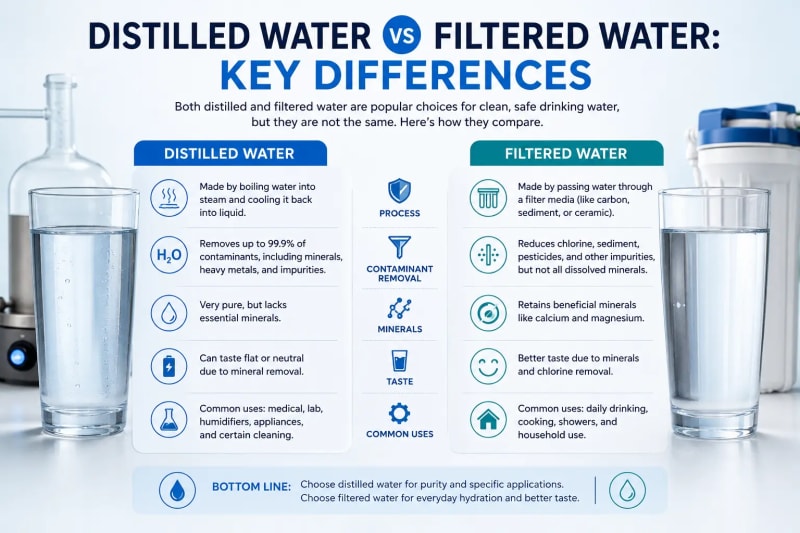
Distillation requires energy to heat the water, and the process is slower than most other filtration methods. It also removes natural minerals from the water along with contaminants, so distilled water is not automatically better for every use. The CDC references NSF/ANSI Standard 62 as the certification standard for distillation systems.
Steps in the distillation process:
Water enters the boiling chamber: Untreated water fills the heating section of the distiller.
Heat raises the water to boiling temperature: An internal heating element brings the water to a full boil.
Water turns into vapor: As the water boils, it changes from liquid into steam, leaving most contaminants behind.
Vapor travels into a condensing chamber: The steam moves through a tube into a separate cooling section.
Vapor cools and turns back into liquid water: The cooling section lowers the temperature of the steam until it condenses.
Distilled water collects in a separate container: The condensed water drips into a clean storage container, ready for use.
How do point-of-use and point-of-entry water filter systems differ in coverage?
Filtration technology explains how water gets treated. System configuration explains where that treatment happens in a home. The two main configurations are point-of-use, often called POU, and point-of-entry, often called POE. The CDC and NSF both use this distinction to describe household water treatment systems.
Below table shows the difference between point-of-use and point-of-entry systems.
Feature | Point-of-Use (POU) | Point-of-Entry (POE) |
Treatment location | At one tap or one fixture | At the main water line entering the home |
Water coverage | Only water from that fixture | All water used in the home |
Common examples | Pitcher, faucet filter, under-sink filter | Whole-house filter, whole-house softener |
Typical goal | Drinking or cooking water quality | General household water quality |
How do pitcher, faucet, and refrigerator filters provide point-of-use filtration?
Pitcher filters, faucet filters, and refrigerator filters are three common formats of point-of-use filtration. They differ mainly in convenience, capacity, and installation, not in a completely separate filtration mechanism. The filtering media inside these formats is often activated carbon, though the exact media depends on the specific product.
Below table shows how pitcher, faucet, and refrigerator filters compare.
Format | Installation | Typical Capacity | Best Fit |
Pitcher filter | No installation, fill and pour | Small, limited by pitcher size | Renters or small households |
Faucet filter | Attaches directly to the faucet | Moderate, filters water on demand | Households wanting filtered tap water without plumbing changes |
Refrigerator filter | Built into the refrigerator water line | Moderate, tied to refrigerator use | Households already using a water and ice dispenser |
How do countertop and gravity water filters differ in portability and water delivery?
Countertop filters and gravity filters are both point-of-use formats built around portability rather than plumbing connections. A countertop filter usually connects to a faucet through a hose and sits on the counter during use. A gravity filter uses no electricity and no plumbing connection at all. Water is poured into an upper chamber, and gravity pulls it down through the filter media into a lower chamber.
Key traits of countertop and gravity filters:
No permanent installation: Neither format needs plumbing changes, so both are easy to set up and remove.
No electricity for gravity filters: A gravity filter works purely through the weight of water pulling it down through the media.
Faster delivery from countertop filters: Because a countertop unit connects to the faucet, it usually delivers filtered water more quickly than a gravity filter.
Useful during travel or power outages: Gravity filters keep working even without electricity or a plumbing connection, which makes them useful outside a normal kitchen setup.
Performance depends on internal media: The actual contaminant removal in both formats depends on the specific filter media placed inside the unit.
How do under-sink water filters differ from other point-of-use systems?
Under-sink filters install inside the cabinet below a kitchen sink. Some models connect to a dedicated small faucet installed next to the main faucet. Other models connect directly into the existing cold water line. Under-sink systems usually deliver filtered water on demand, without needing a separate pitcher or tank on the counter.
Under-sink systems can contain activated carbon, ultrafiltration, reverse osmosis, or other technologies, depending on the specific product. The filtration mechanism itself follows the same principles explained earlier in this guide.
Below table shows the general attributes of under-sink filter systems.
Attribute | Typical Detail |
Installation location | Cabinet below the kitchen sink |
Faucet setup | Dedicated faucet or existing faucet connection |
Space requirement | Cabinet space for the filter housing or tank |
Delivery | Filtered water on demand |
Possible technologies inside | Carbon, ultrafiltration, reverse osmosis, or a combination |
How do whole-house water filters treat water at the point of entry?
Whole-house filters install at the point where the main water line enters a home, so every fixture in the house receives treated water. This includes kitchen taps, bathroom taps, showers, and laundry connections. Because a whole-house system must handle the full water demand of a household, flow rate becomes an important factor when choosing a system.
The correct filter media for a whole-house system depends on the specific water problem identified through testing. A whole-house system can use sediment filtration, carbon filtration, ion exchange, or other technologies, matched to the contaminants present in the water source.
How water moves through a whole-house filter system:
Water enters the home from the main supply line: This is the single entry point for all water used inside the house.
Water passes through the whole-house filter media: The chosen media treats the water based on the contaminants it targets.
Treated water moves into the home's internal plumbing: From this point, the water travels through the pipes just like normal tap water.
Every fixture in the home receives the treated water: Kitchen taps, bathroom taps, showers, and laundry connections all receive the same treated supply.
How do you match a water filter type to your water source and contaminant problem?
Choosing a water filter type follows a logical sequence. Skipping steps in this sequence often leads to buying a filter that does not solve the actual problem. The CDC recommends testing water and choosing treatment based on the specific contaminants identified. The EPA also recommends checking certified contaminant reduction claims, particularly for contaminants such as PFAS.
Steps for matching a filter type to a water problem:
Identify the water source: Determine if the water comes from a municipal supply or a private well, because each source needs a different testing approach.
Obtain water quality information or a test: A municipal report or a lab test for well water gives the actual facts needed for a decision.
Identify the specific target contaminant: Use the test results to name the exact substance or substances that need treatment.
Select a treatment technology: Match the identified contaminant to the filtration method proven to address it.
Select a point-of-use or point-of-entry configuration: Decide if the household needs treatment at one tap or across the whole home.
Verify the certification of the chosen product: Confirm the product is tested and certified for the specific contaminant, not just filtration in general.
Check maintenance and flow rate requirements: Review cartridge life, replacement cost, and whether the system can handle the household's water demand.
How do you choose a water filter based on a home water test?
A water test gives the specific facts needed to choose an effective filter. Without a test, filter selection becomes guesswork.
Steps for choosing a filter using a water test:
Obtain a current water quality report or test result: This is the starting point, and it should reflect the household's actual water source.
Identify each contaminant present and its level: List every substance flagged in the report along with its measured amount.
Match each contaminant to a certified treatment technology: Use the earlier sections of this guide to find the filter type proven to target each contaminant.
Confirm the chosen system has enough capacity: Check that the system can treat the household's daily water volume without breaking down early.
How do NSF water filter certifications show what a filter can remove?
NSF certification tells a buyer which specific contaminants a filter has been tested and verified to reduce. NSF/ANSI Standard 42 covers aesthetic effects, such as chlorine taste and odor. NSF/ANSI Standard 53 covers health related contaminants, such as lead and certain organic chemicals. NSF/ANSI Standard 58 covers reverse osmosis systems. NSF/ANSI Standard 401 covers a group of emerging contaminants, including certain pharmaceuticals and pesticides.
A certification only confirms the specific claims listed for that product. It does not mean the filter removes every possible contaminant in water.
What is the difference between a water filter and a water softener?
A water filter targets specific contaminants or particles in water. A water softener targets water hardness specifically, using ion exchange to remove calcium and magnesium. Culligan states directly that a water softener is not classified as a filter, because its purpose is narrowly focused on hardness rather than general contaminant reduction.
What is the difference between reverse osmosis and other water filtration methods?
Reverse osmosis is a membrane based process that targets a wide range of dissolved contaminants, including dissolved salts, many heavy metals, and other dissolved substances. Many other basic filter types, such as sediment or single stage carbon filters, target a narrower range of contaminants, such as particles or chlorine taste. This difference in scope is why RO systems often serve as a broader treatment solution when water contains multiple types of dissolved contaminants.
Which water filter type is best for well water?
There is no single best filter type for well water. Well water treatment depends entirely on the specific test results for that well. Common combinations include sediment filtration, iron treatment, activated carbon, UV disinfection, softening, and reverse osmosis, chosen based on the exact contaminants found. Culligan recommends testing well water before selecting a treatment approach.
Which water filter type is best for city or municipal water?
Municipal water already goes through treatment before it reaches a home, so the right home filter depends on the remaining concerns in the local water report. Common goals include reducing chlorine taste, addressing specific contaminants noted in the report, or improving general water taste. The CDC recommends reviewing the local annual water quality report to understand what a municipal supply already treats and what concerns remain.
How often should different water filter types be replaced and maintained?
Replacement schedules depend on filter type, filter capacity, the quality of the incoming water, household usage, and manufacturer instructions. There is no single universal replacement interval that applies to every filter, because these factors change from product to product and home to home. NSF recommends following each specific system's stated replacement requirements and including replacement costs as part of the overall budget for a filtration system.