
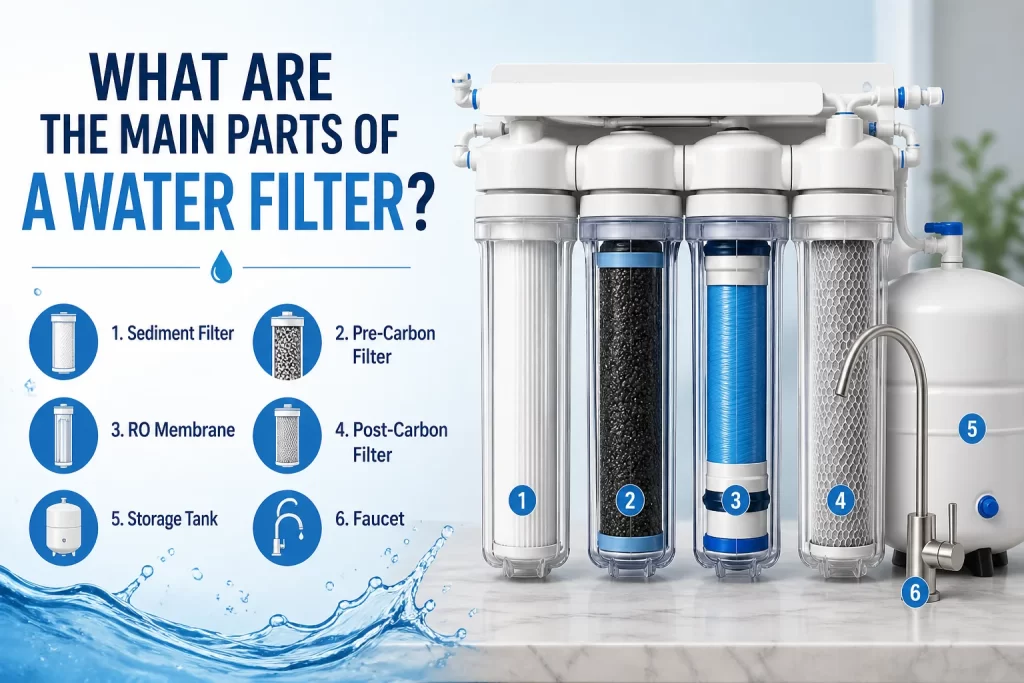
A water filter is a smart machine that removes impurities from your drinking water. It works like a big strainer, catching things we don’t want to swallow, like dirt, chemicals, and tiny germs. Clean water tastes way better, and it’s much safer for your body. Think of it: removing the impurities makes the water crystal clear and healthier for everyone in your family.
Water filters are super important because they protect your health every day. Bad water has invisible problems that make people sick. By trapping these unwanted substances, the filter provides you with a safe and clean drink every time you turn on the tap. This process of cleaning the water also helps your food and beverages taste better. This ensures that the water you use for everything, from making baby formula to boiling pasta, is as pure as possible.
The way these filters work depends on a few special pieces. Different filters use different parts, but here are the main ones:
- Sediment Filter
- Carbon Filter
- RO Membrane (Reverse Osmosis Membrane)
- Post-Carbon Filter (Polishing Filter)
- UV Sterilizer
- Remineralization Filter
- Storage Tank
- Faucet or Dispenser Tap
- Filter Housing and O-Rings
Because you want the purest, best-tasting water, knowing about each of these parts truly matters. Our simple guide helps you understand exactly what each piece does, so you can choose the perfect setup for your home and ensure your family gets the very best water quality available.
1. Sediment Filter
A sediment filter acts as the first guard for your water system, catching larger particles of debris. It removes contaminants such as dirt, sand, rust flakes, and tiny rocks that float in your water before they reach the other filters. This first step prevents the fine filters from becoming clogged too soon, which saves you money. The sediment filter is super important because it protects the rest of the system from gunk, making everything last longer, that’s for sure.Here is the finest sediment filter we reviewed for you:
iSpring WSP50ARB Spin Down Sediment Water Filter

The iSpring WSP50ARB is a super important filter that goes first in your whole-house water system. It acts like the main guard, standing at the entry point to catch big chunks of stuff. It protects all the other, more sensitive filters and appliances in your home from getting ruined too fast by abrasive dirt and rust.
Key Specifications
| Feature | Detail |
| Brand | iSpring |
| Model | WSP50ARB |
| Price (Approx.) | $197.99 |
| Rated Flow Rate | Up to 34 GPM (Gallons Per Minute) |
| Filtration Rating | 50 Micron |
| Filter Mesh Material | 316L Food Grade Stainless Steel |
| Pressure Resistance | Tested over 500 PSI |
| Purification Mechanism | Mechanical Filtration (Spin-Down) |
Filtration Technology and Performance
The WSP50ARB works by spinning the water to catch big stuff. It uses a very durable, food-safe 316L stainless steel mesh screen to trap sand, rust, and other debris that are 50 microns or larger. This action significantly reduces the load on finer filters, allowing them to stay clean and perform more effectively over an extended period.
Flow Rate and Pressure Assurance
This filter provides a maximum flow rate of up to 34 GPM. This robust flow capacity ensures the unit experiences minimal pressure loss, even when multiple people use water simultaneously in a large house. The strong brass-top construction confirms the system handles pressure spikes well.
Certification and Trust
The unit underwent intense testing, including over 100,000 water hammer cycles, which proved its reliability. It’s essential to note that this filter is designed solely for capturing particles. It does not filter out chemicals, heavy metals, or bacteria.
Summary
| What We Like | What We Don’t Like |
| The auto-flushing module eliminates manual maintenance. | Mechanical pre-filter only; does not remove chemicals or bacteria. |
| Reusable 316L stainless steel mesh is highly durable. | Requires a dedicated drain for flushing. |
| High flow rate (up to 34 GPM) works for large homes. | Must be installed indoors in a dry environment. |
Cost of Ownership and Maintenance
The WSP50ARB is a reusable system. It features a smart, auto-flushing module with a touch screen that allows you to program it to clean itself. This automatic self-cleaning feature dramatically reduces the need for manual work, making maintenance quite easy. The module uses a dual power supply (AC adapter or batteries) to keep running. This auto-flush feature helps the entire system run effectively for 5 to 10 years, which is certainly a benefit, saving money on replacement filters.
2. Carbon Filter
A carbon filter uses tiny pieces of activated carbon to clean your water. It works like a sponge, absorbing and trapping bad tastes, unpleasant smells, and chemicals like chlorine. This process makes the water taste much cleaner and fresher for drinking and cooking.
ICEPURE 4.5″ x 20″ Whole House CTO/KDF Combined Media Filtration Cartridge

This carbon filter is a specialized cartridge for your main water line that combines a CTO carbon block and KDF media to clean your whole house water. It’s designed to fit standard “Big Blue” filter housings and focuses on removing bad tastes, odors, chlorine, and heavy metals like lead. It makes your water much cleaner and better for every tap in your home.
Key Specifications
| Feature | Details |
| Price | $199.99 |
| Micron Rating | 5 Micron (Nominal) |
| Flow Rate (GPM) | 6 GPM |
| Stated Capacity (General) | Up to 100,001 Gallons |
| Stated Capacity (KDF/Heavy Metal) | 19,999 Gallons |
| Dimensions | 4.5″ D x 20″ H |
Filtration Technology and Performance
This filter is special because it uses two cleaning methods: CTO Carbon Block and KDF media. The carbon block acts like a sponge, using adsorption to remove bad tastes, odors, and up to 99% of chlorine. The KDF media uses a chemical process called Redox (oxidation-reduction) to target heavy metals like lead and mercury, which carbon alone cannot easily remove. This dual system provides cleaner, better-tasting water and helps protect the filter from premature failure.
Flow Rate and Pressure Assurance
The flow rate is set low at 6 GPM. This is a necessary trade-off: the water must move slowly to give the KDF media enough time to react with and remove the heavy metals effectively. As a result, you will notice a drop in water pressure when you run multiple appliances simultaneously, such as a shower and a washing machine.
Certification and Trust
The filter is certified to NSF/ANSI 42 for reducing aesthetic problems, such as taste and odor. It also meets NSF/ANSI 372 for using lead-free materials. However, if you rely on this filter for health protection, such as lead removal, the manufacturer must provide specific certification for NSF/ANSI 53.
Summary
| What We Like | What We Don’t Like |
| Uses KDF media to remove lead and heavy metals. | Low flow rate (6 GPM) causes a pressure drop in homes. |
| Reduces chlorine and improves taste up to 99%. | Health claims (lead) need verified NSF/ANSI 53 data. |
| Dual media protects the filter from microbial growth. | Short 19,999-gallon life for heavy metal removal. |
| Should not be used for high-sediment raw water. |
Cost of Ownership and Maintenance
The filter has two lifespans: 100,001 gallons for taste/odor removal, but only 19,999 gallons for heavy metal removal. If you need it to protect against lead, you must replace it after 19,999 gallons (approximately 6 months) to ensure it continues to work effectively.
3. RO Membrane (Reverse Osmosis Membrane)
The RO membrane is the heart of the reverse osmosis system. It’s a super-fine, special sheet that water squeezes through. It pushes out almost everything, including salts, minerals, tiny germs, and chemicals, leaving only pure, clean water behind. It’s how you get the highest level of purity.
Applied Membranes M-T4040ALE (4×40 Low Energy RO Element)

This RO membrane is a specialized component for commercial reverse osmosis systems, designed to purify tap water and lightly brackish water. Its main job is to filter water with great efficiency while using less energy than other membranes. This saves money on electricity and improves the overall performance of the system for businesses that require a significant amount of clean water daily.
Key Specifications
| Features | Details |
| Nominal Size | 4″ x 40″ |
| Permeate Flow Rate | 2,850 GPD (Gallons Per Day) |
| Applied Pressure (LE Rating) | 150 PSI |
| Stabilized Salt Rejection | 98.0% |
| Max. Free Chlorine Tolerance | 0 PPM |
| Membrane Material | TFC Polyamide |
Filtration Technology and Performance
This element utilizes Thin Film Composite (TFC) Polyamide material, which is highly effective at separating water from contaminants. It provides a guaranteed 98.0% rejection of dissolved solids, removing substances such as salts, heavy metals, and microorganisms. This high rejection rate results in extremely pure water. The Low Energy (LE) design is a special feature because it achieves high performance (2,850 GPD) while requiring only 150 PSI of pressure, which results in significant energy savings compared to standard membranes.
Flow Rate and Pressure Assurance
The element delivers a high flow rate. This low-pressure operation is a significant benefit for commercial users, as it reduces the operating cost of the system. It reduces the energy needed by the high-pressure pump by about 32% compared to older membranes. Additionally, the lower pressure allows you to use less expensive PVC housings, which saves money when building the system.
Certification and Trust
The membrane is manufactured by Applied Membranes, Inc., in ISO 9001:2015-certified facilities, ensuring high quality. The most important rule for this membrane is a zero (0) tolerance for free chlorine. Chlorine will quickly and permanently damage the TFC material. You must use a carbon filter before this membrane to remove all chlorine, or the membrane will fail, and the warranty will become void.
Summary
| What We Like | What We Don’t Like |
| High flow rate saves time. | Absolute zero (0) free chlorine tolerance. |
| Low 150 PSI pressure saves about 32% energy. | Sensitive to fouling if the flow rate is exceeded. |
| 98.0% salt rejection provides high-purity water. | Short warranty (one year from first use). |
| The standard 4×40 size fits existing housings. | Requires perfect pre-treatment to survive. |
Cost of Ownership and Maintenance
This element is designed to reduce your long-term operating expenses through energy savings. To make it last its expected 2 to 5 years, you must carefully control the feed water quality. Do not let the flow rate exceed 2,850 GPD, as this can cause fouling. For long-term use, you must regularly clean and flush the system with clean water when you shut it down.
4. Post-Carbon Filter (Polishing Filter)
The post-carbon filter is the last thing your water touches. It uses activated carbon to do a final clean-up. This filter removes any tiny leftover tastes or smells that might have gotten through, making your water taste totally fresh.
Inline Post Carbon Polishing Water Filter

This post-carbon filter is a specialized cartridge designed for the very last step in a multi-stage system, usually after a Reverse Osmosis (RO) membrane. Its main job is to polish the water, removing any trace tastes, stale smells, or residual chlorine that might remain, ensuring the final water dispensed is fresh and crisp.
Key Specifications
| Features | Details |
| Model Standard | T33 Inline |
| Media Type | Granular Activated Carbon (GAC) from Coconut Shell |
| Dimensions | 10 inches L x 2 inches D |
| Fittings | 1/4 inch Quick Connect (QC) |
| Maximum Flow Rate | 0.75 GPM (Gallons Per Minute) |
| Recommended Max Pressure | 70 PSI |
| Typical RO Service Life | 11 Months |
Filtration Technology and Performance
This filter uses high-quality granular activated carbon (GAC), made from coconut shells. GAC is chosen because it offers a higher flow rate than carbon block filters, which is important when a user needs quick water from the storage tank.
The GAC removes impurities through adsorption, grabbing hold of bad tastes, odors, and volatile organic compounds (VOCs). It also helps neutralize residual chlorine, which stabilizes the taste of water that has sat in the storage tank. The GAC media is rated at a nominal 5-micron level, which captures any internal carbon dust before it reaches your cup or ice maker.
Flow Rate and Pressure Assurance
The filter has a maximum flow rate of 0.75 GPM. This rate works well for quick dispensing from the RO system or for low-flow applications, such as refrigerators and coffee makers. The housing has a structural limit up to 124 PSI, but the recommended maximum operational pressure is 70 PSI.
Certification and Trust
Membrane Solutions claims this filter is compatible with NSF/ANSI 42 (Aesthetic Effects) for chlorine, taste, and odor reduction, and ANSI 58 (RO components) for material safety. This means it functions like a certified filter, though it may not carry the official NSF seal. The low price is largely due to this certification strategy. The filter utilizes food-grade, BPA-free components, ensuring it does not add any harmful substances to your water.
Summary
| What We Like | What We Don’t Like |
| A low unit cost maximizes savings for bulk purchases. | Officially, the NSF certification is not public. |
| Uses high-flow GAC for quick dispensing. | Requires a mandatory 5-gallon pre-flush to remove carbon dust. |
| Removes tastes and odors, making the final water crisp. | Max pressure is 80 PSI; it needs a PRV for higher-pressure homes. |
| The 1/4-inch quick connect makes installation very easy. | Not designed for lead or heavy metal removal. |
Cost of Ownership and Maintenance
The model is very economical, resulting in a significantly lower cost per filter compared to premium brands. For RO systems, the replacement schedule is typically 11 months. However, when you use this filter as a stand-alone unit for an ice maker or fridge, you must replace it sooner, generally every 6 months or 1999 gallons, whichever comes first. Before connecting any new filter, you must flush at least 4 gallons of water through it to wash out loose carbon dust and prevent black flecks from entering your drinking water.
5. UV Sterilizer
A UV sterilizer uses ultraviolet light to quickly destroy tiny organisms like bacteria and viruses in your water. The light damages their DNA, preventing them from reproducing and causing illness. It’s a chemical-free way to make sure your water is safe from germs.
iSpring UVF11A Ultraviolet Water Sterilizer

This UVF11A is a powerful accessory designed to be the final layer of defense for drinking water, often attached to a reverse osmosis (RO) system. It uses a high-output UV light to ensure water is free from bacteria and viruses before you drink it. Its key feature is the Smart Flow Control, which improves efficiency and reduces maintenance.
Key Specifications
| Features | Details |
| Power Output | 11 Watts |
| Price | $156.22 |
| Rated Flow Rate | 1.0 GPM (Gallons Per Minute) |
| Lamp Lifespan (Calendar) | 11 Months |
| Chamber Material | 304 Stainless Steel |
| Special Feature | Smart Flow Control Switch |
Filtration Technology and Performance
The UVF11A uses an 11-watt lamp that produces UVC light at the 253.7 nm wavelength to disrupt the DNA of microorganisms, making them inactive. By pairing this high power with a restricted 1.0 GPM flow rate, the system maximizes the water’s exposure time, ensuring a strong UV dose. This dose is necessary to kill germs effectively. The stainless steel housing reflects the light to maximize the dose delivered.
Flow Rate and Pressure Assurance
The fixed flow rate of 1.0 GPM is a deliberate safety feature, not a limitation. This low rate increases the time the water spends under the UV light, guaranteeing a sufficient dose for sterilization. The most notable feature is the Smart Flow Control Switch. This sensor turns the lamp on only when water is flowing and off when it stops. This saves electricity, prevents the chamber from overheating (which causes mineral scale buildup on the quartz sleeve), and extends the overall life of the 7,990-hour lamp.
Certification and Trust
The UVF11A is highly effective and manufactured with quality components, but users should note the absence of public NSF 55 Class A certification. However, the 11W power output is significantly higher than the 6W found in many competitors, providing an extra safety margin to ensure high performance. Crucially, the unit requires upstream filtration to remove particles larger than 19.99 microns. If the water is turbid (cloudy), particles will block the UV light, and the sterilization will fail, regardless of the high wattage.
Summary
| What We Like | What We Don’t Like |
| High 11 Watt power ensures a strong germ-killing dose. | No public NSF 55 Class A certification documented. |
| Smart Flow Control saves energy and prevents scaling. | Absolutely requires a clear, pre-filtered water source. |
| Ideal for final disinfection in RO systems. | Mandatory lamp replacement every 11 months. |
| High-value solution with advanced features. |
Cost of Ownership and Maintenance
The annual maintenance cost is predictable, mainly consisting of the mandatory 11-month lamp replacement (around $36 to $67 USD). The Smart Flow Control helps keep the quartz sleeve cleaner by reducing heat, thereby lowering the need for frequent manual cleaning or replacement, which saves on maintenance time and cost. The total system is considered a high-value proposition as it offers advanced features usually found in much more expensive units.
6. Remineralization Filter
A remineralization filter is used after an RO system to add essential minerals, like calcium and magnesium, back into the purified water. Since RO removes almost everything, this final step balances the pH and improves the water’s taste, making it healthier and more enjoyable.
APEC USA Taste-Enhancing PH Alkalizing Remineralization Filter (MEM-MAX)

This APEC filter, identified as the MEM-MAX, is a specialized post-filtration accessory designed to solve the two main problems with water purified by reverse osmosis (RO): its slightly acidic pH and its “flat” taste due to the removal of healthy minerals. The filter is installed as the final stage, after the RO membrane and storage tank, to provide final-stage water quality refinement.
Key Specifications
| Parameter | Detail |
| Price | $38.1 |
| Primary Function | pH Correction and Taste Enhancement |
| Media Type | Calcite and Corosex (Calcium and Magnesium compounds) |
| pH Increase | Up to 1.0 point. |
| Compatibility | Universal 1/4 inch Quick-Connect fittings |
Remineralization Technology and Performance
The filter uses a blend of natural, food-grade mineral media, primarily calcite (calcium carbonate) and a form of magnesium oxide (Corosex). When the acidic RO water flows over these minerals, they slowly dissolve. This process releases safe levels of calcium and magnesium ions back into the water.
This addition of alkaline minerals serves two critical functions:
- pH Balance: It raises the water’s pH from the acidic range (4.8-5.9) closer to a neutral or slightly alkaline level (7.5 or higher), preventing the purified water from being corrosive to plumbing.
- Taste Improvement: By reintroducing essential minerals, the filter restores a natural, crisp taste that is often missing from pure RO water, significantly enhancing consumer appeal.
Flow Rate and Pressure Assurance
The MEM-MAX is designed for low flow rates typical of residential drinking water taps (about 0.5 GPM), ensuring maximum contact time between the water and the minerals for effective pH elevation. The filter body is constructed from durable, FDA-approved polypropylene, capable of withstanding standard household water pressures. Its use of universal 1/4- inch quick-connect fittings makes installation quick and compatible with nearly all standard RO systems on the market.
Summary
| What We Like | What We Don’t Like |
| Effectively raises water pH to prevent corrosion. | The pH effect is limited and may not reach high alkaline levels. |
| Restores natural, crisp taste to purified water. | Mineral media is consumed and must be replaced frequently (6-11 months). |
| Universal quick-connect design for easy installation. | Increases the Total Dissolved Solids (TDS) slightly. |
Cost of Ownership and Maintenance
The filter is a consumable item with a typical replacement interval of 6 to 11 months or after processing approximately 999 gallons, depending on the pH level of the incoming RO water. The rate at which the media dissolves is affected by flow and acidity; the higher the water acidity, the faster the minerals will be consumed. Ignoring the replacement schedule will result in the loss of pH correction and the return of flat-tasting, corrosive water.
7. Storage Tank
The storage tank holds the purified water produced by the reverse osmosis (RO) system. Because the RO process is slow, this pressurized tank collects clean water so you always have a ready supply available instantly when you open the faucet.
30-Gallon Reverse Osmosis Water Storage Pressure Tank

This 30-gallon nominal capacity tank is an essential component for high-demand water purification architectures, often used in light commercial or large residential RO systems. Its main purpose is to serve as a hydraulic buffer, storing purified water (permeate) under pressure to ensure immediate, high-volume dispensing.
This capability is vital for meeting rapid flow requirements that a slow-producing RO membrane cannot handle directly. The tank is a regulated pressure vessel, making safety and proper installation paramount.
Key Specifications
| Parameter | Detail |
| Nominal Volume | 30 Gallons |
| Price | $249.99 |
| Usable Drawdown | 11 to 16 Gallons (approx. 37% to 54% efficiency) |
| Optimal Empty Pre-Charge | 7 PSI (Pounds Per Square Inch) |
| Maximum Operating Pressure | 125 PSI non-shock |
| Operating Weight (Full) | Approximately 200 lbs |
| Primary Wear Item | Internal Butyl Aircell/Bladder |
Working
The tank operates as a hydropneumatic accumulator: the slow-filling RO water compresses a pre-charged air pocket separated by an internal bladder. This compressed air provides the necessary kinetic energy to rapidly deliver water when the faucet is opened.
Maintaining the accurate 7 PSI pre-charge, measured only when the tank is empty, is the most crucial maintenance step. Installers must use a specialized, low-range pressure gauge for this task. Due to the operating pressure, the installation must include a Pressure Relief Valve (PRV) set below 125 PSI, a mandatory safety measure under pressure vessel codes.
Summary
| What We Like | What We Don’t Like |
| Provides high-volume water on demand for large needs. | Usable capacity is limited to only 11 to 16 gallons (37%-54% efficiency). |
| Premium composite models offer long-term structural integrity. | Requires strict adherence to 7 PSI pre-charge to function correctly. |
| Mandatory safety feature (PRV) ensures safe operation. | High operating weight (nearly 200 lbs) requires robust structural support. |
8. Faucet or Dispenser Tap
The faucet or dispenser tap is the specialized, dedicated outlet for your purified water. It provides the final connection point, allowing you to easily and instantly dispense the clean drinking water stored in the RO system’s pressure tank.
Metpure Non-airgap RO Faucet

The Metpure Vase Style RO Faucet in Venetian Bronze is a premium dispensing fixture designed to upgrade standard filtration systems. Its elegant, tall profile and heavy construction immediately set it apart from basic taps. The faucet is certified lead-free, ensuring it maintains the purity of your filtered water.
Key Specifications
| Parameter | Detail |
| Model/Style | Vase Style, Non-Airgap (NAG) |
| Price | $49.99 |
| Key Materials | Lead-Free Brass (internal), Zinc Composite (exterior) |
| Valve Type | Ceramic Disc Valve Cartridge (FA-05) |
| Finish | Venetian Bronze (Confirmed to be color-match consistent) |
| Certification | NSF/ANSI/CAN 61 and 372 (Lead-Free) |
Aesthetic Value
Aesthetically, the Venetian Bronze finish is a key feature that customers like it to match high-end bronze fixtures from other brands, making it ideal for kitchen remodels. The faucet is constructed with lead-free brass for all components that contact water, ensuring long-term safety and durability.
Operational Advantages
The primary functional benefit is the Non-Airgap (NAG) design. Unlike traditional air gap faucets, this model is significantly noise-free because it eliminates the gurgling sound made when RO wastewater discharges. The NAG design also simplifies installation and avoids the common problem of wastewater backing up onto the counter due to drain clogs.
It features an integrated ceramic disc valve for guaranteed smooth, drip-free operation and is easily serviced using a replaceable cartridge (FA-05), extending its lifespan. The inclusion of a specialized faucet wrench also streamlines the installation process, adding value for the user.
Summary
| What We Like | What We Don’t Like |
| A quiet NAG operation is ideal for open-plan kitchens. | NAG design may violate local plumbing codes without auxiliary protection. |
| Premium feel, solid metal construction, and durable ceramic valve. | Consumers must verify the inclusion of lead-free adapters for ⅜-inch tubing. |
| Verified color match for high-end Venetian Bronze aesthetic. | Limited 11-month warranty on the ceramic valve. |
9. Filter Housing and O-Rings
The filter housing is the durable container that holds the filter cartridges. O-rings are rubber gaskets that seal the housing lid, preventing leaks and ensuring that all water passes through the filter media.
Captain O-Ring 151122 Replacement Seals

The Captain O-Ring 151122 replacement seals are high-value, aftermarket seals designed for use in Pentair Big Blue water filter housings. They are explicitly manufactured to match the original equipment manufacturer (OEM) part standards. The seals are sold in a convenient 3-pack, offering a significant cost reduction compared to purchasing single OEM seals.
Key Specifications
| Features | Detail |
| Material | Buna-N (NBR) Rubber, 70 Shore A Hardness |
| Price | $49.99 |
| Compatibility | Pentair Pentek Big Blue 10-inch and 20-inch Housings |
| Size/Dimension | 5.45 inches Inside Diameter (ID), 0.169 inches Cord Diameter (CS) |
| Certification | NSF 61 Certified for Potable Water Contact |
| Product Advantage | Packaged flat to prevent deformation and installation issues |
Material and Performance Considerations
The Captain O-Ring seals are made from Buna-N (NBR), which is suitable for the Big Blue housing’s low operating pressure (80-90 PSI). However, the main limitation of the Buna-N material is its poor resistance to chlorinated water. In municipal water systems, chlorine chemically attacks the rubber, causing it to harden, crack, and lose its sealing ability over time. This vulnerability means the seals have a limited service life and must be replaced proactively.
Summary
| What We Like | What We Don’t Like |
| Significant cost savings (65-70%) over OEM singles. | Buna-N material degrades quickly from chlorine in city water. |
| Accurate OEM sizing and flat packaging reduce installation errors. | Requires mandatory use of silicone grease for proper installation. |
| NSF 61 certification confirms safety for drinking water. | Requires a frequent, proactive replacement schedule to prevent leaks. |
Installation and Value Proposition
Commercially, the 3-pack offers a unit cost of approximately $4.33 per O-ring, representing a 70% saving compared to single OEM seals. This cost advantage enables users to adopt a more reliable, prophylactic replacement strategy (ideally at every filter change) without incurring a significant financial burden.
For successful installation and to prevent leakage, the O-ring must be thoroughly lubricated with food-grade silicone grease before assembly. Over-tightening the housing is the most common error and must be avoided; the sump should be tightened only an additional 1/4 to 1/2 turn past hand-tight to prevent premature failure.
How to Maintain Parts of a Water Filter for Long-Term Usage?
Maintain your water filter for long-term use with these simple, essential steps. Following a routine helps keep your water clean and ensures the system operates efficiently, which is good practice.
- Regular Replacement of Filters
Filters remove dirt and junk from water. They get full overtime. Replace sediment and carbon filters every six to twelve months. This guarantees maximum removal of bad tastes and odors. Do this on time. For a reverse osmosis (RO) membrane, a key component, replace it every two to five years, depending on the water you start with. Ignoring this lowers the clean water flow and damages the pump.
- Cleaning and Sanitizing the System
Clean parts prevent germ build-up. Once a year, sanitize the storage tank, housing, and lines with an EPA-approved sanitizing solution. This kills any bacteria that grow inside. Make sure to drain the tank completely before cleaning; it stops nasty smells and keeps things hygienic.
- Checking for Leaks and Pressure Issues
Check the system regularly. A drip wastes water, naturally, but also damages cabinets. Tighten any loose fittings immediately. Use a gauge to check the air pressure in the storage tank. Maintain the pressure at 7 PSI when the tank is empty. Incorrect pressure makes the water flow very slowly, which is annoying.
- Monitoring Water Quality and Taste
Your taste buds tell you a lot. Bad taste or smell signals a full carbon filter or a weak RO membrane. Test the water with a TDS (Total Dissolved Solids) meter. High TDS means the membrane is failing, and replacing it restores pure water quality. That way, one keeps the water tasting super fresh.
We take a scientific approach to clean water. Water Filter Way doesn’t just skim the surface; we delve into the filtration capacity, contaminant removal rates, and long-term costs of each unit. Our in-depth data and repeated testing provide potential buyers with the definitive information required for a confident and informed choice.
How often should I replace the sediment filter?
Replace the sediment filter every six to twelve months. Sediment filters catch dirt, sand, and rust, which makes them fill up fast. Replacing the filter on time keeps gunk from moving to the carbon filters and the reverse osmosis membrane. This helps your entire system function more efficiently and extends the lifespan of the expensive RO membrane, ultimately saving you money.
What’s the best way to clean the carbon filter housing?
The best way to clean the carbon filter housing is during the annual sanitization process. First, remove the old filter and wash the housing (sump) with warm, soapy water. Then, mix a few teaspoons of an EPA-approved bleach solution with water. Pour this mix into the housing, scrub the inside, rinse it well, and let it air dry completely before putting the new filter inside.
How do I know when my RO membrane needs replacement?
You know your RO membrane needs replacement when the water flow from the faucet becomes significantly slower or when the water’s taste becomes unpleasant. The clearest sign is a high TDS reading. Test the purified water with a TDS meter; if the TDS level is 10% higher than before or significantly higher than the input water, replace the membrane immediately.
Can I reuse or wash the post-carbon filter?
No, you cannot reuse or wash the post-carbon filter. These filters use activated carbon to trap very tiny chemicals, chlorine, and odors. Once the carbon media is depleted, the filter loses its ability to purify water. Trying to wash it damages the filter and releases the trapped dirt back into your drinking water, which is unsafe.
How should I maintain the UV sterilizer for the best performance?
Maintain the UV sterilizer for best performance by replacing the UV lamp every twelve months because its cleaning power fades over time. Additionally, you should clean the clear quartz sleeve that surrounds the lamp every three to four months. Mineral buildup on the sleeve blocks the UV light, making the sterilizer unable to kill germs, so keeping it clean is very important. UV filters are the best when it comes to water purification.
Do I need to sanitize the storage tank regularly?
Yes, you do need to sanitize the storage tank regularly, at least once per year. Water sits in the tank for a while, allowing bacteria and biofilm to grow in the dark, moist environment. Annual sanitization with an approved solution cleans the internal walls and kills these germs, which keeps your water fresh, clean, and safe to drink.
How can I prevent leaks around O-rings and filter housings?
Prevent leaks around O-rings and filter housings by always using food-grade silicone grease on the O-rings during every filter change. This lubrication helps the O-ring seal properly and prevents twisting or pinching. Also, do not overtighten the housing; screw it on hand-tight and then use the wrench for only an extra quarter-turn to half a turn.
What pressure level should the booster pump maintain?
The pressure level the booster pump should maintain is typically between 40 and 80 PSI (pounds per square inch) entering the RO membrane. Check your system’s manual for the exact number. The pump pushes water hard through the membrane, ensuring good water production and proper rejection of contaminants in water, especially when the input water pressure is low.
How do I flush a new filter before use?
Flush a new filter before use by running water through it for at least five to ten minutes before connecting it to the system. This removes any loose carbon fines (dust) or manufacturing residue. If you are flushing an entire system with a new RO membrane, let the storage tank fill completely and then drain it twice before drinking the water.
What’s the right maintenance schedule for all water filter parts?
The right maintenance schedule for all water filter parts is replacing the sediment and carbon filters every six to twelve months, replacing the UV lamp annually, and sanitizing the entire system (including the tank) once a year. Replace the RO membrane every two to five years. Check the tank air pressure and look for leaks quarterly.

