Water purification systems improve water quality using different technologies depending on the specific problem in the water.
A residential system can combine filtration, adsorption, membranes, disinfection, distillation, and ion exchange. No single technology fixes every water problem, so most homes end up with a combination that matches their actual water test results. Systems also differ by installation scope. A point of use system treats water at one tap, while a point of entry system treats water for the whole home at the main line. This page explains each technology, how systems combine into treatment stages, how contaminants guide the right technology choice, and what to check before buying a system, based on guidance from the CDC and the US EPA.
What does a water purification system actually do to improve water quality?
A water purification system improves water quality by doing one or more of three jobs: filtration, contaminant reduction, and disinfection.Purification is a broad term used by consumers, not one single technology. Filtration removes physical particles from water. Contaminant reduction targets dissolved chemicals, metals, or minerals. Disinfection inactivates or removes microorganisms such as bacteria and viruses. The CDC confirms that different systems remove different types of germs or chemicals, so the right system depends entirely on what is actually in the water.
Below is a short table that shows how these three jobs relate to common technologies.
Process | Primary Job | Example Technology |
Filtration | Removes physical particles | Sediment filters, carbon block |
Contaminant reduction | Removes dissolved chemicals or ions | Reverse osmosis, ion exchange |
Disinfection | Inactivates or removes microorganisms | UV treatment, ultrafiltration |
How does mechanical filtration remove particles from household water?
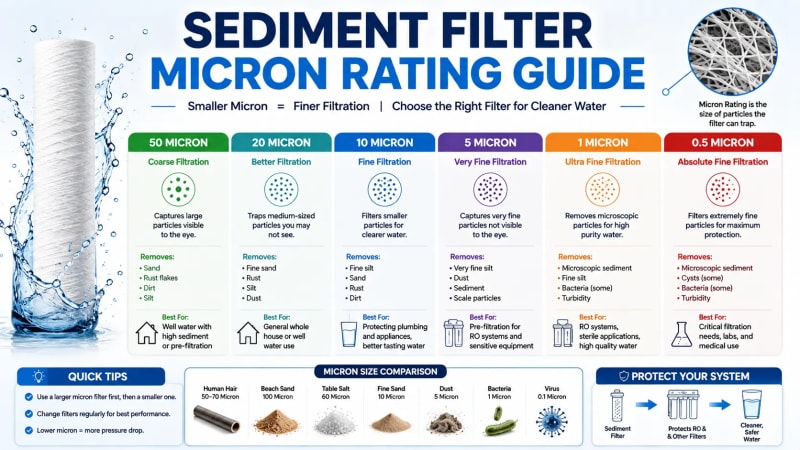
Mechanical filtration removes particles from household water by physically trapping them as water passes through a barrier with tiny openings.This type of filtration works through cartridges or media beds with a fixed pore size. Water passes through, and particles larger than the pore size get caught. Mechanical filtration acts mainly as a pretreatment step for other technologies.
Particles mechanical filtration commonly targets:
Sediment and dirt
Sand
Silt
Rust particles from pipes
General debris
Mechanical filtration does not address dissolved chemicals or most microbial contamination, since these pass through the same pore size that traps larger particles. The CDC's data on microfiltration confirms that pore size determines what a filter can and cannot stop.
How does activated carbon improve water taste, odor, and chemical quality?
Activated carbon improves water taste, odor, and chemical quality through a process called adsorption, where contaminants stick to the surface of the carbon material.Carbon comes in two common forms: granular activated carbon and carbon block. Both attract chlorine, taste and odor compounds, and a range of volatile organic compounds, known as VOCs. Performance depends on the specific carbon media and the target contaminant, since not every carbon filter handles every chemical equally well.
Carbon media types and their typical use:
Granular activated carbon: It reduces chlorine taste and odor in general household use
Carbon block: It offers finer filtration and stronger reduction of specific organic compounds
Catalytic carbon: It targets chloramine, which standard carbon handles less effectively
The US EPA confirms adsorption as the core mechanism behind activated carbon and lists chlorine, taste, odor, and select organic compounds among its common targets.
How does ultrafiltration treat microorganisms without removing dissolved chemicals?
Ultrafiltration treats microorganisms by forcing water through a membrane with pores small enough to block bacteria and parasites, while dissolved chemicals pass through unaffected.
An ultrafiltration membrane, known as UF, acts as a physical barrier. The pore size is small enough to stop microorganisms but too large to stop dissolved chemical molecules, which are far smaller. This makes UF effective for microbial safety but not for chemical contamination. The CDC states that UF is effective for parasites and bacteria, but it does not remove dissolved chemicals from water.
How does nanofiltration differ from ultrafiltration and reverse osmosis?
Nanofiltration sits between ultrafiltration and reverse osmosis, removing some dissolved chemicals and hardness minerals while allowing more water through than reverse osmosis.Nanofiltration, known as NF, uses a tighter membrane than UF, which lets it reduce hardness, color, and certain organic compounds. Its pores are still larger than reverse osmosis membranes, so it does not achieve the same level of dissolved solid removal as RO.
How the three membrane technologies compare:
Ultrafiltration: It removes bacteria and parasites, does not reduce dissolved chemicals or hardness
Nanofiltration: It removes some hardness, color, and organic compounds, offers moderate chemical reduction
Reverse osmosis: It removes the widest range of dissolved solids and contaminants, including many metals and salts
The CDC and the US EPA both support this hierarchy, based on membrane pore size and the resulting contaminant coverage.
How does reverse osmosis reduce dissolved contaminants in drinking water?
Reverse osmosis reduces dissolved contaminants by pushing water through a semipermeable membrane under pressure, which blocks dissolved particles while letting clean water pass through.
Incoming water enters the system and passes through a semipermeable membrane. Clean water that passes through is called permeate or product water. The water left behind, carrying the concentrated contaminants, is called concentrate or reject water and exits through a separate line. This process reduces a broad range of dissolved contaminants, and examples often mentioned include lead, arsenic, nitrate, fluoride, and sodium. The exact contaminants reduced depend on the certified specifications of the individual system, so the specific product claim needs to be checked before buying. Reverse osmosis is commonly installed as a point of use system, though it can be engineered for larger, whole-home applications.
How does distillation purify water through evaporation and condensation?
Distillation purifies water by boiling it into vapor and then condensing that vapor back into liquid, leaving many contaminants behind in the original container.
Water is heated until it evaporates. The vapor rises and moves into a separate chamber, where it cools and condenses back into liquid water. Microorganisms and many inorganic and organic contaminants stay behind because they do not evaporate at the same temperature as water. Some volatile compounds do evaporate along with the water and can travel into the collected vapor, so distillation has specific limitations for these compounds. Distillation uses more energy and time compared with filtration methods, since the water needs to be fully heated and then cooled again.
How does ultraviolet treatment disinfect water without removing chemicals?
Ultraviolet treatment disinfects water by exposing microorganisms to UV light that damages their genetic material, without physically removing anything from the water.
Water passes through a chamber containing a UV lamp. As microorganisms move through the light exposure zone, the UV light inactivates them so they can no longer reproduce or cause illness. Clear water improves UV performance, since cloudy or turbid water can block light from reaching all the microorganisms. This means UV inactivates microorganisms rather than physically removing chemicals or particles from the water. The CDC confirms this mechanism, and UV systems typically work best when paired with a prefilter that removes particles beforehand.
How does ion exchange treat hardness and selected dissolved ions?
Ion exchange treats hardness and selected dissolved ions by swapping unwanted ions in the water for different ions held on a resin bed.
Cation exchange resin is the type used in water softeners, and it swaps calcium and magnesium for sodium or potassium. Anion exchange resin works on negatively charged ions and can target contaminants such as nitrate or sulfate, depending on the resin type. Over time the resin becomes full, and it goes through a regeneration cycle to restore its capacity. A water softener is a form of water treatment, but it should not automatically be labeled a full purifier, since it targets specific ions rather than a broad range of contaminants. The US EPA provides the technical basis for both cation and anion exchange processes.
How do point-of-entry and point-of-use systems differ in treatment coverage?
Point of entry and point of use systems differ mainly in location and the amount of water they cover, not in which technology they use.
A point of entry system, also called a whole-house system, treats water at the main line before it reaches any fixture in the home. A point of use system treats water at one specific location, such as under a sink, at a single faucet, in a pitcher, or inside a refrigerator dispenser. Either type can use any of the technologies already covered on this page.
Below is a table that shows how these two installation types compare.
Location | Water Covered | Typical Purpose | Installation Complexity |
Point of entry, main line | Entire home | Whole-house treatment, such as softening or sediment removal | Higher, needs plumbing at the main line |
Under-sink | One sink or faucet | Drinking and cooking water, often reverse osmosis | Moderate, needs under-sink space and a drain connection |
Faucet-mounted | Water from one faucet | Basic filtration for drinking water | Low, attaches directly to the faucet |
Pitcher | Water poured into the pitcher | Simple taste and odor improvement | Very low, no installation needed |
Refrigerator | Water and ice dispenser | Convenience filtration for drinking water | Low, uses a built-in filter slot |
NSF and the CDC both support this location-based distinction as the correct way to think about point of entry versus point of use systems.
How do multi-stage purification systems combine different treatment technologies?
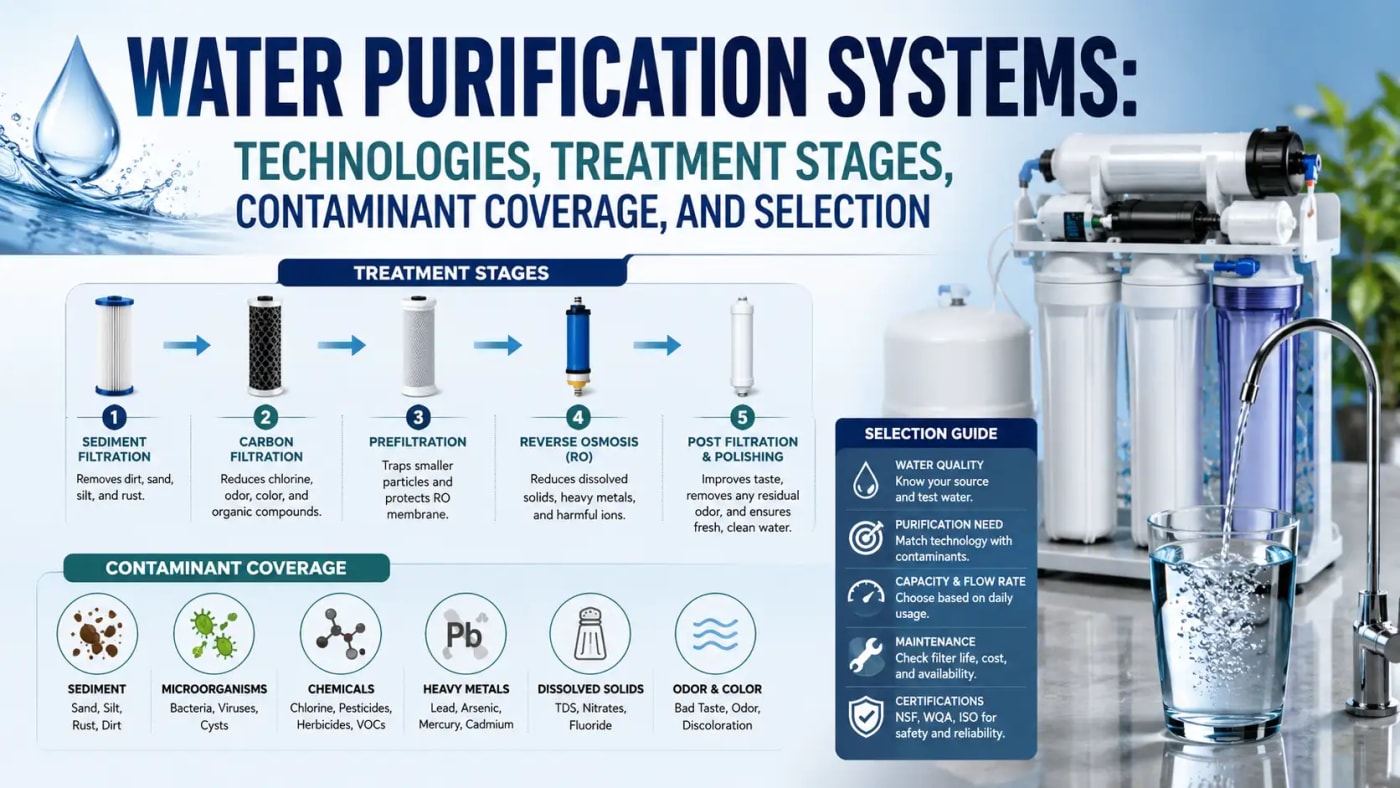
Multi-stage purification systems combine technologies into a treatment train, where each stage handles a specific part of the water problem rather than relying on one technology for everything.
A typical treatment train follows a logical order: pretreatment first, then contaminant-specific treatment, then disinfection or polishing, and sometimes an optional final treatment stage. The exact order depends on the water source and the specific contaminants found in testing, so there is no single sequence that fits every home. Pentair's whole-house carbon plus UV configuration is one common example of this multi-stage approach, combining chemical reduction with microbial disinfection in one system.
Which pretreatment stages protect downstream purification components?
Pretreatment stages protect downstream components by removing particles and conditions that would otherwise clog membranes or block UV light before water reaches later treatment stages.
Common pretreatment functions in a treatment train:
Sediment removal: It protects membranes and valves from physical damage
Turbidity reduction: It improves the effectiveness of UV disinfection later in the system
Carbon dechlorination: It removes chlorine that can damage certain membrane materials
As an example only, a typical sequence places sediment filtration first, followed by carbon dechlorination, before water reaches a membrane or UV stage. This order is an example of common practice, not a universal rule for every system. The CDC notes that UV systems perform better with prefiltration, and the US EPA discusses pretreatment requirements for reverse osmosis and nanofiltration systems.
How should disinfection and final polishing fit into a purification train?
Disinfection and final polishing fit into a purification train as the last barrier before water reaches the tap, handling microbial safety and any remaining taste or odor issues.
UV treatment commonly serves as the microbial safety stage near the end of the train. A final carbon or post-filtration stage can then address any remaining taste or odor concerns. The exact final-stage design depends on the water source, whether water is stored before use, and how the rest of the system is configured.
How should a purification system change for municipal water versus private well water?
A purification system needs to change for municipal water versus private well water because each source comes with a different starting point for what is already known about the water.
Municipal water customers can start with a Consumer Confidence Report, a document utilities provide that lists tested contaminant levels in the public supply. Private well owners do not have this report and need laboratory testing to know what is actually in their water. Treatment decisions follow the actual results from either source, not assumptions based on the source type alone. NSF recommends using the water report or an independent lab test before choosing any treatment technology.
How should water contaminants determine the treatment technology selected?
Water contaminants should determine the treatment technology selected by matching each contaminant category to the specific technology built to address it.This matching step is the central decision point in choosing a purification system.
Below is a table that shows common contaminant categories and the technologies that address them.
Contaminant Category | Technology That Addresses It |
Sediment and particles | Mechanical filtration |
Chlorine, taste, odor, and organic compounds | Activated carbon |
Hardness minerals | Ion exchange, or nanofiltration for partial reduction |
Bacteria and parasites | Ultrafiltration, UV treatment |
Dissolved solids and metals | Reverse osmosis, distillation |
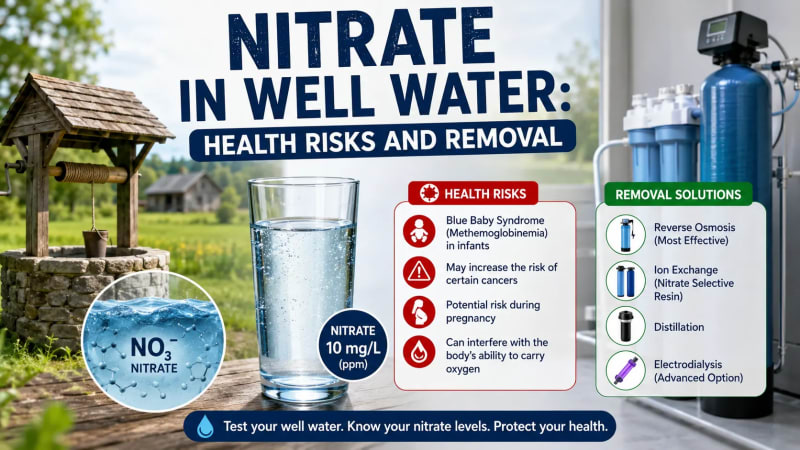
Nitrate | Anion exchange, reverse osmosis |
This matrix simplifies the selection logic covered across every technology section on this page. The CDC, the US EPA, and NSF together support this contaminant-to-technology matching approach.
What system specifications determine whether a purification setup can meet household demand?
System specifications that determine whether a purification setup meets household demand include flow rate, peak demand, pressure, capacity, and available installation space.
A technology that fully addresses a contaminant can still fail a household if it is undersized. Flow rate needs to match the number of fixtures used at the same time. Membrane systems have a rated production capacity, and this number needs to match daily household water use. Storage tanks matter for systems like reverse osmosis that produce treated water slower than a household may draw it. Installation space and existing water pressure also affect which systems physically fit and function correctly in a given home.
Specification checklist for household demand:
Flow rate: It matches simultaneous fixture use
Peak demand: It covers the busiest time of day for water use
System pressure: It meets the minimum operating pressure for the chosen technology
Production capacity: It matches daily household water volume, especially for membrane systems
Storage: It covers gaps between production rate and instant demand
Installation space: It fits the physical footprint of tanks, membranes, or cartridges
Number of bathrooms and fixtures: It affects total flow rate needed across the home
Exact numbers vary by specific system and application, so the manufacturer specification sheet for the chosen model remains the source for real numbers rather than a general estimate.
How do maintenance, replacement, regeneration, and operating demands affect system performance?
Maintenance, replacement, regeneration, and operating demands affect system performance by determining whether a system keeps working at its rated level over time, rather than only at installation.
Every purification technology has an ongoing task attached to it. Cartridge filters need periodic replacement. Carbon and other media need replacement once their adsorption capacity runs out. UV lamps need periodic servicing since their effectiveness drops over time even if the lamp still lights up. Reverse osmosis membranes need their own maintenance and periodic replacement. Ion exchange softeners need regeneration cycles using salt or potassium. Maintenance schedules are specific to each system and manufacturer, so there is no single universal replacement interval that fits every technology. NSF specifically states that ongoing replacement requirements and their costs need to be part of the original treatment decision, not an afterthought.
How should certification claims be checked before buying a water purification system?
Certification claims should be checked before buying a water purification system by confirming the exact standard and the exact contaminant claim tied to that standard, not just the certification logo itself.
NSF/ANSI standards cover different treatment goals. Standard 42 covers aesthetic effects such as taste, odor, and chlorine. Standard 53 covers health effects such as lead and specific contaminant reduction. Standard 55 covers UV treatment. Standard 58 covers reverse osmosis systems. Standard 62 covers distillation. Standard 244 covers residential softeners for water efficiency. Standard 401 covers reduction of specific emerging contaminants. Standard P231 covers microbiological purifiers. Not every standard applies to every system, so the specific standard tied to the product needs to match the actual water problem being solved.
Certification checklist before buying:
Certification body: Confirm which organization issued the certification
Applicable standard: Confirm the specific NSF/ANSI number listed
Specific contaminant claim: Confirm which exact contaminants the certification covers
Model number: Confirm the certification applies to the exact model being purchased
Replacement requirements: Confirm what parts need replacement to keep the certification valid
NSF is the primary source for these certification standards and their specific contaminant claims.
How should a homeowner choose a water purification system from test results to final setup?
A homeowner should choose a water purification system by following a clear sequence from water testing through installation, rather than picking a technology first.
Decision workflow from test results to final setup:
Identify the water source: Municipal supply or private well
Obtain a water report or test: use a Consumer Confidence Report for municipal water, or a lab test for well water
Identify the contaminants: List what the test actually found
Define the treatment scope: Decide between point of entry, point of use, or both
Select the technology: Match each contaminant to the correct treatment type
Determine the stages: Decide the order of pretreatment, main treatment, and disinfection
Size the system: Confirm flow rate, capacity, and production match household demand
Verify certification: Confirm the NSF/ANSI standard and specific contaminant claim
Estimate maintenance: Account for replacement parts and their schedule
Install and monitor: Complete installation and check performance over time
NSF's recommended selection process supports this same sequence, moving from testing to technology rather than starting with a specific product or brand.
How can water-test results be translated into the right purification setup?
Water test results can be translated into the right purification setup by matching the specific problem found in the test to the treatment category built for that problem.
Below is a short example table showing how common water problems lead to a treatment category.
Problem Found in Testing | Treatment Category | Why |
Cloudy water with visible particles | Mechanical filtration | Removes physical particles through a barrier |
Chlorine taste or odor | Activated carbon | Adsorbs chlorine and odor compounds |
High lead or arsenic level | Reverse osmosis | Removes a broad range of dissolved contaminants |
Bacteria present in well water | UV treatment or ultrafiltration | Inactivates or physically blocks microorganisms |
High calcium and magnesium | Ion exchange | Swaps hardness ions for sodium or potassium |
This example shows the general logic only. Each contaminant-specific page on this site goes into full depth on the matching technology.
What does a reverse osmosis system remove from drinking water?
A reverse osmosis system removes a broad range of dissolved contaminants from drinking water, though the exact list depends on the certified specifications of the individual system.Common examples include lead, arsenic, nitrate, fluoride, and sodium, though the specific product certification needs to be checked before relying on any single claim. A dedicated guide covers membrane types, treatment stages, waste water ratio, maintenance, remineralization, and full contaminant coverage.
What does a UV water purification system remove or inactivate?
A UV water purification system inactivates microorganisms in water and does not remove chemical contaminants.UV light damages the genetic material of bacteria, viruses, and parasites so they cannot reproduce or cause illness, but chemicals pass through the treatment chamber unaffected. A dedicated guide covers UV dosage, prefiltration, installation, maintenance, and sizing.
How does activated carbon filtration remove chlorine and other contaminants?
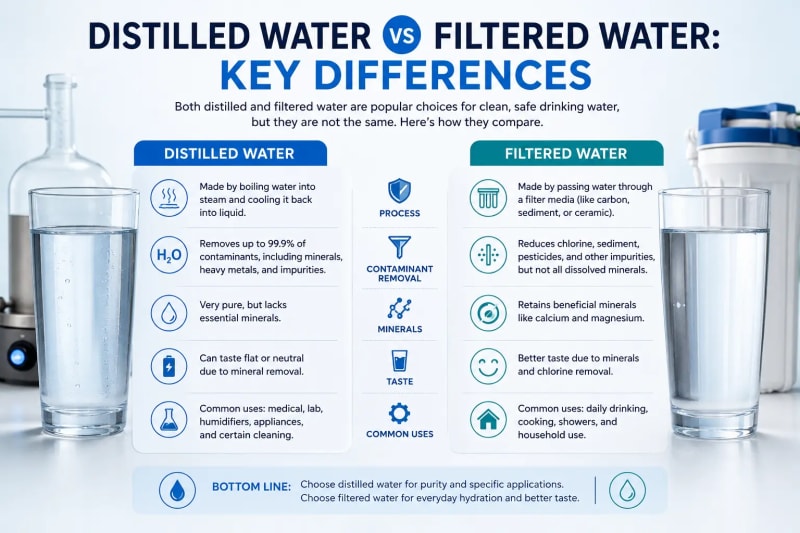
Activated carbon filtration removes chlorine and other contaminants through adsorption, where these compounds stick to the surface of the carbon media as water passes through.This process targets chlorine, taste, odor, and select organic compounds. A dedicated guide covers carbon media types, chloramine treatment, contact time, and replacement schedules in full depth.
What is the difference between reverse osmosis and water filtration?
The difference between reverse osmosis and water filtration is the separation method. Reverse osmosis uses a semipermeable membrane under pressure, while conventional filtration uses physical barriers or adsorption media.Reverse osmosis blocks dissolved particles at the molecular level, while standard filtration mainly targets physical particles or specific chemicals through carbon. A dedicated comparison page explains this difference in complete detail.
What is the difference between a water purifier and a water filter?
The difference between a water purifier and a water filter is often just marketing language, since both terms get used loosely across the industry.The actual treatment mechanism and the certified contaminant claim on a specific product matter far more than whether it is labeled a purifier or a filter. NSF supports this principle, since certification is tied to tested performance, not to the marketing name used on the packaging.
Which water purification system is best for well water?
The best water purification system for well water depends entirely on what an actual water test finds, not on a single universal recommendation.The correct approach tests the water first, identifies microbial, chemical, and mineral concerns separately, and then matches each concern to the correct technology. A dedicated well-water guide covers the complete treatment architecture for private wells.
Which water purification system is best for municipal water?
The best water purification system for municipal water still depends on household-specific concerns, since municipal treatment does not eliminate every taste, odor, or plumbing-related issue.Municipal water already meets safety standards before it reaches the home, but individual households may still notice taste, odor, or contaminants picked up from local distribution pipes. A dedicated municipal water guide covers these specific concerns in full detail.
How much does a home water purification system cost to install and maintain?
The cost of a home water purification system to install and maintain depends on the technology chosen, the treatment scope, water chemistry, flow requirements, installation complexity, and ongoing replacement media.There is no single universal price that applies to every household, since these variables change from home to home. A dedicated cost page covers current researched pricing across different system types.
How often should water purification filters and components be replaced?
Water purification filters and components need replacement on a schedule that is specific to each system, based on the manufacturer requirement, water quality, and household usage.There is no single universal replacement interval that fits every technology or every home. NSF specifically advises accounting for these ongoing replacement costs as part of the original purchase decision. A dedicated maintenance guide covers the full replacement schedule for each technology.