
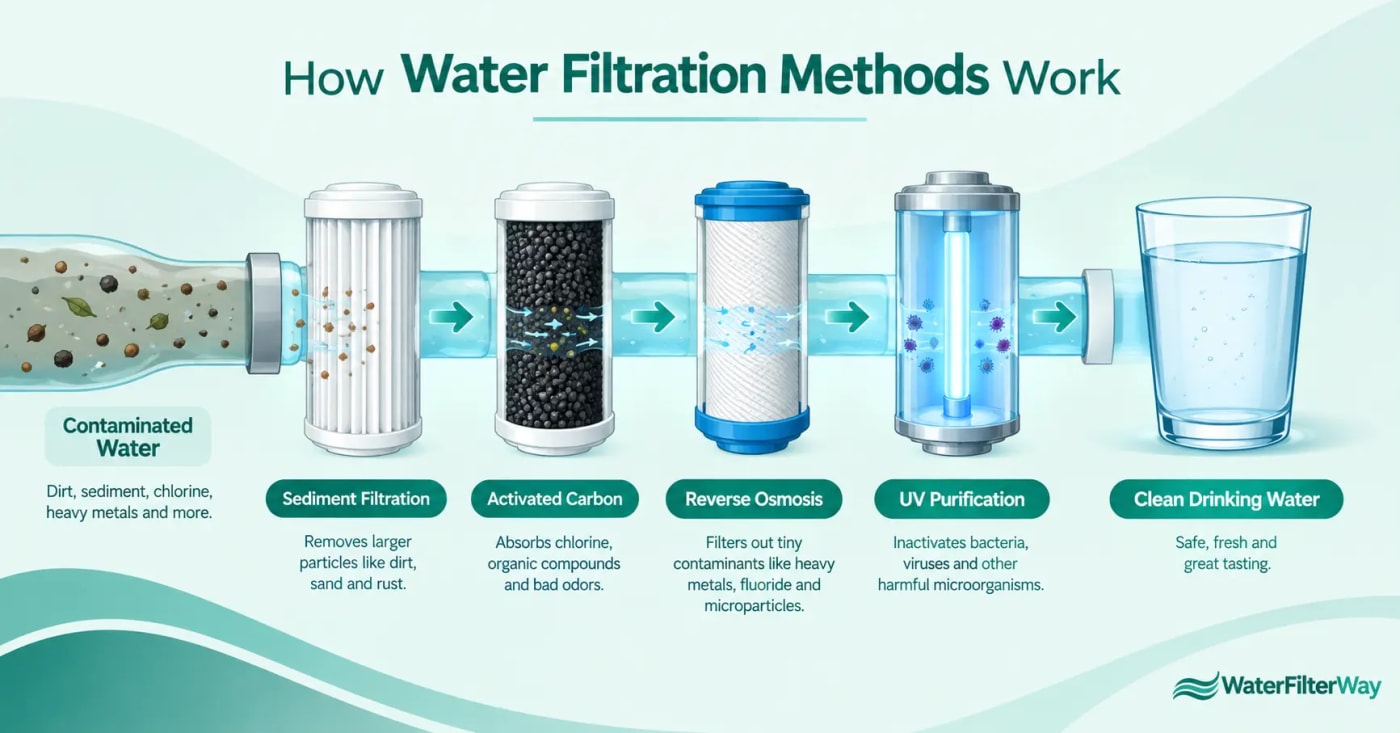
Water filtration methods use different physical, chemical, and membrane-based processes to reduce contaminants in drinking water. Mechanical filters remove particles, activated carbon adsorbs chemicals, reverse osmosis separates dissolved substances, ion exchange targets specific ions, and ultraviolet treatment inactivates microorganisms. The appropriate method depends on the water source, contaminants present, treatment objective, and certified performance of the system.
What are the main water filtration methods and how are they classified?
Water treatment methods are classified by the mechanism they use to change the composition or microbiological quality of water. The main categories are physical filtration, adsorption, membrane separation, ion exchange, disinfection, and distillation.
Treatment method | Primary mechanism | Main treatment target |
|---|---|---|
Mechanical filtration | Physical barrier | Sediment and suspended particles |
Activated carbon | Adsorption | Chlorine, taste, odor, selected organic compounds |
Microfiltration | Membrane separation | Particles and selected microorganisms |
Ultrafiltration | Membrane separation | Particles and selected microorganisms |
Reverse osmosis | Membrane separation | Dissolved solids and many dissolved contaminants |
Ion exchange | Ion exchange | Hardness ions and selected dissolved ions |
Ultraviolet treatment | Photochemical disinfection | Microorganisms |
Ceramic filtration | Physical filtration | Particles and selected microorganisms |
Distillation | Vaporization and condensation | Many dissolved substances |
Adsorptive media | Surface adsorption | Selected inorganic contaminants |
The US Environmental Protection Agency identifies granular activated carbon, ion exchange, reverse osmosis, nanofiltration, adsorptive media, and ultraviolet processes as distinct drinking water treatment technologies. EPA also states that no single treatment technology removes every contaminant.
What does mechanical filtration remove from water?
Mechanical filtration removes suspended particles by passing water through a physical barrier. Sediment filters target particles such as sand, silt, dirt, rust, and other suspended matter.
The defining attribute is particle size. Filter media use different pore structures and micron ratings to retain particles of different sizes. Mechanical filtration does not generally remove dissolved salts, dissolved minerals, or dissolved organic chemicals because these substances are smaller than the retained particles.
Common mechanical filtration targets include:
Sand
Silt
Dirt
Rust
Sediment
Suspended particles
Mechanical filtration also provides an important pretreatment function. Removing larger particles before activated carbon or membrane treatment reduces the particulate load reaching the later treatment stage.
How do sediment filters use micron ratings to capture particles?
Micron ratings describe the particle size that a filter is designed to retain under specified testing conditions. A lower micron rating represents finer particle filtration, although the meaning of a rating depends on the manufacturer's testing method and whether the rating is nominal or absolute.
A sediment filter therefore addresses particle concentration, not total water quality. A finer sediment filter does not automatically remove dissolved chemicals, dissolved minerals, or every microorganism.
How does activated carbon filtration remove chemicals and improve taste?
Activated carbon removes many contaminants through adsorption, in which compounds accumulate on the surface and within the pores of the carbon media. Granular activated carbon and carbon block filters are widely used for chlorine, taste, odor, volatile organic compounds, and selected synthetic organic compounds.
EPA describes granular activated carbon as a highly porous adsorption medium with a large internal surface area. Its performance varies according to the carbon material, manufacturing process, contaminant properties, water chemistry, flow conditions, and media capacity.
Activated carbon commonly addresses:
Chlorine
Taste
Odor
Volatile organic compounds
Selected pesticides
Selected synthetic organic compounds
Some disinfection byproducts
Carbon performance is contaminant-specific. A carbon filter certified for chlorine reduction does not automatically have a certified claim for lead, PFAS, nitrate, fluoride, or another contaminant.
EPA research identifies activated carbon as one of the principal technologies used to reduce PFAS. Performance varies by carbon type, PFAS compound, contact conditions, flow rate, organic matter, and other water characteristics.
What is the difference between granular activated carbon and carbon block filtration?
Granular activated carbon uses loose carbon particles, while carbon block uses compressed carbon material. Both rely primarily on adsorption, but their construction affects contact conditions, flow characteristics, and particulate filtration.
The relevant comparison is not simply GAC versus carbon block. The certified contaminant-reduction claim, carbon formulation, contact time, flow rate, and replacement condition determine actual treatment performance.
How do membrane filtration methods separate contaminants from water?
Membrane filtration separates substances according to their ability to pass through a semi-permeable barrier. Microfiltration and ultrafiltration operate at lower separation levels, while nanofiltration and reverse osmosis provide progressively greater separation of dissolved substances.
EPA classifies reverse osmosis and nanofiltration as membrane separation processes. Pressure forces water through the membrane while retained substances remain in the concentrate stream.
Membrane technologies include:
Microfiltration
Ultrafiltration
Nanofiltration
Reverse osmosis
The membrane type determines the size and characteristics of substances that can pass through the treatment barrier.
What do microfiltration and ultrafiltration remove from water?
Microfiltration and ultrafiltration remove suspended particles and microorganisms according to membrane characteristics and certified performance. They operate differently from reverse osmosis because they do not provide the same level of dissolved-contaminant separation.
Microfiltration generally targets larger suspended matter. Ultrafiltration provides finer membrane separation and can retain additional microorganisms and colloidal material.
Neither technology should be treated as a universal solution for dissolved salts, nitrate, fluoride, or other dissolved contaminants without a verified contaminant-specific claim.
How does reverse osmosis remove dissolved contaminants?
Reverse osmosis removes a broad range of dissolved contaminants by forcing water through a semi-permeable membrane under pressure. The membrane produces treated water called permeate and a concentrated stream called reject or concentrate.
EPA identifies reverse osmosis as a technology for removing many inorganic contaminants, dissolved solids, radionuclides, and synthetic organic chemicals. EPA also identifies applications for desalination of brackish and seawater.
Reverse osmosis can address contaminants including:
Dissolved solids
Many inorganic contaminants
Selected heavy metals
Nitrate
Selenium
Arsenic
Radionuclides
Selected synthetic organic chemicals
Reverse osmosis does not remove every possible contaminant. EPA's WaterSense guide states that RO does not remove all inorganic and organic contaminants and can also remove minerals such as calcium.
RO also produces a concentrate stream. EPA reports that RO and nanofiltration systems can reject approximately 15% to 30% of feed water as concentrate under the treatment conditions described in its technology guidance.
How does ion exchange reduce water hardness and selected dissolved ions?
Ion exchange reduces specific dissolved ions by exchanging them with ions held on a resin. Residential water softeners primarily use cation exchange to reduce calcium and magnesium, the principal ions responsible for water hardness.
The process changes the ionic composition of water rather than physically filtering particles.
Ion exchange applications include:
Calcium reduction
Magnesium reduction
Water softening
Selected anion removal
Selected cation removal
EPA identifies cation exchange as a treatment technology for hardness ions such as calcium and magnesium. Other ion-exchange systems target contaminants such as arsenic, selenium, sulfate, and selected inorganic ions.
A water softener is therefore not equivalent to a drinking-water purification system. Its primary function is hardness reduction.
How does ultraviolet treatment inactivate microorganisms in water?
Ultraviolet treatment uses ultraviolet light to inactivate microorganisms rather than physically removing dissolved contaminants. UV treatment is therefore a disinfection process, not a conventional chemical or sediment filtration process.
UV systems can target microorganisms including:
Bacteria
Viruses
Protozoa
Cysts
UV treatment does not provide a general solution for sediment, dissolved minerals, heavy metals, or organic chemicals. A UV system can therefore operate alongside physical filtration or other treatment technologies when multiple water-quality concerns exist.
NSF identifies NSF/ANSI 55 as the standard associated with ultraviolet microbiological water treatment systems.
How does ceramic filtration reduce particles and microorganisms?
Ceramic filtration uses a porous ceramic barrier to retain particles and selected microorganisms. The treatment performance depends on the ceramic structure, pore characteristics, system design, and verified product claims.
Ceramic filtration is primarily associated with physical separation. It does not provide the same dissolved-contaminant reduction as reverse osmosis.
Ceramic systems can therefore address:
Suspended particles
Sediment
Selected bacteria
Selected protozoa
Other retained particulate material
The exact microbiological claim belongs to the individual system. A ceramic filter's material alone does not establish a universal pathogen-removal capability.
How does distillation separate contaminants through boiling and condensation?
Distillation separates water from many dissolved substances through vaporization and condensation. Water is heated until it becomes vapor, and the vapor is then condensed into liquid water.
The process can reduce many:
Dissolved minerals
Inorganic compounds
Metals
Hardness-causing substances
Microorganisms
Suspended contaminants
Distillation does not provide identical removal for every organic compound. Volatile substances can behave differently during vaporization and may require additional treatment.
EPA documentation identifies distillation as effective for inorganic compounds, hardness, particulates, and most pathogens, while its effectiveness for organic compounds varies according to the chemical.
How does activated alumina target fluoride, arsenic and selenium?
Activated alumina removes selected inorganic contaminants through adsorption onto an aluminum-based media surface. Its principal drinking-water applications include fluoride and certain forms of arsenic and selenium.
EPA identifies adsorptive media as a treatment category for contaminants including:
Arsenic
Fluoride
Selenium
Antimony
Beryllium
Thallium
Uranium
Performance depends on the media, contaminant form, water chemistry, and pH. EPA states that adsorptive capacity varies with media type, water chemistry, and contaminant valence.
Activated alumina is therefore a specialized treatment medium, not a universal household filtration method.
How do water filtration methods differ in what they remove and what they leave behind?
Water filtration methods differ because each treatment mechanism interacts with a different class of contaminants. Mechanical filtration targets particles, activated carbon targets adsorbable compounds, reverse osmosis targets a broad range of dissolved substances, and UV targets microorganisms.
Water concern | Commonly relevant treatment |
|---|---|
Sediment | Mechanical filtration |
Sand and silt | Mechanical filtration |
Chlorine | Activated carbon |
Taste and odor | Activated carbon |
Selected VOCs | Activated carbon |
Hardness | Ion exchange |
Calcium and magnesium | Ion exchange |
Dissolved solids | Reverse osmosis |
Many inorganic contaminants | Reverse osmosis |
Selected microorganisms | UV, ceramic, MF, UF, or other certified treatment |
Fluoride | Activated alumina, RO, or other certified treatment |
Arsenic | Adsorptive media, RO, or other certified treatment |
PFAS | Activated carbon, RO, ion exchange, or other certified treatment |
The table describes treatment categories, not universal removal guarantees. NSF states that certification to an NSF/ANSI standard does not mean that a system reduces every contaminant. The specific contaminant-reduction claim must match the contaminant of concern.
Which water filtration method fits a specific water-quality problem?
The correct treatment method starts with the water-quality problem, not the filter type. Water testing identifies the contaminants, treatment technology addresses those contaminants, and certification verifies the claimed performance.
The selection sequence is:
Identify the water source.
Test the water or review the available water-quality report.
Identify the contaminants of concern.
Match each contaminant with an appropriate treatment technology.
Verify the product's certified contaminant-reduction claim.
Select the point-of-use or point-of-entry configuration.
Follow the manufacturer's maintenance requirements.
EPA's WaterSense guide states that treatment technologies vary in contaminant removal, limitations, and water consumption. It also states that no single treatment system removes all contaminants and that multiple technologies can be combined.
How do you choose a water filter based on your water source?
Water source determines the starting water-quality profile. Municipal water generally has an established water-quality report, while private well water requires individual testing to identify site-specific contaminants.
A water source can include:
Municipal water
Private well water
Surface water
Groundwater
Rainwater
Stored water
The treatment method follows the identified contaminant rather than the source label alone.
Read next: Water Testing and Well Water Filtration Guide.
What is the best water filter for drinking water?
The best water filter is the system certified to reduce the contaminant present in the drinking water. A filter designed for chlorine reduction addresses a different water-quality objective from an RO system designed for dissolved contaminants.
The correct comparison therefore includes:
Contaminant
Treatment mechanism
Certified reduction claim
Water source
Flow requirement
Maintenance
Water consumption
Read next: Best Water Filters for Drinking Water.
Which water filter removes fluoride from drinking water?
Fluoride reduction depends on the treatment technology and the specific product certification. Reverse osmosis and selected adsorptive media can reduce fluoride, but the product's verified claim determines whether that system is appropriate.
EPA identifies fluoride as a contaminant addressed by adsorptive media.
Read next: Best Water Filters for Fluoride.
Which water filtration method removes PFAS?
PFAS reduction is associated with activated carbon, reverse osmosis, and ion exchange technologies, but performance varies by compound and treatment conditions. EPA identifies these three technologies as available approaches for PFAS reduction in drinking water.
The specific filter must carry a verified PFAS reduction claim.
Read next: Best Water Filters for PFAS.
What is the difference between filtered water and distilled water?
Filtered water passes through a physical barrier, adsorption medium, membrane, or combination of treatment media. Distilled water passes through a phase-change process based on vaporization and condensation.
Filtration therefore describes several treatment mechanisms. Distillation describes one specific separation process.
Read next: Distilled vs Filtered Water.
How does reverse osmosis compare with activated carbon filtration?
Reverse osmosis separates a broad range of dissolved contaminants through a semi-permeable membrane. Activated carbon primarily removes adsorbable compounds through adsorption.
Attribute | Reverse osmosis | Activated carbon |
|---|---|---|
Primary mechanism | Membrane separation | Adsorption |
Dissolved solids | Broad reduction | Generally limited |
Chlorine | Can require carbon pretreatment | Strong application |
Taste and odor | Can improve | Strong application |
Water reject | Yes | No treatment reject stream |
Calcium and magnesium | Reduces | Generally does not remove hardness |
Maintenance | Membrane and filter service | Media/cartridge replacement |
EPA identifies RO as a broad dissolved-contaminant treatment and GAC as an adsorption technology for organic compounds, taste, odor, and other target contaminants.
Read next: Reverse Osmosis vs Activated Carbon.
What is the difference between a whole-house and point-of-use water filter?
A point-of-entry system treats water as it enters a building, while a point-of-use system treats water at a specific outlet or use location. Whole-house treatment therefore addresses water throughout the property, while point-of-use treatment concentrates treatment at selected locations.
NSF identifies both point-of-use and point-of-entry applications within residential water treatment standards.
Read next: Whole-House vs Point-of-Use Water Filters.
How often should different water filtration systems be maintained?
Water filtration maintenance depends on the treatment technology, media capacity, water quality, flow, and manufacturer specification. Carbon cartridges, RO membranes, ion-exchange resin, sediment cartridges, and UV lamps have different service requirements.
Replacement timing therefore belongs to the specific system rather than to the filter category alone.
Read next: Water Filter Maintenance and Replacement Guide.
What NSF certification should you look for when choosing a water filter?
NSF certification identifies a tested treatment claim, but the standard number does not represent a general quality ranking. NSF/ANSI 42 covers aesthetic reductions such as chlorine and taste/odor, NSF/ANSI 53 covers specified health-effect contaminants, NSF/ANSI 55 covers UV systems, and NSF/ANSI 58 covers reverse osmosis systems.
The relevant certification depends on the contaminant and treatment technology.
Read next: NSF Water Filter Certifications Explained.
What are gravity-fed water filtration methods and where are they used?
Gravity-fed systems use gravitational pressure to move water through treatment media. The filtration mechanism depends on the media inside the system, which can include activated carbon, ceramic, or other filtration materials.
Gravity describes the operating configuration, not a unique contaminant-removal mechanism.
Read next: Gravity-Fed Water Filters.
What are countertop water filtration methods and how do they work?
Countertop filtration describes a point-of-use configuration rather than a single treatment technology. Countertop systems can use activated carbon, membrane filtration, reverse osmosis, or other treatment media.
The contaminant-reduction capability therefore depends on the treatment mechanism installed inside the countertop system.
Read next: Countertop Water Filters.
How does a sediment filter micron rating affect filtration performance?
A sediment filter's micron rating indicates its designed particle-filtration range under defined testing conditions. Smaller ratings generally represent finer particle filtration, but the rating does not identify dissolved-contaminant removal.
Sediment filtration therefore belongs at the particle-removal stage of a water-treatment system.
Read next: Sediment Filter Micron Rating Guide.
Water Filtration Methods: How Different Technologies Treat Drinking Water
Water filtration methods use different physical, chemical, membrane-based, and disinfection processes to address different water-quality conditions. Mechanical filtration removes particles, activated carbon adsorbs selected compounds, membrane systems separate dissolved substances, ion exchange changes specific ions, UV treatment inactivates microorganisms, and distillation separates water through vaporization and condensation. The correct method remains defined by the contaminant, water source, treatment objective, and verified performance of the system.