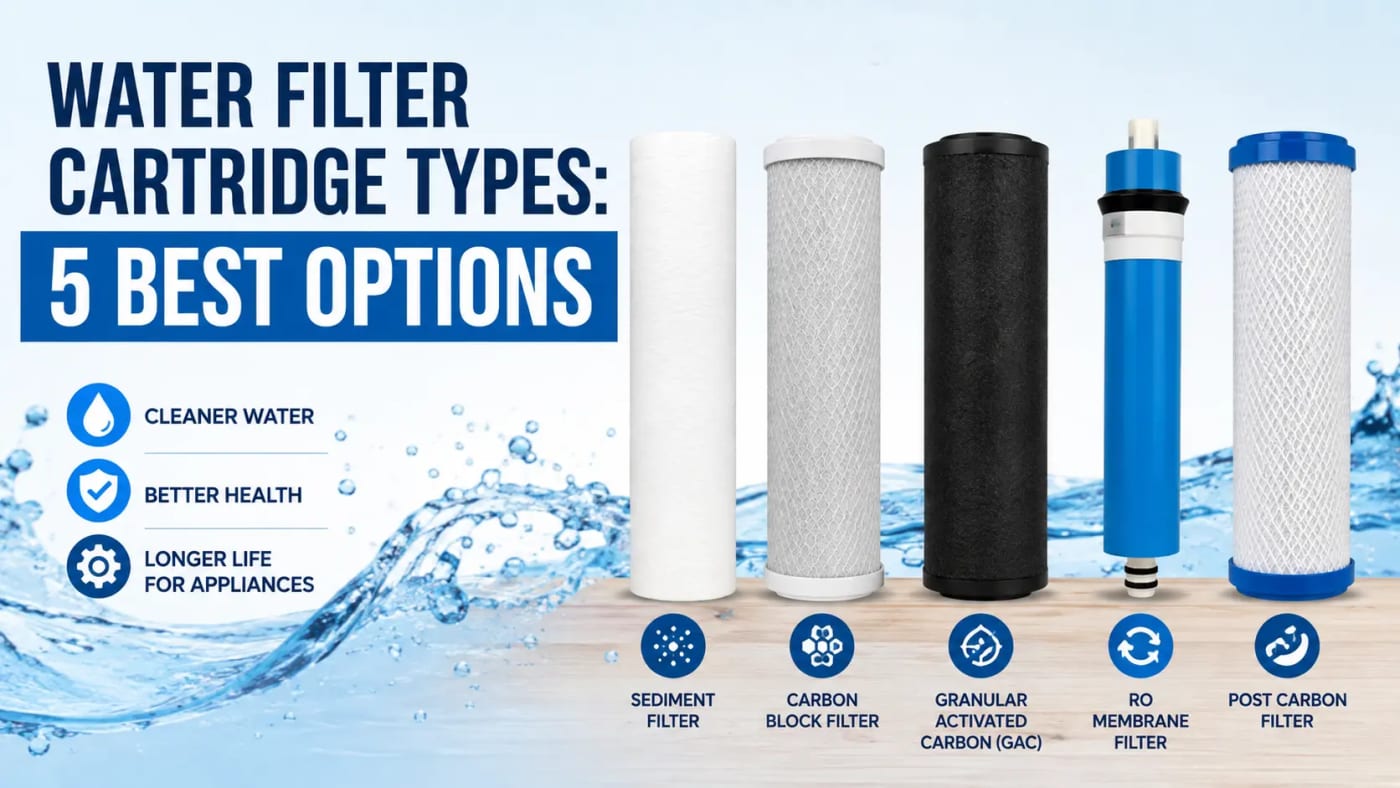
The table below shows how the five cartridges compare on media, filtration target, and format.
Cartridge | Media Type | Micron Rating | Main Target | Format | Typical Replacement |
iSpring FP15US | Polypropylene sediment | 5 micron | Dirt, sand, rust, silt | 10" x 2.5" universal | 6 to 12 months |
iSpring FC15US | Coconut shell carbon block | 5 micron | Chlorine, taste, odor | 10" x 2.5" universal | 6 to 12 months |
iSpring FG15US | Granular activated carbon | Not rated in microns | Chlorine, taste, odor | 10" x 2.5" universal | 6 to 12 months |
Doulton Ultracarb (9501) | Ceramic shell with carbon block core | Sub micron ceramic barrier | Bacteria, cysts, sediment, chlorine, lead | 10" candle, 1/4" BSP thread | 9 to 12 months |
FilmTec TW30-1812-100 | Thin film composite membrane | Not micron rated, membrane separation | Dissolved solids, salts, many dissolved contaminants | 1.8" x 11.75" standard housing | 2 to 3 years |
In Depth Review of Each Product
Each cartridge below plays a specific role in a filtration system. Read the contaminant it targets and the system it fits before you buy a replacement.
iSpring FP15US Universal Sediment Water Filter Cartridge
Quick facts: Polypropylene sediment media. 5 micron rating. Size 10 inch by 2.5 inch. Made in the USA. Tested by an independent third party to meet NSF and ANSI standards.
The iSpring FP15US is a sediment cartridge built from polypropylene, and it uses a multi layer structure to trap particles at different sizes. The structure has a sparse outer layer, a compaction middle layer, and a precision inner layer. This layered build traps large particles first and fine particles last, so the cartridge does not clog too fast. It works as a first stage filter in reverse osmosis systems and under sink systems, and it protects carbon and membrane stages further down the line from physical debris.
What does the iSpring FP15US remove and what is it designed for?
The iSpring FP15US removes physical particles from water and is designed to protect the filter stages that come after it.
This cartridge removes:
Dirt and dust
Sand and silt
Rust particles
Scale flakes
It does not remove chlorine, taste, odor, or dissolved substances. It only stops solid particles from passing through.
Which systems and housings is the iSpring FP15US compatible with?
The iSpring FP15US is compatible with the iSpring PH100 and RO100 systems and most industry standard 10 inch reverse osmosis and under sink housings. Check the exact dimensions and thread type of your current housing before you order a replacement. Not every 10 inch housing uses the same cap style, and a mismatch stops the cartridge from sealing correctly.
How often should the iSpring FP15US be replaced?
The iSpring FP15US needs replacement every 6 to 12 months on average, based on iSpring's own guidance. The exact interval depends on how much sediment is in your source water and how much water your household uses. Homes on well water or municipal water with heavy sediment need more frequent changes. A drop in water flow at the faucet is a common sign that the cartridge needs replacement.
iSpring FC15US Coconut Shell Activated Carbon Block CTO Filter Replacement Cartridge
Quick facts: Coconut shell activated carbon block. 5 micron rating. Size 10 inch by 2.5 inch. Weight 0.9 pounds. Tested to meet NSF and ANSI standards.
The iSpring FC15US is a carbon block cartridge, not a sediment cartridge. Carbon block filters compress activated carbon into a solid block instead of leaving it as loose granules. This dense structure gives water more contact time with the carbon surface, so it absorbs more chlorine and organic chemicals per gallon than loose carbon does. iSpring builds this cartridge from coconut shell carbon, a common high quality carbon source in water filtration.
What contaminants does the iSpring FC15US target?
The iSpring FC15US targets chemical contaminants rather than physical particles.
This cartridge targets:
Chlorine
Bad taste
Bad odor
Some organic chemicals
The carbon traps these substances through adsorption, meaning the contaminant molecules stick to the surface of the carbon rather than passing through a physical screen.
How does the iSpring FC15US differ from a sediment cartridge?
The iSpring FC15US differs from a sediment cartridge by using adsorption instead of mechanical filtration. A sediment cartridge like the FP15US blocks particles based on size, the way a strainer blocks pasta from going down a drain. The FC15US instead lets chlorine and organic molecules stick to the carbon surface as water passes through the block. A sediment cartridge does not remove chlorine, and a carbon block cartridge does not stop large sediment particles as effectively as a dedicated sediment filter. Systems normally use both in sequence, sediment first and carbon second, so each stage does the job it is built for.
Which systems can use the iSpring FC15US?
The iSpring FC15US works with the iSpring PH100, RO100, and most standard 10 inch reverse osmosis and under sink systems. As with the FP15US, confirm the housing size and thread pattern before ordering, since not every 10 inch cartridge fits every 10 inch housing.
iSpring FG15US Universal GAC Granular Activated Carbon Filter Replacement Cartridge
Quick facts: Granular activated carbon (GAC). Size 10 inch by 2.5 inch. Weight 0.9 pounds. Made in the USA. Compatible with standard 10 inch RO and under sink housings.
The iSpring FG15US uses loose granular activated carbon instead of a compressed block. Water flows through the loose carbon granules, and the contaminant molecules bond to the carbon surface through adsorption, the same basic process a carbon block uses. The difference is in the physical form of the carbon and how water moves through it.
What is the iSpring FG15US designed to reduce?
The iSpring FG15US is designed to reduce the same category of contaminants as a carbon block cartridge.
This cartridge reduces:
Chlorine
Bad taste
Bad odor
Organic chemicals
It works through mechanical filtration of loose granules combined with physical adsorption on the carbon surface.
How does the iSpring FG15US compare with the iSpring FC15US?
The iSpring FG15US compares with the iSpring FC15US mainly in how the carbon is built, since both use activated carbon and both target chlorine, taste, and odor. The FC15US packs carbon into a solid block, which increases contact time and often improves reduction of fine particles alongside chemical adsorption. The FG15US uses loose granules, which allow a slightly faster flow rate through the cartridge but with less contact time per gallon compared to a block. Many reverse osmosis systems use a GAC cartridge as an early carbon stage and a carbon block cartridge as a later polishing stage, since the two work well together rather than as substitutes for each other.
Which systems is the iSpring FG15US compatible with?
The iSpring FG15US is compatible with the iSpring PH100 and RO100 systems and most standard 10 inch reverse osmosis and under sink housings. Verify the exact compatibility against your system model before you order, since housing dimensions vary between brands even at the same nominal 10 inch size.
Doulton Ultracarb (9501)
Quick facts: Ceramic candle with an internal activated carbon block containing lead reduction media. Size 10 inch (254 mm) long by 2 inch (49 mm) diameter. Fits a 1/4 inch BSP threaded housing. NSF certified to NSF/ANSI standards 42, 53, and 401.
The Doulton Ultracarb 9501 is a ceramic cartridge, a different category from the polypropylene and carbon cartridges above. It combines a ceramic outer shell with an activated carbon block core that contains lead reduction media. The ceramic shell blocks particles and microorganisms at a very fine physical level, while the carbon core inside handles chlorine and organic chemical reduction. This combination is why Doulton markets it as a multi stage cartridge inside a single candle format. Doulton identifies 9501 as the official replacement code for the Ultracarb cartridge, and it works as a direct substitute for the older, discontinued Supercarb filter.
What filtration function does the Doulton Ultracarb (9501) provide?
The Doulton Ultracarb (9501) provides a combined ceramic and carbon filtration function in one cartridge.
This cartridge reduces:
Doulton states the cartridge also reduces microplastics, based on its own testing. Always check the manufacturer's current test data for the exact contaminant list, since certifications and test results can change between production runs.
Which Doulton systems accept the Ultracarb (9501)?
Doulton systems with a 1/4 inch BSP threaded housing accept the Ultracarb (9501), a format common on Doulton countertop and under sink gravity systems. It is not compatible with Franke systems, and it does not fit the newest version of the Doulton EcoFast system, which ships with a Biotect Ultra or Biotect Ultra SI filter instead. Doulton recommends genuine approved cartridges for its systems, since third party ceramic cartridges do not always match the thread pattern or filtration rating.
How often should the Doulton Ultracarb (9501) be replaced?
The Doulton Ultracarb (9501) needs replacement every 9 to 12 months on average, based on Doulton's own guidance and depending on water quality and household usage. A drop in flow rate through the candle or a change in water taste are practical signs that the cartridge needs replacement, even before the listed interval passes.
FilmTec TW30-1812-100 Reverse Osmosis Membrane
Quick facts: Thin film composite (TFC) polyamide membrane in a spiral wound design. Rated at 100 gallons per day (GPD) at 50 psi. Stabilized salt rejection around 98 percent. Size approximately 1.8 inch by 11.75 inch, fits standard 2 inch diameter pressure vessels. NSF/ANSI Standard 58 listed for material safety.
The FilmTec TW30-1812-100 is not a cartridge in the same sense as the four filters above. It is a reverse osmosis membrane, and it works through membrane separation rather than mechanical filtration or carbon adsorption. Water is pushed under pressure through a semi permeable membrane. Water molecules pass through, while dissolved salts, minerals, and many other dissolved contaminants stay behind and get flushed to a drain line. This is the stage in a reverse osmosis system that reduces total dissolved solids, something no sediment or carbon cartridge can do on its own.
What makes the FilmTec TW30-1812-100 different from cartridge filters?
Membrane separation makes the FilmTec TW30-1812-100 different from cartridge filters. Sediment and carbon cartridges filter or adsorb based on particle size and chemical attraction. A membrane separates based on molecule size at a much finer level, which lets it reduce dissolved solids that pass straight through a sediment or carbon cartridge. This membrane needs upstream sediment and carbon pre filtration to work correctly. Chlorine in unfiltered water damages the thin film layer over time, which is why RO systems always place a carbon pre filter, such as the FC15US or FG15US above, ahead of the membrane stage.
Which RO systems use the FilmTec TW30-1812-100?
Standard residential reverse osmosis systems with a 100 GPD membrane housing use the FilmTec TW30-1812-100. This membrane fits standard 1.8 inch by 12 inch pressure vessels, a size used across most residential reverse osmosis systems regardless of brand, and it is rated for 100 GPD production at 50 psi inlet pressure. Confirm your RO system uses a 100 GPD membrane housing before ordering a replacement, since systems also ship with 50 GPD, 75 GPD, and 150 GPD membrane options that are not interchangeable without adjusting the drain flow restrictor.
When should an RO membrane cartridge be replaced?
An RO membrane cartridge needs replacement when permeate flow drops or total dissolved solids rise in the filtered water, typically every 2 to 3 years as a general guideline. Membrane replacement depends on water production rate and the number of dissolved solids in the source water, not a fixed calendar date. Heavy source water contamination or a well with high mineral content shortens that interval.
How Do Water Filter Cartridge Types Differ by Filtration Mechanism?
Water filter cartridge types differ by filtration mechanism across four core categories, and every cartridge on the market falls into one of them. Understanding these four groups makes it easier to see why a sediment filter and a carbon filter are not interchangeable, and why a reverse osmosis membrane does a job no cartridge can do alone.
The four core filtration mechanisms are:
Mechanical filtration: physically blocks particles based on size
Adsorption: chemically attracts and holds contaminant molecules onto a media surface
Ion exchange: swaps unwanted charged ions for other ions using a resin bed
Membrane filtration: separates dissolved substances at the molecular level under pressure
How do sediment cartridges remove physical particles?
Sediment cartridges remove physical particles through mechanical filtration. Water passes through a physical barrier, and particles larger than the rated pore size get trapped while water continues through.
Common sediment cartridge constructions include:
Spun or melt blown polypropylene, built from fine fibers wound into a dense mat
Pleated cartridges, which fold the filter media to increase surface area
String wound cartridges, made from cotton or polypropylene string wrapped around a core
These constructions trap sand, rust, silt, and dirt. The micron rating on the cartridge label tells you the smallest particle size the filter reliably catches.
How do activated carbon cartridges reduce chlorine, taste, and odor?
Activated carbon cartridges reduce chlorine, taste, and odor through adsorption. The carbon surface has a huge number of microscopic pores, and contaminant molecules stick to that surface as water flows past. There are three common carbon types. Granular activated carbon (GAC) uses loose carbon particles, which allow faster flow but slightly less contact time. Carbon block compresses carbon into a solid shape, which increases contact time and often improves particle reduction alongside chemical adsorption. Catalytic carbon is processed to handle chloramine more effectively than standard carbon, since chloramine resists adsorption by regular activated carbon. All three types target chlorine, taste, odor, and a range of volatile organic compounds, though the exact reduction rate depends on the specific product and its certification.
How do ceramic cartridges filter water?
Ceramic cartridges filter water through a rigid, fired ceramic shell with an extremely fine pore structure. This structure physically blocks particles and many microorganisms from passing through, based on the pore size built into that specific ceramic product. Some ceramic cartridges, like the Doulton Ultracarb reviewed above, add an internal carbon or lead reduction core to combine physical filtration with chemical adsorption in one unit. Not every ceramic cartridge performs the same, so check the specific certification and test data for the exact product rather than assuming all ceramic filters remove the same contaminants.
How do reverse osmosis membranes filter dissolved contaminants?
Reverse osmosis membranes filter dissolved contaminants through membrane separation under pressure. Pressure pushes water through a semi permeable membrane. Water molecules cross the membrane, while dissolved salts, minerals, and many dissolved contaminants remain on the other side and get flushed away. This is fundamentally different from sediment or carbon filtration, since it targets substances that are dissolved in the water itself rather than suspended particles or adsorbed chemicals. RO systems need sediment and carbon pre filters ahead of the membrane to prevent particle clogging and chlorine damage to the membrane surface.
How do ion exchange cartridges target dissolved ions?
Ion exchange cartridges target dissolved ions by swapping one type of ion for another as water passes through a resin bed. A water softening resin, for example, exchanges hardness ions such as calcium and magnesium for sodium ions. Other ion exchange resins target specific charged contaminants, such as nitrate. This mechanism is distinct from sediment or carbon filtration, since it works on charged dissolved ions rather than physical particles or adsorbed molecules. An ion exchange cartridge only works on the specific ion it is designed for, so it does not replace sediment or carbon filtration for other contaminants.
How do specialty cartridges target specific water problems?
Specialty cartridges target specific water problems through media built for one narrow contaminant, beyond the four main mechanisms above.
Common specialty filter media include:
KDF media, which uses a copper and zinc alloy to reduce chlorine and inhibit bacterial growth in the cartridge
Activated alumina, used to target fluoride and arsenic
Nitrate selective resin, built specifically for nitrate reduction in well water
Iron treatment media, used to oxidize and filter dissolved iron and manganese
Remineralization media, which adds back minerals after reverse osmosis filtration
Each of these media types solves one specific water problem. None of them functions as a general purpose replacement for sediment or carbon filtration.
How does micron rating affect cartridge selection?
Micron rating affects cartridge selection by defining the smallest particle size a cartridge reliably captures. A lower micron number means finer filtration. There are two rating types. A nominal micron rating means the cartridge captures most particles at that size, typically a stated percentage such as 85 or 90 percent. An absolute micron rating means the cartridge captures nearly all particles at that size, often 99 percent or higher. Finer filtration captures more particles, but it also increases resistance to water flow and clogs faster under heavy sediment loads. Matching micron rating to actual water conditions avoids both under filtration and premature clogging.
How do cartridge size and housing compatibility affect replacement choices?
Cartridge size and housing compatibility affect replacement choices by determining whether a cartridge physically fits a system, a separate question from filtration performance.
Key compatibility factors to check before buying a replacement cartridge:
Cartridge diameter and length, most commonly 10 inch or 20 inch for under sink and whole house systems
Thread type or cap style, since not every 10 inch cartridge uses the same connection
Brand specific proprietary cartridges, which sometimes only fit that brand's own housing
System type, since well pump housings, under sink RO housings, and whole house housings use different formats
Confirming physical fit protects against leaks and wasted purchases, but the filtration media inside the cartridge is what actually determines whether it solves the underlying water problem.
How should water filter cartridges be staged in a filtration system?
Water filter cartridges are staged in a filtration system so each stage protects or supports the stage that follows it. A general staging pattern places sediment filtration first, since it protects downstream carbon and membrane stages from particle damage and clogging. Carbon filtration typically comes next, since it reduces chlorine before that chlorine can damage a reverse osmosis membrane. A reverse osmosis membrane, when present, comes after the carbon stage. Final polishing stages, such as a post carbon filter or remineralization cartridge, come last in some systems. The exact sequence depends on the specific system design, and it is a common source of confusion among people replacing cartridges for the first time.
How should cartridge capacity, flow rate, and pressure drop affect selection?
Cartridge capacity, flow rate, and pressure drop affect selection by determining how long a cartridge lasts and how much it restricts water pressure. Cartridge capacity describes how much water or how many contaminants a cartridge handles before it needs replacement. Higher capacity cartridges generally last longer under the same water demand. Flow rate describes how much water passes through the cartridge per minute, and pressure drop describes how much the cartridge restricts water pressure as water moves through it. Finer filtration and denser media increase pressure drop, which can reduce flow rate at the faucet if the cartridge is undersized for household water demand. Matching cartridge capacity and flow rating to actual household water usage prevents both premature replacement and weak water pressure.
How should certifications be used when comparing cartridge claims?
Certifications are used to confirm that an independent lab tested a specific contaminant claim on the cartridge label, under a defined testing standard such as NSF/ANSI 42, 53, 58, or 401. A certification for one contaminant does not confirm removal of a different contaminant. This distinction matters most for health related claims, such as lead or PFAS reduction, where an unverified marketing claim does not carry the same weight as a certified test result. Check the specific contaminant listed on the certification rather than assuming the cartridge material alone guarantees removal.
How Can You Match a Water Filter Cartridge to Your Actual Water Problem?
You can match a water filter cartridge to your actual water problem by identifying the contaminant first, then the filtration mechanism that targets it, then the system it needs to fit.
The table below shows how common water problems connect to the filtration mechanism that addresses them.
Water Problem | Contaminant Type | Filtration Mechanism Needed |
Cloudy or gritty water | Sediment, sand, rust | Mechanical sediment filtration |
Chlorine smell or taste | Chlorine, chloramine | Carbon adsorption |
Scale buildup on fixtures | Calcium, magnesium (hardness) | Ion exchange softening |
Bacteria or parasite concern | Microorganisms, cysts | Ceramic or sub micron filtration |
Metallic taste or lead concern | Heavy metals | Certified lead reduction media |
High mineral content overall | Dissolved solids | Reverse osmosis membrane |
This table gives a starting point, not a final answer. Many households deal with more than one water problem at the same time, and the right system often combines two or three of these mechanisms in sequence. The sections below link to detailed guides for specific water problems.
What is the best water filter for well water?
Well water filtration depends on the exact contaminants a water test finds, commonly sediment, iron, hardness, and microorganisms. A full breakdown of well water filtration options is available in the guide Best Water Filters for Well Water.
What is the best water filter for hard water?
Ion exchange water softening, not cartridge filtration, is the standard treatment for hard water. A cartridge filter does not remove hardness minerals, since calcium and magnesium are dissolved ions that pass through sediment and carbon media. The full comparison is covered in Best Water Filters for Hard Water.
What is the best water filter for chlorine and chloramine?
Standard activated carbon is the best filter media for chlorine, and catalytic carbon works best for chloramine, since chloramine resists adsorption by regular activated carbon. See the full breakdown in Best Water Filters for Chlorine and Chloramine.
What is the best water filter for lead?
A cartridge with a certified lead reduction rating, such as NSF/ANSI Standard 53, is the best filter for lead, rather than a filter chosen on material alone. Not every carbon or ceramic cartridge is tested or rated for lead reduction. Full product recommendations are covered in Best Water Filters for Lead.
What is the best water filter for fluoride?
Activated alumina or reverse osmosis, not standard sediment or carbon cartridges, is the best filter approach for fluoride. Standard sediment and carbon cartridges do not reduce fluoride in any meaningful amount. A detailed comparison is covered in Best Water Filters for Fluoride.
What is the best reverse osmosis water filter?
A reverse osmosis system that combines sediment, carbon, and membrane stages together is the best setup for handling both particles and dissolved solids. A full system by system comparison is available in Best Reverse Osmosis Water Filters.
How often should a water filter cartridge be replaced?
A water filter cartridge needs replacement based on its type, rated capacity, source water quality, household usage, and manufacturer guidance, typically ranging from 6 months to 3 years depending on the cartridge. There is no single number that applies to every cartridge. A full breakdown by cartridge type is available in How Often to Replace Water Filter Cartridges.
How do you know which water filter cartridge fits your housing?
Cartridge dimensions, the housing format, and the exact model number of your system determine which water filter cartridge fits your housing. A universal size label, such as 10 inch by 2.5 inch, does not guarantee a match on thread type or cap style. Full sizing guidance is available in Water Filter Cartridge Sizes and Compatibility.