A sediment filter micron rating tells you how fine or coarse a filter's filtration is, based on the size of particles it targets. Ratings range from coarse options like 50 microns down to fine options like 1 micron, and each range suits different sediment conditions, flow needs and downstream equipment. There is no single best micron rating for every situation. The right choice depends on the type and severity of sediment in your water, whether you need a single stage or a staged setup, and what equipment sits downstream of the filter. This guide walks through what micron rating actually measures, how common ratings compare, the difference between nominal and absolute ratings, how rating affects flow and clogging, and how to choose the right setup for your water source and equipment.
What does a sediment filter micron rating measure?
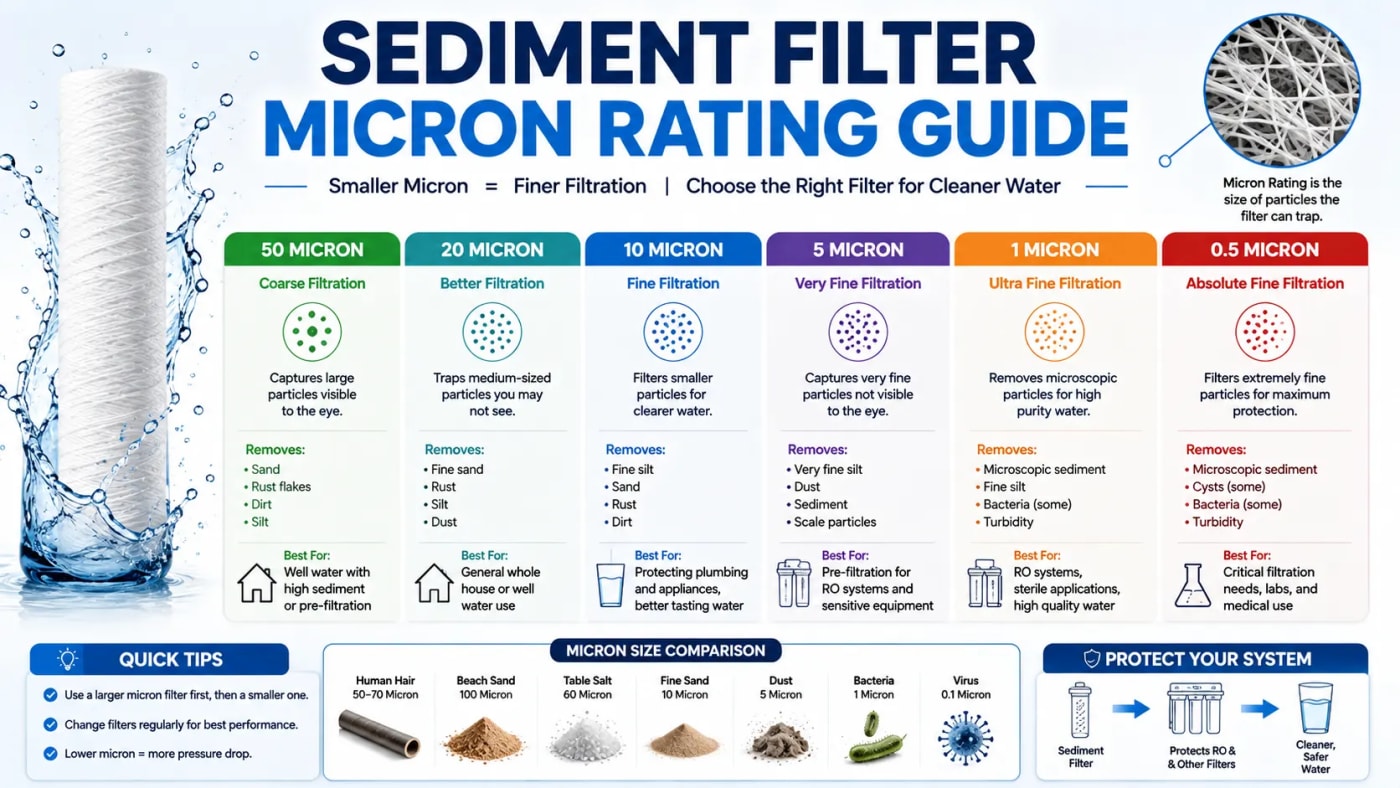
A sediment filter micron rating measures the particle size threshold associated with the filter's filtration performance, using the micron as the unit of measurement. A micron is another name for a micrometer, a unit equal to one millionth of a meter, far too small to see with the naked eye.A lower micron rating means finer filtration, capturing smaller particles. A higher micron rating means coarser filtration, capturing only larger particles while letting smaller ones pass through. Lower is not automatically better, since a very fine filter can restrict flow or clog quickly if used where it does not match the actual sediment present.
Sediment filters are designed to remove suspended particles such as sand, silt, rust and clay. They are not designed to treat dissolved contaminants, meaning substances fully dissolved in the water rather than suspended as solid particles. According to CDC guidance on filter pore size, this distinction between particle filtration and dissolved contaminant treatment is fundamental to understanding what a sediment filter can and cannot do.
How do common micron ratings differ by particle size?
Common micron ratings differ by particle size along a clear spectrum, with each range generally suited to a different type and size of sediment.
The table below compares common sediment filter micron ratings:
Micron Rating | Filtration Level | Typical Sediment | Typical Role |
50 micron | Coarse | Large sand, grit, large debris | First stage protection against heavy sediment |
20 micron | Moderately coarse | Sand, larger silt particles | General sediment reduction for moderate sediment loads |
10 micron | Moderate | Fine sand, silt, rust particles | Common general purpose sediment filtration |
5 micron | Fine | Fine silt, clay, smaller rust particles | Finer sediment reduction, often a second stage |
1 micron | Very fine | Very fine suspended particles | Polishing stage for water that still appears slightly cloudy |
No single rating in this table is universally correct. A coarser rating fits situations with heavy, larger sediment, while a finer rating fits situations where remaining suspended particles are small enough to pass through coarser media. The right starting point depends entirely on the sediment actually present in your water.
Which sediment conditions need a coarser or finer rating?
Sediment conditions that need a coarser or finer rating depend on the type and severity of particles present in your water, not on a fixed rule tied to water source alone.
Common sediment conditions to identify:
Coarse sand and grit: Larger, heavier particles that settle quickly and often need a coarser first stage.
Rust flakes: Particles from aging pipes or fixtures, often visible and moderate to large in size.
Silt: Fine mineral particles that can make water appear slightly cloudy.
Clay: Very fine particles that often require finer filtration to capture effectively.
Fine sediment: Small suspended particles that persist even after coarser filtration.
Cloudy or turbid water: A visible sign that fine suspended particles remain in the water.
Follow this general decision process to identify the right starting range for your situation.
Steps to identify the right starting micron range:
Identify the sediment type. Observe or test the water to determine whether coarse particles, fine particles or a mix of both are present.
Estimate severity. Consider how much sediment is present and how quickly it accumulates, since heavier sediment loads often justify a coarser first stage.
Choose a starting range. Select a micron rating that matches the sediment type and severity you identified, starting coarser if sediment is heavy.
Observe performance. Monitor water clarity, flow rate and cartridge loading after installation, and adjust the rating if the result does not match your expectations.
Heavy sediment often calls for a coarser first stage to avoid rapid clogging, while relatively fine suspended particles may justify moving to a finer stage once larger sediment has already been addressed. Balancing cloudy or discolored water against the risk of frequent clogging is a common challenge, and starting with a reasonable estimate, then adjusting based on observed performance, works better than guessing a single fixed number in advance.
What is the difference between nominal and absolute ratings?
The difference between nominal and absolute ratings lies in how each one defines filtration performance, meaning two filters marked with the same micron number can still perform quite differently.A nominal rating describes an approximate particle size that the filter is generally expected to capture, often based on a percentage removal rate rather than a strict guarantee. An absolute rating describes a stricter particle size threshold, generally indicating a higher percentage of particles at that size are captured consistently.
The table below compares nominal and absolute micron ratings:
Rating Type | General Meaning | Practical Implication |
Nominal | Approximate particle size capture, often based on a percentage removal estimate | Some particles at or near the stated size may still pass through |
Absolute | Stricter particle size threshold with more consistent capture at that size | Provides more reliable performance at the stated micron size |
Because of this difference, two filters both labeled "5 micron" are not automatically equivalent. One may use a nominal rating and the other an absolute rating, resulting in different real world performance even though the number on the label looks the same. CDC guidance explains why absolute and nominal pore sizes represent materially different filtration standards, and this distinction matters most when filtration performance needs to be more predictable, such as when protecting sensitive downstream equipment.
How does micron rating affect water flow and clogging?
Micron rating affects water flow and clogging because finer filtration media naturally creates more resistance to water passing through it, and this resistance increases further as sediment accumulates on the filter surface.
The general cause and effect relationship works as follows:
Finer media: A lower micron rating captures smaller particles, which also means the filter media itself restricts flow more than a coarser option.
Greater restriction potential: This added restriction becomes more noticeable as water flow increases or as the filter accumulates more trapped sediment.
Sediment loading: As particles accumulate on the filter surface, available flow paths through the media narrow further.
Pressure decline: Reduced flow paths lead to a gradual decline in water pressure until the filter reaches the point where replacement becomes necessary.
This relationship explains why pressure loss and clogging are common concerns, particularly when a finer rated filter faces a heavier sediment load than it can handle efficiently. Replacement frequency depends on this same relationship, since a filter facing more sediment or finer capture requirements will typically need replacement sooner than one facing lighter sediment with a coarser rating.
How should water sources affect micron selection?
Water source should affect micron selection as a starting context rather than as the deciding factor on its own, since actual sediment load and downstream requirements matter more than the source label alone.
The table below separates general source characteristics from the actual decision factors:
Water Source | General Characteristic | Actual Decision Factor |
Municipal water | Generally treated before reaching the home, though sediment can still occur from pipe corrosion or system work | Actual observed sediment and any known local water quality issues |
Well water | Can vary widely depending on geology, well construction and local conditions | Water testing results and observed sediment severity |
Municipal water and private well water represent different starting contexts, but neither one alone determines the correct micron rating. Testing your water, rather than guessing based on source type, gives a much more reliable basis for selecting the right starting rating, especially when sediment conditions are uncertain or when downstream equipment requires more predictable protection.
When should sediment filtration use multiple stages?
Sediment filtration should use multiple stages when a single micron rating cannot efficiently handle the full range of sediment present in the water, particularly when both larger and finer particles need to be addressed.
The general logic behind staged filtration follows a coarse to fine sequence.
Example staged filtration sequence:
Coarser pre-filter stage. A higher micron rating captures larger sediment first, reducing the load reaching later stages.
Finer sediment cartridge stage. A lower micron rating then captures smaller remaining particles that the first stage did not address.
This is one common example, not a universally required configuration. The right staging arrangement depends on the specific sediment mix present in your water. Homeowners dealing with heavy sediment loads commonly consider a staged arrangement specifically because a single filter, especially one with a fine rating, would otherwise clog too quickly under that same sediment load.
How should downstream equipment influence the micron rating?
Downstream equipment should influence the micron rating because equipment such as reverse osmosis membranes, UV systems and water softeners often has specific protection requirements that go beyond general sediment reduction.
Downstream equipment protection considerations:
Reverse osmosis membranes: Sediment protects the membrane from physical damage and fouling, and the appropriate micron rating should follow the specific membrane manufacturer's pre-filtration requirement rather than a general assumption.
UV systems: Sediment filtration helps maintain clear water so UV light can pass through effectively, since suspended particles can shield microorganisms from UV exposure.
Water softeners: Sediment filtration protects softener resin from fouling caused by larger particles.
It is important to distinguish sediment removal from certified cyst reduction, since these represent different performance standards. CDC guidance draws a clear distinction between general sediment filtration and filters specifically certified for cyst reduction, and a sediment filter alone should not be assumed to provide certified microbiological protection unless it carries that specific certification.
How can you tell when a micron rating is too fine?
You can tell when a micron rating is too fine by watching for several symptoms related to excessive restriction and rapid sediment loading.
Symptoms that a micron rating may be too fine:
Rapid pressure loss: Water pressure drops noticeably soon after installing a new filter.
Frequent cartridge changes: The filter requires replacement much sooner than expected.
Rapid sediment loading: The filter visibly fills with trapped sediment very quickly.
Inadequate flow: Household water flow feels restricted even with a newly installed filter.
If these symptoms appear, the likely correction involves stepping to a coarser micron rating, increasing the cartridge's overall capacity, or adding a coarser pre-filter stage ahead of the fine filter to reduce the sediment load reaching it. Addressing the underlying sediment load before it reaches a fine filter often solves the problem more effectively than repeatedly replacing an overwhelmed cartridge.
How can you tell when a micron rating is too coarse?
You can tell when a micron rating is too coarse when sediment problems continue despite filtration, or when equipment downstream of the filter shows signs of inadequate protection.
The table below outlines common symptoms, likely issues and next actions:
Symptom | Likely Issue | Next Action |
Water remains visibly cloudy after filtration | Rating is too coarse to capture the fine particles present | Consider a finer stage or a staged filtration approach |
Sediment accumulates in downstream equipment | Coarse filtration is not protecting sensitive equipment adequately | Match the rating to the downstream equipment's specific requirement |
Insufficient protection despite visible sediment reduction | Some particles may be too fine for the current rating to capture | Test water and consider a finer stage if particles remain suspended |
Moving to a finer rating is not automatically the right answer if the remaining problem is caused by dissolved contaminants rather than suspended particles, since sediment filters do not address dissolved substances regardless of how fine the rating becomes. Confirming whether the issue is truly suspended sediment, rather than a dissolved contaminant, helps avoid choosing an unnecessarily fine filter that will not actually solve the problem.
How should you choose a micron rating for your setup?
You should choose a micron rating for your setup by following a clear decision sequence rather than picking a number at random.
Decision sequence for choosing a micron rating:
Identify the sediment present. Determine whether coarse particles, fine particles or a mix of both appear in your water.
Determine your filtration objective. Decide whether your priority is general sediment reduction, protecting downstream equipment or addressing visibly cloudy water.
Check nominal versus absolute rating. Confirm which rating type a filter uses before comparing it directly to another product.
Consider flow and sediment load. Match the rating to your household's flow rate and the severity of sediment present to avoid excessive restriction.
Consider downstream equipment. Check whether equipment such as an RO membrane or UV system has a specific pre-filtration requirement.
Choose single or staged filtration. Decide whether one filter stage meets your needs or whether a coarse to fine staged approach fits your sediment conditions better.
This sequence brings together the technical factors already covered, without repeating the full comparison table. Different applications, such as well water systems, whole-house setups or pre-filtration ahead of reverse osmosis, often call for more specific guidance beyond this general sequence.
What micron filter is best for well water?
The best micron filter for well water depends on the specific sediment present in your well water, since well water sediment varies significantly based on geology and well construction. Testing your water and observing actual sediment load matters more than assuming a single universal rating fits every well. A staged approach is common in wells with heavier sediment, though the specific stages should follow your test results rather than a fixed formula. For complete guidance on choosing a well water sediment filter, see Best Sediment Filter for Well Water.
What micron filter is best for whole-house water?
The best micron filter for whole-house water depends on your household's flow rate and overall sediment load, since a whole-house system needs enough cartridge capacity to handle continuous use across multiple fixtures without excessive pressure loss. For a complete guide to whole-house sediment filter selection, see Best Whole-House Sediment Filter.
What micron filter should you use before reverse osmosis?
The micron filter you should use before reverse osmosis should follow the specific pre-filtration requirement listed by your RO membrane's manufacturer, since sediment pre-filtration exists to protect the membrane from physical damage and fouling. For complete guidance on sediment filtration for RO systems, see Best Sediment Filter for RO Systems.
What is the difference between 1 and 5 micron filters?
The difference between 1 and 5 micron filters is filtration fineness, with 1 micron capturing much smaller particles than 5 micron, though this finer capture often comes with greater flow restriction depending on the application. For a complete comparison between these two ratings, see 1 vs 5 Micron Water Filter.
How often should you replace a sediment filter?
How often you should replace a sediment filter depends on your sediment load, the cartridge's capacity, any noticeable pressure or flow changes, and the manufacturer's specific replacement guidance. For a complete replacement schedule guide, see How Often to Replace a Sediment Filter.
What do sediment filters remove from water?
Sediment filters remove suspended particles from water, such as sand, silt, clay and rust, but they do not address dissolved contaminants or provide reliable protection against microorganisms unless specifically certified for that purpose. For a complete breakdown of what sediment filters do and do not remove, see What Does a Sediment Filter Remove?
Conclusion
Choosing the right sediment filter micron rating starts with understanding your actual sediment conditions rather than assuming a single number works for every situation. Coarser ratings handle larger sediment with less flow restriction, while finer ratings capture smaller particles at the cost of faster clogging if the sediment load is heavy. The difference between nominal and absolute ratings means the same micron number can perform differently across products, so always check which rating type a filter uses before comparing it to another. Match your final choice to your actual sediment, your household's flow needs, and any downstream equipment that requires specific protection, and adjust based on observed performance rather than guessing from source type alone.