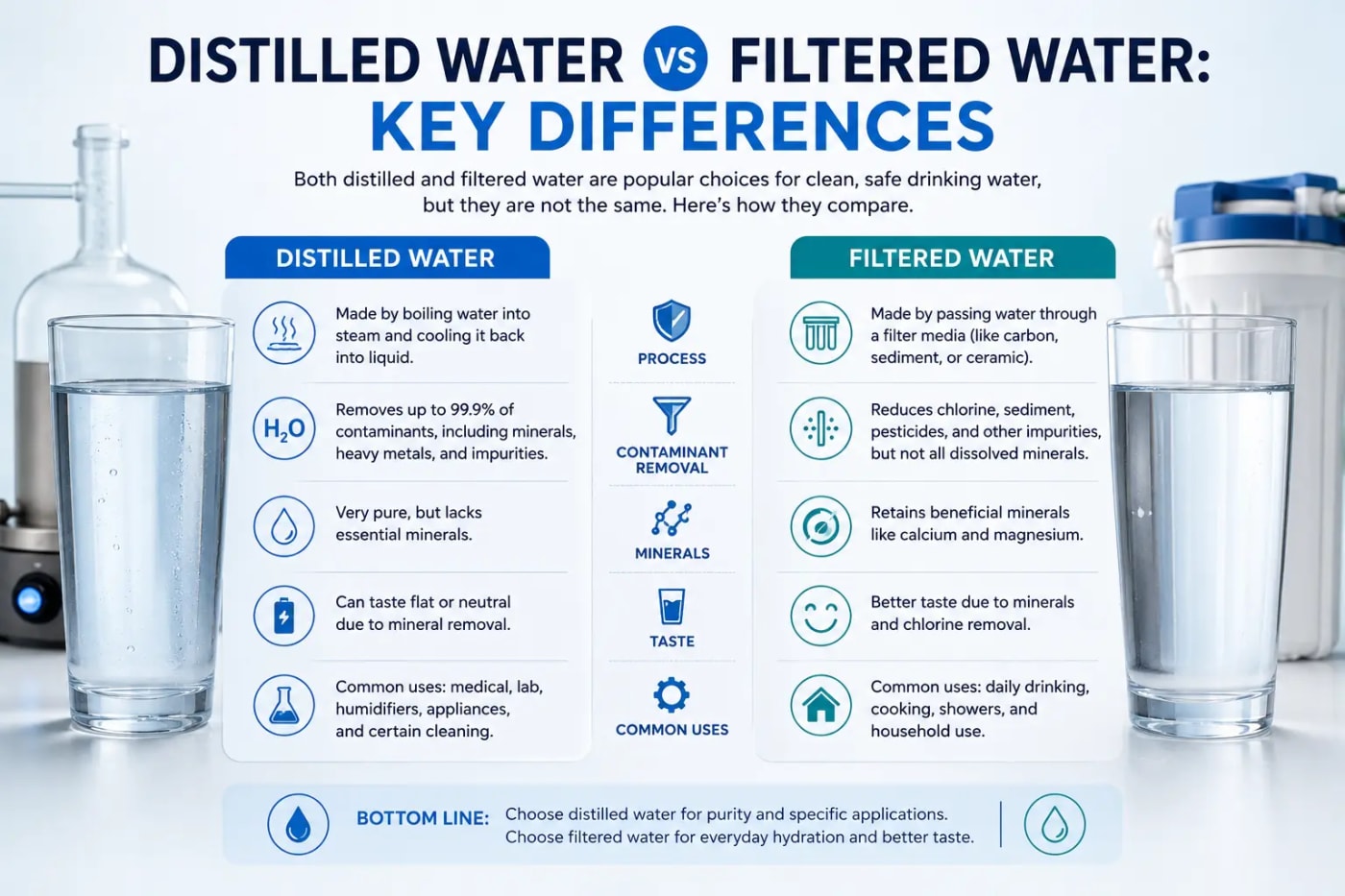
Distilled water and filtered water are not the same thing, and the difference comes down to the treatment method used. Distillation heats water into vapor and then condenses it back into liquid, leaving dissolved minerals and many contaminants behind. Filtration passes water through a treatment medium, such as activated carbon or a membrane, while the water stays in liquid form the whole time.
This article compares both treatment methods across contaminant reduction, mineral content, total dissolved solids (TDS), taste, everyday drinking use, and appliance use. It does not simply declare one type "better." Filtered water is an umbrella term, and its actual quality depends entirely on the filtration technology used. By the end, you will know how to match the right treatment method to your specific water source and daily needs.
What makes distilled and filtered water different?
The core difference is the treatment method, not just the final taste.Filtration relies on a barrier or treatment media. Water passes through carbon, a membrane, or another material that traps or reduces specific substances. Distillation relies on a change of physical state. Water is heated until it evaporates, then the vapor is cooled and collected as liquid again. Most dissolved minerals and salts do not evaporate, so they stay behind in the original container.
This distinction matters because it decides what ends up in your glass.
The table below compares the two treatment methods at a high level:
Feature | Distilled Water | Filtered Water |
Treatment method | Evaporation and condensation | Passing through a filter media |
Physical state change | Yes | No |
Mineral content | Very low | Depends on filter type |
Contaminant range | Broad for non-volatile substances | Depends on certified filter type |
Taste | Flat, neutral | Varies by mineral content |
Common use | Appliances, labs, specific health needs | Daily drinking and cooking |
How does filtration change the water without changing its physical state?
Filtration works by moving water through a solid treatment medium while the water stays liquid from start to finish.Different filter types target different problems. Activated carbon filters use a porous material that attracts and holds certain chemicals, chlorine byproducts, and substances that affect taste and odor. Sediment filters catch physical particles like sand, rust, and dirt. Membrane filtration, including reverse osmosis, forces water through a very fine membrane that blocks a wider range of dissolved substances.
Not every filter removes the same things. A basic carbon pitcher filter and a reverse osmosis system solve very different problems, even though both are called "filtered water." The National Sanitation Foundation (NSF) sets certification standards for filters, and checking a product's certified claims is the only reliable way to know what it actually reduces.
How does distillation separate water from dissolved substances?
Distillation follows three basic steps: heating, vapor formation, and condensation.
Heating: Water is heated in a chamber until it reaches its boiling point.
Vapor formation: Water turns into steam, while most minerals, salts, and other non-volatile dissolved substances stay behind in the boiling chamber.
Condensation: The steam passes into a cooling section, where it turns back into liquid water and is collected as distilled water.
This process does not remove everything from water. Volatile substances, meaning chemicals that evaporate at or near the boiling point of water, can travel with the steam and end up in the final product unless additional treatment, such as carbon filtration, is added. Distillation is highly effective against non-volatile dissolved solids, including most common minerals, but it is not a universal solution for every possible contaminant.
Which contaminants can filtration remove from drinking water?
Contaminant removal through filtration depends entirely on the technology used. There is no single answer that applies to "filtered water" as a category.Sediment filters address physical particles. Carbon filters commonly reduce chlorine taste and odor, and some certified products reduce lead or specific organic chemicals. Reverse osmosis systems can reduce a much broader range of dissolved contaminants, including many salts and heavy metals. Some advanced filters are certified to reduce PFAS, a group of persistent chemical compounds, but this depends on the specific certification the product carries.
NSF/ANSI standards help clarify these differences:
Common NSF/ANSI standards for water filters:
NSF/ANSI 42: Covers aesthetic effects, such as chlorine taste, odor, and particulate reduction.
NSF/ANSI 53: Covers health-related contaminant reduction, such as lead or certain organic chemicals, depending on the certified claim.
NSF/ANSI 58: Covers reverse osmosis systems and their reduction of dissolved solids and other contaminants.
A filter without relevant certification for a specific contaminant should not be assumed to remove that contaminant, even if the packaging uses general marketing language.
Which contaminants are reduced by carbon, RO, and other filters?
Each filtration technology has a distinct treatment mechanism and target range.
Activated carbon: Reduces chlorine taste and odor, and some organic compounds, through adsorption onto the carbon surface.
Reverse osmosis (RO): Forces water through a semi-permeable membrane, reducing a wide range of dissolved solids, salts, and many contaminants, though performance depends on the specific system and membrane condition.
Sediment filtration: Removes visible particles like dirt, rust, and sand through a physical straining process.
UV treatment: Uses ultraviolet light to inactivate certain microorganisms, rather than removing dissolved substances.
Ion exchange: Swaps unwanted ions, such as calcium and magnesium in hard water, for other ions like sodium or potassium.
The certification on a specific product matters more than the general category of filter. Two carbon filters from different manufacturers can have very different real-world performance if only one carries a relevant NSF certification for the contaminant you care about.
What can distillation remove that ordinary filtration may leave behind?
Distillation uses a phase change, and this gives it an advantage against many non-volatile dissolved substances that some ordinary filters may not fully address.Hardness minerals, such as calcium and magnesium, generally stay behind during distillation because they do not evaporate with the steam. Many inorganic contaminants behave the same way. A basic carbon filter, by contrast, is not primarily designed to remove dissolved minerals or hardness, since its main function is adsorption of specific chemicals rather than separation of dissolved solids.
Distillation compared with basic carbon filtration:
Minerals and hardness: Distillation reduces these significantly. Basic carbon filtration generally does not.
Chlorine taste and odor: Carbon filtration handles this directly. Distillation also removes it, though through a different mechanism.
Volatile compounds: These need extra attention with distillation, since some can travel with the steam.
Microorganisms: Distillation's heat generally inactivates many microorganisms, while filtration performance depends on pore size and specific certification.
How do minerals and dissolved solids differ after treatment?
Final water composition is one of the clearest differences between distilled and filtered water.Distilled water contains very little dissolved mineral content, because most minerals, including calcium, magnesium, and sodium, stay behind during evaporation. Fluoride, which is often added to municipal water supplies, is also largely left behind during distillation in most cases. Filtered water composition varies. A basic carbon filter usually leaves most minerals intact, since removing dissolved minerals is not its primary function. A reverse osmosis system reduces dissolved solids much more broadly, including many minerals, though typically not as completely as distillation.
The table below compares typical mineral retention across treatment types:
Treatment | Calcium & Magnesium | Sodium | Fluoride |
Distillation | Removed | Removed | Largely removed |
Carbon filtration | Mostly retained | Mostly retained | Mostly retained |
Reverse osmosis | Significantly reduced | Significantly reduced | Significantly reduced |
TDS, or Total Dissolved Solids, is a measurement of the material dissolved in water, not a direct safety score on its own.
What does TDS tell you about distilled and filtered water?
TDS measures the combined weight of minerals, salts, and other dissolved substances in a given volume of water.Distilled water has very low TDS because the treatment process leaves most dissolved material behind. Filtered water TDS depends completely on the filter type. Carbon-filtered water often keeps a TDS level close to the original tap water, since carbon filtration mainly targets specific chemicals rather than dissolved solids in general. Reverse osmosis water usually shows a much lower TDS than carbon-filtered water, because the membrane blocks a broader range of dissolved material.
A low TDS number does not automatically mean water is safer, and a higher TDS number does not automatically mean water is unsafe. TDS should be understood as one piece of information about water composition, not a complete safety measurement on its own.
How does mineral content affect the taste of each water type?
Mineral content has a direct and noticeable effect on how water tastes.Filtered water that retains dissolved minerals, such as calcium and magnesium, often has a fuller or more rounded taste, because these minerals contribute detectable flavor. Distilled water has very little mineral content, so many people describe it as tasting flat, neutral, or slightly empty by comparison. Neither taste profile means the water is unsafe. This is simply a sensory difference created by what remains in the water after treatment.
Common taste observations reported by consumers:
Distilled water: Often described as flat or neutral, due to very low mineral content.
Carbon-filtered water: Often described as cleaner tasting than untreated tap water, mainly due to reduced chlorine taste and odor.
Reverse osmosis water: Often described as light or slightly flat, since many minerals are also reduced.
Is distilled water safe to drink regularly?
Yes, distilled water is safe to drink. The very low mineral content makes it nutritionally different from water that retains minerals, but this does not make it unsafe.A common myth claims that distilled water leaches minerals from the body or causes dehydration. There is no reliable evidence to support this claim. The body gets the large majority of its mineral intake from food, not from drinking water, so drinking mineral-free water on its own does not create a mineral deficiency for most healthy people. Distilled water is commonly used in households, medical settings, and specific health situations precisely because it is considered safe and predictable in composition.
Common myths about distilled water:
Myth: Distilled water pulls minerals out of the body. Fact: Dietary mineral intake mainly comes from food, and drinking distilled water does not create this effect in healthy people.
Myth: Distilled water causes dehydration. Fact: Distilled water hydrates the body the same way any other clean water does.
Myth: Distilled water is unhealthy overall. Fact: It is safe to drink, though it is not a source of dietary minerals.
Does filtered water provide a nutritional advantage from minerals?
Minerals present in drinking water are a small part of overall dietary mineral intake, and drinking-water minerals should not be treated as a major nutritional source.Carbon-filtered water often retains most naturally occurring minerals, since carbon filtration does not specifically target them. Reverse osmosis water contains fewer minerals, because the membrane reduces a much wider range of dissolved solids. Neither option should be viewed as a primary mineral source. A balanced diet remains the main way people meet their mineral needs, and water composition plays only a supporting role.
Which water works better for daily drinking and cooking?
The right choice depends on your source water quality and what you are trying to achieve, not on a blanket rule that one type is always healthier.Filtered water is often practical for daily drinking and cooking when the filter is matched to an actual issue in the local water supply, such as chlorine taste or a specific contaminant identified in a water quality report. Distilled water can still be the right choice when very low mineral content is specifically wanted, such as for certain medical needs or particular cooking and baking situations where mineral content affects results.
The table below offers a general decision guide based on common needs:
Situation | Better Fit | Reason |
Daily drinking, no known issue | Filtered water | Matches treatment to normal tap water conditions |
Known specific contaminant | Filtered water with matching certification | Certification confirms the contaminant is addressed |
Very low mineral content needed | Distilled water | Removes most dissolved minerals |
General cooking | Filtered water | Retains some mineral content and flavor |
Mineral-sensitive recipes or brewing | Distilled water, sometimes with added minerals | Gives precise control over mineral content |
NSF recommends starting with your local water quality report, often called a Consumer Confidence Report, before choosing a treatment method. This report lists what is actually present in your municipal water supply, which removes guesswork from the decision.
Which water is better for CPAPs, humidifiers, and steam irons?
For mineral-sensitive equipment, distilled water is commonly recommended because it reduces mineral deposits and scale buildup inside the device.
Common appliances that often call for distilled water:
CPAP humidifiers: Reduce mineral buildup inside the humidifier chamber and tubing.
Steam irons: Prevent mineral deposits from clogging steam vents and staining fabric.
Home humidifiers: Limit white mineral dust that can form when tap water is used.
Certain small appliances: Some coffee makers and specialty machines also benefit from lower mineral content, depending on the manufacturer.
Always follow the specific instructions from the appliance manufacturer, since requirements can differ between brands and models. Using the wrong type of water in some appliances can void a warranty or shorten the device's working life.
How do cost, speed, energy use, and maintenance compare?
Filtration and distillation differ significantly in day-to-day operating characteristics.Filters need periodic replacement, and the frequency depends on water usage and the specific filter type. Basic carbon filters often need replacement every one to three months, while some reverse osmosis membranes last longer with proper maintenance. Distillation requires electricity or another heat source to boil the water, and the process itself takes longer to produce a batch of water compared with simply filtering it. Filtration systems generally produce water on demand, while distillation is a batch process, so the countertop or under-sink unit needs time to complete each cycle.
The table below compares general operating characteristics:
Factor | Filtration | Distillation |
Energy use | Low, usually none for gravity filters | Higher, requires heating water |
Production speed | Often immediate or fast | Slower, batch process |
Maintenance | Regular filter replacement | Periodic cleaning of the heating chamber |
Storage needs | Minimal | Requires a collection container |
Exact cost per gallon varies by equipment, local electricity prices, and water usage habits, so it is worth checking manufacturer specifications for your specific model rather than relying on a single fixed number.
How does source-water quality change the better choice?
Treatment selection should always start with understanding what is actually in your water, rather than choosing a method based on general assumptions.Municipal water and private well water can have very different starting points. Municipal suppliers are required to publish a water quality report, often called a Consumer Confidence Report, which lists tested contaminant levels. Private wells are not covered by these municipal reports, so independent testing is the only reliable way to know what is present in well water. Once you know what is actually in your water source, you can match the treatment method to the specific issue instead of guessing.
Steps to understand your source water before choosing treatment:
Check your water source: Confirm whether your water comes from a municipal supplier or a private well.
Review the water quality report: Municipal customers can usually request or find this report from their local water utility.
Test private well water: Independent testing is recommended, since well water is not covered by municipal reporting requirements.
Identify specific concerns: Note any contaminants, hardness levels, or taste issues mentioned in your results.
How should you choose between filtration and distillation?
The right choice comes from your specific objective, not from a general claim that one method is always superior.
Follow this decision process to choose the right treatment method:
Identify your water source: Determine whether you use municipal or well water, since this affects what testing information is available.
Identify the contaminant or issue: Use your water quality report or independent test results to find specific concerns, such as chlorine taste, hardness, or a particular contaminant.
Identify the required treatment: Match the contaminant to a technology known to address it, such as carbon filtration for chlorine taste or reverse osmosis for a broader range of dissolved solids.
Verify certification: Check that the specific product carries a relevant NSF/ANSI certification for the contaminant you want to address.
Choose equipment based on daily needs: Consider drinking, cooking, and any mineral-sensitive appliances you own before finalizing your choice.
Some households use both methods for different purposes, such as a carbon filter for daily drinking water and a distiller for a CPAP machine or steam iron. This combined approach often makes more practical sense than trying to find one single method for every use in the home.
What should you check before choosing a water treatment method?
Before finalizing a treatment method, confirm a few practical details so your choice matches your actual water and your actual needs.
A quick checklist before selecting a treatment method:
Source water: Confirm whether you use municipal or private well water.
Water quality report: Review your Consumer Confidence Report, or test private well water independently.
Specific contaminant or use case: Identify exactly what you are trying to address, such as taste, hardness, a specific contaminant, or an appliance requirement.
Certification: Verify that any filter you consider carries a relevant NSF/ANSI certification for your specific concern.
Equipment selection: Choose a filter or distiller sized and rated for your household's daily water use.
This sequence naturally leads into more specific topics, including how reverse osmosis works, what a certified carbon filter actually removes, how hard water is treated, and how to choose water for specific appliances like CPAP machines, humidifiers, and coffee makers.
What is reverse osmosis water?
Reverse osmosis water is produced by forcing water through a semi-permeable membrane under pressure. The membrane blocks a wide range of dissolved solids, which is why reverse osmosis is often compared directly with distilled water. Reverse osmosis systems fall under NSF/ANSI 58, the standard covering this specific technology. For a full explanation of how the membrane works and what it removes, see our dedicated guide: Reverse Osmosis Water: How It Works and What It Removes.
What is purified water?
Purified water describes water that has been treated to meet a specified purity standard, and it can be produced using several different methods, including reverse osmosis and distillation. The term itself does not point to one single treatment process. For a closer comparison against distilled water specifically, see: Purified Water vs Distilled Water.
What does a carbon water filter remove?
Activated carbon filters mainly reduce chlorine taste, odor, and certain organic chemicals through an adsorption process, where contaminants stick to the surface of the carbon material. Actual performance depends entirely on the specific certified product you use. For a detailed breakdown of what carbon filtration addresses, see: What Does an Activated Carbon Filter Remove?
What does an RO water filter remove?
Reverse osmosis filters reduce a broad range of dissolved solids, including many minerals and certain contaminants, though exact performance depends on the specific system and certification. For the full mechanism and contaminant list, see: What Does Reverse Osmosis Remove?
What does a water filter remove from tap water?
The answer depends completely on the specific filter and its certified reduction claims. No single filter should be assumed to remove bacteria, fluoride, lead, PFAS, and minerals all at once. Always check the certified performance data sheet for the exact product you are considering. For more detail, see: What Do Water Filters Remove?
What is hard water and how is it treated?
Hard water contains higher levels of calcium and magnesium. Ordinary carbon filtration is not designed to soften water, since softening requires a different process, typically ion exchange. For a full explanation of causes and treatment options, see: Hard Water: Causes, Effects, and Treatment.
What water should you use in a CPAP machine?
Follow your specific CPAP manufacturer's instructions, since requirements can vary between brands. Distilled water is commonly used because its very low mineral content reduces mineral deposits inside the humidifier chamber. For complete guidance, see: Best Water for CPAP Machines.
What water should you use in a humidifier?
Requirements depend on whether the humidifier is mineral-sensitive. Follow the manufacturer's instructions closely, since low-mineral water can reduce white dust and mineral buildup in certain humidifier models. For a full breakdown, see: Best Water for Humidifiers.
What water is best for coffee makers?
Coffee equipment generally needs a balance between low scale potential and some mineral content, since minerals can affect extraction and flavor. This makes "distilled water is always best" an oversimplified answer for coffee brewing specifically. For a detailed guide, see: Best Water for Coffee Makers.
How do you choose a certified water filter?
A simple checklist for choosing a certified filter:
Identify the contaminant: Use your water quality report or test results to know what you need to address.
Check the certification: Look for a relevant NSF/ANSI certification that matches your specific concern.
Verify the exact reduction claim: Read the product's certified performance data rather than relying on general marketing language.
Follow replacement instructions: Replace filter cartridges on schedule to maintain performance.
For a complete walkthrough, see: How to Choose a Certified Water Filter.
Conclusion
Distilled water and filtered water are produced through fundamentally different processes, and each has a clear place depending on your needs. Distillation uses evaporation and condensation to remove most dissolved minerals and many non-volatile contaminants, making it a strong choice for CPAP machines, steam irons, and other mineral-sensitive equipment. Filtration covers a wide range of technologies, from basic carbon filters to reverse osmosis systems, and its real performance always depends on the specific certified product used. Start by reviewing your water quality report or testing your private well, identify your specific concern, and match that concern to a treatment method with the right certification. This approach gives a far more reliable result than assuming one type of water is universally better than the other.