
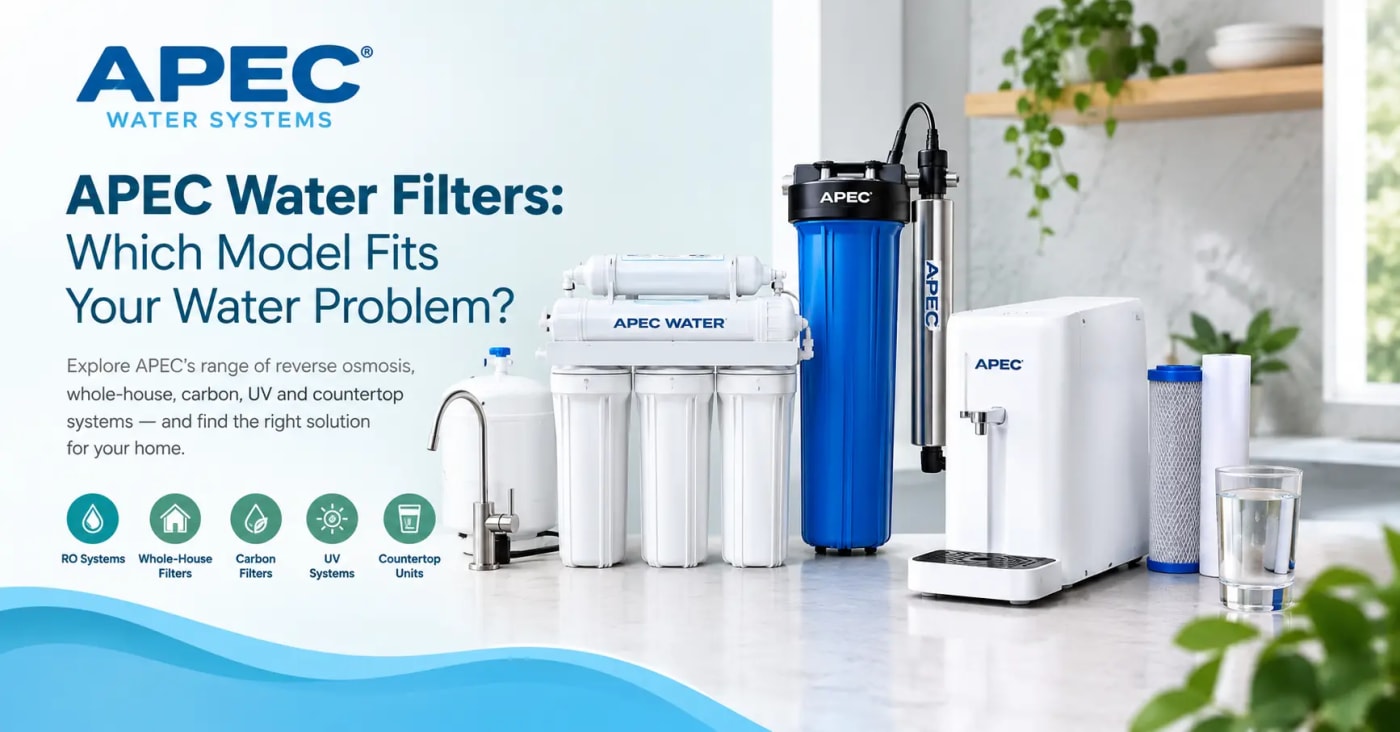
Filtering well water is fundamentally different from treating city water because you are effectively operating your own mini-utility. Unlike municipal supplies that arrive at your home pre-treated for bacteria and chemicals, well water comes directly from the ground and carries a unique “fingerprint” of minerals, gases, and organic matter specific to your local geology. This means there is no one-size-fits-all filter; the system must be precisely matched to the specific contaminants found in your backyard.

This guide begins with the most critical step in the entire process: professional water testing. We explain why detailed lab reports are required to avoid the biggest financial loss well water owners can incur: buying a system not designed for their specific iron, sulfur, or bacterial levels. You are basically guessing with your home plumbing and family health without a recent test.

The following sections break down the APEC product lineup by the specific problems they solve. We have classified the systems to treat common well water challenges, such as “rotten egg” smells, heavy sediment, and high mineral hardness, and assigned each challenge to the APEC whole-house or point-of-use technology designed to address it.

We also provide a blueprint for a full “Well-to-Tap” setup. This section shows how to use APEC heavy-duty prefiltration in conjunction with their advanced reverse osmosis systems to get water that is safe for appliances and showers but tastes like bottled water at your kitchen sink.

Why You Must Test Your Well Water before Buying Any APEC Filter?

Your local utility treats and monitors city water before it reaches your tap. Private well water has no regulation; what goes in the ground goes in your glass. That means neighboring wells could have very different water profiles. One may have clear water, and the other has high arsenic odors, like “rotten egg” smells.

The Real Cost of Skipping the Test

Buying a filter based on a general “best of” list is the most expensive mistake well water owners make. Specific contaminants require specific technologies, and the wrong choice can ruin your equipment:

What to Test For and What It Costs

At a minimum, your test should cover iron, manganese, hardness (calcium/magnesium), pH, total dissolved solids (TDS), nitrates, arsenic, and coliform bacteria. You have three main options for testing:

  1. County Health Department

The most affordable ($30-$60), though they usually only check for bacteria and nitrates.

  1. DIY Home Kits

Available for $20-$50 for basic indicators, but they aren’t sensitive enough to detect trace levels of lead or arsenic.

  1. Certified Mail-in Labs

Services like Tap Score or SimpleLab cost $100-$250 but provide a “Master” report that tells you exactly which APEC system will work.

Spend $100 on a lab test now to avoid wasting $1,000 on a filtration system that wasn’t built for your well.

Best APEC Filter for Well Water with Iron, Rust Stains, or Metallic Taste

If your well water leaves orange or rust-colored stains in your sinks and toilets or has a distinct metallic “penny-like” taste, you cannot connect a standard APEC reverse osmosis (RO) system directly to your supply. Iron is the primary enemy of RO technology. When iron levels exceed 0.3 ppm, the minerals oxidize on the surface of the RO membrane, “blind” the pores, and permanently destroy the system within weeks.

To protect your investment and your plumbing, you need a two-stage approach:

  1. Stage 1: Whole House Iron Removal.

You must install a dedicated iron filter at the point where water enters your home. This removes iron, manganese, and hydrogen sulfide from every faucet, protecting your dishwasher, washing machine, and RO system. APEC offers the Iron-Hydro series (available in 10, 15, and 20 GPM models), which uses manganese dioxide media to oxidize and trap iron before it reaches your pipes.

  1. Stage 2: Under-Sink Drinking Water.

Once the iron is reduced below 0.3 PPM, you can safely install an APEC RO system for purified drinking water.

Which APEC Product Should You Choose?

For the drinking water stage, the APEC ROES may be the better option for well owners. Well water typically feels “heavy” or tastes flat after the RO process; the ROES consists of a basic remineralization stage, which contributes high-purity calcium back into the water, balancing the pH and enhancing the flavor.

But if your water test demonstrates excessive Total Dissolved Solids (TDS) but decreased iron (below 0.3 PPM), the ROES is able to deal with warm water straight without having an upstream iron filter, as they’re rated for as much as 2,000 PPM of TDS. Always confirm your iron levels initially to stay away from a costly membrane failure.

Best APEC Filter for Well Water with a Rotten Egg Smell

The rotten egg smell in well water is caused by hydrogen sulfide (H₂S), a gas that occurs in groundwater when organic matter or some mineral deposits decay. It may be more pronounced in your hot water tap, but the smell can pervade every faucet in your home and make showering and laundry unpleasant.

Sourcing homes with low-to-moderate sulfur issues requires the APEC Green-Carbon-10 whole-house solution. Instead of the typical activated carbon that “takes in the smells” until it is saturated and no longer works, the Green-Carbon-10 uses catalytic coconut shell carbon. Such specialized media breaks down hydrogen sulfide chemically, so it can be used longer for long-term well water treatment.

While catalytic carbon is a powerhouse for smell removal, it has its limits:

The Green-Carbon-10 is highly effective if your H₂S levels are below 1.0 PPM.

If your water test shows sulfur levels above 1.0 ppm or you also have iron and manganese problems, you should consider joining the APEC Iron-Hydro system. It uses a manganese dioxide-based oxidation process to “scrub” high levels of sulfur and iron out of the water before they reach your home’s plumbing.

If you want to eliminate the smell in the shower but also want high-quality drinking water, use the Green-Carbon-10 for the whole house and pair it with an ROES-PH75 under the sink. This combination ensures that the sulfur gas is removed at the source, while the reverse osmosis system polishes the drinking water to a crisp, bottled-water quality.

Best APEC Filter for Well Water with Bacteria or Safety Concerns

A common error that well owners make is thinking that a whole-house carbon filter or a simple reverse osmosis system provides complete biological protection. Understand the difference: Carbon filters kill or remove bacteria. They enhance taste and remove chemicals but do not kill living things like E. coli or coliform.

Physically, an APEC RO membrane has a 0.0001 micron pore size that blocks most bacteria and viruses. Although this offers good physical protection, standard RO systems like the ROES-50 are not independently certified as “microbiological purifiers.” If your well has a confirmed contamination history, physical filtration is not enough; bacteria can bypass seals or grow inside the filter housings over time.

ROES-PHUV75

For wells with confirmed bacterial concerns or those located in areas prone to runoff and flooding, the APEC ROES-PHUV75 is the correct choice. This 7-stage system includes a dedicated ultraviolet (UV) Sterilizer.

When recent flooding or a cracked well cap results in a positive test for bacteria in your well, shock chlorinate the well before installing any filtration. A filter maintains safety but is not a substitute for a clean, professionally disinfected well source.

Can You Use an APEC RO System Directly on Well Water?

Yes, you can use an APEC RO system directly on well water, but only under specific conditions. You can connect an APEC RO system directly to your well supply if your water test results fall within the manufacturer’s “Safe Zone” for membranes. If your water exceeds these limits, the system will still “work,” but the membrane will likely fail or clog within just a few months.

The “Direct Connection” Checklist

To use a system like the ROES-50 or ROES-PH75 without advanced pre-treatment, your well water must meet these standards:

The Reality for Most Well Owners

At least one of these limits is exceeded by most private wells in the US. If you have hard or iron water, you will need a whole-house sediment filter and probably a softener/iron filter before the water enters the RO unit. With no such “protection squad,” the most expensive component, the RO membrane, has to do all the heavy lifting by itself, leading to massive drops in water production and frequent filter changes.

Think of the APEC RO as the “polisher” at the end of the line. The correct order should always be:

Sediment Filter → Iron/Sulfur Removal → Water Softener → APEC RO.

What Is the Best Complete APEC Filter Setup for a Well Water Home?

Educational diagram showing the complete APEC well water filtration process, including water testing, sediment filtration, iron and sulfur treatment, water conditioning, reverse osmosis purification, UV sterilization, and clean drinking water.

A single filter is rarely enough in most homes with well water. The best strategy is layered filtration: you treat heavy contaminants like iron or sediment at the main water line into your house and then “polish” it at the kitchen tap so it is the purest drinking water.

Depending on your specific water test results, here are the three most common APEC configurations for well water homes:

ImagesYour Well Water ProblemRecommended APEC ProductWhat It DoesInternal LinkCurrent Price
APEC Water ROES-50 5-stage under sink reverse osmosis water filter system with NSF 58 and NSF 372 certification, producing 50 gallons of purified drinking water per day. Clean well water (low iron, no bacteria)APEC ROES-50 or ROES-PH75RO filtration + optional remineralizationAPEC ROES-50 Full ReviewCheck Price
APEC Water ROES-50 5-stage under sink reverse osmosis water filter system with 50 GPD capacity. Iron / rust stains / metallic tasteIron pre-filter (3rd party) + APEC ROES-PH75Protect membrane from iron + pure drinking waterAPEC ROES-PH75 Full ReviewCheck Price
APEC GREEN-CARBON-10 whole house water filter system designed to reduce chlorine, chloramine, hydrogen sulfide, and other contaminants. Rotten egg smell (sulfur / H2S)APEC Green Carbon 10 (whole house)Catalytic carbon removes H2S at all taps + showersAPEC Green Carbon 10 ReviewCheck Price
APEC ROES-PHUV75 7-stage alkaline reverse osmosis system with UV sterilization and 75 GPD water production. Bacteria / E. coli / coliformAPEC ROES-PHUV75 (7-stage with UV)UV sterilizer kills bacteria + viruses at kitchen tapAPEC ROES-PHUV75 Full ReviewCheck Price
APEC FUTURA-15 whole house salt-free water softener and conditioner with 15 GPM flow rate. Hard well water (scale buildup)APEC FUTURA-15 + APEC ROES-50Salt-free scale prevention + pure drinking waterAPEC Brand HubCheck Price

Setup 1: “The Clean Well” (Low Iron, No Bacteria, High TDS)

If your test shows iron below 0.3 ppm, no “rotten egg” smell, and no bacteria, your goal is simply to remove sediment and high mineral content.

A 20-inch Big Blue Sediment Filter to catch sand and grit that can clog appliances.

An APEC Futura-15 salt-free conditioner if your water is hard (above 7 grains per gallon).

The APEC ROES-PH75. Since well water often feels “flat,” the alkaline stage in this system adds minerals back for a better taste.

Setup 2: “The Smelly Well” (Iron or Sulfur Present)

If your water smells like sulfur or leaves orange stains, you must remove these before they reach your indoor plumbing.

An APEC iron-hydro oxidizing filter. This is the “heavy lifter” that removes iron and sulfur gas.

The APEC Green-Carbon-10 to remove any residual odors and chemicals from all showers and taps.

The APEC ROES-50 or PH75 for bottled-quality drinking water.

Setup 3: “The Safety-First Setup” (Bacteria or Surface Runoff Concerns)

If your well is shallow or your test showed coliform/E. coli, you need biological protection.

APEC Iron-Hydro (if iron is present) followed by a 5-micron sediment filter.

The APEC ROES-PHUV75. This is APEC’s “top-tier” well water system. It combines reverse osmosis with a UV Sterilizer that kills 99.99% of bacteria and viruses, ensuring your drinking water is safe even if the well becomes contaminated.

Maintenance Note for Well Owners

Well water usually carries far more physical debris than city water. City users can wait 12 months, but well owners should check sediment pre-filters once every 3-6 months. Unexpected pressure loss due to a blocked pre-filter is the most common problem encountered in APEC.

How Often Should You Test Well Water When Using an APEC Filter System?

The US EPA recommends testing private well water at least one time annually for bacteria (coliform, E. coli), nitrates, and pH. You must additionally test right after any flooding, heavy rainfall, or an obvious change in your water’s color, taste, and smell. If you are using an APEC RO process, you need to check your performance monthly with a $15 TDS meter. If the total dissolved solids (TDS) reading starts climbing considerably above your baseline, it’s a sure indication that your RO membrane or maybe pre-filters are failing and need to be changed. For all those making use of the ROES, the UV lamp has to be replaced every twelve weeks without fail, as an expired lamp will quit killing bacteria even when the light bulb remains glowing.

Does APEC Make a Whole House Well Water System That Handles Iron?

No, APEC does not currently make a dedicated iron removal filter. This is a notable gap in their lineup compared to brands like SpringWell or iSpring. While APEC’s Green-Carbon-10 and WH-SOLUTION lines are excellent for removing odors, sediment, and chemicals, they are not designed to handle iron levels above 0.3 PPM. For a well with high iron, the correct approach is to install a third-party air injection oxidizing filter as “Stage 1” to protect your plumbing. You can then safely run that pre-treated water into an APEC system for whole-house taste improvement or under-sink purification.

Can You Use the APEC ROES-50 on a Well with High Arsenic?

Yes, reverse osmosis is one of the more useful methods to remove arsenic from well water. Both the ROES have performed very well in impartial laboratory tests, reducing arsenic to almost undetectable levels. Nevertheless, there’s a technical catch: arsenic is present in 2 forms, arsenate (As V) and arsenite (As III). While RO removes arsenate quite successfully, it battles with dissolved arsenite. But if your water test demonstrates excessive levels of arsenite, you are going to need to oxidize warm water first (using an air injection system or maybe chemical treatment) to turn it into a form the RO membrane is able to catch.

What Is the Difference between the APEC ROES-PH75 and ROES-PHUV75 for Well Water?

The ROES is a 6-stage system that cleans your water and, after that, provides healthful nutrients back in for a much better, more alkaline taste. The ROES is a 7-stage system that has everything in the PH75, along with a UV ultraviolet sterilizer. While the PH75 is generally sufficient for city water, which has currently been disinfected, the ROES is the much safer option for well water. Since individual wells do not possess a city treatment plant to eliminate germs, the UV stage acts as a last safety net to ruin 99.99% of viruses and cysts that could usually get into your drinking glass.

Frequently Asked Questions

Can I connect an APEC RO system directly to my well water?

Yes, but only if your water meets specific limits. Iron must be below 0.3 PPM, manganese below 0.05 PPM, hydrogen sulfide below 0.1 PPM, and TDS below 2,000 PPM. If any of these limits are exceeded, the RO membrane will clog and fail within weeks. Get a professional water test before connecting any APEC system directly to your well.

Which APEC filter is best for well water with a rotten egg smell?

The APEC Green-Carbon-10 whole house filter is the best choice for sulfur odors. It uses catalytic coconut shell carbon that chemically breaks down hydrogen sulfide instead of just absorbing it. It works effectively when H2S levels are below 1.0 PPM. For higher sulfur levels combined with iron, you will also need an APEC Iron-Hydro system installed before it.

Does APEC make a whole house filter that removes iron from well water?

No, APEC does not currently make a dedicated iron removal filter. Their Green-Carbon-10 and whole house systems are not designed to handle iron levels above 0.3 PPM. For high-iron well water, you need to install a third-party air injection oxidizing filter first to remove the iron, and then run the pre-treated water into your APEC system.

Which APEC system should I choose if my well water has bacteria?

The APEC ROES-PHUV75 is the correct choice for wells with bacterial concerns. It is a 7-stage system that includes a UV sterilizer which destroys 99.99% of bacteria, viruses, and cysts like Giardia. The UV lamp requires replacement every 12 months. Standard carbon filters and basic RO systems do not kill bacteria and should not be relied on for biological protection.

How often should I test my well water when using an APEC filter?

The EPA recommends testing your well water at least once a year for bacteria, nitrates, and pH. If you use an APEC RO system, check your TDS level monthly with a TDS meter. A rising TDS reading means your RO membrane or pre-filters are failing and need replacement. Also test immediately after any flooding, heavy rainfall, or noticeable change in your water’s color, taste, or smell.

Leave a Reply

Your email address will not be published. Required fields are marked *