
The APEC Green Carbon 10 is a high-capacity filtration system designed to provide clean, chemical-free water to every faucet in your home. This review examines how the system eliminates the “swimming pool” smell of city water by targeting chlorine and chloramines at the main entry point. We look at how it treats thousands of gallons without backwashing, electricity, or regular maintenance.
This system can improve taste and protect your skin from harsh chemicals, but it is no “fix-all” for all water problems. We distinguish chemical filtration from mineral removal, explain why this unit is not a water softener, and specify which heavy metals it cannot remove from your pipes. This section tells you not to buy the wrong technology for limescale or lead.
Our cost analysis goes beyond the purchase price to show you the real return on investment of a non-backwashing system. We detail the expenditures for the multi-year filter media life and the minor upkeep of the sediment pre-filter. Below you will see a comparison of this unit’s operating expenses over a decade with traditional salt-based or electronic filtration systems.
Finally, we give you a quick guide on whether this is the best investment for your plumbing setup. Whether you are on metered city water with high chlorine or a private well with different needs, we pinpoint the buyer profiles that benefit most. This conclusion helps you decide if Green Carbon 10 is the last solution or part of a bigger water treatment picture.
| Quick Verdict | APEC Green Carbon 10 (GREEN-CARBON-10) |
|---|---|
| Best For | City water homes wanting chlorine and chloramine removed from every tap and shower — without monthly maintenance |
| Not Right For | Homes needing hard water softening | Buyers needing lead or PFAS removal | Well water without pre-treatment | Outdoor installation |
| Price Range | ~$400–$600 (verify current pricing — varies by retailer and variant) |
| Annual Running Cost | ~$15–50/year for sediment pre-filter only — among the lowest of any whole house system |
| Media Lifespan | 5–8 years without replacement or backwashing |
| Flow Rate | 10 GPM — suitable for 1–3 bathroom homes |
| Electricity Needed? | No — entirely passive, no drain, no backwash, no power |
| Certification | WQA certified catalytic coconut carbon media | NSF certified media | 10-year warranty on tank and valves |
| Recommended Pairing | APEC ROES-50 (under-sink RO for drinking water) + optional water softener for hard water homes |
| Price | Check Price |
What Exactly Does the APEC Green Carbon 10 Do to Your Water?
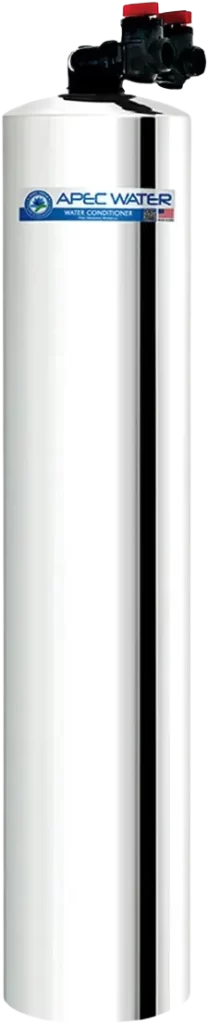
It is a whole-house point-of-entry filtration system, APEC Green Carbon 10. This is where your home’s plumbing begins, to scrub off chemicals before they reach your kitchen faucet, showerhead, and washing machine. Its job is to eliminate chloramines and chlorine, hydrogen sulfide, that rotten egg smell, and volatile organic compounds (VOCs).
Almost all basic filters utilize standard activated carbon, which is effective against chlorine but completely ineffective against chloramine. Chloramine is a chlorine-plus-ammonia mix that many modern city water utilities use because it remains active in long pipe networks. A slippery molecule like chloramine would be caught too quickly by a standard carbon filter.
Catalytic coconut shell carbon with a modified surface is used in Green Carbon 10 as an “accelerator chemical.” It isn’t about waiting for chloramine to stick; it’s about doing something now. It breaks the bond of the chlorine with ammonia and destroys the chemical on contact! This enables the system to efficiently clean water at high flow rates necessary for a household.
The Two-Stage Process
- Stage 1 (Pre-filter)
Your water first passes through a 10-inch “Big Blue” sediment filter. This stage catches the “big stuff,” sand, rust, and silt, to prevent the main tank from clogging.
- Stage 2 (Main Tank)
The water flows through the large bed of catalytic carbon. Here, the chemicals and odors are adsorbed (locked away), leaving the water clear and odorless.
Once installed, you’ll notice the “swimming pool” smell in your shower vanishes immediately. Beyond taste, this system prevents the dry, itchy skin and brittle hair caused by bathing in harsh disinfectants. While the water is not “softened” in a mineral sense, it feels much gentler on your body and your clothes.
What Does the Green Carbon 10 NOT Remove from Your Water?
Before investing in a whole-house system, it is vital to understand that the Green Carbon 10 is a specialized tool, not a universal filter. It excels at removing chemical disinfectants, but there are five things it cannot do that buyers often expect.
Hard Water and Limescale
Green Carbon 10 isn’t a softener for water. This will not remove calcium and magnesium minerals that cause white crusty buildup on faucets, spots on glassware, or stiff laundry. Pair this unit with a dedicated softener or a salt-free conditioner like the APEC FUTURA-10 to stop scale.
Lead and Heavy Metals
Catalytic carbon is compelling but not certified to remove dissolved heavy metals like lead, arsenic, or chromium. If you live in an aging pipe or have tested lead levels in your home, you should add an NSF-certified under-sink RO system like the APEC ROES-50 to your main drinking water.
PFAS “Forever Chemicals”
Standard whole-house carbon beds are not rated for high-efficiency PFAS removal of PFOA/PFOS at flow rates required for a full home. Some adsorption occurs, but this system is not recommended for PFAS protection alone.
Bacteria and Viruses
Carbon filtration is not a disinfectant for bacteria & viruses. They don’t kill bacteria, viruses, or cysts. If your well is private and potentially biologically contaminated, you must add a UV sterilization stage before the water enters the Green Carbon tank.
Fluoride and Nitrates
This system does not reduce fluoride, nitrates, or total dissolved solids (TDS). They are too small and nonreactive to be filtered by carbon media and thus require specialized filtration by alumina or reversed osmosis
For city dwellers, the Green Carbon 10 takes care of the most common complaints: smell, taste, and skin irritation. But if your water test comes back with lead or very high mineral hardness, you will want to treat this system as just one stage of a multistage solution.
Is the Green Carbon 10 Actually Maintenance-Free?
APEC labels the Green Carbon 10 as “maintenance-free,” and while that is largely true, it requires a small clarification. The main catalytic carbon media inside the tank is a “set it and forget it” system; it requires no backwashing, no electricity, and no replacement for 5–8 years.
That is exceptional for a whole-house system. However, the sediment pre-filter included with the system (FG model) does need replacing approximately every 6–12 months. This process is a simple cartridge swap that requires no special tools and ensures that dirt and rust don’t clog your main carbon tank. These pre-filters typically cost between $15 and $25 each.
Because there are no expensive membranes to replace or salt to buy, the total annual running cost for the Green Carbon 10 is approximately $15–50 per year. This makes it one of the most affordable whole-house filters to own for over a decade. For perspective, the SpringWell CF1 costs about $40/year in maintenance, while the Aquasana EQ-1000 can run up to $120/year due to more frequent filter changes.
How to Know When the Media Is Spent?
The catalytic carbon will not fail in succession. It instead loses the ability to “catch” chemicals. The smell of your nose tells you it’s time for a tank refresh (which costs about $255 for new media). If the carbon smells like chlorine or your water tastes like a pool, it’s used up. You can confirm your suspicions with a $5 chlorine test strip from any hardware store. If your 5-8 year cycle shows any color at your tap, your cyclone is active.
Maintenance Cost Table
| Component | Replace Every | Approximate Cost |
| Sediment pre-filter | 6–12 months | ~$15–25 per filter |
| Catalytic carbon media | 5–8 years | Media refill or professional service |
| Tank and valves | 10-year warranty | No expected cost within warranty period |
| Annual total | ~$15–50/year | Lowest annual cost in its category |
How Hard Is the Green Carbon 10 to Install?
Installing the APEC Green Carbon 10 is a “point-of-entry” project, meaning it connects directly to your home’s main water line. This is a difficult task compared to a plain under-sink filter. A professional plumber can usually do the installation in one to 1.5 hours, but a competent DIYer with basic plumbing skills ought to permit 2 to 4 hours.
What the Installation Involves
You will need to cut through your main 1-inch or 3/4-inch copper/PEX supply line shortly after your main shut-off valve opens. The system uses 1-inch female pipe thread connections, but APEC usually includes adapters for 3/4-inch standard lines. We recommend installing a three-valve bypass loop. This option lets you divert water around your system for sediment pre-filter change without shutting off water to the house.
The “Head Tightening” Fix
An unexpected leak at the main tank head right after installation is a common frustration for installers. The tank body is smooth with no grip points, so the head fitting is almost impossible to tighten enough to form a seal when the tank is empty, as it spins in place.
- The Solution: Partially fill the tank with water before the final tightening. The added weight of the water provides the necessary resistance to let you torque the head fitting down securely. This simple step, missing from the official manual, prevents 90% of initial leaks.
So when you first crack the valves open, don’t freak out if black or gray water pours out of your faucets. This is “carbon fines,” tiny dust particles of the new media. Run cold water taps for 5–10 minutes, or until the water is clear.
Pressure Drop Reality
Real-world testing shows only a 3-4 PSI drop throughout the system. You can run two showers and a dishwasher simultaneously at 10 GPM in a 1- to 3- bath home with no change in performance.
What Are the Real Weaknesses of the APEC Green Carbon 10?
The APEC Green Carbon 10 is a top-tier choice for chemical removal, but it isn’t a perfect “fit-all” solution. Here are the five documented weaknesses you should consider before clicking “buy.”
1. No “End of Life” Indicator
Unlike modern “smart” filters, this system has no digital display, app, or blinking light to show you when the carbon is exhausted. Then you keep track of the installation date and check the water manually with a chlorine test strip every few months after that five-year mark.
2. Indoor Installation Only
APEC is specifically to be installed indoors. You could damage the tank and void your warranty if it is installed in an unheated garage, a crawl space with extreme temperature swings, or an outdoor utility closet. The biggest enemies are UV exposure and freezing temperatures.
3. The 10 GPM Flow Limit
The standard Green Carbon 10 is designed for small to medium-sized homes (1-3 bathrooms). You may find that the 10 GPM flow rate drops the pressure drop when you have 4 or more bathrooms and a high-demand household, like when two showers and a washing machine are running at the same time. For larger homes, you need the GREEN CARBON 15.
4. No Impact on Hard Water
We cannot stress this point enough: This system does nothing to prevent limescale. If your fixtures have “white crust,” the Green Carbon 10 cannot replace it. Still need a water softener for mineral hardness.
5. Professional Help Likely Needed
This is not a “screw-on” filter. Since cutting into your main water line requires a plumber, most homeowners will hire one. Add another $150 to $300 for the initial setup, depending on your local rates.
Is the APEC Green Carbon 10 the Right System for Your Home?
The Green Carbon 10 is the gold standard for city dwellers who want to strip “swimming pool” chemicals out of every tap and shower without the headache of monthly maintenance. However, it is a specialized tool, not a one-size-fits-all filter.
- The Ideal City Water Buyer Buys the Green Carbon 10
If you are on municipal water and your main complaints are chlorine smells, dry, itchy skin after showering, or brittle hair, this is your solution. It provides whole-home protection for up to 8 years with almost zero effort. It is perfect if you are already planning to add an under-sink RO system for “bottled-quality” drinking water.
- The “Hard Water” Household: Pair it with a Softener
If you have white crusty buildup on your faucets or spotty dishes, the Green Carbon 10 will not help. You should pair this unit with the APEC FUTURA-10 salt-free conditioner or a traditional water softener. Install the Green Carbon 10 first in the sequence to protect the softener’s resin from chlorine damage.
- The Large, High-Demand Home Upgrade to the GREEN-CARBON-15
If your home has 4 or more bathrooms or you frequently run two showers and a high-efficiency washing machine at the same time, the standard 10 GPM flow rate may cause a pressure drop. The GREEN-CARBON-15 offers a 15 GPM flow rate to handle the extra load.
- The Private Well Owner Proceeds with Caution
This system is primarily engineered for city water. If you are on a well, you must test for iron, manganese, and bacteria first. These contaminants can “foul” or clog the carbon media almost instantly. Only use the Green Carbon 10 on a well if your water is already pre-treated and your main concern is taste or specific chemical runoff.
How Does the Green Carbon 10 Compare to SpringWell CF1 and Similar Systems?
Choosing the right filtration system often comes down to balancing upfront cost against long-term maintenance. Here is how the APEC Green Carbon 10 stacks up against its two biggest rivals in 2026.
- Green Carbon 10 vs. SpringWell CF1
The SpringWell CF1 (~$1,040) is a premium alternative that uses a “flex bed” of catalytic carbon and KDF media. This combination allows it to claim PFAS removal and a longer 10-year lifespan, backed by a lifetime warranty. While the CF1 offers broader protection, the Green Carbon 10 is roughly $400 cheaper and provides the same core chloramine performance for city water users on a budget.

- Green Carbon 10 vs. Aquasana EQ-1000
It is the Aquasana EQ-1000 ($1,000+), a “Rhino” system often combined with UV and salt-free conditioning. If you need to deal with chemicals and scale in one footprint, it has a lower flow rate (7 GPM) and much more frequent maintenance, with pre-filters swapped every 2-3 months. The Green Carbon 10 is for those who need a simple high-flow (10 Gpm) tank that only requires attention once or twice a year.

- Green Carbon 10 vs. GREEN-CARBON-15
These two systems are identical in build quality and media type but differ in plumbing capacity. The GREEN-CARBON-15 (~$1,100) is designed for homes with 4 to 6 bathrooms, providing a 15 GPM flow rate to ensure no pressure loss during high-demand mornings. Stick with the 10 for smaller households, but upgrade to the 15 if you have a large family or a high-pressure showerhead.

Why Does Your City Water Need Chloramine Removal If It’s Already Safe to Drink?
While US city water meets EPA regulatory standards, “legal minimums” are sometimes not ideal for everyday use. Chloramine and chlorine at permissible levels are documented triggers for dry, itchy skin and irritated scalps in people with eczema or psoriasis. And breathing in chlorine vapor in a hot shower is another common exposure that drinking-water standards do not account for. This Green Carbon 10 whole-home protection keeps every shower and bath free of these harsh chemical irritants.
Can You Use the Green Carbon 10 Together with a Water Softener?
Yes, APEC recommends that combination for homes with chemicals and hard water, too. The correct setup is Green Carbon 10 at the main line entry point, followed by a water softener. This order is critical because chlorine in city water will “mush,” or degrade, costly water softener resin; removing the chemicals first protects the resin bed and extends the life of the softener! For those who do not like salt, the system pairs well with the APEC FUTURA-10 salt-free conditioner.
What Happens When the Catalytic Carbon Media Gets Exhausted After 5–8 Years?
Once the catalytic carbon reaches its 1-million-gallon limit, it no longer “traps” chemicals, and you’ll smell the chlorine coming back to your taps. Not necessarily a new system at this stage. You can have a professional re-bed the tank with new media for $150-$300. The hardware should still be in excellent shape when the carbon expires because APEC backs the tank and valves with a 10-year warranty. Try using a chlorine test strip annually starting in year four to catch the decline before your water quality drops.
What Is the Difference Between the GREEN-CARBON-10, COAT, FG, and GREEN-CARBON-15?
The suffixes make navigating APEC model names simpler: the GREEN-CARBON-10 is the base tank, and the COAT version adds an insulated fabric jacket to prevent tank sweat and minor scuffs. Generally, the best value is the GREEN-CARBON-10-FG, which includes the basic “Big Blue” sediment pre-filter housing & filter for free. And finally, the GREEN CARBON-15 is just the larger version of the technology, offering a 15 GPM flow rate in a home with 4 or more bathrooms. For a 1-3 bathroom standard home, the FG variant is almost always the smartest buy.
FAQ’s:
Does the APEC Green Carbon 10 remove chloramine?
Yes. The APEC Green Carbon 10 uses catalytic carbon media to reduce chloramine, chlorine, hydrogen sulfide, and common chemical odors from city water.
Does the APEC Green Carbon 10 soften hard water?
No. The system does not remove hardness minerals like calcium and magnesium that cause limescale and hard water buildup.
Can the APEC Green Carbon 10 remove lead or PFAS?
No. The Green Carbon 10 is not certified to remove lead, PFAS, fluoride, or nitrates. A reverse osmosis system is recommended for removing those contaminants.
How often does the APEC Green Carbon 10 need maintenance?
The sediment pre-filter should be replaced every 6–12 months, while the catalytic carbon media typically lasts 5–8 years under normal household use.
Can the APEC Green Carbon 10 work with a water softener?
Yes. The APEC Green Carbon 10 can be paired with a water softener to reduce chlorine and chloramine while also treating hard water and preventing scale buildup.
