
Home
The right iron filter for a private well depends entirely on which type of iron is present, ferrous, ferric, organic, or iron bacteria, along with the iron concentration in parts per million and whether manganese or sulfur odor show up alongside it, since no single filter works for every well. Whole house systems built around air injection oxidation and media such as Katalox Light, greensand, or hydrogen peroxide with catalytic carbon are the standard residential answer, with prices typically running from around 1,300 to 4,500 dollars depending on capacity and technology. Getting the iron type and concentration right before buying anything is usually what separates a system that works for years from one that clogs within weeks.
What Types of Iron Are Found in Well Water?
Well water iron generally falls into four practical categories: ferrous iron, ferric iron, organically complex iron, and iron bacteria. Organically complex iron is a less common fourth form that gives water an orange, yellow, or brown tint rather than following the classic clear-then-rust pattern of ferrous iron or showing up as already visible particles like ferric iron. Picking a treatment method before knowing which type is present is the single most common reason iron treatment fails, since each type calls for a different fix.
What Is Ferrous Iron in Well Water?
Ferrous iron, often called clear water iron, is fully dissolved and invisible in water straight from the tap. A simple glass test shows the pattern clearly: water drawn straight from the well looks clear, but after sitting exposed to air for 20 to 30 minutes it turns orange or rust colored as the ferrous iron oxidizes into ferric iron. Because it is a fully dissolved ion rather than a solid particle, ferrous iron needs an oxidation step, such as air injection or a catalytic media, before any filter can actually capture it.
What Is Ferric Iron in Well Water?
Ferric iron, often called red water iron, is already oxidized and shows up as visible reddish brown particles straight from the faucet rather than developing color only after sitting out. Because it is already a solid particle, ferric iron generally responds to standard filtration on its own. That said, the underlying cause is often ferrous iron oxidizing somewhere earlier in the plumbing or well, which is worth investigating rather than only filtering the visible symptom.
What Is Iron Bacteria and How Is It Different From Ferrous or Ferric Iron?
Iron bacteria are naturally occurring microorganisms that feed on dissolved iron and manganese, producing a slimy, rust colored biofilm along with a swampy or oily odor, most commonly noticed as stringy buildup inside a toilet tank. Iron bacteria are not solved by standard oxidation or filtration media alone. The biofilm keeps clogging any filter installed without addressing the bacteria directly, which is why shock chlorination is the necessary first step rather than an optional extra. Iron bacteria are generally not a direct health hazard on their own, but the biofilm can harbor other harmful organisms and cause real plumbing damage over time.
How Do You Test Your Well Water for Iron?
A proper water test, ideally through a certified lab, reports total iron along with the ferrous versus ferric split, pH, and a screen for iron bacteria, since all of these affect which system will actually work. A targeted lab iron test typically costs around 70 to 75 dollars and returns results within a few days. pH and dissolved oxygen levels specifically affect how well certain filter media perform, so a full water chemistry profile matters more than the iron number by itself.
How Can You Identify Iron Type at Home With a Simple Glass Test?
Before ordering a lab test, a quick glass test can give a useful first read. Fill a clear glass with cold water straight from the tap and observe it immediately: cloudy or reddish brown suggests ferric iron, while clear water suggests ferrous iron. Then let the glass sit for 20 to 30 minutes. Water shifting from clear to orange during that time confirms ferrous iron oxidizing in real time. This test cannot detect iron bacteria or give a precise ppm reading, so it works best as a first indicator rather than a replacement for lab testing.
Is Iron in Well Water Dangerous to Health?
The EPA classifies iron as a secondary contaminant, meaning its 0.3 mg per liter guideline addresses taste, staining, and odor rather than a proven health risk, and this standard is not federally enforceable for private wells. Iron can affect taste and cause staining at levels as low as 0.05 mg per liter, well below that guideline. There is one real exception: people with hereditary hemochromatosis absorb iron abnormally and should be more cautious about all sources of dietary iron, including water, and very high levels above 10 ppm can cause mild gastrointestinal discomfort. For most households this is a nuisance issue rather than a safety emergency.
How Do Iron Filters for Well Water Actually Work?

Most whole house iron filters share the same underlying principle: dissolved ferrous iron needs to be oxidized into a solid particle before it can be captured by a filter media bed, and once oxidized, the media traps the particles until a backwash cycle flushes them out. Air injection oxidation, greensand, Katalox Light, and hydrogen peroxide with catalytic carbon each handle that oxidation step in their own way.
What Is Air Injection Oxidation (AIO) and How Does It Remove Iron?
Air injection oxidation systems maintain a pocket of air at the top of the tank, and as water passes through, that air pocket oxidizes ferrous iron, manganese, and hydrogen sulfide into solid particles that the media bed then traps. A typical single tank AIO system is rated for up to 7 ppm iron, 8 ppm hydrogen sulfide, and 1 ppm manganese, with some Katalox Light based units rated much higher. Where the control valve sits on the tank matters too. Systems with the valve mounted on top can let oxidized iron accumulate right inside it, while a side mounted valve keeps oxidation confined to the media tank instead, which manufacturers report can cut service issues substantially. AIO systems typically need periodic backwashing on a timer rather than chemical regeneration.
How Does Greensand Filter Media Remove Iron?
Greensand media is coated with manganese dioxide, which oxidizes ferrous iron on contact, but that coating depletes over time and needs regular potassium permanganate regeneration to stay effective. Greensand performs best in neutral to slightly alkaline water and struggles outside that pH range, and its media lifespan runs roughly 5 to 8 years compared with longer lasting alternatives. It remains a legitimate, long standing option, though the ongoing chemical maintenance is worth factoring in before choosing it over a chemical free alternative.
How Does Katalox Light Compare to Greensand and Birm?
Katalox Light contains a higher concentration of manganese dioxide than greensand, which allows faster oxidation, a wider effective pH range, and no potassium permanganate chemical feed, with a media lifespan often cited around 7 to 10 years or longer versus 3 to 5 years for Birm. Birm only works reliably when pH stays between 6.8 and 9.0 with sufficient dissolved oxygen present, which limits it to simpler, more stable water chemistry. Katalox Light is commonly rated to handle much higher iron concentrations, in some product listings up to 30 ppm, along with 10 ppm sulfur and 15 ppm manganese in a single tank.
| Media Type | Iron Capacity | Chemicals Required | pH Range | Media Lifespan |
| Katalox Light | Up to 30 ppm | No | Wide (roughly 6.0 and up) | 7 to 10 years |
| Greensand | 10 to 15 ppm | Yes, potassium permanganate | Neutral to slightly alkaline | 5 to 8 years |
| Birm | 3 to 5 ppm | No | 6.8 to 9.0 | 3 to 5 years |
How Does Hydrogen Peroxide Injection With Catalytic Carbon Remove Iron?
Hydrogen peroxide injection with catalytic carbon works differently from the chemical free options above. Hydrogen peroxide is injected just ahead of a catalytic carbon bed, and the carbon both filters the oxidized particles and acts as a catalyst that speeds up the reaction between the peroxide and the iron. This method is commonly rated to handle up to around 20 ppm of iron, higher than typical single tank AIO ratings, and it is one of the few oxidation methods that also works on iron reducing bacteria directly, rather than needing shock chlorination as a separate step first. The trade off shows up in the ongoing cost: the peroxide tank needs periodic refilling, commonly cited around 200 to 300 dollars a year, and the catalytic carbon media itself is typically replaced after about 4 to 5 years.
How Do You Size an Iron Filter for Your Well?
Sizing an iron filter starts with your well pump’s flow rate rather than just the size of your house, since the filter has to keep up with peak demand plus extra flow during its own backwash cycle. An average shower alone uses roughly 2.1 gallons per minute, so a home with 3 full bathrooms running showers simultaneously can need over 6 GPM before adding laundry or kitchen use, which is why manufacturers commonly size 1 to 4 bathroom systems around 12 GPM and 4-plus bathroom systems around 20 GPM rather than the 6 to 7 GPM some budget systems are built around. Iron concentration also affects sizing, since higher ppm levels call for a larger media bed or more frequent backwashing regardless of flow rate.
| Bathroom Count | Recommended Flow Rate | Notes |
| 1 to 4 bathrooms | Around 12 GPM | Covers typical simultaneous shower and appliance use |
| 4 or more bathrooms | Around 20 GPM | Needed for larger households with heavier peak demand |
How Do You Measure Your Well’s Flow Rate Before Buying a Filter?
A practical bucket test works well here. Open a hose bib near the pressure tank, let the pump build to full pressure, then time how long it takes to fill a 5 gallon bucket. The formula is simple: gallons collected divided by seconds elapsed, multiplied by 60, equals gallons per minute. Most residential wells fall in the 5 to 12 gallon per minute range, and this number, not the size of the house alone, determines which filter model can be installed without causing pressure problems.
What Are the Best Iron Filters for Well Water in 2026?
Which system counts as best depends on the iron level and water conditions involved rather than a single universal winner. For moderate iron around 7 to 8 ppm, a single tank AIO system such as the SpringWell WS Series is a solid, chemical free starting point rated for iron, hydrogen sulfide, and manganese together. For high iron above 15 to 20 ppm, a Katalox Light system such as the Fleck 2510AIO, or a hydrogen peroxide plus catalytic carbon system such as the Matrixx or Flexx inFusion line, handles the heavier load that a basic single tank AIO unit was not built for. For homes dealing with iron reducing bacteria specifically, hydrogen peroxide injection stands out since it is one of the few oxidation methods that addresses the bacteria directly rather than requiring shock chlorination as a separate step. For homes that already have a softener and want a lower cost upgrade, a combination unit such as the Genesis Iron Pro Max pairs iron filtration with softening in one tank.
| Best For | System Type | Rated Iron Capacity | Main Trade Off |
| Moderate iron, 7 to 8 ppm | Single tank AIO (SpringWell WS Series) | Up to 7 ppm iron, 8 ppm sulfur, 1 ppm manganese | Lower ceiling for very high iron |
| High iron, 15 to 20 ppm and up | Katalox Light AIO (Fleck 2510AIO) | Up to 30 ppm iron, 10 ppm sulfur, 15 ppm manganese | Higher upfront cost |
| Iron reducing bacteria | Hydrogen peroxide plus catalytic carbon (Matrixx or Flexx inFusion) | Up to 20 ppm iron | Annual chemical refill cost |
| Homes with an existing softener | Combination iron filter and softener (Genesis Iron Pro Max) | Moderate iron plus hardness | Less specialized than a dedicated iron filter |
How Much Does an Iron Filter for Well Water Cost?
Standard single tank AIO or Katalox Light systems commonly sell for roughly 1,300 to 2,800 dollars, branded whole house systems such as SpringWell’s WS Series list from around 2,250 to 4,545 dollars depending on size and add-ons, and hydrogen peroxide plus catalytic carbon systems built for higher iron loads, such as the Matrixx or Flexx inFusion line, typically run from about 2,600 to 6,700 dollars. Chemical free media such as Katalox Light or AIO systems have close to no ongoing consumable cost beyond backwash water and electricity, with a single backwash cycle typically running about 14 minutes at 7 to 10 gallons per minute, or roughly 100 to 140 gallons per cycle. Hydrogen peroxide systems carry an ongoing chemical cost commonly cited around 200 to 300 dollars a year. Media replacement itself is infrequent, often once every 6 to 8 years for Katalox Light or 4 to 5 years for catalytic carbon, which is worth weighing against the higher upfront cost of premium systems.
| System Type | Typical Upfront Cost | Ongoing Cost |
| Standard AIO or Katalox Light | $1,300 to $2,800 | Backwash water and electricity only |
| Branded whole house AIO (SpringWell WS Series) | $2,250 to $4,545 | Backwash water and electricity only |
| Hydrogen peroxide plus catalytic carbon | $2,600 to $6,700 | About $200 to $300 a year in peroxide |
What Common Problems Do Iron Filter Owners Run Into?
Iron filters are not entirely a set and forget purchase, and a few recurring issues show up in installer experience and homeowner reports. Pressure drops and clogging happen when a system is undersized for the home’s actual flow rate or iron level, greensand loses effectiveness when potassium permanganate regeneration is skipped or delayed, and installing a filter without first addressing iron bacteria simply results in the same slime clogging the new equipment. These are installation and maintenance issues with known fixes rather than reasons to avoid iron filtration altogether.
Why Does My Iron Filter Keep Clogging or Losing Pressure?
Clogging and pressure loss usually trace back to one of three causes: the system was sized below the well’s actual flow rate or iron concentration, the backwash cycle is not running often enough to flush trapped particles, or unresolved iron bacteria is fouling the media with biofilm faster than normal oxidized iron would. It is worth checking the original sizing against a fresh flow rate and iron test before assuming the unit itself is defective, since undersizing is described repeatedly in installer sources as the leading cause of iron filter failure.
How Do You Treat Iron Bacteria Before Installing a Filter?
When iron bacteria has already been confirmed, shock chlorination is the standard first response. A strong chlorine solution, commonly cited around 200 ppm free chlorine, is circulated through the well and the full plumbing system with 12 to 24 hours of contact time before flushing. Shock chlorination often needs to be repeated two or three times for established colonies and does not guarantee permanent elimination, which is why many homeowners pair it with an ongoing chlorination, ozone, or filtration system afterward. A DIY treatment typically costs around 50 to 100 dollars in supplies, while professional service runs roughly 150 to 500 dollars.
What Are the Signs Your Iron Filter Needs Service?
A return of the original symptoms, discoloration, metallic taste, or staining on laundry and fixtures, along with an unexpected drop in flow rate, both point to a system that needs attention rather than one that has simply failed outright. These signs are worth treating as a prompt to check the media’s age against its expected lifespan and confirm the backwash cycle is still running on schedule, rather than assuming the unit needs full replacement. Some modern control valves can send automatic notifications when service is likely needed, which removes the guesswork for homeowners who are not tracking media age manually.
What Should You Know Before Choosing Between an Iron Filter and Other Well Water Treatment?
An iron filter is usually one piece of a larger treatment setup rather than a complete solution on its own. A full setup can also include a water softener, a sediment pre-filter, and sometimes reverse osmosis at the kitchen tap, and the right combination and installation order depends on what a full water test actually shows.
Do You Need a Water Softener in Addition to an Iron Filter?
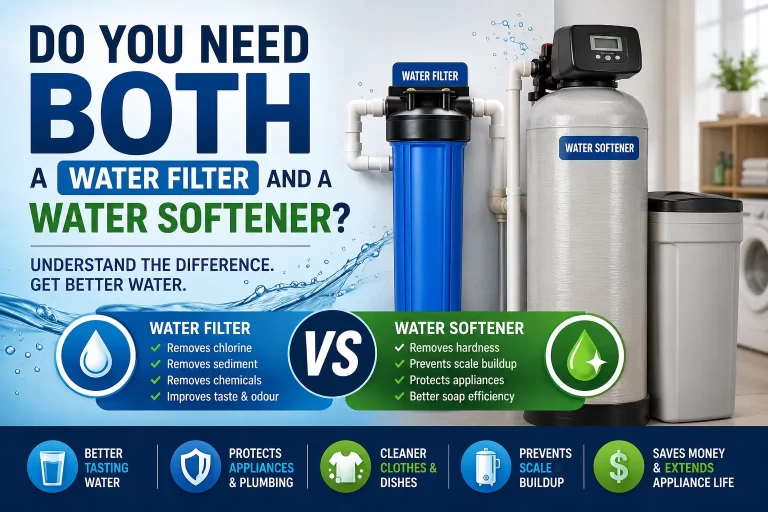
A standard water softener can handle only a limited amount of dissolved ferrous iron, generally cited in the range of 2 to 5 milligrams per liter by health authorities such as the Minnesota Department of Health, before the iron begins to foul the resin, while a dedicated iron filter is built for higher concentrations through oxidation rather than ion exchange. The correct installation order matters here: the iron filter should always be installed before the water softener, since oxidizing media can add a small amount of hardness back into the water that the softener then handles afterward. The full setup, including sizing and the exact installation order for water softeners on well water, is worth understanding before adding a softener to an existing iron filter.
How Does an Iron Filter Compare to a Whole House Sediment Filter?
A sediment filter is a simple mechanical pre-filter designed to catch sand, silt, and larger particles, and it is typically installed ahead of an iron filter to protect it from physical debris, though a sediment filter alone does nothing to oxidize or remove dissolved ferrous iron. Skipping a sediment pre-filter on a well with noticeable grit can shorten an iron filter’s media life and increase how often it needs backwashing. Getting the installation order and micron rating right for a whole house sediment filter protects the more expensive iron filter media sitting downstream of it.
Can a Reverse Osmosis System Remove Iron From Well Water?
A point of use reverse osmosis system at the kitchen tap can reduce iron along with many other dissolved contaminants, but high iron levels can foul the membrane quickly if the water is not pre-treated first. RO works best as an additional polishing step for drinking water rather than a replacement for whole house iron treatment. Anyone considering reverse osmosis for well water should plan for a whole house iron filter ahead of it to protect the membrane from premature fouling.
How Does Manganese Removal Relate to Iron Filtration?
Manganese frequently occurs alongside iron in well water and causes its own black or dark brown staining along with a bitter, metallic taste. The same oxidation based media used for iron, particularly Katalox Light and greensand, also oxidizes and removes manganese in the same treatment pass. Manganese carries its own EPA secondary guideline of 0.05 mg per liter, lower than iron’s 0.3 mg per liter guideline, so manganese removal from well water can become noticeable at smaller concentrations than iron typically does.
How Does Hydrogen Sulfide (Sulfur Smell) Removal Relate to Iron Treatment?
Hydrogen sulfide, responsible for the classic rotten egg smell in well water, is commonly treated by the same air injection oxidation systems used for iron, since the same air pocket that oxidizes ferrous iron also oxidizes dissolved sulfide gas into a form the media bed can trap. Systems rated for iron often list a separate hydrogen sulfide capacity, typically several parts per million, so a household dealing with both problems can usually solve them with one properly sized system rather than treating sulfur smell and hydrogen sulfide removal as a completely separate project.
How Do You Test Your Well Water for Bacteria and Other Contaminants Beyond Iron?
A full well water test should go beyond iron and manganese to include coliform bacteria, nitrates, pH, hardness, and any regional concerns such as arsenic, since iron problems often surface alongside other water quality issues that a narrow iron only test would miss. Working through a complete process for testing your well water for bacteria and other contaminants gives a much clearer picture than an iron reading on its own.
What Does a Whole House Well Water Filtration System Include Beyond Iron Removal?
A complete well water treatment setup often layers several stages together, a sediment pre-filter, an iron and manganese oxidation stage, a water softener, and sometimes a carbon or UV stage for taste and microbial protection, rather than relying on the iron filter alone to solve every issue. Looking at a full whole house well water filtration system built around all of these stages helps put the iron filter in context as one part of a larger treatment train.
Frequently Asked Questions
What is the best filter for iron in well water?
It depends on the iron type and level. A single tank AIO system handles moderate iron up to about 7 to 8 ppm, while a Katalox Light or hydrogen peroxide system is better suited to high iron above 15 to 20 ppm.
Can a water softener remove iron on its own?
Only in small amounts. A standard softener can handle roughly 2 to 5 mg per liter of ferrous iron before the resin starts to foul, which is why higher iron levels need a dedicated iron filter installed first.
Is iron in well water dangerous to drink?
For most people, no. The EPA treats iron as a secondary, aesthetic contaminant with a 0.3 mg per liter guideline. The main exceptions are people with hereditary hemochromatosis and very high levels above 10 ppm, which can cause mild stomach upset.
Why does my iron filter keep clogging?
The most common cause is undersizing, either for the well’s actual flow rate or its iron concentration. Unresolved iron bacteria and a backwash cycle that runs too infrequently are the other two leading causes.
Do I need to treat iron bacteria before installing a filter?
Yes. Iron bacteria forms a biofilm that a standard iron filter cannot remove on its own, so shock chlorination is needed first to avoid clogging the new equipment with the same slime.