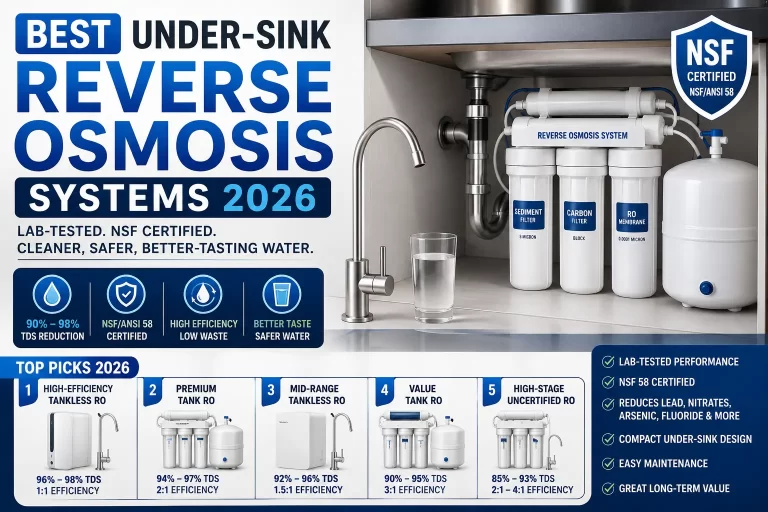
The best under-sink reverse osmosis systems in 2026 combine 90% to 98% TDS reduction, verified NSF 58 certification, and efficient water usage instead of high stage counts. Lab-tested ranking in 2026 depends on measurable output. The strongest under-sink filter systems reduce dissolved solids at a high rate, hold stable flow, and keep wastewater in a practical range. NSF-certified RO status is important because independent verification separates a reverse osmosis system from marketing-only water purifier claims. Real home water system performance also changes by design, like a tankless RO unit saves cabinet space and improves dispense speed and tank systems buffer demand and hold steadier pressure during repeated usage. Lab-tested filter comparisons also show that a 7-stage water filtration label does not mean that it is better than a 5-stage design when the membrane is weaker. Users distrust marketplace lists because inconsistent testing hides membrane quality, certification scope, and replacement cost.
The following table compares the top RO system 2026 options by design, efficiency, certification, and price range.
| Rank | System Type | Tank vs Tankless | Lab-Tested TDS Reduction | Efficiency Ratio | NSF 58 | Typical Price |
| 1 | High-efficiency tankless RO | Tankless | 96% to 98% | 1:1 | Yes | $450 to $699 |
| 2 | Premium tank RO | Tank | 94% to 97% | 2:1 | Yes | $280 to $499 |
| 3 | Mid-range tankless RO | Tankless | 92% to 96% | 1.5:1 | Yes | $299 to $499 |
| 4 | Value tank RO | Tank | 90% to 95% | 3:1 | Yes | $199 to $349 |
| 5 | High-stage uncertified RO | Tank or tankless | 85% to 93% | 2:1 to 4:1 | No/Partial | $169 to $399 |
What makes an RO system “lab-tested” in 2026?
A lab-tested RO system is a reverse osmosis water filter verified by a third-party laboratory for contaminant reduction performance under controlled conditions. A lab-tested reverse osmosis system in 2026 follows a clear testing structure. The system is tested without any control of the manufacturer to avoid biased results. This testing checks how much contamination the system removes from water, especially dissolved solids and harmful chemicals. The most trusted standard is NSF/ANSI 58 certification from the National Sanitation Foundation (NSF).
This test calculates the following things:
- Total Dissolved Solids (TDS) reduction rate
- Structural safety of the RO unit
- Verified performance claims for specific contaminants
Lab testing also evaluates key contaminants such as Lead, Arsenic, Fluoride, Nitrates, and Chromium. According to membrane filtration studies in water treatment research departments, RO membrane performance can change by more than 10% when pressure conditions change. This is why two systems with the same number of filtration stages still produce different water quality results. A system is considered truly lab-tested only when it has third-party certification like NSF 58, published test data, and verified contaminant reduction results. A simple “tested in lab” label without certification details is not a reliable proof of performance.
Which RO systems perform best in real-world TDS reduction tests?
Top RO systems reduce total dissolved solids (TDS) by about 90% to 98% in real water use conditions. Real-world RO performance depends on feed-water, inlet pressure, membrane condition, and post-filter design. In normal home testing, a reverse osmosis membrane with strong contaminant removal lowers water from 300 ppm to about 6 to 30 ppm. When feed water is around 500 ppm, good systems usually bring it down to 10 to 50 ppm. Weak systems often stay above 60 ppm because the membrane quality, sealing, or pressure support is not that strong. This is why users see different results even with similar systems. Lab water test data shows that premium RO systems keep about 94% to 98% TDS removal, while cheaper systems often drop to 88% to 93% after some use. Removal of heavy metals like lead, arsenic, chromium, and nitrate depends on certification and membrane quality. Chlorine is removed by carbon filters, not the RO membrane. Research in membrane filtration shows that low pressure and clogging reduce performance over time. The best RO systems give stable TDS reduction consistently, not just for a couple of days.
Are tankless RO systems better than tank systems in 2026?
Tankless RO systems have a compact design and continuous flow, while tank systems give pressure stability. Tankless RO design solves two common under-sink RO problems: the cabinet space loss and stagnant storage volume. A tankless water purifier uses a booster pump and direct-flow design, so the system design becomes compact and output starts quickly. Many 2026 models also improve wastewater control. That makes tankless RO attractive for apartments, narrow cabinets, and modern kitchens. The limit is in the pump. If the inlet pressure falls or power stops, the output also drops. Storage tank RO design works differently. A tank system filters water into a pressurised chamber, then releases buffered water during dispensing. This design improves pressure stability for repeated short draws and gives a steady flow rate during temporary pressure change. Its limit is physical space and a slower refill after heavy use.
Why do some high-stage RO systems perform worse than lower-stage systems?
More filtration stages do not guarantee better performance because membrane quality matters more than the number of stages. The RO stages numbers look simple on product pages. In practice, the reverse osmosis system membrane does most of the dissolved contaminant removal. Sediment and carbon filters protect the membrane and improve taste, odour, and chlorine reduction, but extra filter stages often add little benefit after the main sequence is complete. A weak membrane inside a 7-stage unit can perform worse than a strong membrane inside a 5-stage design. These additional stages change flavour or pH slightly, but those additions do not increase the main TDS rejection like a better membrane does. Lab studies on water purification systems show that pressure, membrane pore structure, and fouling resistance make up the overall performance. Redundant carbon stages can even lower system efficiency by dropping pressure before the membrane. A useful RO design uses the necessary filter stages, then invests in membrane quality, flow control, and certification. Water filter performance comes from engineering quality, not an extra stage.
How do efficiency ratios (wastewater) impact RO system ranking?
Efficiency ratios measure wastewater output but do not directly show filtration quality. RO efficiency compares purified water output to reject water output. A 1:1 wastewater ratio means 1 gallon of purified water produces 1 gallon of drain water. A 3:1 ratio means 1 gallon of purified water produces 3 gallons of drain water. Lower reverse osmosis waste is important because household water usage and utility costs rise over time. High-efficiency systems save hundreds to thousands of gallons per year in larger households. An eco-filter that wastes less water can still perform poorly if the membrane removes fewer contaminants or the water flow is not steady. Lab testing shows that better water recovery depends on pump pressure, flow restrictor setup, membrane size, and the chemistry of the incoming water. Systems that try to save too much water can build up scale on the membrane, especially in hard water. University desalination research shows the same idea: water saving and filtration quality must stay balanced. A good home RO system saves water but still keeps a stable performance. In 2026 rankings, a 1:1 waste ratio improves efficiency, but it does not automatically make a system the best. Efficiency matters only after certification, contaminant removal, and when long-term performance is proven.
Which RO system offers the best long-term value in 2026?
The best long-term value comes from systems with certified membranes, affordable filter replacements, and stable performance over time. Long-term RO cost depends on 4 things: purchase price, annual filter replacement, membrane lifespan, and failure risk. A low upfront price often hides expensive cartridges or short replacement cycles. Many budget systems cost $180 to $260 initially, but then require $120 to $180 per year in filters. Better-designed systems may cost $350 to $550 initially, then run $80 to $150 per year with longer membrane life. That difference narrows total ownership cost within 2 to 4 years. A durable RO system commonly uses pre-filters that last 6 to 12 months and a membrane that lasts 24 to 36 months under moderate feed-water conditions. Warranty coverage also matters. A 1-year warranty gives less value than a 2-year or 3-year warranty when pump assemblies or manifold seals fail. Certified membranes reduce confusion because they give tested performance instead of unclear claims. Running costs also depend on how much wastewater the system produces. A system that wastes less water reduces total water loss. The best value in 2026 comes from a balance of strong RO durability, easy filter replacement, clear maintenance costs, and stable contaminant removal. The cheapest system is not the best because the yearly maintenance cost becomes high over time.
What are the most common failures in RO systems according to real users?
Most common RO failures come from clogged pre-filters, pressure loss, or membrane fouling.
Real-user failure reports the following 5 issues:
- Clogged filter packs
- Fouled membranes
- Pump failure
- Tank pressure loss
- Leaking fittings.
Clogged pre-filters reduce feed pressure to the membrane. That reduces pressure, creates slow flow, low tank fill, and weaker contaminant removal. Membrane fouling raises product-water TDS and lowers daily output. Hard water, iron, sediment, and missed maintenance increase that pattern. Many “bad brand” complaints trace back to these mechanical causes.
Which under-sink RO system should you choose in 2026 based on your household type?
Choose tankless RO for small kitchens, A tank system for stable pressure needs, and NSF-certified systems for long-term reliability. System selection works best by household profile, not by one universal type. A small apartment benefits from a compact kitchen water system with tankless RO design, fast dispense, and a 1:1 to 1.5:1 wastewater ratio. A large family usually use a higher-capacity reverse osmosis system with strong daily output and buffered storage. Well water users need a filtration setup with sediment control and water testing before RO installation because iron, sulfur, and hardness can shorten membrane life. Budget buyers need a system with a lower annual replacement cost, not only a lower shelf price. A practical RO buying guide uses 4 filters for decision-making, which are installation space, inlet water quality, daily volume, and annual operating cost. NSF 58 matters across all profiles because certification verifies contaminant reduction. Buyers comparing options can also review a related tank vs tankless guide, NSF certification guide, installation guide, and filter replacement guide for scenario-specific setup details. Clear RO comparison reduces return rates and maintenance complaints. In 2026, the right water filter choice is the model that matches cabinet size, pressure conditions, household demand, and verified filtration reliability.

