The best refrigerator water filters for 2026 are the LG LT1000P (NSF 42, 53, 401 – broadest certified contaminant coverage), GE XWFE (NSF 42, 53, 401 – 50+ contaminants including PFOA/PFOS and microplastics), EveryDrop EDR1RXD1 (NSF 42, 53, 401 – 70 contaminants, 99% microplastic reduction), Samsung HAF-QIN/EXP (NSF 42, 53, 401 – French Door models), and Frigidaire PurePour PWF-1 (NSF 401 certified, carbon fiber media). Filter lifespan across all models is 200–300 gallons or 6 months, whichever comes first. Price ranges from $15 (certified third-party) to $60 (OEM single unit).
Top Refrigerator Water Filters: Quick Reference (2026)
| Images | Filter Model | Fridge Brand | NSF Certifications | Contaminants Reduced | Current Price |
|---|---|---|---|---|---|
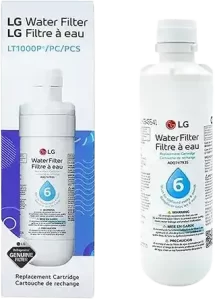 | LG LT1000P | LG | NSF 42, 53, 401 | 8+ certified: lead, cysts, pharmaceuticals | Check Price |
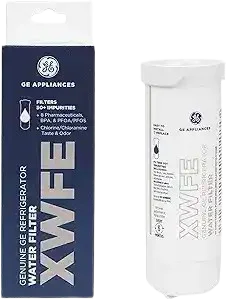 | GE XWFE | GE, GE Profile, Café | NSF 42, 53, 401 | 50+ incl. PFOA/PFOS, microplastics | Check Price |
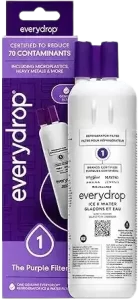 | EveryDrop EDR1RXD1 | Whirlpool, Maytag, KitchenAid | NSF 42, 53, 401 | 70 incl. 99% microplastics | Check Price |
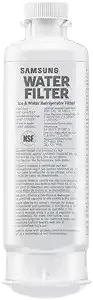 | Samsung HAF-QIN/EXP | Sumsung French Door (2019+) | NSF 42, 53, 401 | Lead, Benzene, Chlorine, Cysts | Check Price |
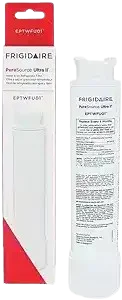 | Frigidaire PurePour PWF-1 | Frigidaire | NSF 401 | 99% Contaminant reduction (carbon fiber) | Check Price |
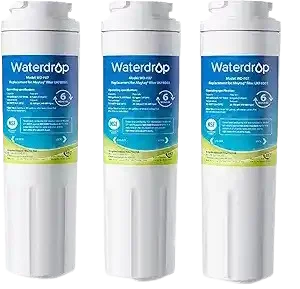 | Waterdrop WD-F07 | Whirlpool/Mytag (third party) | NSF 42, 53 | 200+ Contaminants | Check Price |
What Does a Refrigerator Water Filter Actually Remove?
A refrigerator water filter primarily uses activated carbon block media to adsorb chlorine, chloramines, lead, mercury, asbestos, and select pharmaceuticals from tap water. Activated carbon block uses tighter pore structure and higher contaminant contact time than granular activated carbon (GAC), which is why carbon block filters outperform GAC filters for health-related contaminant reduction.
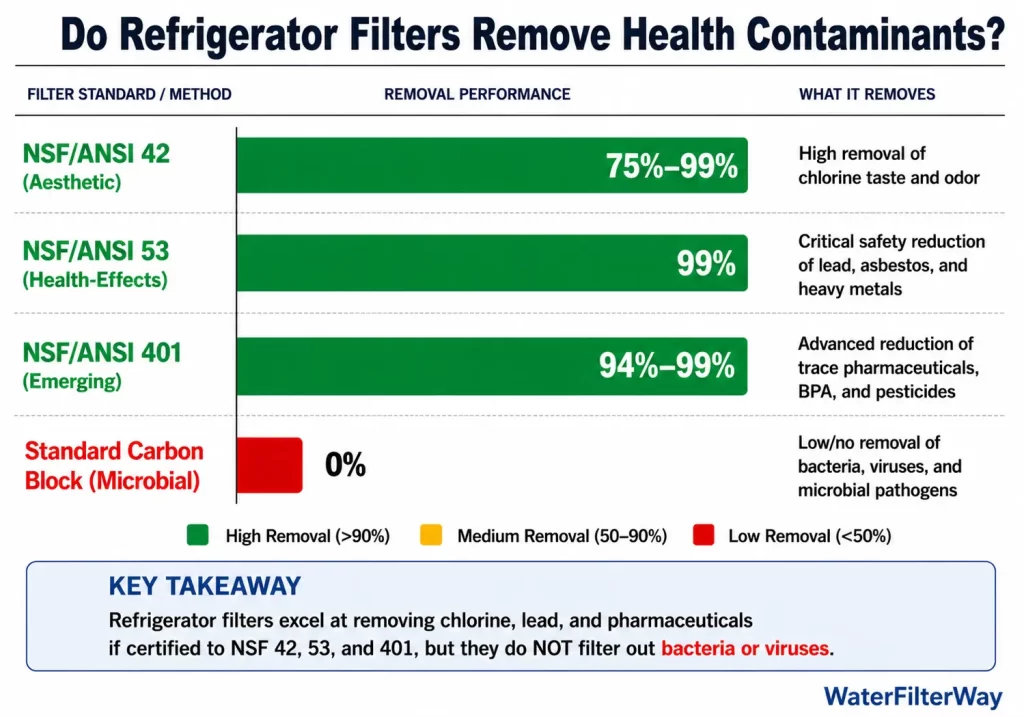
Refrigerator filters are certified under 3 NSF/ANSI standards. NSF/ANSI 42 covers aesthetic contaminants (chlorine taste and odor). NSF/ANSI 53 covers health-effect contaminants including lead at the EPA MCL of <10 ppb, Cryptosporidium, Giardia, asbestos, and VOCs. NSF/ANSI 401 covers 15 emerging trace contaminants including pharmaceuticals, herbicides, and pesticides with verified reduction percentages published in manufacturer performance data sheets.
NSF/ANSI Certification Standards Explained
| NSF Standard | Category | Contaminants Covered | Notes |
| NSF/ANSI 42 | Aesthetic | Chlorine taste/odor, particulates (Class I >75%; Class III >25%) | Baseline for all consumer filters |
| NSF/ANSI 53 | Health-effect | Lead (<10 ppb EPA MCL), mercury, Cryptosporidium, Giardia, asbestos, benzene, VOCs | Safety-critical certification |
| NSF/ANSI 401 | Emerging contaminants | 15 pharmaceuticals: ibuprofen (94.4%), naproxen (96.2%), estrone (96.6%), BPA (99.2%), atrazine (94.6%), lindane (99%) | Most advanced standard |
| NSF/ANSI P473 | PFAS | PFOA, PFOS, and broader per- and polyfluoroalkyl substances | Required for verified PFAS removal claims |
| NSF/ANSI 372 | Lead-free construction | Max 0.25% weighted lead content in filter materials | Ensures filter housing is safe |
Refrigerator water filters do NOT remove 7 contaminants. Standard activated carbon block does not remove microbial pathogens a claim that marketing language frequently implies incorrectly.
What Refrigerator Water Filters Do NOT Remove
| Contaminant | Removed by Standard Carbon Block? | What Removes It Instead |
| Fluoride | NO retained by design | Reverse osmosis system; activated alumina filter |
| Nitrates | NO | Reverse osmosis; ion exchange |
| Total Dissolved Solids (TDS) | NO | Reverse osmosis; ZeroWater ion exchange |
| Bacteria | NO carbon block is not a microbiological filter | UV disinfection; reverse osmosis with 0.0001 micron membrane |
| Viruses | NO | UV disinfection; nanofiltration |
| Chloramines (partial) | PARTIAL carbon block has lower efficiency vs chloramines than vs chlorine | Catalytic carbon filter; NSF 401 certified media |
| Broad-spectrum PFAS | PARTIAL (PFOA/PFOS only for NSF 53 certified models) | NSF P473 certified filter; reverse osmosis |
How Do You Know If a Refrigerator Water Filter Is NSF Certified or Just Self-Tested?
NSF International independently tests and certifies filters against specific contaminant reduction standards; a filter claiming to be “tested to NSF standards” without the NSF mark has only been self-evaluated by the manufacturer. These are 2 distinct and non-equivalent claims.
Verify any filter’s NSF certification at nsf.org using the free public product search tool. The WQA Gold Seal at wqa.org and the IAPMO Water Systems Certification Program are 2 additional recognized certification bodies.
NSF Certification vs Self-Testing: Key Differences
| Verification Type | Who Tests | Standard Applied | Reliability |
| NSF International certified | Independent accredited lab | NSF/ANSI 42, 53, 401, P473 | Highest third-party verified |
| WQA Gold Seal certified | Water Quality Association | WQA S-100, equivalent to NSF | High independent industry body |
| Self-tested (“meets NSF standards”) | Manufacturer’s own lab | Manufacturer-defined protocols | Unverified no independent audit |
Brands with confirmed independent NSF certification (2026): EveryDrop EDR1RXD1 (NSF 42, 53, 401), LG LT1000P (NSF 42, 53, 401), GE XWFE (NSF 42, 53, 401 50+ contaminants), Waterdrop WD-F07 (NSF 42, 53 certified third-party).
The packaging distinction to look for: “Certified by NSF International” with a listed standard number, not “tested to NSF standards.” Many sub-$20 Amazon generic filters display NSF-style logos without holding current NSF certification.
Which Refrigerator Water Filter Fits Your Specific Fridge Model?
Refrigerator water filter compatibility is determined by fridge brand, model number, and physical filter slot location not by brand name alone. Purchasing the wrong filter number within the same brand family is the single most common buyer error.
Find the fridge model number at 3 locations: inside the door frame on a label, on the existing filter cartridge, or in the owner’s manual. The model number not the brand name alone determines the correct filter number.
Refrigerator Water Filter Compatibility Map by Brand and Model
| Images | Fridge Brand | Filter Model | Slot Location | Notes | Current Price |
|---|---|---|---|---|---|
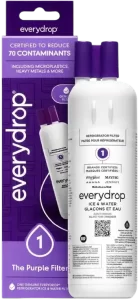 | Whirlpool / Maytag / KitchenAid | EDR1RXD1 (Filter 1) | Base grille | Side-by-side and bottom-freezer models | Check Price |
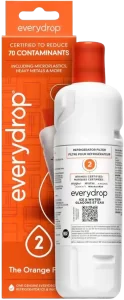 | Whirlpool / Maytag / KitchenAid | EDR2RXD1 (Filter 2) | Inside upper right | French Door models | Check Price |
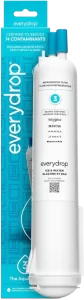 | Whirlpool / Maytag / KitchenAid | EDR3RXD1 (Filter 3) | Inside upper right | Most common Whirlpool filter side-by-side and French door | Check Price |
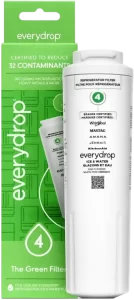 | Whirlpool / Maytag / KitchenAid | EDR4RXD1 (Filter 4) | Inside upper right | Whirlpool, Maytag, KitchenAid, Amana, JennAir most popular by unit volume | Check Price |
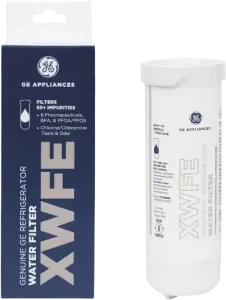 | GE | XWFE | Inside upper right | 2018+ GE, Profile, Café, Monogram replaces XWF; NO RFID lock | Check Price |
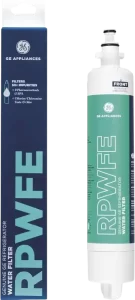 | GE | RPWFE | Inside upper right | Uses RFID chip OEM-only; third-party triggers error warnings | Check Price |
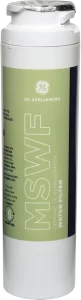 | GE | MSWF | Inside upper right | 2007+ side-by-side GE models | Check Price |
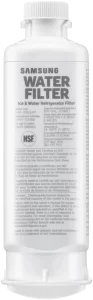 | Samsung | HAF-QIN/EXP | Inside upper right | 2019+ French Door models current 2026 model | Check Price |
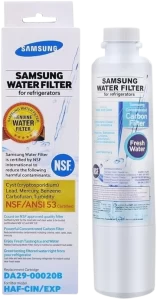 | Samsung | HAF-CIN (DA29-00020B) | Inside upper right | Older Samsung models | Check Price |
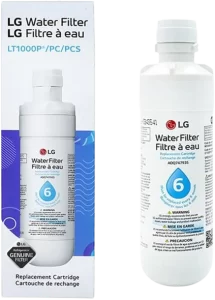 | LG | LT1000P | Front grille (twist) | 2016+ InstaView and French Door models | Check Price |
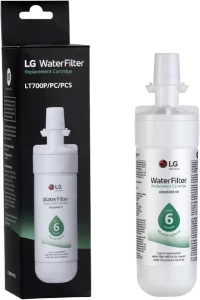 | LG | LT700P | Front grille (twist) | Older LG different form factor; NOT cross-compatible with LT1000P | Check Price |
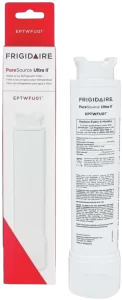 | Frigidaire | EPTWFU01 (PureSource Ultra II) | Inside upper right | Frigidaire Gallery and Professional models | Check Price |
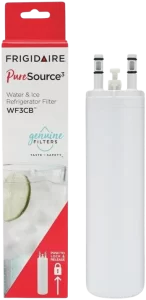 | Frigidaire | WF3CB (PureSource3) | Inside upper right | Older Frigidaire models | Check Price |
GE RPWFE Warning: This model uses RFID chip authentication built into the refrigerator housing. Non-OEM filters trigger a ‘replace filter’ error warning even when new. The GE XWFE does NOT use RFID and accepts compatible third-party filters. On r/Appliances, multiple documented threads confirm users bought EDR1RXD1 when their fridge required EDR3RXD1 the physical connectors differ and the filter will not seat correctly.
How Long Does a Refrigerator Water Filter Actually Last Before Performance Drops?
Most refrigerator water filters are rated for 200–300 gallons or 6 months, whichever comes first but actual performance degradation begins earlier in households with high-sediment or high-chloramine source water. The change indicator light in most OEM models is timer-based, not a sensor that measures contaminant saturation.
Average household dispenser and ice maker consumption: 1–2 gallons/day = 180–360 gallons over 6 months. 3 signs of a depleted filter before the indicator activates: reduced dispenser flow rate, return of chlorine taste or odor, and cloudy or off-tasting ice.
Filter Lifespan Comparison by Type and Brand
| Images | Filter Type | Brand / Model | Capacity | Lifespan | Change Indicator Type | Current Price |
|---|---|---|---|---|---|---|
| | OEM internal cartridge | LG LT1000P, EveryDrop EDR1RXD1 | 200 gallons | 6 months | Timer-based | Check Price |
| | OEM internal cartridge | GE XWFE | 300 gallons | 6 months | Timer-based | Check Price |
| | OEM internal cartridge | Samsung HAF-QIN/EXP, LG LT700P | 200 gallons | 6 months | Flow-rate sensor | Check Price |
| | Certified third-party | Waterdrop WD-F07 | 200 gallons | 6 months | No indicator | Check Price |
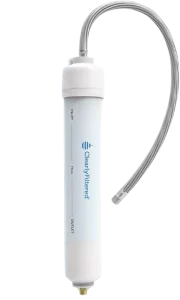 | Inline high-capacity | Clearly Filtered Universal | 2000 gallons | 2-3 years | Manual tracking | Check Price |
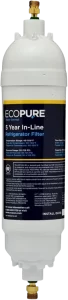 | Inline high-capacity | EcoPure EP10NL30 | 30,000 gallons (sediment only) | ~5 years | Manual tracking | Check Price |
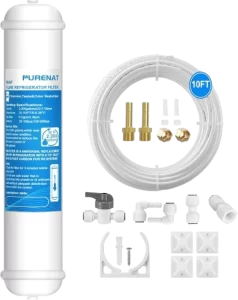 | Inline post-carbon | PURENAT Inline Water Filter | 2,000 gallons | 12 months | No indicator | Check Price |
Cost of overdue replacement: Activated carbon becomes a biofilm surface after saturation. A process called desorption (“dumping”) occurs once carbon pores are fully loaded previously captured contaminants re-enter the filtered water. NSF certification testing covers end-of-life capacity; a filter 2x beyond its rated gallonage is outside the scope of that testing.
Does a More Expensive Refrigerator Water Filter Always Perform Better?
Price alone does not determine refrigerator water filter performance NSF certification level and contaminant-reduction test results are the only reliable performance indicators.
The myth stated directly: “OEM filters are always safer and more effective than aftermarket options.” Consumer Reports (2026) testing found that the Waterdrop replacement filter for Whirlpool/EveryDrop performed comparably on taste and core contaminant categories at approximately one-third the OEM price, with a lifespan matching its claimed capacity.
What makes a third-party filter safe: independent NSF certification verified at nsf.org, correct NSF standard number on packaging, consistent carbon block density in manufacturing.
What makes a third-party filter risky: no independent certification, inconsistent filter media density, no verifiable testing data, sub-$10 pricing from unverified facilities.
GE RPWFE exception: OEM-only required due to RFID chip authentication not because of superior filtration, but because of electronic lock-in. A Clearly Filtered Universal Inline ($65 upfront, $0.03/gallon) has a lower per-gallon cost than any 6-month OEM cartridge.
What Is the True Cost of Owning a Refrigerator Water Filter Per Year?
The annual cost of a refrigerator water filter ranges from $36 to $130+ depending on whether you use OEM or certified third-party filters, filter change frequency, and whether you upgrade to a high-capacity inline system.
Annual Cost of Ownership Comparison
| Images | Filter Type | Replacements/Year | Notes | Current Price |
|---|---|---|---|---|
| | OEM EveryDrop / LG / GE / Samsung | 2x at $49–$60 each | Includes warranty protection | Check Price |
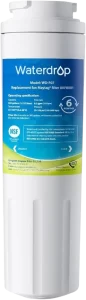 | Certified third-party (Waterdrop) | 2x at $15–$30 each | Must verify NSF cert at nsf.org | Check Price |
| | Frigidaire WF3CB 3-pack (2026 price) | 1 pack = 18 months of use | Best OEM per-gallon value | Check Price |
| | Samsung HAF-QIN-2P/EXP 2-pack (2026) | 2x/year | 22% off single-unit MSRP | Check Price |
| | Clearly Filtered Universal Inline | 1x every 2–3 years | Lowest per-gallon cost available | Check Price |
OEM subscription discounts reduce annual costs: Samsung offers 30% off HAF-CIN on auto-delivery; GE offers 10% off; Whirlpool EveryDrop offers 20% off with 6-month auto-delivery. Amazon review threads on EveryDrop document buyer frustration at the $60/replacement cost most switch to certified third-party after first replacement cycle.
Why Does My Refrigerator Water Still Taste Bad After Replacing the Filter?
A bad taste after replacing a refrigerator water filter is most commonly caused by carbon fines from an unflushed new filter, residual biofilm in the water supply line, or an incorrectly seated filter that allows unfiltered water to bypass the media. Filter quality is rarely the primary cause.
A 5-point diagnostic checklist:
1. Carbon fines: Flush 2–4 gallons (10–15 minutes continuous dispensing) before first use. Carbon dust from manufacturing causes black-tinted, mineral-tasting water that clears with flushing.
2. Plastic off-gassing: Resolves within 1–2 days with additional flushing. Not a defect standard for new carbon housing.
3. Supply line biofilm: If bad taste returns within 2–4 weeks of a new filter, the issue is upstream biofilm in the refrigerator’s internal water line re-contaminates filtered water after chlorine is removed.
4. Incorrect filter seating: GE RPWFE requires a firm click into the RFID dock. A filter seated at 80% of full engagement allows unfiltered water to bypass the media entirely.
5. Chloramine in municipal water: Carbon block reduces chlorine effectively but has lower efficiency against chloramines. 30%+ of US municipal systems use chloramine disinfection standard carbon block filters may not resolve the taste.
How Does an Inline Refrigerator Water Filter Differ from an Internal Cartridge Filter?
An inline refrigerator water filter installs on the external water supply line feeding the refrigerator, while an internal cartridge filter slots directly into the fridge housing. Both use carbon-based filtration but differ in capacity, installation, and contaminant coverage.
Inline Filter vs Internal Cartridge: Side-by-Side Comparison
| Feature | Internal Cartridge | Inline Filter |
|---|---|---|
| Capacity | 200-300 gallons | 2000-30000 gallons |
| Replacement Frequency | Every 6 months (2x/year) | Every 2-3 years |
| Installation | No tools twist and click | Basic plumbing compression or push-connect fittings |
| Compatibility | Brand-specific only | Brand-universal |
| Example Models | LG LT1000P, GE XWFE, EveryDrop EDR1RXD1 | Clearly Filtered (2,000 gal), EcoPure EP10NL30 (30,000 gal), Hydroviv ($266) |
| Best For | Renters, standard municipal water, warranty-sensitive users | High-volume households, no OEM slot available, documented high-contaminant water |
| Current Price | Check Price | Check Price |
Which Refrigerator Water Filter Should You Buy Based on Your Situation?
The right refrigerator water filter depends on fridge brand, municipal water quality report, replacement budget, and whether you prioritize certified contaminant reduction or cost-per-gallon efficiency. There are 4 buyer profiles each with 1 direct named recommendation.
Buyer Profiles: Direct Filter Recommendations
| Images | Recommended Filter | Buyer Profile | Situation | Current Price |
|---|---|---|---|---|
| | Waterdrop WD-F07 | Profile 1 Budget buyer | Standard chlorine-treated municipal water no documented lead alerts | Check Price |
| | EveryDrop EDR1RXD1 or EDR3RXD1 | Profile 2 OEM reliability buyer | Whirlpool, KitchenAid, or Maytag fridge warranty preservation priority | Check Price |
| | LG owners: LG LT1000P. All others: Clearly Filtered Universal Inline | Profile 3 High-contaminant area buyer | Lead service lines, PFAS-positive utility data, agricultural runoff, EPA violations | Check Price |
| | Clearly Filtered Universal Inline | Profile 4 Low-replacement-frequency buyer | 3+ gallons/day usage or aversion to $60 OEM every 6 months | Check Price |
How to Replace a Refrigerator Water Filter Without Leaking
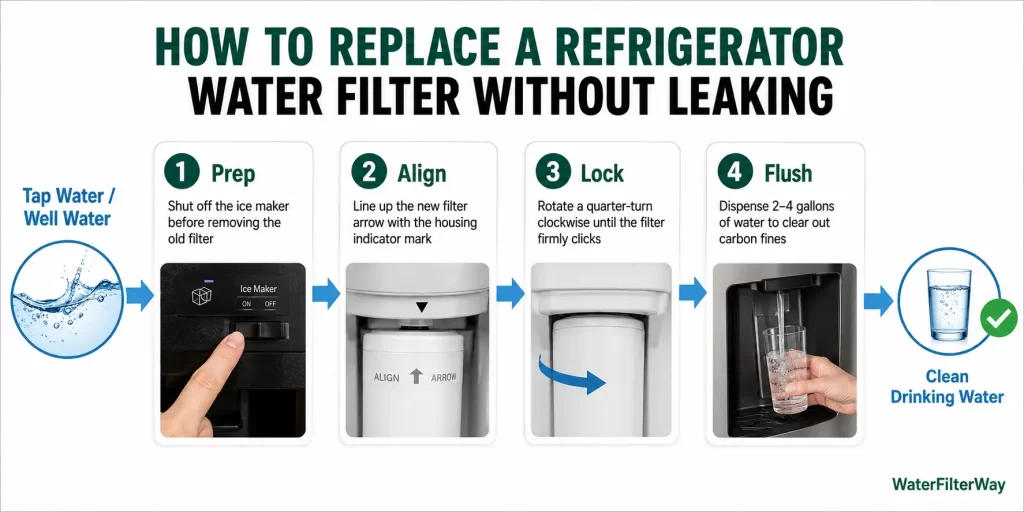
Replace a refrigerator water filter using 4 steps:
6. Shut off the ice maker before removing the old filter to prevent water draining into the housing.
7. Align the new filter arrow with the housing indicator mark.
8. Rotate a quarter-turn clockwise until the filter clicks the housing O-ring requires firm compression to seat fully. A filter seated at 80% allows bypass and leaking.
9. Flush 2–4 gallons through the dispenser to clear carbon fines before first use.
Most post-installation leaks trace to incomplete rotation, not defective filters. The audible click confirms full O-ring compression.
What Is the Difference Between NSF 42, NSF 53, and NSF 401 for Water Filters?
NSF/ANSI 42 certifies reduction of aesthetic contaminants chlorine taste, odor, and particulates and is the baseline certification for all consumer refrigerator filters. NSF/ANSI 53 certifies reduction of health-effect contaminants including lead (below 10 ppb EPA MCL), mercury, Cryptosporidium, Giardia, and turbidity. NSF/ANSI 401 certifies reduction of 15 emerging trace contaminants including pharmaceuticals, herbicides, and pesticides. A filter certified to all 3 standards LG LT1000P, GE XWFE, EveryDrop EDR1RXD1 provides the broadest documented contaminant coverage available in a residential refrigerator format.
When Should You Use an Inline Filter Instead of the Built-In Refrigerator Filter?
Use an inline filter when: the refrigerator has no internal filter housing (common in older models and counter-depth designs), when household consumption exceeds 3 gallons/day making 6-month OEM replacements economically impractical, or when the water utility report shows contaminant levels above EPA MCLs that a 200-gallon carbon block filter cannot adequately address.
The Hydroviv Refrigerator/Ice Maker Filter ($266) is the highest-specification inline option customized by ZIP code using EPA and water utility quality data.
Does a Refrigerator Water Filter Affect Ice Maker Water Quality?
In most refrigerator configurations, a single internal filter cartridge feeds both the water dispenser and ice maker through one supply line replacing the filter improves both dispensed water and ice quality simultaneously. Chlorine reduction directly impacts ice flavor because chlorine compounds concentrate during freezing, amplifying taste defects in ice more than in liquid water.
Exception: Some bottom-freezer and French Door Samsung configurations route ice maker water through a separate supply line. Check the model’s plumbing schematic if ice quality does not improve after filter replacement.
What Happens If You Don’t Replace Your Refrigerator Water Filter on Time?
An overdue filter undergoes progressive contaminant adsorption saturation once carbon media is fully loaded, a process called desorption (“dumping”) causes previously captured contaminants to re-enter filtered water. Dispenser flow rate decreases as pore channels fill. In warm, high-humidity environments, fully saturated carbon block media supports bacterial biofilm growth within the housing. NSF certification end-of-life testing covers performance at rated capacity only a filter 2x beyond its rated gallonage has no certified contaminant reduction guarantee.
How Do Samsung and LG Refrigerator Filters Compare on Contaminant Coverage?
Samsung HAF-QIN/EXP vs LG LT1000P: Contaminant Coverage Comparison
| Feature | LG LT1000P | Samsung HAF-QIN/EXP |
|---|---|---|
| NSF Certifications | NSF 42, 53, 401 | NSF 42, 53, 401 |
| Lead Removal | Certified 99% reduction | Certified |
| Cyst Removal (Crypto/Giardia) | 99.99% NSF 53 certified | Certified |
| Asbestos Removal | 99% NSF 53 certified | Not highlighted in specs |
| Pharmaceuticals (NSF 401) | Ibuprofen 94.4%, Estrone 96.6%, BPA 99.2%, Naproxen 96.2% | NSF 401 specific % not published |
| Capacity | 200 gallons / 6 months | 200 gallons / 6 months |
| Best For | Documented pharmaceutical/pesticide contamination; broadest published reduction data | Standard municipal water; French Door Samsung models |
| Current Price | Check Price | Check Price |
For buyers on standard chlorine-treated municipal water, both filters perform equivalently on contaminants that affect taste and safety at standard EPA levels. For buyers with documented pharmaceutical or pesticide contamination, the LG LT1000P provides more extensively published individual compound reduction data under NSF 401 challenge testing.
FAQ’s:
Q1.What does a refrigerator water filter actually remove?
Most fridge filters use activated carbon block, which is effective against chlorine, lead, mercury, asbestos, and certain pharmaceuticals. It does not remove fluoride, nitrates, dissolved solids, bacteria, or viruses — those need reverse osmosis or UV treatment instead.
Q2.How can you tell if a filter is genuinely NSF certified or just self-tested?
Look for the phrase “Certified by NSF International” along with a specific standard number on the packaging. Claims like “tested to NSF standards” usually mean the manufacturer evaluated it in-house, with no independent audit. You can confirm certification for free at nsf.org.
Q3.Does a more expensive refrigerator filter always perform better?
Not necessarily. Price doesn’t determine performance — the NSF certification level does. Independent testing has found that some certified third-party filters match OEM filters on core contaminant reduction at a fraction of the cost, as long as the certification is verifiable.
Q4.Why does the water still taste bad after replacing the filter?
This is usually not a filter defect. Common causes include unflushed carbon dust from a brand-new filter, a filter that isn’t fully seated, residual biofilm in the supply line, or chloramine-treated water, which standard carbon block handles less effectively than chlorine.
Q5.What’s the difference between an inline filter and an internal cartridge filter?
An internal cartridge slots directly into the fridge and typically lasts 200–300 gallons before needing replacement every 6 months. An inline filter is installed on the external supply line, holds far more capacity (2,000+ gallons), and can last 2–3 years, but requires basic plumbing to install.
Q6.What happens if you don’t replace your refrigerator water filter on time?
Once the carbon media is fully saturated, previously trapped contaminants can leach back into the water — a process known as desorption. Flow rate also drops, and in warm, humid conditions, the saturated filter housing can become a site for bacterial growth.
