
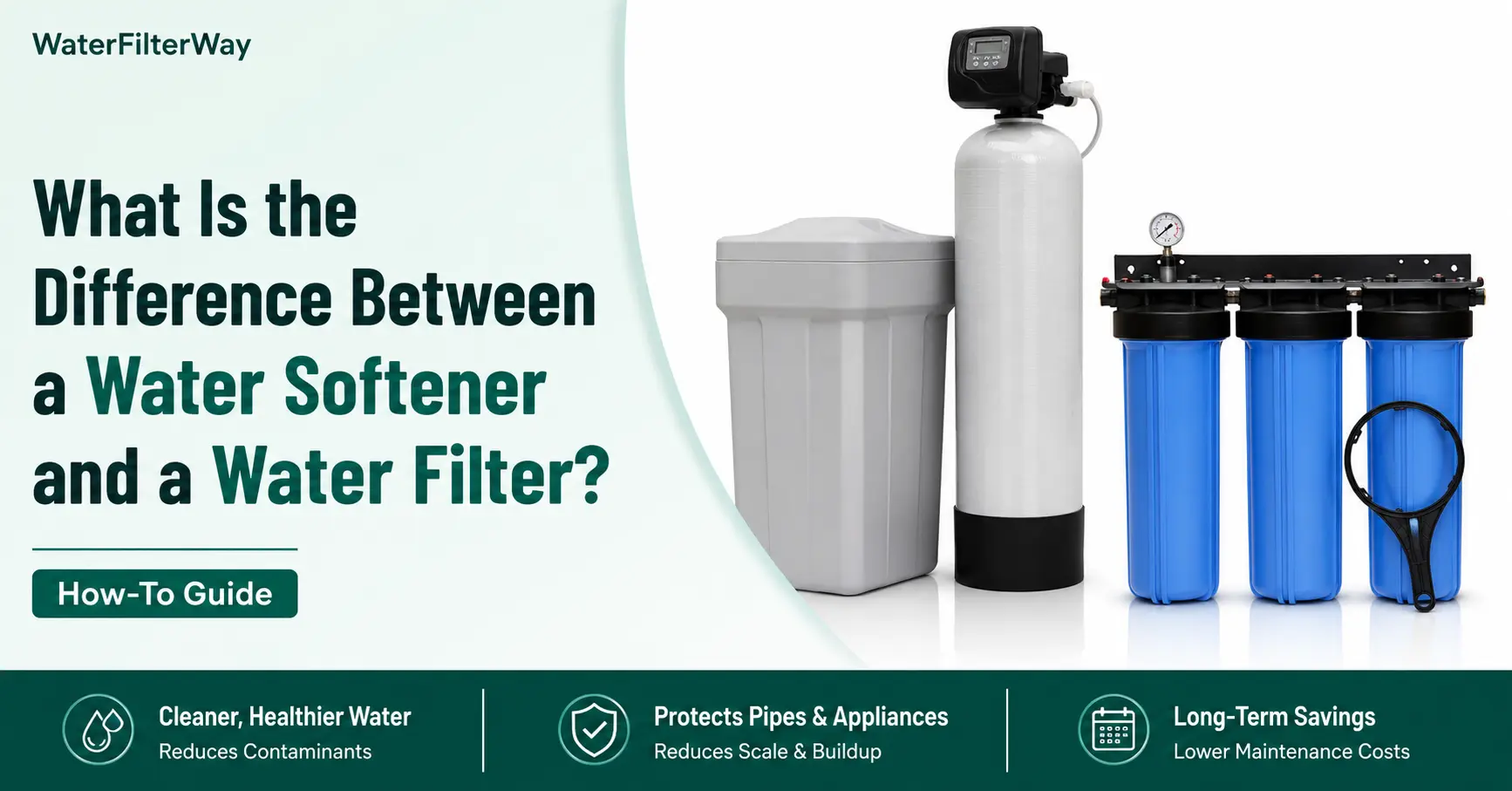
A softener removes calcium and magnesium from your water so it stops leaving spots on dishes, scale on fixtures, and dryness on skin and hair. A filter removes contaminants such as chlorine, sediment, lead, and other substances that affect taste, smell, or safety. One deals with hardness. The other deals with what is actually in the water beyond the minerals. Many homes end up needing both, and understanding what each one actually does is the first step to picking the right setup for your house.
What Does a Water Softener Do to Your Water?
A water softener has one job: get rid of the calcium and magnesium that make water hard. These minerals are not dangerous to your health, but they cause a long list of household headaches. Hard water leaves white spots on glasses and dishes, dulls laundry, makes soap harder to lather, and slowly builds up scale inside pipes, water heaters, and appliances. Over time that buildup reduces the lifespan of anything the water passes through and pushes up your energy bills, since scaled heating elements have to work harder.
A softener fixes this at the source. It does not clean the water of chemicals or bacteria. It just takes the hardness out.
How Does Ion Exchange Remove Hardness Minerals?
Water softeners use a process called ion exchange. Inside the unit is a tank filled with small resin beads coated in sodium or potassium ions. As hard water flows through the tank, the calcium and magnesium ions in the water swap places with the sodium or potassium ions sitting on the beads. The hardness minerals stay stuck to the resin, and the water that comes out the other side is soft.
Over time the beads fill up with calcium and magnesium and need to be refreshed. This is called regeneration. The system flushes the tank with a salt brine solution, which pulls the built-up minerals off the beads and washes them down the drain, leaving the resin ready to soften water again.
What Are the Signs That Your Home Has Hard Water?
You do not need a lab test to suspect hard water. A few signs usually give it away:
● White or chalky spots on glasses, dishes, and shower doors
● A film left on your skin after washing your hands
● Soap or shampoo that will not lather properly
● Laundry that feels stiff or looks dull even after washing
● Reduced water pressure or a clogged showerhead over time
● A water heater that seems to be working harder than it should
That last point matters more than people realize. Mineral deposits from hard water can reduce the life of water-using equipment, raise the cost of heating water, lower the efficiency of electric water heaters, and clog pipes over time.
What Is the Difference Between a Salt-Based and Salt-Free Water Softener?
Not every softener uses salt. Salt-based systems are the traditional type and use ion exchange the way described above, swapping hardness minerals for sodium or potassium. They are the most effective option for genuinely hard water and the standard choice when hardness levels are high.
Salt-free systems, often called water conditioners, work differently. Instead of removing calcium and magnesium, they use a media that changes the mineral structure so it does not stick to pipes and fixtures. The water still contains the minerals, they just stop causing scale. Salt-free units need less maintenance, do not run on electricity, and do not produce the wastewater a salt-based system generates during regeneration, which makes them a common choice in areas where local rules restrict salt discharge. Some are rated for up to a decade of use before the media needs replacing.
The tradeoff is capacity. Salt-free conditioners work well for water that is only mildly to moderately hard, but they generally cannot keep up with very hard water. If a hardness test comes back high, a salt-based softener is still the more reliable choice.
What Does a Water Filter Do to Your Water?
A water filter has a different job than a softener. Instead of targeting hardness minerals, it targets contaminants, the substances in water that can affect taste, smell, or health. Water filter is not one single product. It is an umbrella term that covers several different technologies, each built to catch a different kind of contaminant.
What Filtration Methods Do Water Filters Use?
Most filters combine a few methods depending on what they are designed to remove:
● Activated carbon adsorbs chlorine, chloramine, and the compounds behind bad taste and odor
● Sediment filters physically trap dirt, rust, and other particles before they reach the rest of the system
● Reverse osmosis pushes water through a semi-permeable membrane fine enough to block dissolved solids and metals
● UV filtration uses ultraviolet light to neutralize bacteria, viruses, and cysts without adding any chemicals
Many systems stack two or three of these stages together, so water passes through sediment removal first, then carbon or membrane filtration, which protects each stage and gives a cleaner result.
What Is the Difference Between a Whole House Filter and a Point-of-Use Filter?
Where a filter sits in your plumbing changes what it does for you. A whole house filter, also called a point-of-entry system, is installed where water enters your home, so every tap, shower, and appliance gets filtered water. A point-of-use filter, like an under-sink unit, countertop system, or pitcher filter, treats water at one specific location, usually the kitchen tap used for drinking and cooking.
If your concern is water quality throughout the whole house, including showers and laundry, a whole house system covers more ground. If you mainly care about your drinking and cooking water, a point-of-use filter gets the job done at a lower cost.
Which Contaminants Does a Water Filter Remove?
The exact list depends on the filter type, but common targets include:
● Metals such as lead, arsenic, copper, cadmium, and hexavalent chromium
● Chlorine and chloramine
● PFOS and PFOA, along with other industrial and pharmaceutical byproducts
● Pesticides and herbicides
● Bacteria, viruses, and cysts
● Sediment and other particulates
Notice that hardness minerals are not on this list. That is the core distinction between a filter and a softener: a filter is built to remove things that can affect safety or taste, not the calcium and magnesium that just make water hard.
What Are the Key Differences Between a Water Softener and a Water Filter?
Once you know what each system actually does, the differences are easier to line up side by side.
| Feature | Water Softener | Water Filter |
| Primary function | Removes hardness minerals (calcium and magnesium) | Removes contaminants (chlorine, sediment, metals, and more) |
| Mechanism | Ion exchange with resin beads | Varies by type: carbon adsorption, sediment trapping, membrane filtration, or UV |
| What it does not do | Does not remove chemical contaminants or make water safer to drink | Does not address water hardness or scale buildup |
| Maintenance | Monthly salt refills, occasional brine tank cleaning | Cartridge replacement every three to six months |
| Installed at | Point of entry (whole house) | Point of entry or point of use, depending on type |
Do You Need a Water Softener, a Water Filter, or Both?
The honest answer depends on what is actually bothering you about your water.
If your complaints are spotty dishes, scale on fixtures, dry skin, or soap that will not lather, that is hardness, and a softener is the fix. If your concern is taste, smell, or the safety of what is coming out of the tap, that is a job for a filter. If you are dealing with both hard water and worries about contaminants, which is common in homes on well water, you will likely need both systems working together.
It is worth being clear about one thing: owning a softener does not mean your water is clean or safe to drink. A softener only deals with hardness minerals. It does nothing to remove chlorine, lead, bacteria, or the other contaminants a filter is built to catch. If someone in your house is drinking straight from a softened line and assuming that covers water safety, it does not.
Is Softened Water Safe to Drink?
Yes, for most people. When a softener swaps calcium and magnesium for sodium or potassium ions, the amount of sodium added to your water is small compared to what you get from a normal diet. For most healthy people, this extra sodium is not something to worry about. If you are on a medically restricted sodium diet, it is worth checking with your doctor before drinking softened water regularly, since even a small addition can matter in that situation.
What softened water is not, is purified. Softening addresses hardness only. It does not remove chemical contaminants, bacteria, or viruses, so if your goal is water that is both soft and free of contaminants, you need a filter alongside the softener, not instead of it.
How Do the Cost and Maintenance of a Water Softener Compare to a Water Filter?
Cost is not just the price tag on the unit. What you pay to keep each system running matters just as much.
| Water Softener | Water Filter | |
| Unit cost | $200 to $4,000 | $50 to $4,800 |
| Ongoing maintenance | Salt refills roughly monthly, occasional brine tank cleaning | Cartridge replacement every three to six months |
| Who usually handles it | Often DIY, though professional installation is common for the initial setup | Usually a simple DIY cartridge swap |
| If you run both | Budget for salt and cartridges on two separate schedules | Same |
A softener’s ongoing cost is mostly salt, which is cheap but needs regular attention. A filter’s ongoing cost is the replacement cartridge, which varies more by system but is a simpler swap. If you are running both, budget for two separate maintenance schedules rather than expecting one system to cover the other’s costs.
How Do Water Softeners and Filters Fit Into a Complete Home Water Treatment Plan?
A softener and a filter are not the end of the story for most homes. Once you have addressed hardness and general contaminants, there are a few more decisions worth understanding: whether reverse osmosis makes sense for your drinking water, what to look for in a whole house filtration setup, how to actually test your water before buying anything, and what well water specifically requires beyond the basics. The sections below walk through each of these.
How Does a Water Softener Compare to a Reverse Osmosis System?
A softener conditions water for the entire house using ion exchange. Reverse osmosis works differently and at a smaller scale: it pushes water through a semi-permeable membrane fine enough to remove up to roughly 95 percent of total dissolved solids, including some of the minerals that contribute to hardness.
That might make RO sound like it could replace a softener, but in practice it does not work well that way. Filtering hard water through an RO membrane wears the membrane out faster, and RO systems waste a fair amount of water during filtration. For whole house hardness, a softener remains the more efficient option. What often works best is pairing the two: a softener treats the whole house, and an RO unit sits at the kitchen tap for drinking water, with the softener protecting the RO membrane and extending its life.
If you are trying to decide whether reverse osmosis alone could replace your softener, our Water Softener vs Reverse Osmosis comparison walks through where each one holds up and where it falls short.
What Should You Look for in a Whole House Water Filtration System?
If you have decided your whole house needs filtration, not just your kitchen tap, a few things matter more than others when comparing systems: the flow rate, since undersized systems slow your water pressure; how many filtration stages it uses; whether it is certified against NSF standards for the contaminants you actually care about; and whether it neutralizes acidity, which some systems do as an added benefit that reduces corrosion in pipes and fixtures over time.
Testing your water first tells you which of these actually matter for your house, since a system built for chlorine and sediment will not necessarily help with acidity or specific metals. Our guide to choosing a whole house water filtration system goes through how to match the system to what is actually in your water.
How Do You Test Your Home’s Water Hardness Before Choosing a System?
Before buying either a softener or a filter, it helps to know what you are actually dealing with. Water hardness is measured in grains per gallon, and there are a few ways to check it: a simple test strip kit, sending a sample to a lab for a full breakdown, or checking with your local water utility if you are on a municipal supply. Generally speaking, anything above 7 grains per gallon is considered hard enough that a softener starts to make sense, though very hard water well above that threshold benefits the most.
If you have not tested your water yet, our walkthrough on how to test your home’s water hardness covers each method and what the results actually mean for your decision.
What Water Treatment Does Well Water Need Beyond a Softener or Filter?
Well water often comes with issues a standard softener or filter is not built to handle on its own. Iron and sulfur are common in well water and show up as an orange tint or a rotten egg smell, neither of which a basic carbon filter or softener resin is designed to remove. Bacteria is another concern specific to wells, since there is no municipal treatment step before the water reaches your tap.
If you are on well water, treating just for hardness and general contaminants usually is not enough. Our guide to well water treatment covers the additional stages, like iron and sulfur filtration and disinfection, that well water typically needs on top of the basics.
How Much Does It Cost to Install a Water Softener in Your Home?
The unit itself is only part of the cost. Installation adds labor, and the total depends on your household size, how hard your water actually is, and how accessible your existing plumbing is for the installer to work with. Larger households and harder water usually call for bigger units, which pushes the price up.
For a full breakdown of what installation actually costs by household size and hardness level, our water softener cost and installation guide walks through the numbers in more detail.
What Type of Salt Should You Use in a Water Softener?
Most softeners run on either sodium chloride or potassium chloride. Sodium chloride is the cheaper and more common option. Potassium chloride costs more but is worth considering if you are on a low sodium diet or you use softened water on garden plants, since it avoids adding sodium to the water and soil.
Our comparison of water softener salt types covers the cost, environmental impact, and health considerations behind each option in more depth.
How Do You Maintain a Water Softener for Long-Term Performance?
A softener needs a bit of regular attention to keep working properly: salt refills roughly monthly, occasional cleaning of the brine tank, and an eye on the resin bed, which typically lasts several years before it needs replacing. Warning signs that something needs attention include softened water that suddenly feels hard again, a salty taste, or unusual noise during the regeneration cycle.
Our guide to maintaining a water softener over the long term covers a simple maintenance schedule and what to check for at each stage
Frequently Asked Questions
Can a water softener replace a water filter?
No. A softener only removes hardness minerals like calcium and magnesium. It does not remove chlorine, lead, bacteria, or other contaminants, so it cannot do a filter’s job.
Does softened water taste salty?
It should not. The salt used during regeneration is rinsed away and sent down the drain, not into your household water. If your water tastes salty, the softener likely needs servicing.
Is it safe to drink water from a whole house softener?
For most people, yes. The added sodium is small compared to a normal diet. If you are on a sodium-restricted diet, check with your doctor first.
Do I need a water softener if I already have reverse osmosis?
Usually yes, if your water is hard. RO treats water at one tap, while a softener treats water throughout the entire house and also protects your RO membrane from scale.
How do I know if my water is hard enough to need a softener?
Test it. Anything above roughly 7 grains per gallon is generally considered hard enough to benefit from a softener, though a simple test strip or lab test will give you an exact number.