Water Filter Way
RoundupBuyer’s Guides

Best Water Test Kits for Home Use

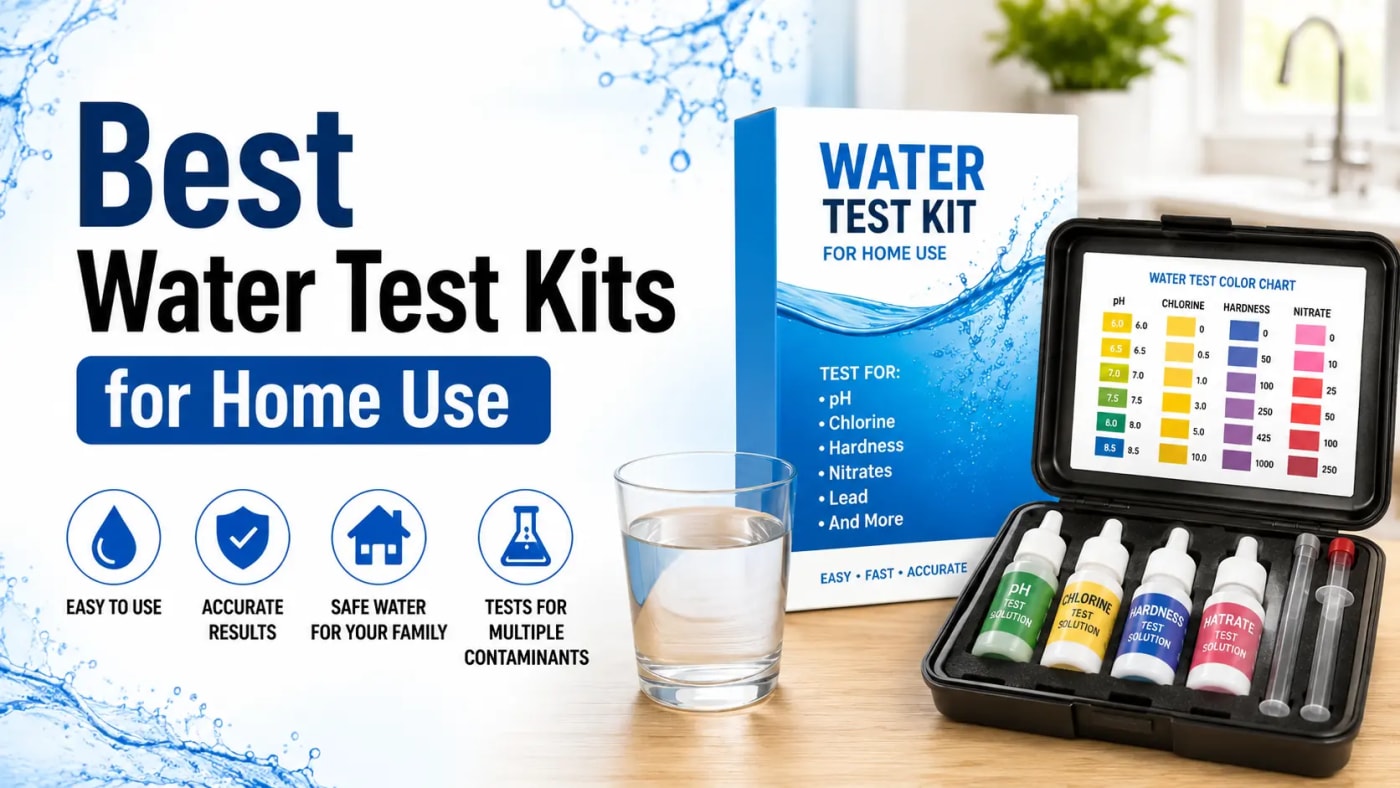
Best water test kits for home use displayed with a water testing kit, glass of water, test solutions, and color chart for checking common water quality parameters.

Share

Our Top Picks

A home water test kit checks your tap or well water for things like lead, bacteria, hardness, and other contaminants. Some kits give you a color strip answer in your kitchen in under a minute. Other kits send your water sample to a certified lab and give you a detailed report in a few days. The right choice depends on where your water comes from, what contaminants worry you, how accurate you need the result to be, how fast you want the answer, and how much you want to spend.

City water and well water are not the same. City water goes through a utility that already tests it, so home testing usually checks your household plumbing for lead or copper. Well water gets no outside testing, so a broader lab panel is the safer starting point. Below, you will find the top picks, a full comparison table, in depth reviews of each kit, and a buying guide that walks you through every decision

Here are the three strongest kits from this guide, based on accuracy, coverage, and ease of use.

Top 3 water test kits at a glance:

  • Tap Score Essential City Water Test. Certified lab test with 49 analytes. Best for homeowners on city water who want lab grade accuracy without paying for hundreds of extra analytes they do not need.

  • Safe Home Ultimate Drinking Water Test Kit (WE TEST AT-LAB). Certified lab test with 200 parameters. Best for anyone who wants the widest possible lab screening in a single kit, for city or well water.

  • Varify Complete Drinking Water Test Kit. DIY strip kit with 17 parameters and 100 strips. Best for fast, repeat, at home monitoring without shipping a sample anywhere.

In-Depth Reviews

#1Best for City Water Baseline Screening

Tap Score Essential City Water Test

$199.99

Key Features

A mail in kit built for people on a public water utility, focused mainly on metals and inorganics like lead, arsenic, copper, iron, and manganese that come from old pipes and fittings rather than the utility itself.

Reasons to Buy

  • Tests 49 analytes, with a strong focus on the metals most relevant to household plumbing
  • Report ranks results against local and federal safety limits with clear treatment advice
  • Free shipping both ways, samples go to ISO/NELAC accredited labs
  • Fast 3 to 5 business day turnaround compared to broader panels

Reasons Not to Buy

  • 49 analytes will not catch PFAS, full VOC screening, or well specific parameters
  • Not the right pick for private well water, which needs a broader panel
  • A bigger Tap Score panel is needed for households near industrial or agricultural concerns

Specs at a Glance

MethodParametersResult timeWater source
Certified lab49 analytes3 to 5 business daysCity water

The Tap Score Essential City Water Test is a mail in kit built for people on a public water utility. You collect a sample at home, mail it to a certified partner lab, and get results back in 3 to 5 business days.

This kit tests 49 analytes. The main focus is metals and inorganics, including lead, arsenic, copper, iron, manganese, and other elements that come from old pipes, fittings, and solder rather than from the utility itself. This makes it a strong pick for anyone living in a home built before 1986, or in an area with aging water infrastructure.

The report ranks your results against local and federal safety limits. It explains what each detected contaminant means and gives treatment advice that is not tied to selling you a specific filter. Shipping is free both ways, and every sample goes to a lab holding accreditation such as ISO or NELAC.

Strengths of this kit include certified lab accuracy, a clear digital report, and free shipping. The main limitation is that 49 analytes will not catch everything. If a household wants PFAS, full VOC screening, or well specific parameters, a bigger Tap Score panel or a different kit fits better. This kit suits city water users who mainly worry about metals and want a trustworthy baseline test without paying for parameters that do not apply to municipal supplies.

#2Best for Comprehensive Single Panel Testing

Safe Home 200-in-1 Ultimate Drinking Water Test Kit

$499.95

Key Features

A mail in lab kit screening for 200 parameters, one of the broadest single panels available for home use, covering physical properties, metals, and both semi volatile and volatile organic compounds.

Reasons to Buy

  • Covers hardness, pH, and turbidity alongside metals like lead and arsenic, plus a long list of chemical compounds
  • Works for both city water and well water in one kit
  • EPA certified lab processes the sample with full quality control review
  • Good fit for new home buyers or households near industrial or agricultural land

Reasons Not to Buy

  • Higher price and longer turnaround (7 to 10 business days) than a small DIY kit
  • Only offers the full lab pathway, no quick strip option included
  • Overkill for someone who just wants a fast yes or no answer on a single contaminant

Specs at a Glance

MethodParametersResult timeWater source
Certified lab200 parameters7 to 10 business daysCity or well water

The Safe Home Ultimate Drinking Water Test Kit is a mail in lab kit that screens for 200 parameters. This is one of the broadest single panels available for home use, covering city water and well water alike.The 200 parameters break down into physical properties, inorganic chemicals, metals, and both semi volatile and volatile organic compounds. In practical terms, this means the kit picks up hardness, pH, and turbidity alongside metals like lead and arsenic, plus a long list of chemical compounds that can come from industrial activity, old plumbing, or nearby land use.

To use the kit, you fill the included collection vessels with a water sample, complete the paperwork, register the kit online, and place everything in the prepaid return shipper. The lab that processes your sample is EPA certified, and the results reach you by email within about 7 to 10 business days after the lab receives your sample.

This is a separate product from the Safe Home DIY strip kits, which use color strips instead of lab analysis. The Ultimate kit only offers the full lab pathway. Anyone wanting a quick strip check needs a DIY product instead. The main trade off with this kit is turnaround time and price, since a 200 parameter lab panel costs more and takes longer than a small DIY kit. It fits homeowners who want one comprehensive test that covers nearly everything at once, such as new home buyers, or households near industrial or agricultural land.

#3Best for Fast, Repeat Home Monitoring

Varify 17-in-1 Complete Drinking Water Test Kit

$21.31

Key Features

A DIY strip based kit testing 17 parameters including chlorine, fluoride, lead, iron, hardness, pH, and copper, plus two separate bacteria tests, with 100 strips packed in sealed pouches to stay fresh.

Reasons to Buy

  • Results in about 60 seconds for strips, no lab or shipping needed
  • 100 strips included across 5 sealed pouches, good for repeat testing over time
  • Works on both tap water and well water
  • Includes 2 bacteria tests for coliform detection

Reasons Not to Buy

  • Readings are semi quantitative (ranges, not exact lab grade numbers)
  • Bacteria test still needs 48 hours to develop
  • Not a substitute for certified lab analysis when an exact number matters, like confirming lead before choosing a filter

Specs at a Glance

MethodParametersResult timeWater source
DIY strips17 parameters plus 2 bacteria tests~60 seconds for strips, 48 hours for bacteriaTap or well water

The Varify Complete Drinking Water Test Kit is a DIY strip based kit built for fast, repeat testing at home. It works on tap water and well water.The kit tests 17 parameters using color changing strips, including chlorine, fluoride, lead, iron, hardness, pH, and copper. It comes with 100 strips packed in five sealed pouches of 20, so the strips stay fresh over time. The kit also includes two separate bacteria tests that detect coliform bacteria.

To use it, you dip a strip in a water sample and match the resulting color to the included chart. Strip results appear in about 60 seconds. The bacteria test works differently. You fill a small vial with your sample and wait 48 hours for a color change that shows whether bacteria are present.

Because this kit uses color matching instead of laboratory equipment, its readings are semi quantitative. That means results appear as ranges rather than exact lab grade numbers. This makes the kit excellent for routine monitoring, tracking changes over time, or catching an obvious problem quickly. It is not a replacement for certified lab analysis when a health decision needs an exact number, such as confirming a specific lead level before choosing a filter or reporting a real estate transaction.

#4Best for Private Well and Spring Water

WaterCheck Deluxe

Key Features

A mail in lab kit testing 107 items, including bacteria, 22 heavy metals and minerals, 7 other inorganic chemicals, 5 physical factors, 4 trihalomethanes, 47 VOCs, and 20 pesticides, herbicides, and PCBs, from a lab serving private well owners since 1990.

Reasons to Buy

  • One of the most complete well water panels available to homeowners
  • Strong fit for annual or pre purchase screening, especially near farmland
  • Covers bacteria (total coliform and E. coli) alongside a wide chemical panel
  • Backed by a lab with decades of well water testing experience

Reasons Not to Buy

  • Return shipping requires next day service and is not included in the kit price
  • Longest turnaround of the group, about 10 to 12 business days
  • Not the right pick for city water users, since it duplicates work a city test does not need

Specs at a Glance

MethodParametersResult timeWater source
Certified lab107 items10 to 12 business daysPrivate well or spring

WaterCheck Deluxe is a mail in lab kit built specifically for private well and spring water. It is offered by National Testing Laboratories, a lab that has served private well owners since 1990.This kit tests 107 items. Coverage includes bacteria testing for total coliform and E. coli, 22 heavy metals and minerals, 7 other inorganic chemicals, 5 physical factors, 4 trihalomethanes, 47 volatile organic chemicals, and 20 pesticides, herbicides, and PCBs. This breadth makes it one of the most complete well water panels available to homeowners.

To use the kit, you collect your sample using the included bottles and instructions, then ship it back to the lab. Return shipping requires next day service and is not included in the kit price, so buyers need to plan the return shipment in advance. Results typically take about 10 to 12 business days after the lab receives the sample.

The kit fits well and spring water owners who want a full annual or pre purchase screening, especially in areas near farmland where pesticide runoff is a real concern. It is not the right pick for someone on city water, since municipal supplies already receive utility level testing and a well focused panel duplicates work a city test does not need. Homeowners on a public utility fit better with a city water kit like the Tap Score Essential City Water Test.

#5Best for Quick Screening of Common Contaminants

Watersafe The Original Water Testing Kit

$34.99

Key Features

A DIY strip and vial kit covering 9 key parameters, lead, bacteria, copper, iron, chlorine, nitrate/nitrite, pH, and hardness, with results in about 10 minutes for most tests.

Reasons to Buy

  • Fast results, about 10 minutes for most parameters
  • No lab or mail in step required
  • Works on both tap water and well water
  • Good first check before deciding whether a deeper lab test is worth the cost

Reasons Not to Buy

  • Will not detect PFAS or most organic chemicals
  • Gives a detected/not detected style answer rather than an exact quantified value
  • Bacteria test still needs 48 hours to develop

Specs at a Glance

MethodParametersResult timeWater source
DIY strips and vial9 key parameters10 minutes for strips, 48 hours for bacteriaTap or well water

The Watersafe Drinking Water Test is a fast, do it yourself kit that checks for the most common water quality concerns without any lab or mail in step.The kit covers 9 key parameters: lead, bacteria, copper, iron, chlorine, nitrate and nitrite, pH, and hardness. Each of these except bacteria gives a result in about 10 minutes using test strips or a color reaction. The bacteria test needs 48 hours to develop before you read the result.

This kit suits homeowners who want a same day answer to a simple question, such as whether lead or bacteria is present after a plumbing repair, a flood, or before moving into a new home. It works on both tap water and well water.

Compared with a full lab panel, this kit trades depth for speed. It will not detect PFAS, most organic chemicals, or give an exact quantified value the way a certified lab does. It gives a clear yes or no signal for the most urgent, common contaminants, which makes it a reasonable first check before deciding whether a deeper lab test is worth the cost.

How do the top water test kits compare for home use?

The table below shows how all five kits compare on method, water source, coverage, speed, and price.

Product

Testing Method

Water Source

Parameters Tested

Key Contaminants

Result Time

Lab Involved

Approx. Price

Best Use Case

Tap Score Essential City Water Test

Certified lab

City water

49 analytes

Lead, arsenic, copper, iron, manganese

3 to 5 business days

Yes

$$

Baseline city water screening for metals and inorganics

Safe Home Ultimate Drinking Water Test Kit

Certified lab

City or well water

200 parameters

Metals, VOCs, pesticides, physical properties

7 to 10 business days

Yes

$$$

Widest single screening for any water source

Varify Complete Drinking Water Test Kit

DIY strips

Tap or well water

17 parameters plus 2 bacteria tests

Lead, chlorine, hardness, iron, bacteria

About 60 seconds for strips, 48 hours for bacteria

No

$

Fast, repeat home monitoring

WaterCheck Deluxe

Certified lab

Private well or spring

107 items

Bacteria, metals, pesticides, herbicides, VOCs

10 to 12 business days

Yes

$$$

Full well water screening including pesticides

Watersafe Drinking Water Test

DIY strips and vial

Tap or well water

9 key parameters

Lead, bacteria, copper, iron, nitrate/nitrite, chlorine

10 minutes for strips, 48 hours for bacteria

No

$

Quick screening of the most common contaminants

How should you choose a home water test kit for your water source and testing goal?

Choosing the right kit comes down to a few key questions about your situation.

Key factors to consider before buying a kit:

  • Water source. City water and well water need different testing priorities.

  • Testing goal. A broad screening test and a single contaminant check are different jobs.

  • Method preference. DIY strips give speed, and lab testing gives precision.

  • Testing frequency. A one time baseline test and repeat monitoring call for different kits.

  • Reason for testing. Health concerns and plumbing or appliance concerns point to different parameters.

What should you test for in city or municipal water?

City water already goes through utility level treatment and testing, so home testing usually targets what happens after the water leaves the treatment plant. This means checking your own household plumbing and fixtures.

Priority parameters for city water include lead and copper, since older pipes, solder, and fittings can add these metals after the utility test point. pH, hardness, and chlorine matter too, since they affect taste, scale buildup, and appliance life. Nitrate is worth checking in areas near agricultural runoff. Checking your local utility water quality report before testing gives a good starting point, since local supply issues vary by area.

What should you test for in private well water?

Private wells receive no outside regulation or testing, so the homeowner carries full responsibility for checking water safety. Health authorities recommend yearly well testing at a state certified laboratory as a baseline safety practice.

Annual well testing priorities include total coliform bacteria, nitrate, total dissolved solids, and pH. Locally relevant contaminants matter too, such as arsenic in certain regions, or pesticides near farmland. A broader panel like WaterCheck Deluxe or the Safe Home Ultimate kit covers these bases in a single test.

Should you choose a DIY water test kit or a laboratory test?

The table below shows how DIY strip kits and laboratory kits compare across the factors that matter most.

Factor

DIY Strip Kit

Laboratory Kit

Speed

Seconds to minutes

Several days

Cost

Low

Higher

Parameter coverage

Limited, usually under 20

Wide, from dozens to hundreds

Precision

Range based, color matching

Exact quantified numbers

Best use

Routine screening and monitoring

Health decisions and treatment planning

DIY kits work well for regular monitoring and catching obvious problems fast. Laboratory testing fits better when a homeowner needs a quantified number to make an important health or treatment decision, such as confirming an exact lead level or deciding on a specific filtration system.

How should you collect a home water sample for testing?

Sample collection steps differ by kit and by the analyte being tested, so there is no single universal method that works for every product. Following the instructions that come with your specific kit gives the most reliable result.

As a general pattern, most kits ask you to run the tap for a set time before collecting, fill the container without touching the inside, and either read the result immediately or ship the sample within a set window. National Testing Laboratories requires the water sample for its WaterCheck Deluxe kit to be returned within one day of collection, which shows why timing instructions matter and why they vary between products. Always check the exact sampling instructions printed on your kit before you begin.

How should you interpret home water test results?

Reading a water test report means comparing your detected levels against a recognized health or regulatory benchmark, usually the EPA maximum contaminant level for that substance. A number appearing on your report does not automatically mean your water is unsafe to drink.

Reports typically show your result next to the safety limit, so you can see at a glance whether a contaminant sits below, near, or above that limit. Small amounts of many naturally occurring minerals are common and harmless. Reading the explanation section of your report, rather than just the raw numbers, gives the clearest picture of what action, if any, is needed.

What should you do after a water test shows a contaminant?

Finding a contaminant on your report calls for a clear next step rather than an immediate reaction.

Steps to take after a contaminant shows up on your results:

  • Confirm the result. Retest with a certified lab if the first test was a DIY strip kit, especially for important contaminants like lead.

  • Find the source. Check whether the contaminant comes from your plumbing, your water source, or nearby land use.

  • Talk to an authority. Contact your local health department or a qualified water treatment professional for guidance specific to your situation.

  • Pick treatment based on the result. Choose a filter or treatment system that targets the exact contaminant found, rather than a generic system.

Choosing a treatment system before testing often means paying for a filter that does not remove the actual problem in your water. Testing first and treating second gives a far more reliable outcome.

How often should you test your home water?

Private well owners benefit from testing at least once a year, covering bacteria, nitrate, and other locally relevant contaminants as a routine check.

Beyond this yearly baseline, certain events call for testing right away rather than waiting for the next scheduled check. These include flooding near the well, recent plumbing repairs or replacement, a noticeable change in taste, odor, or color, or a nearby industrial or agricultural incident. City water users test less often, since the utility already tests the supply, but a fresh test after moving into an older home is a reasonable starting point.

Can a home water test kit detect lead accurately?

Lead has no taste, no smell, and no visible sign in water, so testing is the only way to know whether it is present. A basic drinking water test kit covers lead at minimum, alongside other common contaminants like copper and bacteria.

Not every kit detects lead with the same accuracy. DIY strip kits give a detected or not detected style answer, which works as a first screening step. A certified lab test gives an exact quantified lead level, which matters most when a health decision or treatment choice depends on the precise number.

Can water test kits detect PFAS?

Most home water test kits do not test for PFAS, so this needs a direct check on the exact analyte list of any kit before buying it if PFAS is your main concern. A kit advertising broad coverage does not automatically include PFAS testing.

PFAS testing generally requires a specialized laboratory panel built for that purpose, separate from a general drinking water screening kit. If PFAS contamination is a specific worry in your area, a dedicated PFAS test panel gives a far more reliable answer than assuming a general kit covers it.

What is the difference between a water test kit and a water filter?

A water test kit identifies what is actually in your water. A water filter removes or reduces contaminants once you know what is there. These are two different tools with two different jobs, and using them in the wrong order wastes money.

Selecting a filter before testing means guessing at the problem, which often results in paying for a system that does not target your actual contaminant. Testing first shows exactly which contaminants are present and at what level, so the filter or treatment system chosen afterward directly addresses the real issue in your water.

Share