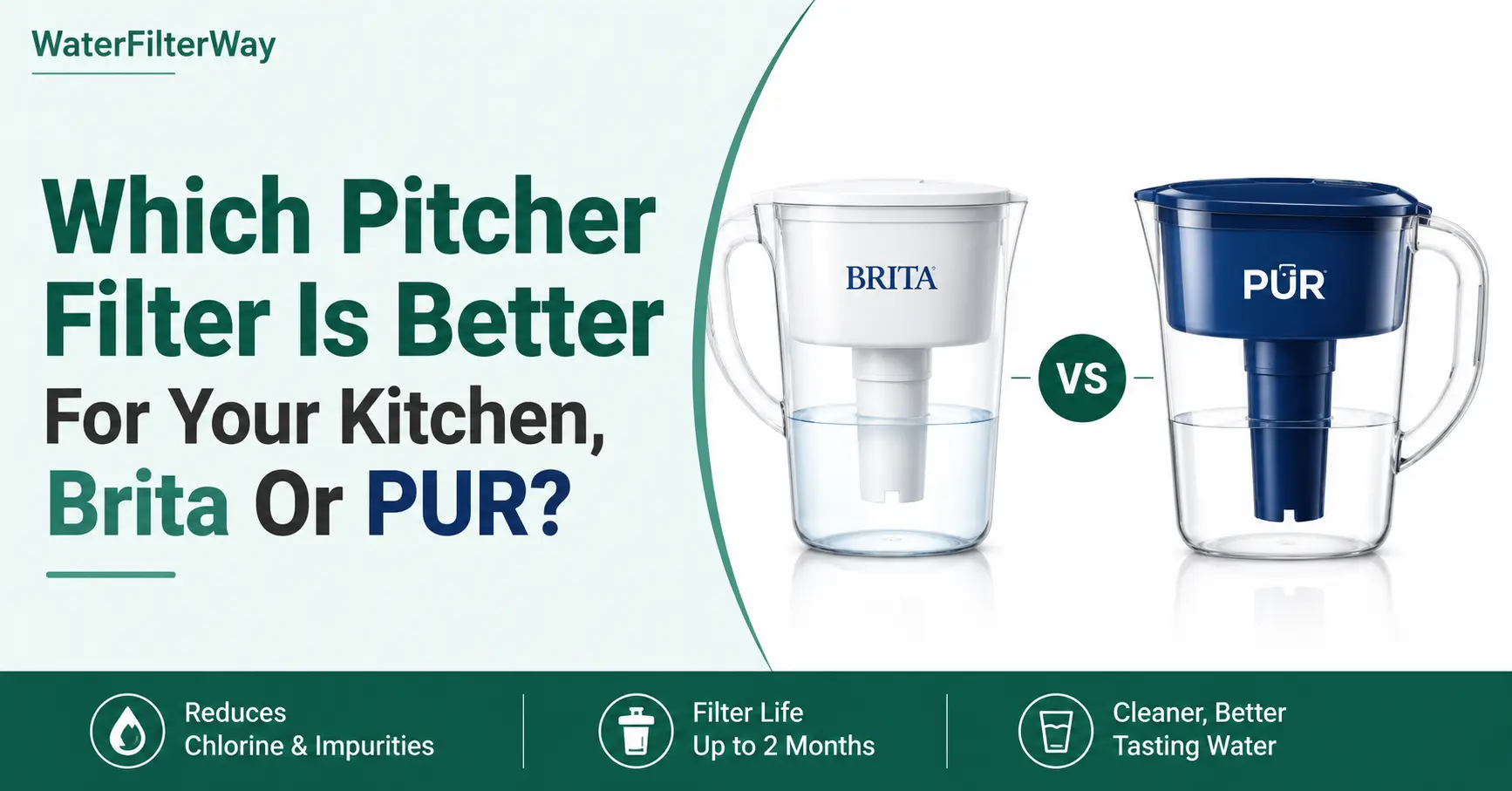
Brita and PUR both make pitchers that clear up the chlorine taste in tap water, and both are easy to find in any grocery store. The real difference between them shows up once you look past the brand name and into the specific filter tier you actually buy, since lead protection, PFAS reduction, filter life, and cost per gallon all shift depending on whether you pick the entry level filter or the premium one. This page walks through certification, speed, taste, cost, and build quality for both brands, then points to a few related questions worth checking before you decide.
What Are The Core Differences Between Brita And PUR Pitcher Filters?
Every comparison below, certification, filter life, speed, cost, taste, sizing, and build quality, comes back to one framing fact. Brita and PUR each sell more than one filter tier, and comparing a premium filter from one brand against a basic filter from the other is where most of the confusion around this topic comes from.
Which Filter Tier Should You Actually Compare, Brita Standard Or Elite Against PUR Classic Or Plus?
Brita sells two main filter tiers, a Standard filter, sometimes called Original, and a step up Elite filter that used to be sold under the name Longlast. PUR also sells two tiers, a Classic or Basic filter and a step up PUR Plus filter built around its MaxIon filtration technology. The fair matchups are Standard against Classic, and Elite against Plus. Most of the confusion in this comparison comes from people holding a Brita Elite next to a PUR Classic, or the reverse, and drawing conclusions from filters that were never meant to compete with each other.
Which Contaminants Is Each Brita Filter Certified To Reduce?
The Standard Brita filter carries NSF/ANSI 42 certification only, which covers chlorine taste and odor, and it also reduces some mercury, cadmium, copper, and zinc, but it is not certified for lead. The Elite filter adds NSF/ANSI 53 and 401 certification on top of that, covering lead, asbestos, benzene, PFOA and PFOS, microplastics, and a handful of pharmaceuticals. One detail worth knowing, an independent lab review found that Brita’s own performance data sheet for the Elite filter lists 33 contaminants, but only 15 of those had a matching official certification on file at the time of testing. Checking Brita’s current published performance data sheet before you buy is a better approach than relying on an older contaminant count.
| Certification | Brita Standard | Brita Elite |
| NSF 42, chlorine taste and odor | Yes | Yes |
| NSF 53, lead and other health contaminants | No | Yes |
| NSF 401, microplastics, PFAS, pharmaceuticals | No | Yes |
Which Contaminants Is Each PUR Filter Certified To Reduce?
PUR’s Basic or Classic filter is certified under NSF 42 and 53, covering chlorine, mercury, cadmium, copper, and zinc. PUR Plus historically added WQA certified lead reduction on top of the Classic’s certified list. One update worth flagging, at least one 2025 independent review reported that PUR Plus had its lead reduction certification revoked and replaced with a microplastics reduction certification instead, a real change from PUR’s older marketing claims. Because of this, it is worth checking PUR’s current NSF or WQA listing directly before assuming PUR Plus still reduces lead.
| Certification | PUR Classic | PUR Plus |
| NSF 42, chlorine taste and odor | Yes | Yes |
| NSF 53, mercury, cadmium, copper, zinc | Yes | Yes |
| Lead reduction | No | Reported and later revoked, verify current listing |
| Microplastics reduction | No | Yes, per recent certification update |
Does Brita Or PUR Reduce Lead From Tap Water?
Brita’s entry level Standard filter does not carry a lead certification, so you would need to move up to the Elite filter to get it. On the PUR side, PUR Plus has long been marketed with WQA certified lead reduction, but at least one independent 2025 review found that certification had been revoked and swapped for a microplastics certification instead. Filter certifications can change between production runs, so checking the specific filter’s current NSF or WQA listing is the most reliable way to confirm lead reduction at the time you buy, rather than trusting brand reputation or an older review.
Does Brita Or PUR Reduce Microplastics?
Among mainstream Brita models, only the Elite filter carries an NSF/ANSI 401 certification specifically for microplastics reduction, confirmed to reduce at least 85 percent of microplastics across its rated life. PUR’s faucet mount filters have been reviewed as reducing microplastics, but PUR’s pitcher filters do not carry the same NSF 401 certification the Brita Elite does. Ordinary activated carbon in a Standard filter from either brand may trap some larger particles by chance as water passes through, but that is not the same as a certified, tested result.
Does Brita Or PUR Reduce PFAS, The Forever Chemicals?
PFAS, often called forever chemicals, are a newer concern that neither brand’s basic filter addresses. The Brita Elite filter’s NSF 53 and 401 certifications do cover PFOA and PFOS specifically, which gives Brita a real edge here. PUR pitcher filters are not currently certified for PFAS removal, even though PUR’s language sometimes references broader contaminant reduction. Anyone whose main concern is PFAS should look at the Brita Elite first among these two brands, or consider a dedicated PFAS focused filter or a reverse osmosis system instead.
Does Filtering With PUR Or Brita Strip Healthy Minerals Like Calcium And Magnesium?
One independent lab test turned up a finding worth knowing if you care about mineral content in your drinking water. The PUR Plus pitcher reduced calcium by about 96 percent and magnesium by about 95 percent in that test, while sodium increased by roughly 388 percent, most likely because PUR’s ion exchange resin swaps calcium and magnesium ions for sodium ions as water passes through. The same test found Brita Elite’s mineral content stayed close to unfiltered levels, since its filter relies mainly on activated carbon rather than ion exchange resin. The resulting sodium level in the PUR test stayed within the EPA’s recommended range for taste, so this was not flagged as a health concern, just a mineral tradeoff worth being aware of.
| Mineral | PUR Plus | Brita Elite |
| Calcium | down about 96% | close to unfiltered level |
| Magnesium | down about 95% | close to unfiltered level |
| Sodium | up about 388% | close to unfiltered level |
How Long Does A Brita Filter Last Compared To A PUR Filter?
The Brita Standard filter is rated for about 40 gallons or two months, while the Brita Elite filter is rated for about 120 gallons or six months. PUR’s filters are rated for about 40 gallons on the Classic tier and closer to 30 to 40 gallons on the Plus tier, both roughly every two months. Brita Elite’s longer life is the main reason it can still cost less per gallon than PUR Plus despite carrying a higher price per filter, a point the cost section below expands on.
| Filter | Rated Life |
|---|---|
| Brita Standard | 40 gallons or 2 months |
| Brita Elite | 120 gallons or 6 months |
| PUR Classic | 40 gallons or 2 months |
| PUR Plus | 30 to 40 gallons or 2 months |
Which Pitcher Filters Water Faster, Brita Or PUR?
One independent test of entry level pitchers found the Brita Everyday filtered about 1.05 cups per minute against about 0.80 cups per minute for the PUR Basic pitcher, a fairly clear gap. A separate lab comparison of the premium tiers found that gap narrows considerably, with PUR Plus measured at 2.82 gallons per hour against Brita Elite at 2.92 gallons per hour, a close result. Brita tends to hold a speed edge at both tiers, but the difference shrinks a lot once you compare the premium PUR Plus against the premium Brita Elite rather than comparing entry level PUR against premium Brita.
Which Pitcher Costs Less Per Gallon Over A Year, Brita Or PUR?
Working out real ownership cost takes two numbers, price per filter and how long each filter lasts. One cost breakdown put per filter prices at roughly 4.17 dollars for Brita Standard, 16.50 dollars for Brita Elite, 6.00 dollars for PUR Basic, and 8.33 dollars for PUR Plus. After annualizing based on each filter’s rated life, yearly cost worked out to about 25 dollars for Brita Standard, 33 dollars for Brita Elite, 36 dollars for PUR Basic, and 50 dollars for PUR Plus. A separate lab review measured cost per gallon directly and found Brita Elite at about 17 cents per gallon against PUR Plus at about 27 cents per gallon. Both measurements point the same direction, Brita costs less to run per year at every tier tested, mainly because its filters last longer.
| Filter | Cost Per Filter | Annual Cost | Cost Per Gallon |
| Brita Standard | $4.17 | about $25 | not separately reported |
| Brita Elite | $16.50 | about $33 | about $0.17 |
| PUR Classic | $6.00 | about $36 | not separately reported |
| PUR Plus | $8.33 | about $50 | about $0.27 |
Which Pitcher Wins In Blind Taste Tests, Brita Or PUR?
One blind test with volunteers scored Brita filtered water at 83 percent preference against 69 percent for PUR and 51 percent for unfiltered tap water. A separate outlet’s testers also leaned toward Brita, describing it as clean, pure, and neutral, while PUR came in as a close second, described as clean and refreshing with no aftertaste. One useful thing to know if a new PUR filter tastes off at first, one tester group initially found PUR water carried a distinct metallic taste that disappeared once they ran several gallons through the filter to flush it before use, so a short flushing period is worth doing with a new PUR filter.
Which Pitcher Sizes And Capacities Does Each Brand Offer?
Brita’s range runs from smaller pitchers around six cups up to ten cup models, with dispensers holding around 27 cups for bigger households. PUR’s range includes an eleven cup Classic pitcher and dispensers holding up to about 30 cups. A larger household filtering more water each day gets more practical benefit from the largest dispenser sizes on either side than from a standard pitcher, since it cuts down how often someone has to stop and refill.
Which Pitcher Is Better Built, Dishwasher Safe, And Leak Resistant?
PUR pitchers are generally dishwasher safe once the filter and the light indicator are removed, while Brita pitchers are typically hand wash only. Some Brita lids and spouts have been reported to feel less sturdy after a year of daily use, while PUR’s lid clasps have been described as more secure, though individual unit quality can vary. Warranty length is part of build confidence too, Brita has been reported to offer a one year warranty against defects, while PUR’s warranty runs shorter, around 90 days on the pitcher and 30 days on the filter cartridge. Both brands include a filter change indicator, either an electronic light or a simple timer based reminder, and that indicator tracks time rather than actual gallons used, so it can run early or late for households that use their pitcher unusually little or a lot. One dated point worth mentioning honestly, an old study from the 1990s found bacteria could build up in a Brita filter’s media within about a week due to biofilm growth, though this predates current filter designs by decades and should be read as historical context rather than a claim about today’s filters.
What Should You Consider Before Choosing Between Brita And PUR?
Both brands handle everyday chlorine taste well. Lead and PFAS protection depend entirely on which specific filter tier you buy rather than the brand name on the box, and neither brand’s pitcher filter touches fluoride at any tier. Where you go from here depends on what you actually need, whether that is understanding fluoride separately, making sense of NSF certification numbers, comparing against a reverse osmosis system, or checking what is actually in your own water first.
Does Brita Or PUR Remove Fluoride From Tap Water?
Neither brand’s pitcher filter removes fluoride, at any tier, including the Brita Elite and PUR Plus. Fluoride exists in water as a dissolved ion rather than something standard activated carbon media is built to capture, and paying for a premium filter tier does not change that. A closer look at whether boiling or filtering removes fluoride from tap water covers why this happens and what actually does remove it.
What Do NSF/ANSI Certification Numbers Like 42, 53, And 401 Actually Mean?
The certification numbers used throughout this page each cover something different. NSF 42 covers chlorine taste and odor. NSF 53 covers health related contaminants such as lead. NSF 401 covers newer, emerging contaminants such as pharmaceuticals and microplastics. A filter can be certified under one of these standards and not another, which is why two filters from the same brand can look almost identical on the shelf but perform very differently once you check what NSF and ANSI water filter certifications actually mean for each one.
How Does A Reverse Osmosis System Compare To A Pitcher Filter For Contaminant Removal?
A full reverse osmosis system, usually paired with a carbon pre-filter, addresses fluoride, PFAS, and a wider range of dissolved contaminants that no pitcher filter on either brand touches, including the Brita Elite. The tradeoff is straightforward, reverse osmosis systems cost more upfront and usually need under sink installation, while a pitcher stays simple and portable. How a reverse osmosis system compares to a pitcher filter goes into this comparison in full.
Is ZeroWater A Better Choice Than Brita Or PUR For High TDS Water?
For water with a high mineral or total dissolved solids reading, neither Brita nor PUR pitcher filters are built to bring that number down. ZeroWater uses an ion exchange design that reduces total dissolved solids to near zero, unlike Brita or PUR, though some independent testers describe the resulting water as tasting flatter or slightly sour as a tradeoff for that extra purity. How Brita compares to ZeroWater for high TDS water covers the full brand by brand breakdown.
Which Water Filter Pitcher Removes The Most Contaminants Overall In 2026?
Brita and PUR are not the only two pitchers worth knowing about. Pitchers built specifically around NSF 401 certification, such as Clearly Filtered, are tested to reduce a substantially wider contaminant list than either Brita or PUR, including fluoride and a broader PFAS range, usually at a higher price per filter. The full ranking of water filter pitchers for 2026 shows where Brita and PUR sit against the wider field.
Are Off-Brand Replacement Filters Safe To Use In A Brita Or PUR Pitcher?
Off-brand or generic filters are not tested or certified to the same standard as genuine Brita or PUR cartridges, even when they are shaped to fit the same pitcher, and using one means losing the certification claims covered earlier on this page. Independent reviewers have found Brita pitchers generally more compatible with off-brand filters, such as AmazonBasics or FilterLogic, than PUR pitchers are, which matters if you are trying to cut costs further. Which off-brand replacement filters are actually safe to use has the full breakdown of which ones have been independently tested.
How Do You Test Your Own Tap Water Before Choosing A Filter?
Checking the local water utility’s annual Consumer Confidence Report is a good starting point, along with the EPA’s Safe Drinking Water Information System for US readers. A certified lab test is the more reliable route for specific concerns like lead or PFAS that a basic test strip cannot confirm. How to test your own tap water before choosing a filter walks through the full process step by step.
Does A Faucet-Mount Filter Remove More Contaminants Than A Pitcher From The Same Brand?
Both brands’ faucet mount filters are certified to reduce a broader contaminant list than their own pitcher filters, since water spends more contact time with the filter media in a faucet mount design. PUR’s faucet line in particular has been reviewed as covering more than 70 contaminants. How faucet-mount filters compare to pitcher filters explains the full difference between the two formats.
Frequently Asked Questions
Is Brita or PUR better overall?
It depends on the tier. Brita Elite generally costs less to run and holds a slightly wider certification list including PFAS, while PUR Plus filters a little faster at the entry level and has historically been marketed for broader contaminant reduction.
Does the Brita Standard filter remove lead?
No. Only the Brita Elite filter carries lead certification. The Standard filter is certified for chlorine taste and odor only, along with some mercury, cadmium, copper, and zinc.
How often should I change my Brita or PUR filter?
Most Standard and Basic filters last about two months or 40 gallons, whichever comes first. The Brita Elite filter lasts about six months or 120 gallons.
Do Brita and PUR filters remove fluoride?
No. Neither brand’s pitcher filter removes fluoride at any tier, since fluoride is a dissolved ion that standard carbon filtration does not capture.
Can I use a generic filter in my Brita or PUR pitcher?
You can in many cases, but generic filters are not independently certified the way genuine cartridges are, and Brita pitchers tend to be more compatible with off-brand options than PUR pitchers.