
A TDS meter is a good first check, but it is not the only tool worth knowing about. Depending on what you are trying to figure out, you might need to check an RO system’s performance, understand how hardness differs from TDS, read your water supplier’s own report, decide whether a lab test makes more sense, compare a meter against test strips, test water that is not meant for drinking, or understand how a filter or softener actually changes what your meter shows. The sections below walk through each of these one at a time.
How Does a TDS Meter Help You Check Your Reverse Osmosis System’s Performance?
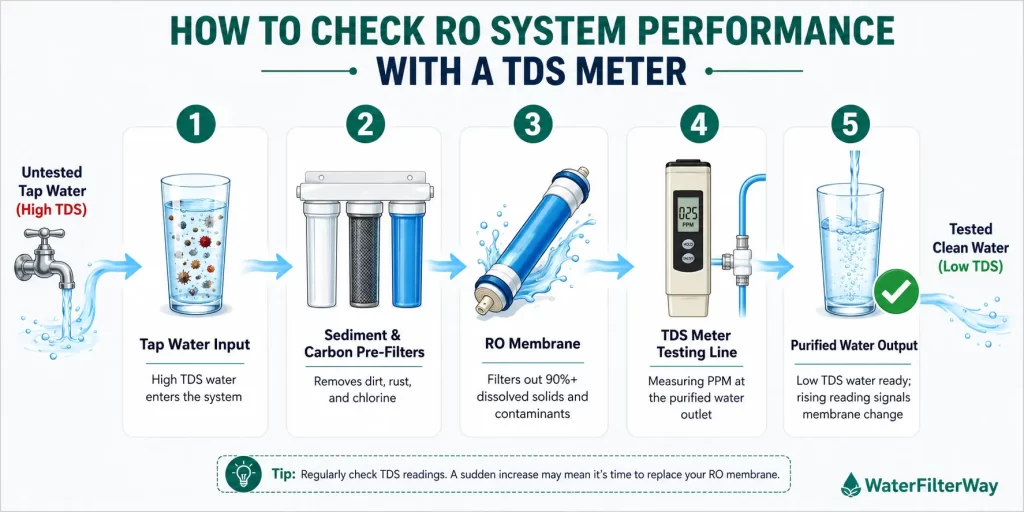
Testing water before and after an RO unit shows how much TDS the system is actually removing, and a rising number on the outlet side over time is often the first sign that the membrane needs replacing rather than the whole system. A TDS meter works well here as a simple maintenance check, giving you a number to track after each filter change. For a closer look at reverse osmosis systems and how they work, including how the membrane itself functions and when it typically needs attention, it helps to understand what is actually happening behind the outlet reading.
How Is Water Hardness Different From TDS?
Hardness refers specifically to calcium and magnesium content, while TDS is the total of everything dissolved in the water, so hard water usually shows a high TDS reading, but not every high TDS reading comes from hardness. If scale on your kettle or soap that will not lather is the real issue behind your reading, water hardness, its causes, and how it is treated is the more specific place to look.
When Should You Get a Lab Water Test Instead of a TDS Meter?
A persistently high reading, untested well water, a health concern in the household, or wanting to confirm specific substances such as lead or bacteria are all good reasons to move past a home reading. In these situations, a professional or lab water testing service can identify exactly what is in the water rather than just how much is dissolved overall, which a TDS meter cannot do on its own.
Should You Check Your Water Supplier’s Report Instead of Testing TDS Yourself?
If your water comes from a public utility in the United States, the supplier is legally required under the Safe Drinking Water Act to publish an annual report listing the specific contaminants found in the water and their levels, which goes well beyond a single TDS number. This report is free and usually available on the supplier’s website. It is worth knowing how to read a Consumer Confidence Report so the numbers actually make sense once you have it in hand. A TDS meter still earns its keep between report cycles, or for anyone on a private well who never receives one.
How Do TDS Test Strips Compare to a Digital TDS Meter?
Test strips use a chemical reagent that changes color based on the dissolved solids present, which makes them cheap and simple, though less precise than a digital reading. A digital meter gives a specific number rather than a color range, which makes it better suited for tracking small changes over time, such as confirming a filter is still performing well after a few months of use.
| Feature | Test Strips | Digital TDS Meter |
| Precision | Approximate, color based | Specific numeric reading |
| Cost | Lower upfront cost | Slightly higher upfront cost |
| Best for | Quick, one off checks | Repeat tracking and filter monitoring |
If you are still deciding between the two, a fuller comparison of test strips against digital meters lays out when each option actually makes sense.
What TDS Level Is Best for Pools, Aquariums, and Hydroponics?
Pool owners use TDS readings to know when a partial drain and refill is due, aquarium owners use it to keep conditions steady for fish and plants, and hydroponics growers rely on it to track nutrient concentration in the water solution feeding their plants. Drinking water benchmarks do not really apply in any of these cases, so it is worth checking how TDS testing works for pools, aquariums, and hydroponic systems separately if one of these applies to you.
How Do Water Filters and Softeners Affect TDS Readings?
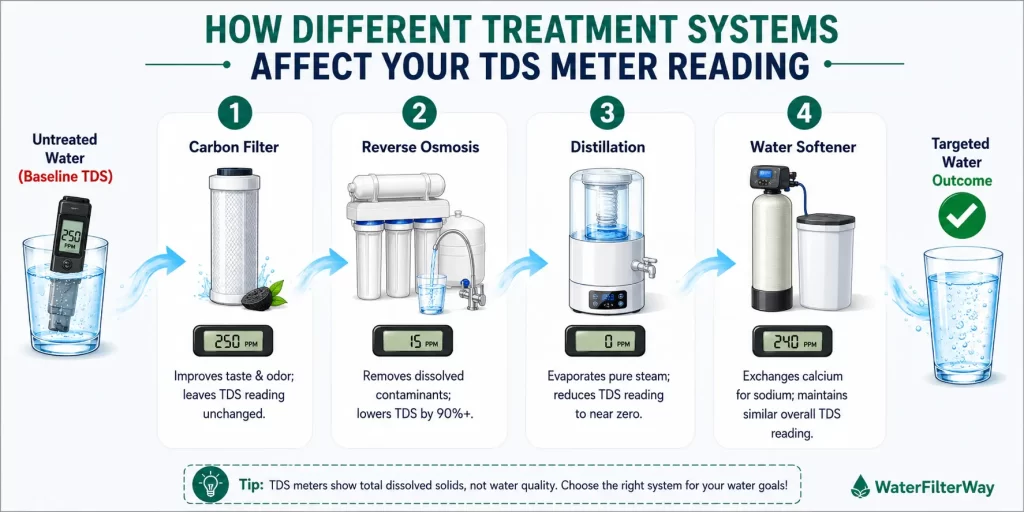
Different treatment methods change a TDS reading in different ways. Carbon filters mainly improve taste and reduce chlorine, but they leave most dissolved minerals in place. Reverse osmosis, distillation, and deionization all reduce TDS significantly. A water softener works differently again, exchanging hardness minerals for sodium, which can change the reading without necessarily lowering the overall TDS total.
| Treatment Type | Typical Effect on TDS |
| Carbon filter | Little to no reduction, improves taste and odor |
| Reverse osmosis | Significant reduction, often 90 percent or more |
| Distillation | Significant reduction |
| Water softener | Exchanges hardness minerals for sodium, may not lower total TDS |
If a high reading is what sent you looking into treatment in the first place, it helps to compare water filters and softeners before picking one, since they solve fairly different problems.
How Do You Choose the Best TDS Meter for Home Use?
For most households, the features worth checking before buying are accuracy rating, whether the meter includes automatic temperature compensation, the probe material, the measurement range, and the price. A basic pen style meter is enough for routine drinking water checks, while a meter with a wider range and better accuracy suits anyone tracking hydroponics, aquariums, or filter performance more closely.
| Feature | Why It Matters |
| Accuracy rating | Determines how close the displayed number is to the true value |
| Automatic temperature compensation | Keeps readings consistent regardless of water temperature |
| Probe material | Affects durability and resistance to corrosion over time |
| Measurement range | Should cover the readings you expect to see for your use case |
| Price | Ranges widely depending on accuracy and added features |
If you are ready to buy one, it is worth seeing a few TDS meters compared side by side before you settle on a price point.
Frequently Asked Questions
Should I trust my TDS meter over my water supplier’s report?
Not entirely. The report covers far more contaminants than a TDS meter can detect, so treat the meter as a quick check between report cycles rather than a replacement for it.
Is a TDS meter enough to confirm my RO system is working?
It is a reasonable first check, since a rising reading after the membrane usually signals it needs replacing, though it will not tell you everything about the system’s overall performance.
Are TDS test strips as reliable as a digital meter?
They are close enough for a quick check, but a digital meter gives a more precise number, which matters more if you are tracking small changes over time.
Can I use a drinking water TDS chart for my aquarium or pool?
No. Drinking water benchmarks do not apply, since pools, aquariums, and hydroponic systems each have their own target ranges.
Will a water softener lower my TDS reading?
Not necessarily. A softener exchanges hardness minerals for sodium, which can change the reading without actually lowering the total amount of dissolved solids.