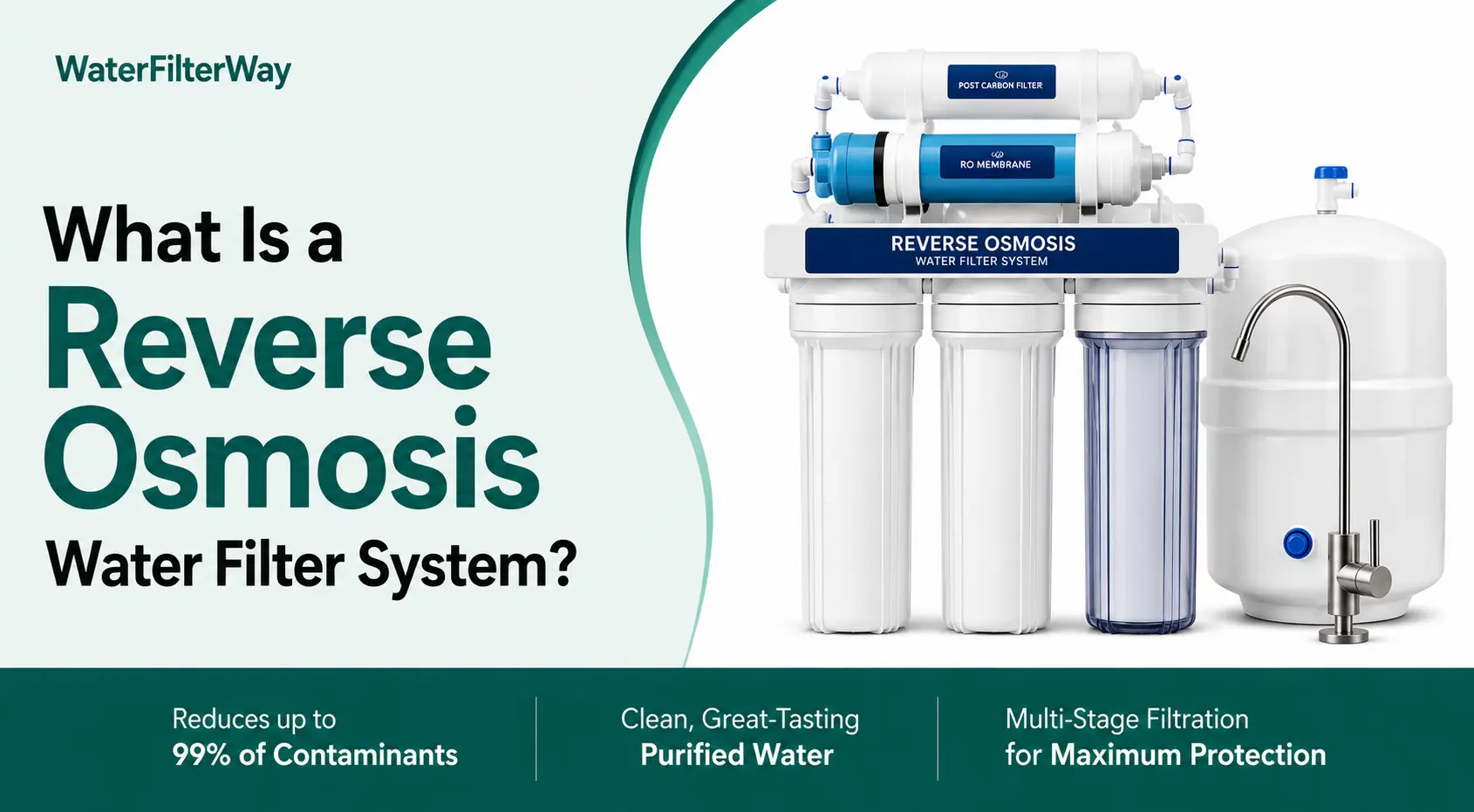
A reverse osmosis water filter system is a home water filtration device that forces tap water through a semi-permeable membrane under pressure, removing dissolved contaminants that carbon filters cannot capture. The system installs under a kitchen sink, on a countertop, or at the main water line for whole-house use, depending on the model. It supplies drinking and cooking water in most residential installations. Homeowners choose reverse osmosis over a standard carbon filter because it removes total dissolved solids (TDS), not only chlorine and odor.
What Does Reverse Osmosis Mean in Water Filtration?
Reverse osmosis means forcing water through a membrane in the opposite direction from its natural flow, using applied pressure. Water naturally moves from a diluted solution toward a concentrated one through a membrane, a process called osmosis. Reverse osmosis reverses that direction: pressure pushes water from the concentrated, contaminated side to the diluted, clean side, leaving dissolved solids behind.
What Is the Difference Between Osmosis and Reverse Osmosis?
Osmosis and reverse osmosis differ in the direction of water flow and the force required to move it. Osmosis happens without outside force, water moves naturally toward the side holding more dissolved particles. Reverse osmosis needs applied pressure, from household water pressure or a booster pump, to push water in the opposite direction.
The table below compares the two processes side by side.
| Process | Direction of Flow | Force Required | Result |
| Osmosis | Toward higher concentration | None, occurs naturally | Solute concentrations equalize |
| Reverse Osmosis | Toward lower concentration | External pressure | Water separates from contaminants |
What Is a Semi-Permeable Membrane in an RO System?
A semi-permeable membrane is the core filtering component of an RO system, built with pores around 0.0001 micron wide that block dissolved salts and metals while letting water molecules pass. Most residential systems use a thin-film composite membrane. The membrane lasts 2 to 5 years before replacement, depending on source water quality and usage volume.
How Does a Reverse Osmosis Water Filter System Work?
A reverse osmosis system works by moving tap water through 3 to 6 sequential filtration stages before it reaches the faucet. Water enters through a sediment pre-filter, passes through a carbon pre-filter, crosses the RO membrane, then exits through a post-carbon filter into a storage tank. Each stage removes a different category of contaminant.
What Are the Stages of a Reverse Osmosis System?
A residential RO system contains 5 common stages, including sediment filtration, carbon filtration, membrane filtration, post-carbon filtration, and remineralization.
- Sediment pre-filter removes dirt, sand, and rust particles.
- Carbon pre-filter removes chlorine and protects the membrane from damage.
- RO membrane removes dissolved solids, heavy metals, and most dissolved contaminants.
- Post-carbon filter improves taste before water reaches the faucet.
- Remineralization or UV stage, where included, adds minerals back or disinfects the water further.
The table below lists what each stage targets.
| Stage | What It Removes | Purpose |
| Sediment pre-filter | Dirt, sand, rust | Protects downstream filters |
| Carbon pre-filter | Chlorine, chloramine | Protects the membrane |
| RO membrane | TDS, lead, arsenic, fluoride | Main contaminant removal |
| Post-carbon filter | Residual taste and odor | Final polish before the tap |
| Remineralization stage | None (adds minerals) | Restores calcium and magnesium |
What Happens to Permeate and Concentrate Water in RO?
Permeate is the clean, filtered water that continues to the storage tank and faucet after crossing the membrane. Concentrate, also called brine or reject water, is the second stream, carrying rejected contaminants to the drain. An RO system produces both streams because the membrane separates incoming water into two paths, unlike a single-pass carbon filter that produces one.
What Contaminants Does a Reverse Osmosis System Remove?
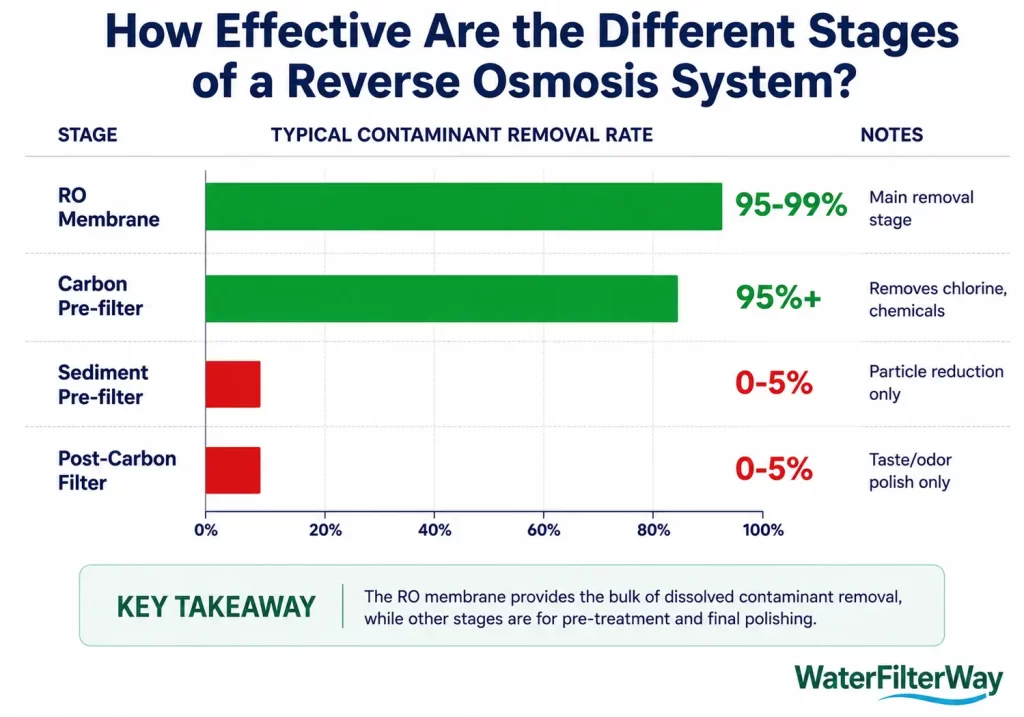
A reverse osmosis system removes 95 to 99 percent of total dissolved solids, along with lead, arsenic, fluoride, chlorine, chloramine, nitrates, and PFAS, according to point-of-use system data published by the U.S. Environmental Protection Agency. The membrane blocks contaminants based on molecular size, so removal rates vary slightly by contaminant type and source water quality.
The table below shows typical removal rates by contaminant category.
| Contaminant Category | Typical Removal Rate |
| Total Dissolved Solids (TDS) | 95 to 99 percent |
| Lead and heavy metals | 95 to 99 percent |
| Fluoride | 90 to 98 percent |
| Chlorine and chloramine | 95 percent or higher (with carbon stage) |
| Nitrates | 85 to 95 percent |
| PFAS | Up to 99 percent |
Does Reverse Osmosis Remove TDS, Lead, and Fluoride?
Reverse osmosis removes TDS, lead, and fluoride at rates of 95 percent or higher in a properly maintained system. The membrane blocks all three because their dissolved particle size exceeds the membrane’s pore size. A carbon filter alone does not achieve the same fluoride or TDS reduction, since carbon media adsorbs organic compounds and chlorine rather than dissolved minerals and salts.
Can Reverse Osmosis Remove Bacteria and Viruses?
Reverse osmosis blocks most bacteria and many viruses due to membrane pore size, but standard RO systems are not certified as stand-alone microbiological purifiers. Municipal water is treated for pathogens before it reaches the tap in most systems. Well water users concerned about bacteria and viruses need an added UV disinfection stage rather than relying on the RO membrane alone.
What Types of Reverse Osmosis Systems Are Available?
There are 4 common types of reverse osmosis systems: under-sink, whole-house, countertop, and tankless models.
The table below outlines what each type serves and who it fits.
| System Type | What It Serves | Typical Install Location | Best For |
| Under-sink | Single faucet | Kitchen cabinet | Drinking and cooking water |
| Whole-house | Entire home | Main water line | Heavily contaminated source water |
| Countertop | Single faucet, no plumbing changes | Kitchen counter | Renters, temporary setups |
| Tankless | Single faucet | Kitchen cabinet | Small spaces, faster output |
What Is the Difference Between Under-Sink and Whole-House RO Systems?
Under-sink and whole-house RO systems differ in the amount of water they treat and where they connect to the plumbing. Under-sink systems treat water at one faucet, cost less, and install without a plumber in most homes. Whole-house systems treat all water entering the home at the main line, cost more, and typically require professional installation.
What Is a Tankless Reverse Osmosis System?
A tankless reverse osmosis system is a design that filters water on demand instead of storing it in a pressurized tank. It saves cabinet space under the sink and produces filtered water faster than most tank-based models. Tankless systems generally reject less water per gallon produced than older tank-based designs.
What Are the Pros and Cons of a Reverse Osmosis System?
A reverse osmosis system carries 4 main advantages and 4 main drawbacks.
| Pros | Cons |
| Removes more dissolved contaminants than other home filtration methods | Produces wastewater during filtration |
| Requires no electricity in standard household pressure systems | Removes beneficial minerals along with contaminants |
| Improves water taste by reducing dissolved solids | Filters water slower than a direct tap |
| Reduces long-term cost compared to bottled water | Costs more upfront than a pitcher or faucet filter |
Does Reverse Osmosis Waste Water?
Reverse osmosis produces wastewater as part of the filtration process, at a ratio that depends on the system’s age and design. Older systems reject 3 to 4 gallons of water for every 1 gallon of filtered water produced, based on figures published by the EPA. Modern tankless and high-efficiency systems lower that ratio to close to 1 to 2 gallons wasted per gallon produced.
Does Reverse Osmosis Remove Healthy Minerals From Water?
Reverse osmosis removes beneficial minerals such as calcium and magnesium along with contaminants, since the membrane does not distinguish between the two by molecular size. Drinking water supplies a small share of daily mineral intake compared to food sources. A balanced diet covers the mineral gap left by RO filtration for most people.
How Much Does a Reverse Osmosis Water Filter System Cost?
A reverse osmosis system costs between 150 and 500 dollars for an under-sink unit, and between 1,000 and 4,800 dollars for a professionally installed whole-house system, based on cost data published by home services platform Angi. The total includes the unit price and, for whole-house systems, professional installation labor.
The table below breaks down cost by system type.
| System Type | Unit Cost Range | Install Cost Range | Annual Maintenance Cost |
| Under-sink | $150 to $500 | $0 (DIY) to $300 | $50 to $100 |
| Whole-house | $600 to $3,500 | $400 to $1,300 | $100 to $150 |
What Is the Installation Cost of a Reverse Osmosis System?
Installation for a reverse osmosis system costs 150 to 300 dollars in professional labor for point-of-use systems, and more for whole-house units requiring plumbing modifications. Under-sink systems qualify as DIY installs in most residential kitchens. Whole-house systems typically need a licensed plumber due to main line connections.
What Is the Ongoing Maintenance Cost of an RO System?
Ongoing maintenance for an RO system costs an average of 50 to 150 dollars per year, covering filter and membrane replacement. Pre-filters and post-filters need replacement every 6 to 12 months. The membrane needs replacement every 2 to 5 years, depending on source water quality and system usage.
How Do You Maintain a Reverse Osmosis System?
Maintaining a reverse osmosis system requires 4 recurring tasks: checking the pressure gauge, sanitizing the system yearly, monitoring flow rate, and replacing filters on schedule.
- Check the pressure gauge periodically to confirm the tank holds correct pressure.
- Sanitize the full system once a year to prevent bacterial buildup in the housing.
- Watch for reduced flow rate, a common sign a filter needs replacement.
- Replace filters and the membrane on the manufacturer’s recommended schedule.
How Often Should You Replace RO Filters and Membranes?
RO filters and membranes need replacement every 6 to 12 months for pre-filters and post-filters, and every 2 to 5 years for the membrane. Harder or more contaminated source water shortens these intervals.
| Component | Typical Replacement Interval |
| Sediment pre-filter | 6 to 12 months |
| Carbon pre-filter | 6 to 12 months |
| Post-carbon filter | 12 months |
| RO membrane | 2 to 5 years |
Is Reverse Osmosis Water Safe to Drink?
Reverse osmosis water is safe to drink, consistent with drinking water guidance published by the World Health Organization. Mineral loss from RO filtration does not create a health risk for someone eating a varied diet. RO water can read slightly lower on pH than tap water, but this does not measurably affect the body’s internal pH, which stays regulated by normal physiological processes.
Do You Need to Remineralize Reverse Osmosis Water?
Remineralizing reverse osmosis water is optional, improving taste and alkalinity rather than meeting a health requirement. Some RO systems include a built-in remineralization or alkaline cartridge as an added stage. A person eating a balanced diet does not need remineralized water to meet daily mineral intake.
How Do You Choose the Right Water Filtration System for Your Home?
Choosing the right water filtration system depends on 4 factors: water source, specific contaminants present, household size, and budget. City water and well water carry different contamination risks, which changes which filter type applies. The sections below cover related systems and components based on these factors.
What Is the Best Under-Sink Reverse Osmosis System?
A strong under-sink reverse osmosis system combines a high TDS reduction rate, NSF certification, and a flow rate suited to household size. Tankless models generally produce water faster than tank-based designs at a comparable footprint. Best Under-Sink Reverse Osmosis Systems ranks current models by these criteria, including TDS performance and long-term filter cost.
How Does an APEC Reverse Osmosis System Compare to Other Brands?
APEC reverse osmosis systems hold WQA and NSF certification, with components manufactured in the United States. The brand positions its systems around certified contaminant removal rates and long-term filter availability. APEC Water Filters Review covers full pricing, model differences, and independent test results.
How Does an iSpring Reverse Osmosis System Compare to APEC?
iSpring and APEC differ mainly in certification emphasis and remineralization options. APEC systems generally emphasize WQA-certified, US-made components, while iSpring systems commonly include built-in alkaline remineralization stages. APEC vs iSpring compares both brands directly on TDS reduction, annual filter cost, and taste performance.
What Is the Best Whole House Water Filter System for Well Water?
A whole-house water filter system for well water addresses iron, sulfur, and sediment issues that point-of-use RO systems do not treat at the main line. Well water households commonly need broader filtration than drinking-water-only RO provides. Best Whole House Water Filter for Well Water ranks systems by contaminant removal and maintenance cost specific to well water.
How Is Reverse Osmosis Different From Ultrafiltration Systems?
Reverse osmosis and ultrafiltration differ in membrane pore size and mineral retention. RO membranes measure around 0.0001 micron and remove dissolved solids and minerals. Ultrafiltration membranes measure larger, removing particles, bacteria, and cysts while leaving minerals in the water and producing no wastewater. Top Ultrafiltration Water Systems covers models suited to households that want mineral retention.
| Property | Reverse Osmosis | Ultrafiltration |
| Membrane pore size | 0.0001 micron | 0.01 micron |
| Minerals retained | No | Yes |
| Wastewater produced | Yes | No |
How Do You Choose the Right Replacement Cartridge for a Reverse Osmosis System?
Choosing the right replacement cartridge for an RO system requires matching the cartridge type, sediment, carbon, or membrane, to the specific stage and housing size of the existing system. Water Filter Cartridges: Types, Sizes and How to Choose covers cartridge sizing, micron rating, and compatibility across major housing standards.
What Are the Other Types of Water Filters Besides Reverse Osmosis?
Water filtration includes 3 other major types besides reverse osmosis: activated carbon, ion exchange, and UV disinfection.
- Activated carbon removes chlorine, odor, and organic compounds through adsorption.
- Ion exchange removes hardness minerals and some dissolved solids by swapping ions.
- UV disinfection inactivates bacteria and viruses using ultraviolet light, without removing dissolved solids.
Water Filter Types Explained covers each type in full detail, including which contaminants each one targets.
Does a Water Softener Work Differently Than a Reverse Osmosis System?
A water softener works differently from a reverse osmosis system by targeting hardness minerals only, using ion exchange or salt-free conditioning, across all household water. Reverse osmosis targets a broader range of contaminants at a single point of use for drinking water. Households with hard water commonly run both systems together rather than choosing one over the other. SpringWell Water Softener Systems covers the three softener types and how each pairs with an RO system.
Frequently Ask Question
Does Reverse Osmosis Need Electricity?
Reverse osmosis does not need electricity in standard household pressure systems. Only booster pump models, used in homes with low water pressure, draw electricity.
Can Reverse Osmosis Water Damage Pipes?
Reverse osmosis water does not damage plumbing. Its slightly lower mineral content has no corrosive effect on standard household pipes.
Does Reverse Osmosis Reduce Sodium in Water?
Reverse osmosis reduces sodium along with other dissolved solids, at removal rates near 95 percent.
How Long Does an RO Storage Tank Last?
An RO storage tank lasts 8 to 12 years before the internal bladder needs replacement or the tank needs resealing.
Is Reverse Osmosis the Same as Distillation?
Reverse osmosis differs from distillation. RO uses pressure and a membrane to separate contaminants, while distillation uses heat to evaporate and recondense water.