
PFAS, the group of synthetic chemicals commonly called forever chemicals, show up in tap water across the country, and standard treatment plants were never built to remove them. Three filtration technologies have been shown to reduce PFAS effectively: activated carbon, reverse osmosis, and ion exchange resin. None of them removes every trace of PFAS, but a properly certified filter can cut levels sharply, often by 90 percent or more. The only reliable way to know a filter actually works is third party certification from an organization such as NSF International, WQA, or IAPMO.
What Is PFAS and Why Does It Matter for Water Filtration?
PFAS stands for per and polyfluoroalkyl substances, a family of manufactured chemicals used since the 1940s in nonstick cookware, waterproof fabric, food packaging, and firefighting foam. They get into drinking water near industrial sites, military bases, and landfills, and they also turn up at low background levels in supplies with no obvious source. Before choosing a filter, it helps to understand what makes these chemicals different from ordinary contaminants, which compounds are regulated, and why health agencies have grown more concerned about even small amounts of exposure.
What Makes PFAS a “Forever Chemical”?
PFAS molecules contain a bond between carbon and fluorine atoms that is one of the strongest bonds found in organic chemistry. That bond does not break down through the routes that remove other contaminants from water, including sunlight, heat, and the biological processes treatment plants rely on for most pollutants. This is why PFAS builds up in soil, groundwater, and the human body over years instead of breaking down the way most industrial chemicals eventually do. It is also why municipal water treatment, designed for contaminants that degrade, generally lets PFAS pass straight through.
Which PFAS Compounds Are Most Commonly Found in Tap Water?
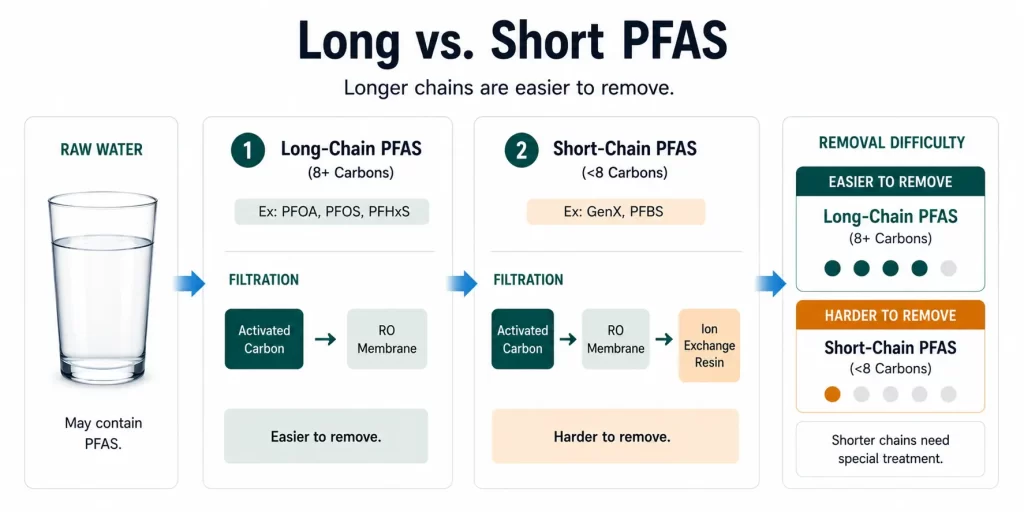
The Environmental Protection Agency has set enforceable limits for six PFAS compounds found most often in drinking water: PFOA, PFOS, PFHxS, PFNA, GenX (also known as HFPO-DA), and PFBS. PFOA and PFOS are the two most studied and carry the strictest individual limits. Compounds are also grouped by chain length, meaning the number of carbon atoms in the molecule. Long-chain PFAS, those with eight or more carbons, tend to be easier for filters to capture. Short-chain PFAS, with fewer than eight carbons, are smaller and harder for carbon or membranes to catch, which is one reason no single filter type handles every compound equally well.
| Compound | Full Name | Chain Length |
| PFOA | Perfluorooctanoic acid | Long-chain |
| PFOS | Perfluorooctane sulfonic acid | Long-chain |
| PFHxS | Perfluorohexane sulfonic acid | Long-chain |
| PFNA | Perfluorononanoic acid | Long-chain |
| GenX (HFPO-DA) | Hexafluoropropylene oxide dimer acid | Short-chain |
| PFBS | Perfluorobutane sulfonic acid | Short-chain |
What Health Concerns Are Linked to PFAS Exposure?
Research on PFAS exposure has pointed to a range of health concerns, including higher cholesterol, developmental effects in children, immune system changes, and an increased risk of certain cancers in some studies. These findings come from public health agencies and peer reviewed research rather than being settled beyond debate, and PFAS exposure affects people differently depending on the specific compounds, the level, and the length of exposure. This section is not medical advice, and anyone with specific health concerns about PFAS exposure should speak with a doctor. What it does explain is why so many households decide to filter their water even when their utility reports levels below the current legal limit.
Which Water Filtration Technologies Remove PFAS?
Three filtration technologies have consistent, independently verified track records for reducing PFAS: activated carbon, reverse osmosis, and ion exchange resin. Reverse osmosis generally performs best across the widest range of compounds, ion exchange resin is particularly strong against short-chain PFAS that other methods struggle with, and activated carbon performs well on long-chain PFAS when the filter is designed with enough contact time. Many of the best performing consumer systems combine two or three of these technologies rather than relying on just one.
How Does Activated Carbon Filtration Remove PFAS?
Activated carbon removes PFAS through adsorption, meaning PFAS molecules stick to the surface of the carbon as water passes through rather than being chemically broken down. The carbon is riddled with microscopic pores that give it a large surface area for contaminants to bind to. The biggest factor in how well a carbon filter performs is contact time, or how long the water stays in contact with the carbon bed. Industry sources disagree on whether granular carbon or solid carbon block performs better in general, but both work on the same principle, and a filter with a longer, slower flow path tends to outperform one that lets water rush through in seconds. Carbon filtration is noticeably better at capturing long-chain PFAS than short-chain PFAS, since the larger molecules bind more readily to the carbon surface.
How Does Reverse Osmosis Remove PFAS?
Reverse osmosis works differently from carbon. Instead of relying on adsorption, it forces water through a semi-permeable membrane with pores fine enough to physically block PFAS molecules while letting water molecules through. Because the membrane acts as a physical barrier rather than depending on binding, reverse osmosis systems certified to NSF/ANSI 58 typically reduce PFOA and PFOS by 90 to 99 percent. A peer reviewed study from Duke University that tested 76 point of use filters found reverse osmosis systems averaged a 94 percent reduction in total PFAS. The tradeoff is that reverse osmosis also removes beneficial minerals along with contaminants, and it produces some wastewater during filtration, though newer systems recover water far more efficiently than older designs.
How Does Ion Exchange Resin Remove PFAS?
Ion exchange resin captures PFAS by swapping the PFAS ions for harmless ions, typically chloride, as water moves through a resin bed. This technology is especially effective against short-chain PFAS compounds, often the hardest for carbon and even some reverse osmosis systems to fully capture, which is why ion exchange frequently appears alongside carbon in whole-house and multi-stage under-sink systems. It is worth being clear that PFAS-specific resin is a completely different product from the resin used in an ordinary water softener.
Why Do Some Filters Remove Long-Chain PFAS but Not Short-Chain PFAS?
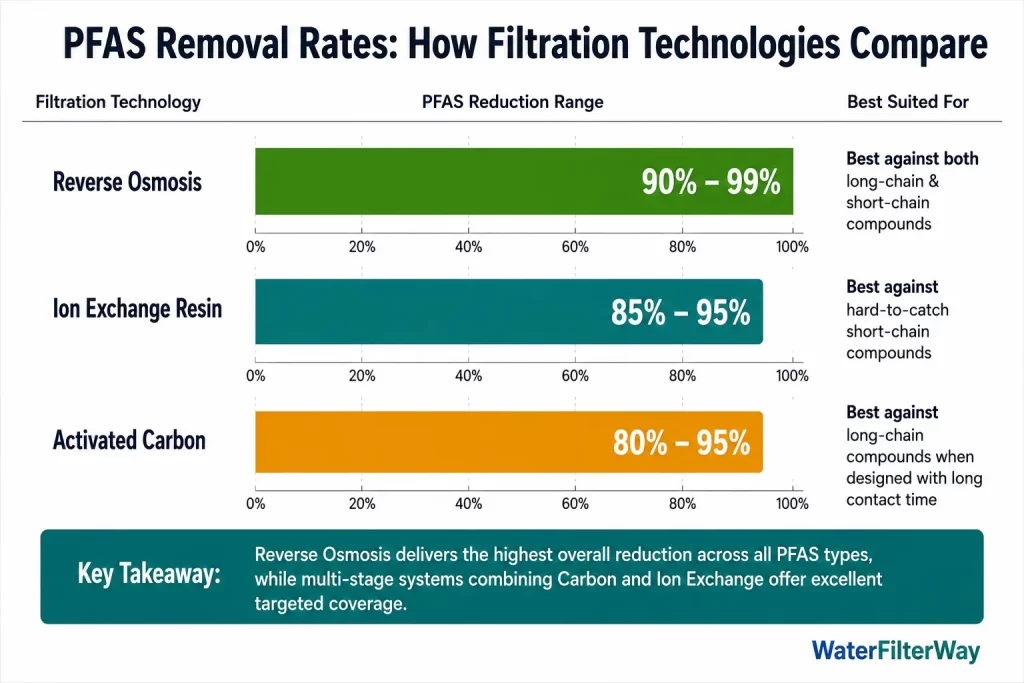
Chain length, the number of carbon atoms in a PFAS molecule, has a direct effect on how easily a filter can capture it. Long-chain compounds such as PFOA and PFOS are larger and bind more readily to activated carbon or get physically blocked by a reverse osmosis membrane. Short-chain compounds are smaller and more mobile in water, so they pass through some filters that handle long-chain PFAS with no trouble. This gap is why a filter that performs strongly in marketing materials for PFOA and PFOS is not automatically effective against the full range of PFAS compounds, and it is a big part of the case for multi-stage systems that combine carbon with ion exchange resin.
| Technology | Typical Reduction | Best Against |
| Reverse Osmosis | 90% to 99% | Long-chain and short-chain |
| Activated Carbon | 80% to 95% | Long-chain |
| Ion Exchange Resin | 85% to 95% | Short-chain |
How Do You Verify a Water Filter Actually Removes PFAS?
Manufacturer claims on a package are not proof that a filter removes PFAS. The only dependable way to confirm a product performs as advertised is independent, third party certification. Several organizations test water treatment products against accepted standards, and knowing what those standards actually cover, and which ones do not apply to PFAS at all, will save you from buying a filter that looks credible but was never tested for forever chemicals.
What Do NSF/ANSI 53 and 58 Certifications Mean for PFAS?
NSF/ANSI 53 covers contaminant reduction claims for substances with known health effects, and it is the standard most carbon-based filters use to prove PFAS reduction. NSF/ANSI 58 is specific to reverse osmosis systems and covers the same category of health effect contaminants for that technology. Both standards absorbed the testing protocols from an older certification, NSF P473, used specifically for PFOA and PFOS between 2016 and 2021 before being folded into 53 and 58. You may still see P473 referenced on older product marketing, and that is not a red flag on its own, since the underlying test methods now live inside the current standards.
| Standard | Applies To | What It Certifies |
| NSF/ANSI 42 | Carbon filters | Taste and odor only, not PFAS |
| NSF/ANSI 53 | Carbon-based systems | Health effect contaminants, including PFAS |
| NSF/ANSI 58 | Reverse osmosis systems | Health effect contaminants, including PFAS |
| NSF P473 (legacy) | Filters certified 2016-2021 | PFOA and PFOS, now merged into 53 and 58 |
Why Doesn’t NSF/ANSI 42 Certify PFAS Removal?
NSF/ANSI 42 only certifies improvements to taste and odor, such as chlorine reduction, and it is the certification most basic carbon pitcher filters carry. A filter with nothing beyond NSF 42 on its packaging has not been tested for PFAS at all, no matter how the marketing around it reads. If PFAS is the reason you are shopping for a filter, NSF 42 alone tells you nothing useful, and you need to look specifically for NSF/ANSI 53 or 58 with PFOA, PFOS, or Total PFAS named on the certificate.
What Is the Difference Between PFOA/PFOS Certification and “Total PFAS” Certification?
Some filters are certified only for PFOA and PFOS individually, the two most studied and most heavily regulated compounds. Others carry a broader Total PFAS certification covering additional compounds beyond just those two. This distinction matters most if you have already tested your water and know which specific PFAS compounds are present, since a filter certified only for PFOA and PFOS will not necessarily have been tested against a short-chain compound like GenX or PFBS.
How Can You Check If a Specific Filter Brand Is Certified for PFAS?
The most reliable method is to search the product directly on the NSF, WQA, or IAPMO public certification database rather than relying on packaging claims, and to confirm the specific standard number and contaminant listed rather than a general mention of PFAS. This is where a lot of genuine confusion comes from with specific brands. Standard Brita pitchers, for example, are certified only to NSF 42 and are not certified for PFAS. Berkey has not held a current NSF certification for PFAS reduction, yet independent lab testing conducted by advocacy groups outside the certification system has in some cases shown strong PFAS reduction from Berkey filters. Both facts are true at the same time, and they illustrate that certification lookups and independent lab results are two different forms of evidence that do not always agree. Checking both, where both exist, gives a fuller picture than relying on either one alone.
Which Organizations Besides NSF Certify PFAS Filters?
NSF International, WQA, and IAPMO R&T are the three certifying bodies most commonly seen on PFAS filter claims, but they are not the only accepted testers. UL Solutions, CSA Group, and Intertek, also known by its ETL mark, all perform legitimate independent contaminant testing for water treatment products. Which organization performed the testing matters less than confirming that PFOA, PFOS, or Total PFAS is explicitly named on the certificate itself, since a general water quality seal from any of these groups does not automatically mean PFAS was part of what was tested.
| Certifying Body | What to Look For |
| NSF International | NSF/ANSI 53 or 58 listing with PFAS named |
| WQA (Water Quality Association) | Gold Seal with a PFAS-specific claim |
| IAPMO R&T | Certification mark referencing NSF/ANSI 53 or 58 |
| UL Solutions | Product listing referencing PFAS reduction standards |
| CSA Group / Intertek (ETL) | Certification mark with PFAS explicitly listed |
Which Water Filter Format Should You Choose for PFAS Removal?
Technology and certification are only part of the decision. The same carbon or membrane can perform very differently depending on how it is built into a pitcher, a countertop unit, an under-sink system, or a whole-house setup, largely because contact time and flow design vary so much between formats.
Do Pitcher Filters Remove PFAS Effectively?
Most pitcher filters are the least effective format for PFAS, because water passes through the carbon cartridge quickly, leaving little contact time for adsorption to happen even when the carbon itself is a reasonable quality. That said, some pitchers now carry a genuine NSF/ANSI 53 certification for PFAS, which means certification still matters more than format alone. A pitcher without that specific certification should not be assumed to help with PFAS just because it improves taste.
Are Under-Sink Reverse Osmosis Systems Worth It for PFAS?
Under-sink reverse osmosis systems typically combine a carbon pre-filter with an RO membrane, and this combination gives the strongest PFAS reduction available at the point of use while also addressing many other contaminants at once. The tradeoffs are a higher upfront cost, professional or DIY installation, and some wastewater generated during filtration. This format tends to make the most sense for a household with confirmed PFAS contamination, a private well, or anyone who wants the highest level of protection for drinking and cooking water specifically.
Can Whole-House Filters Remove PFAS From Every Tap?
Whole-house systems treat water at the point it enters the home, so every tap, shower, and appliance gets filtered rather than just the water used for drinking. These systems generally use larger carbon media and sometimes ion exchange resin, and models built with catalytic carbon and KDF media can reach very high reduction rates. Some researchers have pointed to dermal contact and inhalation during showering as a secondary route of PFAS exposure beyond drinking water, which is the main reason a household would choose whole-house coverage over a drinking water filter alone, though this is still an emerging area of research rather than settled fact. Whole-house systems cost more upfront and usually need annual professional servicing.
How Do Fridge and Faucet-Mount Filters Compare for PFAS Removal?
Fridge filters and faucet-mount filters are both small carbon cartridge formats that work on the same adsorption principle as a pitcher, with the same limitations unless the specific product is certified for PFAS. Their main advantage is convenience, and cartridges in this category typically need replacing every three to four months. For someone specifically concerned about PFAS, these formats are a lower priority than certified pitchers, countertop RO units, or under-sink systems, unless the exact model carries an NSF/ANSI 53 PFAS certification.
What Does It Cost to Maintain a PFAS Water Filter?
Cost is a separate decision from technology and format, and it is where a lot of buyers get the comparison wrong by looking only at the sticker price.
How Much Do PFAS-Certified Filters Cost Upfront?
Pitcher filters certified for PFAS generally run from about 20 to 90 dollars. Faucet and fridge filters sit in a similar range. Countertop and under-sink reverse osmosis systems typically cost between 150 and 700 dollars depending on the brand and stage count, and whole-house systems can run from several hundred dollars up to well over a thousand. The number that matters more than any of these upfront prices is cost per gallon, since a cheap pitcher with a short filter life can end up costing more over a year than a pricier system with a long-lasting cartridge.
| Format | Typical Upfront Cost | Approx. Cost per Gallon |
| Pitcher (certified) | $20 – $90 | $0.50 – $1.20 |
| Faucet-mount | $30 – $80 | $0.40 – $0.90 |
| Countertop RO | $250 – $400 | $0.15 – $0.30 |
| Under-sink RO | $150 – $700 | $0.10 – $0.30 |
| Whole-house | $500 – $1,500+ | Varies by household usage |
How Often Should You Replace a PFAS Filter Cartridge?
Replacement intervals vary widely by format and design. Pitcher and faucet cartridges can last anywhere from about three weeks to six months depending on their rated capacity. Carbon pre-filters on reverse osmosis systems generally last twelve to twenty four months, while the RO membrane itself typically lasts two to three years. Whole-house carbon media can last anywhere from one year to as long as ten years depending on household water volume, and sediment pre-filters usually need replacing every twelve to eighteen months. A shorter replacement interval is often the tradeoff for a lower upfront price, which ties directly back to the cost per gallon point above. Always defer to the specific manufacturer’s schedule over these general ranges.
| Filter Type | Typical Replacement Interval |
| Pitcher/faucet cartridge | 3 weeks to 6 months |
| RO carbon pre-filter | 12 to 24 months |
| RO membrane | 2 to 3 years |
| Whole-house carbon media | 1 to 10 years |
| Sediment pre-filter | 12 to 18 months |
What Happens to PFAS Removal If You Miss a Filter Change?
Once a carbon or resin filter reaches its rated capacity, it stops adsorbing new PFAS, and in some cases it can even release previously captured contaminants back into the water passing through it, a process known as breakthrough. A certified filter used well past its rated life offers no meaningful advantage over having no filter at all. This is a common and avoidable mistake, and it is worth setting a reminder tied to the manufacturer’s stated filter life rather than replacing a cartridge only when water flow noticeably slows down or taste changes.
Do Common Water Treatment Myths Actually Work Against PFAS?
A few widely believed shortcuts do nothing for PFAS, and one of them can make things worse. Both are worth addressing directly since they come up often enough to cause real confusion.
Does Boiling Water Remove PFAS?
No. Boiling does not remove PFAS, and it can actually concentrate the chemicals in your water. As water evaporates during boiling, PFAS molecules stay behind in the remaining liquid, which raises their concentration rather than lowering it. Boiling is effective against certain biological contaminants, which is likely why the myth persists, but it does nothing for PFAS and should not be relied on as a treatment method.
Does a Water Softener Remove PFAS?
No. Water softeners use ion exchange, but the resin inside them is designed specifically for hardness minerals like calcium and magnesium, and it has essentially no affinity for PFAS molecules. This is a different resin entirely from the PFAS-specific ion exchange media discussed earlier in this guide. A softener can still be a useful part of a broader water treatment setup, but it is not doing anything to address PFAS on its own.
What Is the Current Regulatory Status of PFAS in Drinking Water?
Regulatory status matters because it determines what your utility is legally required to test for and remove, which shapes how much responsibility falls on you to filter further at home. This is also an area currently in motion, so the information below is dated and worth revisiting as the rulemaking develops.
What Are the EPA’s Maximum Contaminant Levels for PFAS?
In April 2024 the EPA finalized the first enforceable federal limits for PFAS in drinking water, called Maximum Contaminant Levels. PFOA and PFOS are each limited to 4 parts per trillion, a concentration roughly equivalent to four drops of water spread across an Olympic sized swimming pool. Four additional compounds, PFHxS, PFNA, GenX, and mixtures involving PFBS, were also given limits under the original rule. Public water systems were originally given until 2029 to comply with these limits.
| Compound | Maximum Contaminant Level |
|---|---|
| PFOA | 4 ppt |
| PFOS | 4 ppt |
| PFHxS | 10 ppt |
| PFNA | 10 ppt |
| GenX (HFPO-DA) | 10 ppt |
| Mixtures (PFHxS, PFNA, GenX, PFBS) | Hazard Index of 1 |
How Do the 2026 EPA Proposed Rule Changes Affect PFAS Protections?
On May 18, 2026, the EPA proposed two changes to the 2024 rule. The first would keep the PFOA and PFOS limits at 4 parts per trillion while giving water systems the option to request two additional years, moving the compliance deadline from 2029 to 2031. The second would rescind the limits on the other four compounds, PFHxS, PFNA, GenX, and the related Hazard Index mixture, and reconsider them separately. As of this writing both are proposals open for public comment, not final rules, and the original 2024 limits remain in effect until any change is formally adopted. Given how actively this is being debated, treat any specific deadline or compound list you read elsewhere as subject to change and check the EPA’s page for the current status.
Do Any States Set Their Own PFAS Drinking Water Standards?
Beyond the federal limits, a number of states, roughly a dozen, have set their own PFAS drinking water standards that apply regardless of what happens to the federal rule. This matters more given the proposed federal rollback described above, since a state standard can remain in force even if a federal limit is delayed or rescinded. Standards and the list of states involved change over time, so checking your own state environmental agency’s website is the most reliable way to find your state’s current requirements.
How Does PFAS Filtration Fit Into Your Overall Water Quality Strategy?
Choosing a PFAS filter rarely happens in isolation. Most people arrive at this decision already thinking about testing their water, whether the same system will handle other contaminants they are worried about, and how much their living situation limits their options.
Should You Test Your Water for PFAS Before Buying a Filter?
Testing first changes the whole decision, because a lab test tells you exactly which PFAS compounds are present and at what level, which lets you match a filter’s actual certification to your real water instead of guessing. A free first step is checking your utility’s annual Consumer Confidence Report, since some utilities already test for PFAS. If you are on a private well or want more certainty, a paid mail-in kit is the next step, with prices generally running from under 100 dollars to around 300 dollars depending on the lab and how many compounds are tested. Picking the right kit and making sense of the numbers once they arrive is really its own decision, covered in more depth under PFAS water testing kits.
Does a PFAS Filter Also Remove Fluoride From Your Water?
It depends on the technology. Reverse osmosis systems generally reduce fluoride well as a side effect of the same membrane that blocks PFAS. Standard activated carbon filters, on the other hand, generally do not remove fluoride effectively, since fluoride ions do not adsorb to carbon the way PFAS molecules do. The technologies and certifications specific to fluoride water filters are worth a closer look if fluoride is also on your list of concerns.
Does a PFAS Filter Also Remove Lead From Your Water?
Both reverse osmosis systems and NSF/ANSI 53 certified carbon filters can be certified separately for lead reduction, but a PFAS certification on its own does not guarantee the same filter also handles lead. The two need to be checked independently on the product’s certification listing, and knowing what to look for in lead water filters helps if lead is a separate concern in your water.
What’s the Best PFAS Filter Option If You Rent or Live in an Apartment?
Renting usually rules out under-sink and whole-house installations without a landlord’s approval or plumbing changes, which leaves certified pitchers, faucet-mount filters, and countertop reverse osmosis units as the realistic options. The same rule from earlier still applies here: check for an NSF/ANSI 53 PFAS certification specifically, since a compact format does not automatically mean weaker performance if the underlying technology is certified. The specific models and setups that work without any plumbing changes are covered under the best water filters for apartments.
How Does Reverse Osmosis Work Beyond PFAS Removal?
Reverse osmosis membranes are fine enough to reduce a wide range of contaminants beyond PFAS, including nitrates, arsenic, and traces of pharmaceuticals, which is worth knowing if you are weighing RO against carbon for reasons beyond forever chemicals alone. The mechanics and maintenance side of how reverse osmosis works goes deeper into the technology than this guide needs to.
How Do You Interpret a Private Well Water Test for PFAS?
Private wells fall outside EPA regulation for public water systems, which means well owners carry full responsibility for testing and treatment decisions on their own. Once the filtration technologies covered earlier make sense, the next step is understanding what your specific test results actually mean, which is where reading a well water test comes in.
Frequently Asked Questions
What filter removes PFAS from water?
Reverse osmosis is the most effective option. Activated carbon and ion exchange filters can also reduce PFAS when certified to NSF/ANSI 53 or 58 for PFOA, PFOS, or Total PFAS.
Does Brita remove PFAS?
Standard Brita pitchers are not certified to remove PFAS. They are primarily designed to reduce chlorine, taste, and odor.
Does boiling water remove PFAS?
No. Boiling does not remove PFAS and may increase its concentration as water evaporates.
What is the EPA limit for PFAS in drinking water?
The EPA set Maximum Contaminant Levels of 4 parts per trillion (ppt) for both PFOA and PFOS in drinking water.
How often should I replace a PFAS water filter?
Replacement depends on the system. Pitcher filters usually last a few months, RO membranes 2–3 years, and whole-house carbon media up to 10 years.