A well water sediment filter does not follow one fixed replacement date. Replacement timing depends on how much sediment your well produces, how much water your household uses, the size and type of cartridge you own, and what the manufacturer recommends for that specific product. This guide covers replacement timing, the factors that shorten or extend a cartridge's life, the warning signs that a filter needs attention, and the full replacement procedure. It also explains how to build a maintenance schedule, when a spin-down screen should be flushed instead of replaced, and what to monitor between filter changes so your well water stays clean and your equipment stays protected.
How Often Should a Well Water Sediment Filter Be Replaced?
A well water sediment filter should be replaced when its capacity is used up, and this can happen anywhere from one month to nine months depending on your water conditions. There is no single interval that applies to every well. Manufacturer guidance and the actual condition of your filter always take priority over a generic number.
Pentair states that its sediment pre-filter cartridges are effective for approximately six to nine months, depending on use. Other well-water sources report shorter ranges, often one to three months or three to six months, for households with heavier sediment or higher water use.
The table below shows common replacement ranges based on sediment conditions:
Sediment condition | Typical replacement range | Notes |
Low sediment | 6 to 9 months | Matches Pentair's guidance for lighter use |
Moderate sediment | 3 to 6 months | Common for average well conditions |
Heavy sediment | 1 to 3 months | Sandy or silty wells load cartridges fast |
Unusually rapid clogging | Days to a few weeks | Often signals a filtration or well issue |
Use these ranges as a starting point only. Your own filter's condition, your water pressure, and the manufacturer's instructions for your exact cartridge are the real deciding factors.
Which Factors Shorten a Sediment Filter's Service Life?
Several variables determine how long a cartridge lasts before it needs to be replaced. Understanding these factors helps you predict your own replacement pattern instead of guessing.
Main factors that affect filter lifespan:
Sediment concentration: More sand, silt, or clay in the raw water fills the cartridge faster.
Household water usage: Higher daily water use pushes more volume through the filter, speeding up loading.
Cartridge size: Larger cartridges hold more sediment before they restrict flow.
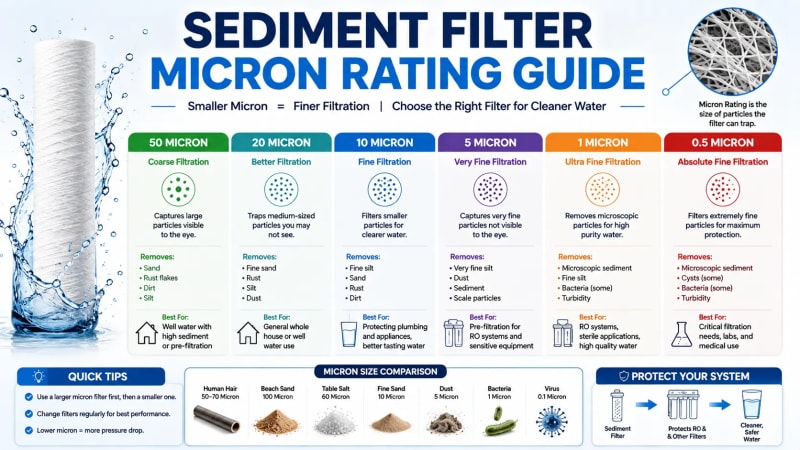
Micron rating: A finer micron rating traps smaller particles but can clog sooner under heavy sediment load.
Filter design: Pleated, spun, and other cartridge designs differ in dirt-holding capacity.
Upstream pre-filtration: A coarse pre-filter ahead of the main cartridge removes large particles first and extends the main filter's life.
Changes in well conditions: A new pump, well disturbance, or seasonal shifts can suddenly increase sediment entering the system.
Greater particle load and higher water throughput both push a cartridge toward its limit faster. When several of these factors combine, a filter that normally lasts months can clog within weeks.
How Does Sediment Load Affect Replacement Timing?
The amount and type of particulate matter entering the cartridge has a direct effect on how quickly it fills up. Sand, silt, clay, rust, and other suspended particles all take up space inside the filter media. A well with naturally sandy or sediment-heavy water can use up a cartridge much faster than a well with cleaner, low-turbidity water.
Sediment load severity and its typical effect on cartridge life:
Low turbidity water with fine, occasional particles causes slow, steady loading.
Moderate turbidity with regular sand or silt causes noticeably faster loading.
High turbidity, especially after well disturbance or heavy rain, can load a cartridge within days.
Groundwater conditions tied to well construction, aquifer type, and local geology all influence how much sediment a well naturally produces.
How Does Household Water Usage Affect Filter Life?
The volume of water passing through a cartridge also determines how fast it loads, separate from sediment concentration. A household with low daily water use pushes less total volume through the filter, so the cartridge lasts longer even with the same water quality. A household with high demand, such as a large family, frequent laundry, or irrigation drawn from the same line, pushes far more volume through the same cartridge and shortens its working life.
How Does Filter Size Affect Replacement Frequency?
Larger housings and cartridges generally hold more sediment before flow becomes restricted, because they offer more surface area for particles to collect on. A 10-inch cartridge holds less capacity than a 20-inch cartridge of the same design, and Big Blue-style housings are often chosen for households with higher water demand or heavier sediment for this reason. Always check the manufacturer's rated capacity for your specific cartridge rather than assuming a larger size guarantees a proportionally longer life.
How Does Micron Rating Affect Filter Lifespan?
Micron rating measures the smallest particle size a filter can capture. A finer micron rating captures more particles, which can cause the cartridge to load faster when the incoming water carries a lot of sediment. A coarser micron rating positioned ahead of a finer filter can remove larger particles first, which extends the life of the finer cartridge downstream. This coarse-to-fine staging approach is a common strategy in multi-stage sediment filtration.
What Signs Show a Sediment Filter Needs Replacement?
A sediment filter needs replacement when water pressure drops, flow slows down, or the cartridge shows signs of heavy loading beyond what the manufacturer considers normal. No single sign proves a filter has reached the end of its capacity on its own, so it helps to look at several signals together.
Checklist of replacement warning signs:
Reduced water pressure: A noticeable drop in pressure at faucets or fixtures.
Reduced flow rate: Water takes longer to fill a container than it used to.
Rising pressure differential: A growing gap between inlet and outlet pressure on systems with gauges.
Heavily loaded cartridge: Visible buildup that matches or exceeds the manufacturer's stated capacity.
Recurring sediment breakthrough: Grit or discoloration appearing in water downstream of the filter.
Manufacturer service limit reached: The cartridge has been in place longer than its rated lifespan.
Treat each of these as a warning sign rather than absolute proof that the filter is fully exhausted. A combination of signs gives a clearer picture than any single observation.
How Does Pressure Drop Show Filter Loading?
Pressure differential is one of the more reliable ways to judge filter loading if your system has gauges before and after the housing. As sediment builds up inside the cartridge, it restricts water flow, and the gap between the inlet pressure and the outlet pressure grows wider. Mid Atlantic Water uses a pressure differential greater than 10 psi as the point at which its systems call for cartridge replacement. This is guidance for that specific system, not a universal rule for every sediment filter, so check the pressure differential your own manufacturer recommends.
Does a Dirty Filter Always Need Immediate Replacement?
No, a discolored filter does not automatically need immediate replacement. Discoloration shows that the cartridge has captured material, which is exactly what it is designed to do. The real question is whether that captured material has restricted flow enough to matter. A cartridge can look dirty on the outside while still filtering effectively, and a filter that looks only lightly stained can still be near the end of its useful capacity depending on the type of sediment. Evaluate discoloration alongside flow rate, pressure differential, and how long the cartridge has been installed, rather than replacing based on color alone.
How Does Filter Type Change Replacement Timing?
Disposable cartridge filters and reusable spin-down screens follow completely different maintenance routines, and the two should never be treated as interchangeable schedules.
The table below compares maintenance requirements for each filter type:
Filter type | Maintenance action | Typical frequency |
Disposable cartridge | Remove and replace with a new cartridge | Weeks to several months, based on sediment load |
Spin-down screen | Flush or clean the reusable screen | Regularly, often weekly to monthly depending on sediment |
How Do Disposable Sediment Cartridges Differ in Maintenance?
Disposable cartridges, including pleated and spun polypropylene designs, are discarded once they reach their capacity or performance limit. Different cartridge formats do not all share the same service life, since pleated media, spun media, and other constructions hold sediment differently. Always follow the manufacturer's guidance for the specific cartridge you own instead of assuming one type behaves like another.
When Should a Spin-Down Filter Be Flushed Instead of Replaced?
A reusable spin-down screen is built to be flushed, not thrown away on the same schedule as a disposable cartridge. These systems use a flush valve to release trapped sediment from the screen. Flush the unit regularly based on visible sediment accumulation, and inspect the screen periodically for damage or wear that would require full replacement instead of a routine flush.
How Should You Set a Replacement Schedule?
A practical replacement schedule combines several inputs rather than relying on one fixed number. Start with the manufacturer's stated interval, then adjust it based on your own inspections, pressure and flow observations, and the sediment your well actually produces.
Steps to build a working replacement schedule:
Start with the manufacturer's recommended replacement interval for your specific cartridge.
Record the installation date every time you change the filter.
Inspect the cartridge periodically and note its condition.
Watch water pressure and flow rate for gradual changes.
Record the date you actually replace the filter, and compare it to the manufacturer's estimate.
Adjust your next interval based on how the previous cartridge actually performed.
A sample maintenance schedule structure:
Task | Frequency |
Inspect cartridge condition | Monthly during the first year |
Check water pressure and flow | Ongoing, or whenever a change is noticed |
Record installation and replacement dates | Every time the filter is changed |
Reassess the replacement interval | After each cartridge change |
How Should You Establish Your First Replacement Interval?
Building your first replacement interval takes a season or two of observation. Record the date you install a new cartridge, then inspect it periodically rather than waiting for a problem to appear. All Filters recommends monthly inspection during the first year of ownership, which gives you enough data points to see how your specific well behaves. Track pressure and flow during this period, record the date you eventually replace the filter, and use that real result to set your next interval with more confidence.
When Should You Shorten Your Established Schedule?
Certain changes signal that your existing schedule is running too long between replacements. Watch for faster pressure decline than in previous cycles, a visible increase in sediment, seasonal shifts such as spring runoff, nearby construction, flooding, or any pump or well work. The EPA recommends testing your well water after significant changes to the well system or noticeable changes in water quality, and the same logic applies to your filter schedule. If any of these events occur, shorten your replacement interval rather than waiting for the original schedule to run out.
When Does Frequent Filter Replacement Signal a Well Problem?
If a sediment cartridge clogs far faster than expected, repeatedly and without an obvious external cause, this can point to a problem beyond normal filter maintenance. Repeated rapid loading can mean the well is producing more sediment than usual, the pump position or drawdown level has changed, pre-filtration is inadequate for the sediment level, or the filtration setup is too fine for the amount of sediment coming through.
A simple way to work through repeated rapid clogging:
First, confirm it is not a filtration setup issue: check that the micron rating and cartridge size match your sediment load.
Next, rule out a maintenance gap: confirm the cartridge was installed correctly and within its rated capacity.
If the pattern continues, investigate the well itself, including pump position, well screen condition, and recent changes near the well.
Do not attempt to diagnose a specific well failure without proper inspection or testing. A well contractor or water treatment professional can identify the actual cause if repeated rapid clogging continues.
How Should You Replace a Sediment Filter Cartridge?
Replacing a sediment filter cartridge follows a consistent procedure across most residential systems, though details can vary slightly by housing design.
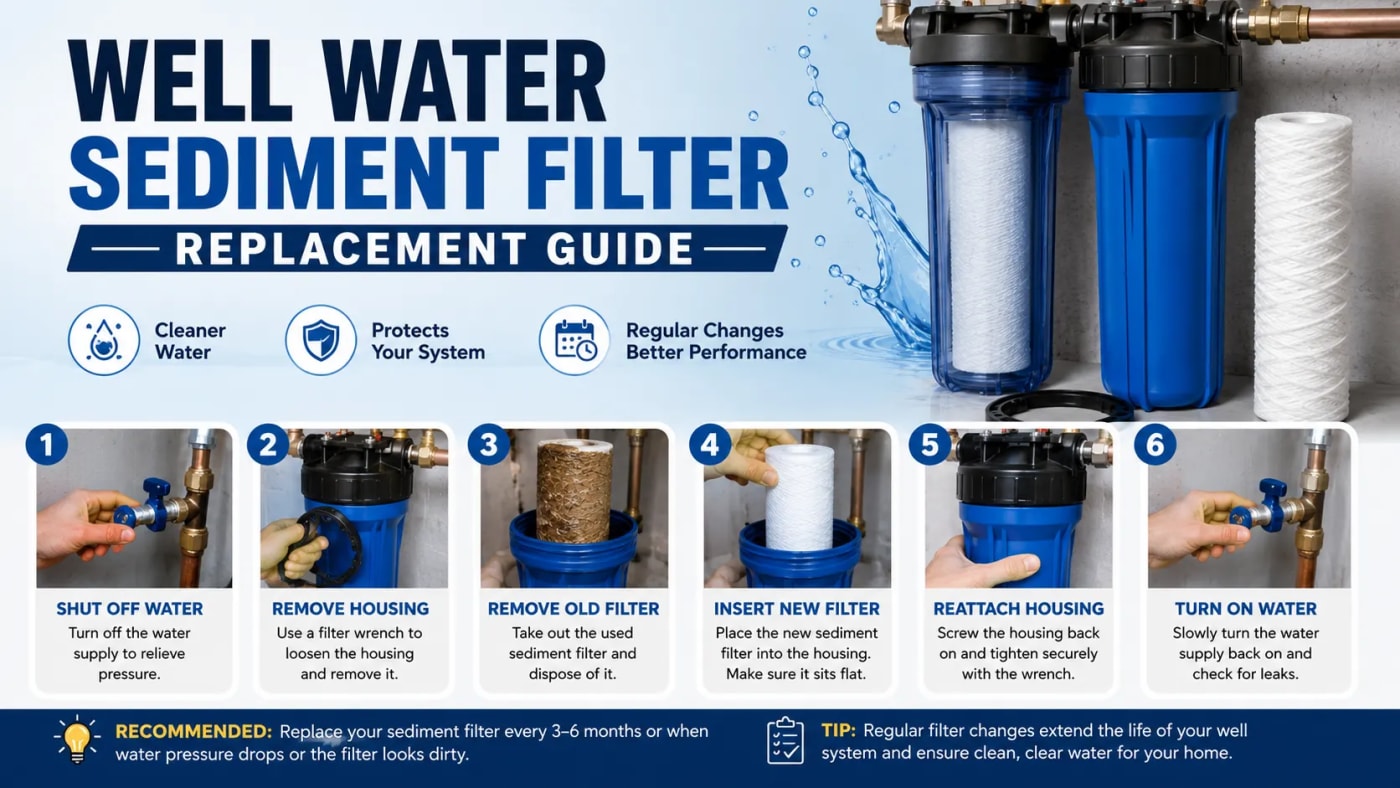
Steps to replace a sediment filter cartridge:
Shut off the water supply to the filter housing.
Open a nearby faucet or the housing's pressure relief button to release trapped pressure.
Place a container or towel under the housing to catch any remaining water.
Open the housing using the housing wrench provided or recommended by the manufacturer.
Remove the old cartridge and set it aside for disposal.
Check the housing and O-ring for damage, dirt, or wear, and clean if needed.
Install the new cartridge, making sure it seats correctly in the housing.
Reassemble and tighten the housing according to the manufacturer's instructions.
Restore the water supply slowly.
Flush the system briefly and check the housing and connections for leaks.
Follow this procedure in order, and avoid rushing the pressure relief step, since a housing opened under pressure can cause water to spray unexpectedly.
What Should You Check After Installing a New Filter?
After installing a new sediment filter, confirm the system is working correctly before considering the job finished.
Post-installation checklist:
Correct seating: Confirm the cartridge sits properly inside the housing.
Housing seal: Check that the housing is closed and sealed as intended.
No leaks: Inspect the housing and connections for any dripping or seepage.
Restored pressure and flow: Confirm water pressure and flow return to normal levels.
Flushing: Run water briefly to clear any loose particles from the new cartridge.
Unusual taste or appearance: Watch for any unexpected taste, odor, or cloudiness after the change.
Installation date recorded: Note the date somewhere you will see it, so you know when the next replacement is likely due.
Recording the installation date matters because it becomes the starting point for your next replacement interval. Without this record, every future replacement decision relies on guesswork instead of your own well's history.
What Should Well Owners Monitor Between Filter Changes?
Cartridge replacement is only one part of maintaining a private well. Between filter changes, pay attention to any shift in water color, taste, odor, or clarity, since these changes can point to issues beyond sediment alone. The EPA recommends testing private well water annually for total coliform bacteria, nitrates, total dissolved solids, and pH, with additional testing after flooding, well repairs, or other significant changes near the well. A sediment filter protects against particles, but it does not replace regular water testing as a way to confirm your well water remains safe.
How Do Sediment Filters Work for Well Water?
A sediment filter works by mechanically trapping suspended particles, such as sand, silt, and rust, as water passes through the filter media. This process removes visible particulate matter but does not address dissolved contaminants that pass through in solution rather than as solid particles. For a full explanation of how these filters function, see our complete guide on sediment filters for well water.
Which Micron Rating Is Best for Well Water Sediment?
The right micron rating depends on the size of the particles in your water, your overall sediment load, and what equipment you are trying to protect downstream. Many systems use a coarse-to-fine staging approach, removing larger particles first before finer filtration handles smaller sediment. For a full breakdown of how to choose the right rating for your well, see our dedicated guide on the best micron rating for well water sediment.
How Do You Install a Sediment Filter on a Well?
Installing a sediment filter involves placing the housing at the correct point in your water line and following the manufacturer's instructions for your specific system design. Placement and plumbing details vary depending on your well setup and household layout. For complete installation steps, see our guide on how to install a well water sediment filter.
When Should You Test Private Well Water?
Test your private well water on a routine annual schedule, and again whenever water quality changes, after flooding, or after well repairs or replacement. The EPA recommends this baseline testing for total coliform bacteria, nitrates, total dissolved solids, and pH, with extra testing whenever conditions around the well change significantly. For a full testing schedule and process, see our private well water testing guide.
How Do You Remove Sand From Well Water?
Sediment filtration captures sand as water passes through, but filtration alone does not solve an underlying cause of excessive sand production. A spin-down pre-filter can handle heavier sand loads before water reaches finer filtration stages. If sand production increases suddenly or does not improve with filtration, the source may need investigation. For full details, see our guide on how to remove sand from well water.
Can a Sediment Filter Remove Iron From Well Water?
A sediment filter can capture particulate or oxidized iron that has already formed solid particles in the water. It cannot remove dissolved iron, which stays in solution and requires a different treatment approach, such as oxidation or specialized iron filtration media. For the full distinction and treatment options, see our guide on how to remove iron from well water.
Conclusion
A well water sediment filter does not run on a single fixed replacement date. Sediment load, household water use, cartridge size, micron rating, and manufacturer guidance all combine to determine how long a filter actually lasts. Watch for pressure drops, reduced flow, and heavy cartridge loading as your main warning signs, and build your own replacement schedule around real observations rather than a guess. Combine consistent filter maintenance with regular well water testing, and your system will keep delivering clean, well-filtered water while protecting your home's plumbing and appliances.