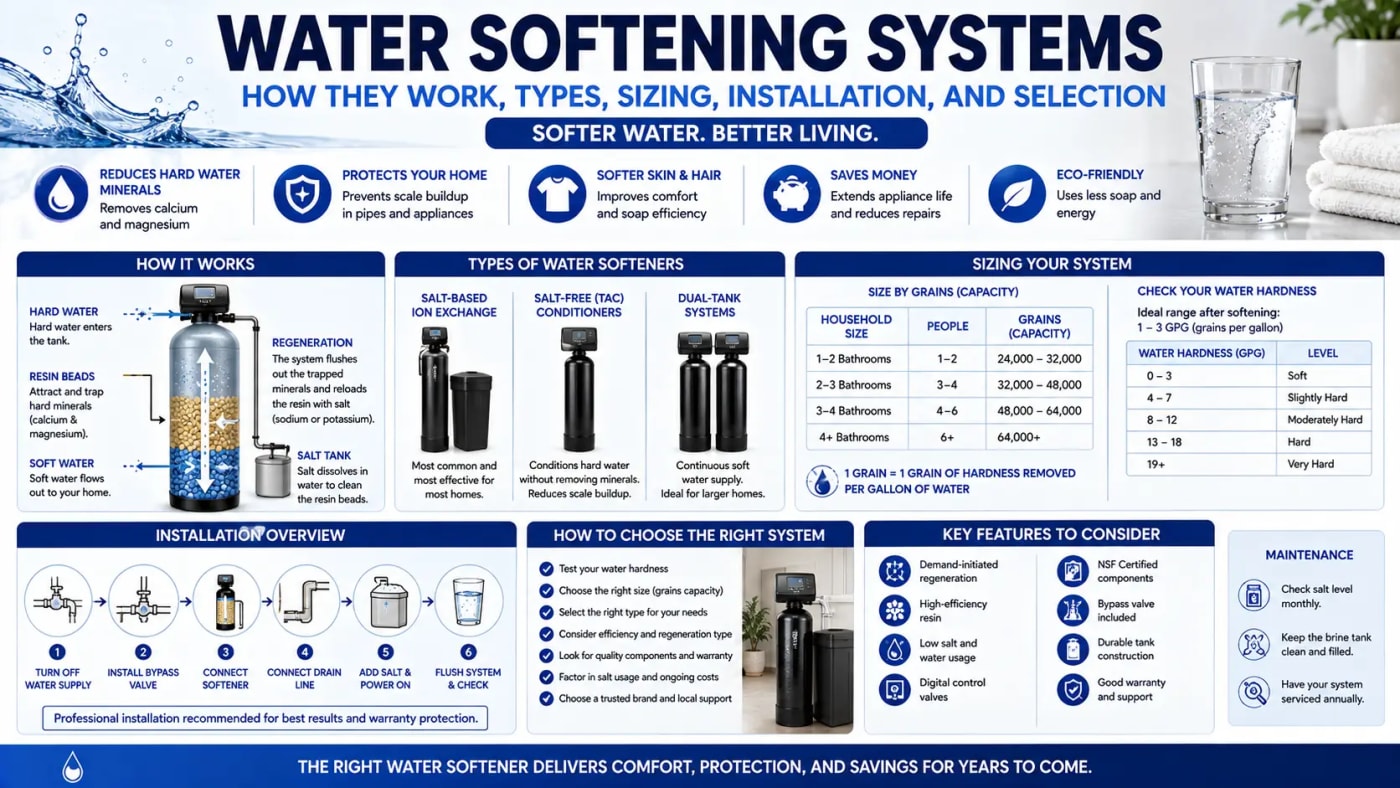
Water softening systems remove calcium and magnesium from hard water.This removal happens through a process called ion exchange. Inside the unit, a resin bed traps calcium and magnesium as water passes through it. In their place, the resin releases sodium or potassium into the water. Over time, the resin fills up with trapped minerals, so the system runs a regeneration cycle. This cycle flushes the trapped minerals out and resets the resin so it can keep softening water.
A softening system is not just one tank. It is built from several working parts, including the resin tank, the brine tank, a control valve, and a drain connection, and these parts come in different configurations such as single-tank, dual-tank, timer-controlled, and cabinet-style units. Choosing the right one depends on two main numbers: how hard the incoming water is, measured in grains per gallon, and how much water the household uses each day. Together these numbers decide the grain capacity and flow rate a household actually needs.
Water source also plays a role in system selection. Municipal water and private well water can carry different mineral loads, and well water often needs a check for iron, manganese, and sediment before a softener is chosen. Regeneration frequency, salt dose, and overall efficiency all affect how well the system performs and how much water and salt it uses over time. Correct installation at the point where water enters the home, along with basic ongoing maintenance, keeps a softener working properly for years.
It is also important to know what a softener is not. True softening through ion exchange is different from salt-free conditioning, which does not remove hardness minerals at all. This page walks through each of these topics in order, from the exchange mechanism inside the tank to sizing, installation, and long term maintenance, so a household can match the right system to their actual water and usage needs.
How does a water softening system remove calcium and magnesium from hard water?
A water softening system removes calcium and magnesium from hard water using a resin bed that swaps these minerals for sodium or potassium.Hard water is water with high levels of dissolved calcium and magnesium. These minerals cause scale buildup and reduce soap performance. The resin bed inside the softener tank is made of small plastic beads. Each bead carries a negative charge. Calcium and magnesium ions carry a positive charge, so they stick to the resin beads as hard water flows through the tank. In exchange, the resin releases sodium or potassium ions into the water. This swap is the core mechanism of ion exchange. The water leaving the tank has calcium and magnesium removed and a small amount of sodium or potassium added instead.This mechanism is confirmed by the US Environmental Protection Agency, Penn State Extension, and NSF International, the organization that sets performance standards for water treatment equipment.
What happens inside the resin tank as hard water passes through the exchange bed?
Inside the resin tank, hard water enters from the top and moves down through the resin bed, where calcium and magnesium stick to the beads.The resin tank is the main working part of a softener.
Main components inside the resin tank:
Resin beads: Small beads coated with a negative charge that attract calcium and magnesium
Resin bed: The full layer of resin beads packed inside the tank
Distributor: A tube system at the top and bottom of the tank that spreads water evenly across the resin bed
Pressure tank shell: The outer container that holds the resin bed and withstands household water pressure
As water moves through the resin bed, it stays in contact with the beads long enough for the exchange to happen. By the time water reaches the bottom of the tank, most of the calcium and magnesium is gone.
How does the resin regain its softening capacity during regeneration?
The resin regains its softening capacity during regeneration when a strong salt solution flushes out the trapped calcium and magnesium and replaces them with sodium or potassium.Resin beads can only hold a limited number of calcium and magnesium ions. Once the beads are full, the resin is exhausted and softening stops working properly.
Steps in a regeneration cycle:
Backwash: Water flows upward through the resin bed to loosen and clean the beads
Brine draw: A strong salt solution from the brine tank is pulled through the resin bed
Ion release: Sodium or potassium ions in the brine push out the trapped calcium and magnesium, and these hardness ions are flushed out through the drain
Rinse: Fresh water flushes remaining brine and loose particles out of the tank
Return to service: The resin bed is refreshed and ready to soften water again
The US EPA and Penn State Extension both describe regeneration as a required maintenance step that keeps a softener working correctly.
What components make up a residential water softening system?
A residential water softening system is made up of a resin tank, a brine tank, a control valve, a flow meter, a bypass valve, a drain connection, and plumbing connections.A full residential softener is more than just a resin tank. It is a small system of connected parts that work together to soften water and clean the resin automatically.
Main parts of a residential water softener:
Resin tank: Holds the resin bed where ion exchange happens
Brine tank: Stores salt or potassium pellets and mixes the brine solution used in regeneration
Control valve: Manages water flow, tracks usage, and starts regeneration at the right time
Flow meter: Measures how much water passes through the system
Bypass valve: Allows water to skip the softener during maintenance or repair
Drain connection: Carries wastewater from regeneration out of the system
Plumbing connections: Inlet and outlet pipes that connect the softener to the home's main water line
How does a metered single-tank softener operate during normal household use?
A metered single-tank softener operates by tracking actual water use and starting regeneration only when the resin nears its capacity limit.This type of softener uses one resin tank and a flow meter. The meter tracks the exact volume of water used by the household. When the volume reaches the programmed capacity limit, the control valve starts a regeneration cycle automatically. This is called demand-initiated regeneration. It matches regeneration to actual water use instead of a fixed schedule, which reduces wasted salt and water.
When does a dual-tank softening system provide an advantage over one resin tank?
A dual-tank softening system provides an advantage when a household needs a constant supply of soft water with no interruption during regeneration.This system uses two resin tanks instead of one. While one tank regenerates, the second tank stays in service and continues to soften water. This gives the household a constant supply of soft water with no interruption.
This setup is useful for larger households or homes with high daily water use, where a single tank regenerating at the wrong time would leave the home with hard water for a period. The Water Hub notes that continuous soft water supply is the main reason households choose a dual-tank configuration.
How does a timer-controlled softener differ from a demand-initiated system?
A timer-controlled softener regenerates on a fixed schedule, while a demand-initiated system regenerates only after a set volume of water has actually been used.A timer-controlled softener regenerates every few days, for example every three days, regardless of how much water the household actually used. A demand-initiated system regenerates only after a set volume of water has passed through the resin, based on real usage.
Timer-controlled systems are simpler but often waste salt and water because they regenerate even when the resin still has capacity left. The US EPA specifically recommends demand-initiated programming because it matches regeneration to actual need and improves efficiency.
How do cabinet-style softeners differ from separate-tank systems?
A cabinet-style softener combines the resin tank and brine tank into one unit, while a separate-tank system keeps them as two individual tanks.A cabinet-style softener saves floor space because both tanks sit inside a single cabinet. A separate-tank system uses two tanks connected by tubing, which usually takes up more room.
Below is a short comparison of the two designs.
Feature | Cabinet Style | Separate Tank |
Footprint | Compact, single unit | Larger, two tanks needed |
Installation space | Fits small utility areas | Needs more floor space |
Service access | Some parts are harder to reach | Easier access to each tank |
Common capacity range | Lower to mid capacity | Mid to high capacity |
The choice between the two depends on available space and household capacity needs, not on softening performance.
How do salt-based water softeners differ from salt-free water conditioners?
A salt-based water softener removes calcium and magnesium from water, while a salt-free water conditioner does not remove any hardness minerals at all.
This is one of the most confusing topics in water treatment, so the difference needs to be clear. A salt-based system uses ion exchange to pull hardness minerals out of the water. A salt-free system instead changes the physical structure of the minerals so they are less likely to stick to pipes and surfaces.
The table below shows how the two systems differ.
Attribute | Salt-Based Softener | Salt-Free Conditioner |
Removes hardness minerals | Yes | No |
Measured hardness after treatment | Lower | Same as before treatment |
Requires salt or potassium | Yes | No |
Reduces scale buildup | Yes | Yes, through crystal formation |
Produces wastewater | Yes, during regeneration | No |
Regeneration cycle | Required | Not required |
The US EPA treats these as two separate treatment functions with different results, and this difference should guide the buying decision more than price or brand.
How does template-assisted crystallization control scale without removing hardness minerals?
Template-assisted crystallization controls scale by turning calcium and magnesium into tiny crystals that do not stick to surfaces, without removing the minerals from the water.This technology, known as TAC, is the main method used in salt-free conditioners. Water flows through a special media that contains microscopic nucleation sites. Calcium and magnesium in the water form tiny hardened crystals on these sites instead of sticking to pipe walls and surfaces.
The hardness minerals remain in the water. TAC does not lower the measured hardness value. It only changes the mineral form so it causes less scale. TAC should not be described as producing softened water, since that claim belongs to true ion-exchange softening.
When does a magnetic or electronic descaler serve a different purpose from a true softener?
A magnetic or electronic descaler serves a different purpose from a true softener because it does not remove any calcium or magnesium from the water.These devices are marketed as scale-control products. They use a magnetic field or electronic pulse around the water pipe, and the claim is that this changes how minerals behave in the water.
These devices do not remove calcium or magnesium from water. Bob Vila draws a clear line between magnetic descaling products and true mineral removal systems. A homeowner who needs measurable hardness reduction needs a true ion-exchange softener, not a magnetic or electronic descaler.
How do water hardness and household water demand determine softener size?
Water hardness and household water demand determine softener size by setting the two numbers that decide grain capacity: how hard the water is, and how much water the household uses each day.Bedroom count or bathroom count is not a reliable sizing method by itself. The correct approach multiplies hardness level by daily water use, then adds a reserve margin.
How is water hardness measured in grains per gallon or milligrams per liter?
Water hardness is measured in grains per gallon, written as GPG, or in milligrams per liter, also called parts per million or ppm. One grain per gallon equals about 17.1 milligrams per liter.The actual hardness value should come from a real water test, either a municipal water quality report or a private test for well water. USGS publications confirm GPG and mg/L as the standard units used to report water hardness in the United States.
How does daily water consumption affect the required softening capacity?
Daily water consumption affects softening capacity because more gallons passing through the resin bed each day means more hardness ions need to be removed, which uses up capacity faster.This is the second key sizing variable after hardness level.
Lowe's uses a starting estimate of about 80 gallons per person per day for sizing purposes. This number is a general starting point, not a fixed rule, since actual household water use varies by habits, fixtures, and appliances.
What does a 32,000-, 48,000-, or 64,000-grain softener capacity actually mean?
A 32,000, 48,000, or 64,000 grain rating describes the softener's maximum rated capacity under specific test conditions, not a guaranteed number of grains removed every day.
The table below shows how grain rating relates to typical household size, as a general guide only.
Grain Rating | General Household Fit |
32,000 grains | Small households, one to two people |
48,000 grains | Medium households, three to four people |
64,000 grains | Larger households or higher water hardness |
Actual usable capacity depends on the salt dose used during regeneration and the settings programmed into the control valve. NSF/ANSI 44 is the standard that covers softening capacity and performance testing for these units.
How does peak flow rate affect the softener size chosen for a household?
Peak flow rate affects softener size by determining how much water the unit can treat at one time without a large pressure drop, separate from its grain capacity.Flow rate is measured in gallons per minute, or GPM.
A larger home with more bathrooms does not automatically need higher grain capacity just because it has more fixtures. It does need a softener with enough flow rate to handle several fixtures running at the same time, such as a shower and a washing machine running together. Sizing research separates these two factors clearly, since grain capacity and flow capacity solve different problems.
How should iron and manganese change the sizing calculation for well water?
Iron and manganese should change the sizing calculation by adding extra treatment load that must be checked against an actual water test rather than guessed.Well water often contains these minerals in addition to calcium and magnesium, and they can reduce softening performance if not accounted for.
There is no single universal multiplier that works for every well. The correct approach is to use the actual water test result for iron and manganese levels, then check the manufacturer specification for the chosen resin and system. Online community discussions among well owners confirm this is a common and real sizing concern that a water test resolves.
How does a water softener decide when regeneration is needed?
A water softener decides when regeneration is needed by tracking water usage against its programmed capacity, and starting a cycle once that capacity is close to full.The system tracks water usage and hardness level to know when the resin bed is close to full. Once the volume of treated water reaches the programmed capacity, the control valve starts a regeneration cycle. This is capacity depletion, and it uses the water meter and the reserve capacity setting instead of a fixed calendar schedule. The US EPA recommends programming regeneration based on hardness level and flow rate rather than a fixed time interval.
How do salt dose and regeneration settings affect softening efficiency?
Salt dose and regeneration settings affect softening efficiency by determining how much hardness capacity the resin regains after each cycle.The amount of salt used during regeneration directly affects this outcome. Using more salt does not always produce a proportional increase in capacity. Efficiency is measured as grains of hardness removed per pound of salt used.
The advertised grain rating on a softener is a maximum figure, and it should not be treated as the guaranteed usable capacity at every salt setting. NSF/ANSI 44 includes salt and water efficiency as part of its performance standard, and the US EPA recommends a rate of at least 3,500 grains removed per pound of salt for an efficient system.
How much water does regeneration use and where does the wastewater go?
Regeneration uses water during the backwash, brine draw, and rinse steps, and the resulting wastewater exits through the drain connection.This wastewater carries the removed hardness minerals and leftover brine. This wastewater carries the removed hardness minerals and leftover brine, and it exits through the drain connection.
The exact amount of water used per regeneration cycle varies by model, resin volume, and programmed settings, so there is no single fixed number that applies to every softener. The US EPA recommends considering both water efficiency and salt efficiency when choosing a system, since these two factors together determine total water use over time.
How does a softener's salt setting affect regeneration frequency?
A softener's salt setting affects regeneration frequency because a lower setting means less usable capacity and more frequent cycles, while a higher setting means more usable capacity and fewer cycles.This setting is programmed into the control valve. A lower salt setting produces less usable capacity, which means the softener reaches its limit sooner and regenerates more often. A higher salt setting produces more usable capacity, which means regeneration happens less often but uses more salt each time.
As an example only, a household using 300 gallons of water per day with a resin capacity of 30,000 usable grains would need regeneration roughly every four to five days, depending on hardness level. This is a labeled example, not a fixed rule for every home. Online community discussions confirm this relationship between salt setting and regeneration frequency is often misunderstood by new softener owners.
How does the incoming water source affect which softening system is appropriate?
The incoming water source affects softening system choice by changing what extra minerals or conditions the system needs to handle beyond calcium and magnesium.Municipal or private well water changes what a softener needs to handle. The source alone does not decide the exact softener model, since actual water chemistry and household demand still matter most. A water test remains the starting point for both source types.
Why can well water require pretreatment before a water softener?
Well water can require pretreatment because iron, manganese, and sediment can interfere with the resin bed or add extra load a standard softener is not built to handle. These substances can interfere with the resin bed or add extra load that a standard softener is not designed to handle alone.
Pretreatment, such as sediment filtration or iron removal, addresses these specific issues before water reaches the softener. The correct treatment plan always follows a verified water test rather than a general assumption about well water.
How is a water softener different from a whole-house water filter?
A water softener is different from a whole-house water filter because it targets hardness minerals, while a filter targets other contaminants such as sediment, chlorine, taste, or odor.Which contaminants a filter actually removes depends on the filter media used inside it.
Not every filter removes every contaminant. The type of filter media determines what it actually removes, so a filter chosen for chlorine reduction will not necessarily remove sediment or other substances. This distinction is a common source of confusion among homeowners comparing the two systems.
Why is reverse osmosis usually treated as a separate point-of-use system from whole-house softening?
Reverse osmosis is treated as a separate point-of-use system because it purifies drinking water at one location, while a softener treats hardness across the entire home.
RO, is commonly installed under a kitchen sink, while a softener works at the point where water enters the house. These two systems serve different purposes and are usually installed separately.
Where should a whole-house water softening system be installed in the plumbing line?
A whole-house water softening system should be installed at the point of entry, the location where the main water line enters the home, before it splits off to different fixtures.This placement allows the entire home to receive softened water.
The installation location needs enough space for the resin tank and brine tank, access to a drain, access to electrical power if the control valve requires it, and enough room for a bypass valve and service access. This Old House lists water softener installation as an advanced plumbing project, meaning it usually benefits from professional installation unless the homeowner has strong plumbing experience.
What plumbing connections does a residential water softener require?
A residential water softener requires an inlet, an outlet, a bypass valve, a drain line, and often an electrical connection for the control valve.
Connections needed for a residential softener installation:
Inlet connection: Brings unsoftened water from the main line into the softener
Outlet connection: Sends softened water out to the rest of the home
Bypass valve: Allows water to skip the softener during service or repair
Drain line: Carries regeneration wastewater away from the unit
Overflow line: Prevents brine tank overflow in case of a malfunction, where applicable
Electrical connection: Powers the control valve, where the specific valve requires electricity
Exact plumbing code requirements vary by location, so any specific code question should be checked against the applicable local plumbing code before installation.
Which household fixtures should remain connected to unsoftened water?
Outdoor fixtures such as hose bibs used for lawn watering are the ones most often left connected to unsoftened water.Bypassing these fixtures reduces unnecessary softened-water consumption and salt use.
There is no single universal plumbing layout that fits every home, since household needs and local practice vary. The US EPA notes that bypassing water-intensive outdoor uses can reduce overall softened-water demand and lower salt and water use over time.
How should a residential water softening system be operated after installation?
A residential water softening system should be operated by checking the salt supply, watching the control valve for system status, and confirming regeneration cycles run correctly.Day-to-day operation of a softener is simple once installed. It also helps to test the softened water occasionally and use the bypass valve when maintenance is needed.
How should the brine tank and salt supply be maintained?
The brine tank and salt supply should be maintained by keeping salt topped up, watching for salt bridges, and cleaning the tank periodically.
Regular brine tank maintenance tasks:
Check salt level: Keep the brine tank at least one third full of salt or potassium pellets
Watch for salt bridges: A hardened salt crust can form above the water line and block proper brine mixing, so this crust should be broken up if it forms
Clean the brine tank: Remove sediment and buildup from the bottom of the tank periodically
Refill correctly: Add the salt type recommended by the manufacturer, and avoid overfilling the tank
The US EPA recommends periodic salt level checks along with an annual brine tank cleaning as part of normal softener care.
How can a homeowner recognize that a softener is no longer producing properly softened water?
A homeowner can recognize a failing softener through signs such as returning scale, poor soap lather, and regeneration cycles that stop running on schedule.
Common signs that a softener needs attention:
Hardness returns downstream, noticeable through scale spots on dishes or fixtures
Soap and detergent no longer lather as easily as before
White scale buildup reappears on faucets or shower heads
Regeneration cycles stop running on schedule or the control valve shows an error
Salt bridges or salt mushing appear in the brine tank
These are symptoms, not a diagnosis. A water hardness test should confirm whether the softener is actually underperforming before assuming a specific part has failed.
How often should a residential water softener receive professional service?
A residential water softener should receive professional service once a year, based on US EPA guidance for maintaining good performance and efficiency. Annual service typically checks the resin bed, control valve settings, and overall system function. Resin itself does not have one universal replacement interval, since resin life depends on the specific system, local water chemistry, and how the unit has been operated over time.
How does softened water change the behavior of soap, scale, plumbing, and appliances?
Softened water improves soap performance and reduces scale buildup in pipes, water heaters, and appliances throughout the home.Removing calcium and magnesium from water changes how it interacts with these surfaces. Soap and detergent rinse away more completely in softened water, which reduces soap scum on skin, dishes, and fabric. Scale buildup slows down significantly inside pipes, water heaters, and other appliances, which helps protect these systems over time. Both the US EPA and Penn State Extension confirm these appliance and soap-related benefits as direct results of hardness reduction.
How does ion-exchange softening change sodium or potassium levels in treated water?
Ion-exchange softening raises sodium or potassium levels in treated water because these ions replace the calcium and magnesium that are removed.The regenerant used in the brine tank determines which one is added. The regenerant used in the brine tank determines which one is added, since some systems use sodium chloride and others use potassium chloride.
The exact amount of sodium or potassium added to the water depends on the incoming hardness level and how the system is operated, so there is no single fixed number that applies to every household. NSF standards cover labeling requirements related to this ion exchange process.
What does a water softener not remove from household water?
A water softener does not remove bacteria, viruses, pesticides, PFAS chemicals, sediment, or chlorine from household water.It is designed primarily to reduce hardness, not to act as a universal water filter. Removing these substances requires a different type of treatment, matched to the specific contaminant found in the water test.
How should water test results be translated into a suitable softening system?
Water test results should be translated into a suitable softening system by following a clear decision path from hardness reading to installation planning.Once a water test is complete, the results guide the entire selection process. The steps below summarize the full decision path covered on this page, without repeating the detailed explanations already given.
Decision path from water test to system selection:
Test the water: Get an accurate hardness reading along with iron, manganese, and sediment levels if the source is a private well
Establish the hardness load: Convert the test result into grains per gallon
Determine household demand: Estimate daily water use for everyone in the home
Evaluate water chemistry: Check for iron, manganese, or other conditions that affect sizing
Choose a configuration: Decide between single-tank, dual-tank, timer-controlled, or cabinet-style based on household needs
Verify efficiency and certification: Look for NSF/ANSI 44 certification and confirm salt and water efficiency
Plan the installation: Confirm space, drain access, and plumbing connections before purchase
How do you test water hardness before buying a softener?
The starting point is a municipal water quality report for city water, or a private water test for well water. This test provides the actual hardness number needed for sizing. A separate guide covers hardness testing methods in full detail.
How do you calculate the right water softener size for your household?
Basic sizing multiplies hardness in grains per gallon by daily household water demand, then adds a reserve capacity margin and checks peak flow rate. A dedicated sizing guide walks through the full calculation with worked examples.
How does a water softener compare with a salt-free conditioner?
A salt-based softener removes hardness minerals through ion exchange. A salt-free conditioner changes mineral structure without removing hardness. A separate comparison page covers technology, hardness results, scale behavior, and maintenance differences in full detail.
How does a water softener compare with a whole-house water filter?
A softener targets hardness specifically. A whole-house filter targets other contaminants such as sediment, chlorine, taste, or odor, depending on the media used. A dedicated comparison page explains which system fits which water quality problem.
How does a water softener work with well water?
Well water treatment starts with testing for hardness along with other common well conditions such as iron, manganese, and sediment. A dedicated well-water page explains pretreatment options and softener compatibility for private wells.
How do you install a whole-house water softener?
Installation happens at the point of entry, with connections for inlet, outlet, drain, bypass, and power where required. A dedicated installation guide walks through each connection step by step.
How do you maintain a water softener?
Ongoing maintenance includes checking salt level, watching for salt bridges, cleaning the brine tank, confirming regeneration cycles run correctly, and scheduling annual professional service as recommended by the US EPA. A dedicated maintenance guide covers the full schedule.
How much does a water softener system cost?
Cost varies based on configuration, grain capacity, technology type, installation complexity, and whether a service plan is included. There is no single universal price that applies to every household. A dedicated cost page covers current pricing ranges by system type.
What are the best water softener systems for different household needs?
The best system depends on household hardness level, water demand, water source, configuration preference, and efficiency rating, not on brand name alone. A dedicated comparison page reviews specific systems against these criteria for different household scenarios.