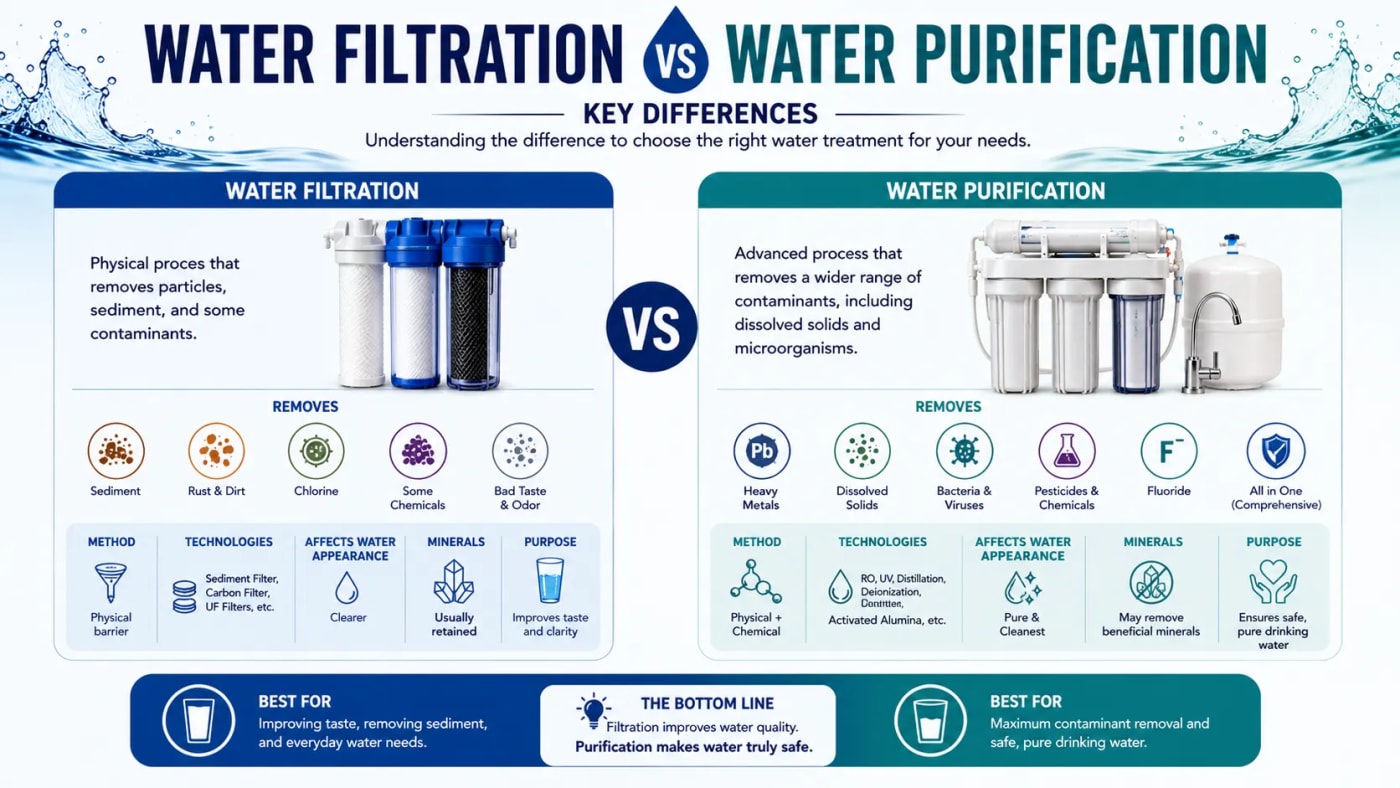
Water filtration and water purification key differences come down to six factors: treatment mechanism, contaminant target, microbiological protection, technology, certification, and water source. Filtration physically separates or adsorbs specific contaminants, such as sediment, chlorine, or certain dissolved substances, using a filter medium. Purification is a broader term that often includes microbial treatment, meaning it targets bacteria, viruses, or cysts, alongside other treatment methods. This article breaks down each of these factors so you can choose a water filter or water purifier that actually matches your water problem.
How Do Water Filtration and Purification Differ?
Water filtration and purification differ mainly in intent and scope. A water filter is designed to physically remove or reduce specific particles and chemical contaminants as water passes through a filter medium. A water purifier is a broader category, and it often means the device includes some form of microbial treatment, whether that is a membrane fine enough to block microorganisms or a technology like UV light that inactivates them.
The word "purifier" is not a guarantee that every possible contaminant is removed. NSF, the organization that develops many of the water treatment certifications used in the United States, is clear that a certified claim only covers what was specifically tested. A device marketed as a purifier still needs a specific certification, such as NSF P231, to back up any microbiological claim. Filtration and purification are best understood as two overlapping categories of water treatment, not two competing brands.
What Does Water Filtration Actually Do?
Water filtration actually works through physical barriers and adsorption. A physical barrier traps particles that are larger than the pores in the filter medium, which is how sediment filters catch sand, rust, and other visible debris. Adsorption works differently. Activated carbon, for example, has a large internal surface area that attracts and holds certain dissolved chemicals as water flows past it.
Performance always depends on the exact filter design, the pore size, the type of media, and the certified claim printed on the product. A basic sediment filter and a fine carbon block filter both count as filtration, but they target very different contaminants.
Common filtration mechanisms:
Physical straining: Traps particles larger than the filter's pore size, such as sediment, rust, and sand.
Adsorption: Uses activated carbon or similar media to attract and hold dissolved chemicals and compounds.
Ion exchange: Swaps unwanted ions, such as hardness minerals, for other ions held on a resin bed.
What Does Water Purification Actually Do?
Water purification actually refers to treatment aimed at a defined safety objective, most often microbiological protection. This includes reducing or inactivating bacteria, viruses, and protozoan cysts such as Giardia and Cryptosporidium. Some purification methods physically remove these organisms, while others inactivate them so they can no longer cause illness.
Purification is not the same as removing everything from water. A device can be a certified purifier for microbial contaminants and still have no meaningful effect on dissolved metals or certain chemicals. NSF P231 is the specific protocol used to certify microbiological water purifiers, and it exists precisely because the term "purifier" needed a measurable, testable standard behind it rather than being a vague marketing word.
Which Treatment Mechanisms Separate Filtration From Purification?
Treatment mechanisms that separate filtration from purification include physical filtration, adsorption, membrane separation, and microbial inactivation. Several distinct mechanisms sit behind these two words, and a single system often combines more than one. Understanding how each mechanism works, rather than only what it is called, makes it much easier to judge whether a product will actually solve your water problem.
The table below compares the core treatment mechanisms used in home water treatment:
Mechanism | How it works | Typical use |
Physical filtration | Traps particles larger than the filter's pore size | Sediment, rust, some cysts |
Adsorption | Contaminants stick to a media surface, commonly activated carbon | Chlorine, taste, odor, some organic chemicals |
Membrane separation | Forces water through a semipermeable barrier at defined pore scales | Dissolved solids, salts, some metals, some microbes |
Microbial inactivation | Disables the ability of microorganisms to reproduce or cause illness | Bacteria, viruses, protozoa |
How Does Activated Carbon Treat Drinking Water?
Activated carbon treats drinking water through adsorption. As water passes through the carbon media, chlorine, certain taste and odor compounds, and some volatile organic compounds stick to the surface of the carbon rather than passing through. The U.S. Environmental Protection Agency identifies granular activated carbon as an established drinking water treatment technology, and it remains one of the most common filter media in home systems.
Carbon does not remove every chemical or dissolved contaminant. Performance depends on the type of carbon media used, how long the water stays in contact with it, the overall system design, and the specific certification behind the product.
Common attributes activated carbon targets:
Chlorine: Reduces the taste and smell associated with chlorine disinfection.
Taste and odor compounds: Improves the general drinking experience of tap water.
Selected organic chemicals: Reduces some volatile organic compounds and other specific chemicals, depending on the certified claim.
How Do Membranes Remove Water Contaminants?
Membranes remove water contaminants by forcing water through a semipermeable barrier that blocks particles and dissolved substances above a certain size. Several membrane technologies exist at different pore scales, and each one is suited to a different range of contaminants. The EPA classifies reverse osmosis and nanofiltration as membrane separation processes that physically remove contaminants from water.
The table below shows how membrane pore scale relates to what each technology can block:
Membrane type | Approximate pore scale | What it can block |
Microfiltration | Largest pores | Sediment, some bacteria, some protozoa |
Ultrafiltration | Finer than microfiltration | Bacteria, protozoa, some viruses, suspended matter |
Nanofiltration | Finer than ultrafiltration | Some dissolved organics, some hardness, larger ions |
Reverse osmosis | Finest common membrane | Dissolved solids, salts, many metals, many chemicals |
Membrane selectivity depends on the exact membrane material, its pore structure, and how the full system is engineered around it, so two products using the same general membrane category can still perform differently.
How Does UV Treatment Inactivate Waterborne Microbes?
UV treatment inactivates waterborne microbes by exposing water to UV light, which damages the genetic material inside bacteria, viruses, and protozoa so they can no longer reproduce. This is inactivation, not physical removal. The organisms remain in the water, but they lose the ability to cause infection.
UV treatment requires electricity to power the lamp, and it depends on water clarity. Cloudy or turbid water can shield microorganisms from UV exposure, which reduces effectiveness. UV also does nothing for contaminants that are not living organisms, such as dissolved metals, salts, or most chemicals, so it is typically paired with a filtration stage rather than used alone.
Which Contaminants Can Filtration and Purification Address?
Contaminants that filtration and purification can address fall into physical, chemical, and biological categories. No single filter or purifier removes every substance that might be present in water, so it helps to organize contaminants this way and match each category to the mechanisms that actually address it.
The table below maps common contaminant categories to the treatment approach typically used:
Contaminant category | Examples | Typical treatment approach |
Physical | Sediment, rust, sand, turbidity | Sediment filtration, microfiltration |
Aesthetic chemical | Chlorine, chloramine, taste, odor | Activated carbon (NSF/ANSI 42) |
Health-related chemical | Lead, PFAS, VOCs, pesticides | Certified carbon or membrane systems (NSF/ANSI 53, 401, 58) |
Biological | Bacteria, viruses, protozoan cysts | Fine membranes, UV, certified purifiers (NSF P231, 244) |
How Do Filters Handle Sediment, Chlorine and Taste Problems?
Filters handle sediment, chlorine, and taste problems through sediment filtration and activated carbon working together. Sediment filters use physical straining to catch suspended particles before they reach downstream stages. Activated carbon then adsorbs chlorine and chloramine, along with many of the compounds responsible for off tastes and odors. NSF/ANSI 42 is the relevant certification for these aesthetic contaminant claims, and it confirms that a product actually reduces the specific taste, odor, or chlorine issue it advertises.
Problems this combination typically targets:
Suspended particles: Sand, rust flecks, and sediment that make water look cloudy.
Chlorine taste and smell: The sharp taste many people notice in municipally treated tap water.
General off-flavors: Musty or metallic notes caused by various taste and odor compounds.
How Do Treatment Systems Address Lead, PFAS and Chemicals?
Treatment systems address lead, PFAS, and chemicals through certified carbon and membrane technologies. Health-related and emerging chemical contaminants require a more specific certified claim than aesthetic filtration does. Lead, PFAS, volatile organic compounds, pesticides, and other dissolved chemicals each need their own tested and certified reduction claim, because a filter that handles one of these does not automatically handle the rest.
The table below maps common health-related contaminants to the technology and certification typically associated with reducing them:
Contaminant | Common treatment technology | Relevant certification |
Lead | Certified carbon block, reverse osmosis | NSF/ANSI 53 |
PFAS | Activated carbon, reverse osmosis | NSF/ANSI 53 or 58, product-specific claim |
VOCs and pesticides | Activated carbon | NSF/ANSI 53 |
Emerging or incidental compounds | Advanced carbon block | NSF/ANSI 401 |
No filter or purifier should be assumed to remove any of these contaminants without checking the specific certified claim for that exact product, since certification is always tied to the individual model rather than the general technology category.
How Do Treatment Systems Handle Bacteria, Viruses and Cysts?
Treatment systems handle bacteria, viruses, and cysts through fine membranes, UV inactivation, or certified purifiers. Microbiological contaminants fall into three distinct categories: bacteria, viruses, and protozoan cysts. Each category has a different size and different resistance to treatment, so a system that reduces one should never be assumed to reduce the others without a specific claim covering each one.
The table below compares how filtration and purification approaches typically handle each microbial category:
Microbial category | Example organisms | Typical treatment method |
Bacteria | E. coli, coliform bacteria | Fine membranes, UV inactivation, certified purifiers |
Viruses | Rotavirus, norovirus | UV inactivation, reverse osmosis, certified purifiers |
Protozoan cysts | Giardia, Cryptosporidium | Microfiltration, ultrafiltration, certified purifiers |
The distinction between removal and inactivation also matters here. A membrane physically removes organisms by blocking them at the membrane surface. UV light inactivates organisms without physically taking them out of the water. NSF P231 and NSF/ANSI 244 are the standards most relevant to verifying these specific microbiological claims, and each covers a defined scope rather than a blanket promise of microbial safety.
How Do Water Treatment Technologies Differ in Performance?
Water treatment technologies differ in performance based on scope, power needs, and operating limitations. Beyond the basic filtration versus purification split, it helps to compare the individual technologies directly. This section looks at activated carbon, microfiltration, ultrafiltration, reverse osmosis, UV, and distillation as distinct approaches, each with its own strengths and limits.
The table below compares these technologies on scope and operating requirements:
Technology | Primary treatment scope | Power needed | Typical limitation |
Activated carbon | Chlorine, taste, odor, selected chemicals | No | Does not remove dissolved solids or salts |
Microfiltration | Sediment, some bacteria and protozoa | No | Limited virus performance |
Ultrafiltration | Bacteria, protozoa, suspended matter | No | Virus performance varies by system |
Reverse osmosis | Dissolved solids, salts, many metals and chemicals | Sometimes | Slower production, produces reject water |
UV | Bacteria, viruses, protozoa inactivation | Yes | Water clarity affects performance; no chemical removal |
Distillation | Wide range of dissolved contaminants | Yes | Slow, energy intensive |
What Is Microfiltration Designed to Remove?
Microfiltration is designed to remove larger particles and some pathogens using a membrane with relatively large pores compared with other membrane technologies. It acts as a physical barrier against these larger particles, including certain bacteria and protozoan cysts. Actual microbial performance is product specific, so any claim about bacteria or cyst reduction should be verified against that particular system's certification rather than assumed from the general microfiltration category.
What Is Ultrafiltration Designed to Remove?
Ultrafiltration is designed to remove bacteria, protozoa, and suspended matter using a finer membrane than microfiltration. This finer structure allows it to act as a stronger barrier against microorganisms while still allowing dissolved minerals to pass through, unlike reverse osmosis.
Key attributes of ultrafiltration:
Bacteria and protozoa: Blocked by the fine membrane structure.
Suspended matter: Removed through the same physical barrier.
Mineral retention: Dissolved minerals generally pass through, unlike with reverse osmosis.
Virus performance: Varies by specific membrane and system design, so verify this claim directly.
What Is Reverse Osmosis Designed to Remove?
Reverse osmosis is designed to remove dissolved contaminants, including total dissolved solids, salts, and many metals and chemicals, using a semipermeable membrane. Water is pushed through the membrane under pressure, separating it into two streams: purified water, called permeate, and a concentrated reject stream that carries the rejected contaminants to the drain.
A simple way to picture the process:
Feed water enters the system, passes through prefiltration to remove sediment and chlorine, moves through the RO membrane where dissolved contaminants are separated out, and exits as two streams: purified permeate water headed to the faucet or storage tank, and reject water headed to the drain.
NSF/ANSI 58 is the standard that applies specifically to point-of-use reverse osmosis drinking water treatment systems, covering TDS reduction along with structural and material safety. As with other technologies, individual contaminant claims beyond TDS still need their own specific certification.
What Is Distillation Designed to Remove?
Distillation is designed to remove a wide range of dissolved contaminants through boiling and condensation. Because most dissolved contaminants do not evaporate along with the water, this process separates out many minerals, salts, and heavy metals. Distillation uses significant energy to boil the water and is generally slower to produce usable volumes than filtration or membrane systems. It is not automatically superior to every other treatment technology, since its main tradeoffs are energy use and production speed rather than treatment quality.
How Do Water Sources Change Treatment Requirements?
Water sources change treatment requirements because the right treatment choice depends on what is actually in your incoming water, not on the label printed on the device. A filter or purifier that works well for one household's water can be the wrong match for another household with a different source or a different set of contaminants. Municipal water, private wells, unknown sources, travel, and emergencies all carry different risk profiles.
The table below maps common water sources to their primary concern and general treatment requirement:
Water source | Primary concern | General treatment requirement |
Municipal water | Chlorine taste, occasional regulated contaminants, plumbing-related lead | Aesthetic filtration, targeted contaminant reduction |
Private well | Bacteria, nitrates, arsenic, local contamination | Testing first, then matched treatment |
Unknown or untreated source | Unverified microbiological safety | Purifier-level microbial treatment |
Travel or emergency | Uncertain water quality, possible cloudiness | Filtration plus disinfection when needed |
What Should Municipal Water Users Check Before Choosing Treatment?
Municipal water users should check their Consumer Confidence Report before choosing treatment. This report lists the regulated contaminants detected in the local supply along with their measured levels. It tells you whether your area has documented issues with specific contaminants, or whether your main concern is simply chlorine taste. It is also worth considering your building's own plumbing, since older pipes or fixtures can introduce lead even when the water leaving the treatment plant is fully compliant.
Steps for municipal water users:
Read your Consumer Confidence Report: Identify any regulated contaminants detected in your area.
Consider your building's plumbing age: Older plumbing can introduce lead independent of the treated water quality.
Match treatment to the identified concern: Choose a certified filter or purifier for the specific contaminant found, rather than a general product.
What Should Private Well Owners Check Before Treatment?
Private well owners should test their water before treatment rather than guessing at contaminants. Private wells do not receive a Consumer Confidence Report, and water quality can vary significantly from one well to another, even in the same area.
Ordered steps for private well owners:
Test the water: Use an independent, accredited lab to test for bacteria, coliform, nitrates, arsenic, and other regionally relevant contaminants.
Identify the specific contaminants present: Review lab results to see exactly what needs to be addressed.
Match treatment to those results: Choose filtration or purification technology certified for the identified contaminants.
Verify ongoing performance: Retest periodically, since well water quality can change over time.
What Changes During Travel or Emergency Water Treatment?
Travel or emergency water treatment changes because the water involved often carries unknown or unverified microbiological quality. Outdoor water sources can carry bacteria, viruses, and protozoan cysts that are not present in treated municipal supplies.
The table below outlines how treatment needs shift by scenario:
Scenario | Main risk | Typical response |
Backcountry or outdoor water | Bacteria, protozoa, viruses | Purifier-rated filtration or boiling |
Cloudy or turbid emergency water | Reduced disinfection effectiveness | Filter first, then disinfect |
Boil-water advisory | Confirmed microbiological risk | Boiling or an equivalent verified method |
When emergency water looks cloudy, filtration should generally come before chemical disinfection or UV treatment, since turbidity can shield microorganisms and reduce the effectiveness of disinfection methods applied afterward.
How Can Certification Verify a Filter or Purifier Claim?
Certification can verify a filter or purifier claim by confirming that an independent, accredited body has tested that exact product against a defined standard. Each NSF/ANSI standard covers a defined scope, and certification is never a general quality badge, only a confirmation of one specific tested claim.
The table below summarizes the standards most relevant to home water treatment:
Standard | Technology or use | Type of claim covered |
NSF/ANSI 42 | Carbon filters | Aesthetic effects: chlorine, taste, odor |
NSF/ANSI 53 | Carbon and other filters | Health-related contaminant reduction, including lead |
NSF/ANSI 55 | UV systems | Microbiological treatment of visually clear water |
NSF/ANSI 58 | Reverse osmosis systems | TDS reduction and system-level safety |
NSF/ANSI 401 | Advanced carbon filters | Emerging or incidental compounds |
NSF/ANSI 244 | Supplemental filtration | Bacteria, viruses, cysts in already-disinfected water |
NSF P231 | Microbiological purifiers | Bacteria, viruses, and cysts in untreated or unsafe water |
NSF is explicit that certification under one standard does not imply protection against contaminants covered by a different standard. A product certified under NSF/ANSI 42 has not been tested for health-related contaminants, and a product certified under NSF/ANSI 58 for TDS reduction has not automatically been tested for microbiological reduction. Always match the certification to the exact concern you are trying to solve.
What Does NSF/ANSI 42 Certify for Water Filters?
NSF/ANSI 42 certifies aesthetic effects for water filters. This includes chlorine reduction, taste and odor improvement, and applicable particulate reduction claims. It does not test for health-related contaminants such as lead or PFAS, and it should not be treated as evidence that a filter makes water safer to drink beyond these aesthetic improvements.
What Does NSF/ANSI 53 Certify for Water Filters?
NSF/ANSI 53 certifies health-effect contaminant reduction for water filters. A product certified under this standard has been tested and verified to reduce the specific contaminants listed on its certification, which can include lead, certain volatile organic compounds, and other regulated substances, depending on the exact model. Certification under NSF/ANSI 53 does not mean a product reduces every possible health-related contaminant, only the ones specifically listed for that product.
What Does NSF P231 Certify for Water Purifiers?
NSF P231 certifies microbiological water purifiers, covering bacteria, cysts, and viruses. This protocol involves testing against water intentionally challenged with these organisms to confirm the product can convert compromised water into safe drinking water. This certification should not be generalized to every product marketed with the word "purifier," since that word alone is not a certification and does not guarantee microbiological protection unless backed by this or a similarly scoped standard.
How Should Treatment Performance Be Compared Beyond the Label?
Treatment performance should be compared beyond the label by checking the practical details that determine whether a product performs well in your home over time. Once you know which treatment category and certification matches your water problem, the next step is evaluating the actual system you are considering rather than the marketing copy on the box.
Buyer evaluation checklist:
Exact contaminant claim: Confirm the specific certified claim matches your actual water concern, not just the general product category.
Independent testing: Look for third-party verification rather than relying only on manufacturer statements.
Flow rate: Check whether the system delivers water fast enough for your household's typical demand.
Capacity: Confirm the filter or membrane capacity fits your water usage before replacement is needed.
Maintenance requirements: Understand what upkeep the system needs and how often.
Installation requirements: Check whether the system needs professional installation or fits a simple DIY setup.
Power requirements: Confirm whether the system needs electricity, which matters for UV systems in particular.
Operating limitations: Review any conditions, such as water pressure or temperature, that affect performance.
How Do Flow Rate and Maintenance Affect Treatment Performance?
Flow rate and maintenance affect treatment performance because real-world results depend heavily on keeping a system serviced according to the manufacturer's instructions. Filter media loses effectiveness as it accumulates contaminants, so replacement intervals matter as much as the initial certified claim. Membrane systems can experience fouling over time, which reduces flow rate and treatment performance if filters upstream of the membrane are not replaced on schedule. UV systems depend on lamp power and bulb condition, and a weakening bulb can reduce microbial inactivation even if the system still appears to be running normally.
Attributes to check for ongoing performance:
Flow rate under normal use: Confirms the system keeps up with household demand.
Filter loading and capacity: Determines how much water a filter can treat before performance declines.
Replacement intervals: Set by the manufacturer and based on typical usage and water quality.
Membrane fouling risk: Affects reverse osmosis and other membrane systems over time without proper prefiltration.
UV power requirements: Confirms lamp output stays sufficient for consistent inactivation.
How Do Treatment Costs Differ Over the System's Life?
Treatment costs differ over the system's life based on far more than the sticker price. Initial equipment cost is only the starting point, followed by replacement filters, electricity for systems like UV or smart tankless RO units, water lost to the reject stream in reverse osmosis systems, and general maintenance over the life of the product.
The table below compares typical cost factors across common technologies:
Technology | Initial cost factor | Ongoing cost factor |
Activated carbon filter | Generally lower | Regular cartridge replacement |
Membrane systems (MF, UF) | Moderate | Periodic membrane replacement |
Reverse osmosis | Moderate to higher | Filter and membrane replacement, reject water use |
UV systems | Moderate | Electricity, annual bulb replacement |
Distillation | Varies | Electricity, slower production per gallon |
Because prices change over time and vary by brand and region, always verify current pricing directly with a manufacturer or retailer before making a purchase decision.
How Can You Match Treatment to the Actual Water Problem?
You can match treatment to the actual water problem by following five steps in order, rather than picking whichever option has the most attractive label. This keeps the decision grounded in your actual water instead of marketing language.
A step-by-step framework for matching treatment to your water:
Identify your water source: Determine whether your water comes from a municipal utility, a private well, or an unknown source such as while traveling.
Identify the contaminants present: Use a Consumer Confidence Report for municipal water or independent lab testing for a private well.
Select the treatment mechanism: Match the identified contaminants to the mechanism proven to address them, whether that is adsorption, membrane separation, or microbial inactivation.
Verify the certified claim: Confirm the specific product carries a certification, such as NSF/ANSI 53 or NSF P231, that covers your exact concern.
Account for operating requirements: Check flow rate, power needs, installation complexity, and maintenance before finalizing your choice.
How Does Water Quality Connect Treatment Choice to Next Steps?
Water quality connects treatment choice to next steps because understanding the difference between filtration and purification is only the foundation. Most households still have a more specific question once they reach this point, usually centered on a particular contaminant, a particular technology, or a particular water source, rather than the general category distinction covered above.
The sections below point toward the next step for the most common follow-up questions, each with a short direct answer here and a link to a deeper resource for full detail.
How Can You Test Your Drinking Water Before Choosing a Filter?
You can test your drinking water before choosing a filter by starting with your local water-quality report if you are on municipal water, or by using an independent, accredited lab if you are on a private well. Either way, testing identifies the specific contaminant that your treatment choice needs to target.
A short path to testing your water:
Check your source type: Confirm whether you are on municipal water or a private well.
Get the right report or test: Pull your Consumer Confidence Report, or order independent lab testing for a well.
Match results to treatment: Use the confirmed contaminant list to choose a certified product.
For complete testing methods and how to interpret your results, see the dedicated Water Testing Guide.
How Do You Choose a Water Filter for Lead Removal?
You choose a water filter for lead removal by verifying the specific product's certified claim rather than assuming the general filter category covers it. NSF/ANSI 53 is the key reference point for lead reduction claims, and the exact certified product listing will confirm whether lead is actually covered. For a complete breakdown of lead-specific products and performance data, see the dedicated Best Water Filters for Lead page.
How Do Activated Carbon Water Filters Work?
Activated carbon water filters work through adsorption, pulling chlorine, taste, and odor compounds out of water as it passes through the carbon media. For a full look at different carbon media types, contaminant performance, and product comparisons, see the dedicated Activated Carbon Water Filters page.
How Does Reverse Osmosis Compare With Other Filters?
Reverse osmosis compares with other filters by using a semipermeable membrane designed for broader dissolved-contaminant reduction than basic sediment or carbon filtration alone, since it targets total dissolved solids and many dissolved chemicals that carbon filtration does not address. For a complete technology and product breakdown, see the dedicated Reverse Osmosis Water Filters page.
How Does UV Water Treatment Protect Drinking Water?
UV water treatment protects drinking water by inactivating bacteria, viruses, and protozoa, damaging their genetic material so they can no longer cause infection. This process requires reasonably clear water to work effectively. For complete UV technology details, sizing guidance, and maintenance information, see the dedicated UV Water Purifiers page.
How Often Should Water Filters Be Replaced?
Water filters should be replaced according to the specific product, its rated capacity, your water quality, and the manufacturer's instructions. There is no single interval that applies to every filter type. For a complete replacement schedule broken down by filter category, see the dedicated Water Filter Replacement Guide.
Conclusion
Water filtration and water purification describe two related but distinct approaches to treating drinking water. Filtration physically separates or adsorbs specific contaminants, while purification more often involves microbial treatment aimed at bacteria, viruses, and cysts. Neither term guarantees removal of every possible contaminant, so the real work is matching your specific water source and its confirmed contaminants to a technology and a certification that actually covers that concern. Test your water, check the exact certified claim on any product you consider, and account for flow rate, maintenance, and total cost before you decide. That process, more than any single label, is what determines whether your water treatment choice actually solves your water problem.