
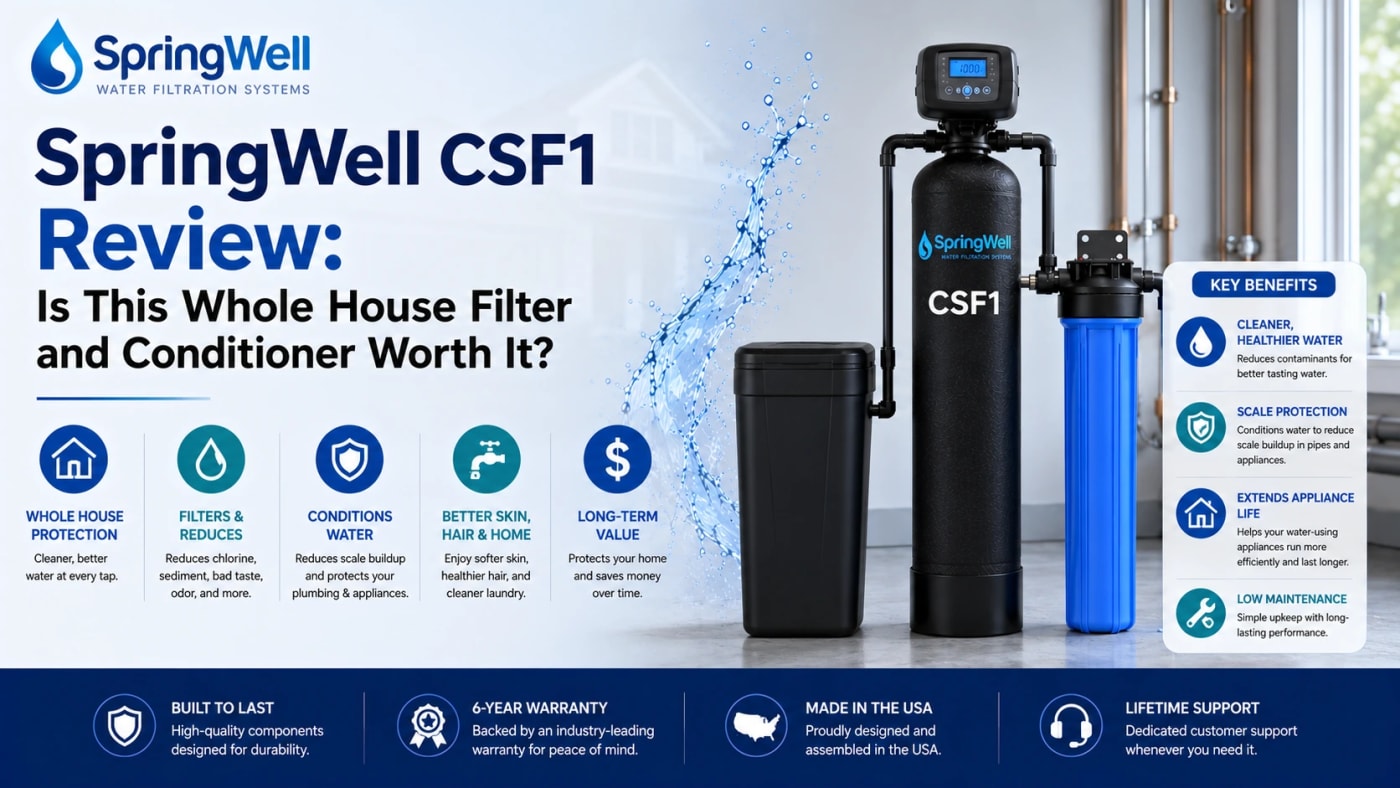
The SpringWell CSF1 combines a whole house water filter with a salt free scale conditioner in one system, and it fits a 1 to 3 bathroom city water home that wants both contaminant reduction and scale control without a traditional softener. This review covers how the two parts work together, what the CSF1 removes, its specifications, installation, maintenance, warranty, and who it fits best.
reviewReviews
SpringWell CSF1 Review: Is This Whole House Filter and Conditioner Worth It?
Share
SpringWell CSF1
$2,399.24
- Combines two treatment functions in one purchase - filtration + scale control
- No salt, no electricity, no backwashing, no drain line, no wasted water
- Long CF1 media life - 10 years / 1,000,000 gallons
- FutureSoft media is non-sacrificial - never needs replacing
- Lifetime warranty on tanks/valves/fittings/FutureSoft media
- FutureSoft conditions, doesn't remove hardness - no true "soft water" feel
- Built for city water only - FutureSoft's iron/manganese/hydrogen sulfide limits are set at zero
- Two-tank system needs more installation floor space
- Not a microbiological solution
- 10% restocking fee on approved non-defective returns
Specifications
| Recommended bathrooms | 1 to 3 |
|---|---|
| CF1 filter capacity | 1,000,000 gallons |
| FS1 conditioner capacity | No gallon limit (non-sacrificial media) |
| CF1 tank size | 9" wide, 48" tall (52" with head) |
| FS1 tank size | 6" wide, 35" tall (39" with head) |
| System flow rate | 9 GPM (limited by CF1 stage) |
| Connection size | 1 inch |
| Maximum hardness | 81 grains per gallon |
| CF1 media replacement | Every 10 years or 1,000,000 gallons |
| FS1 media replacement | Never (non-sacrificial) |
What Is the SpringWell CSF1 and How Do Its Two Systems Work Together?
The CSF1 combines two separate SpringWell products into one connected system. The first part is the CF1 whole house water filter. The second part is FutureSoft, a salt free water conditioner. Water enters the home, passes through the CF1 tank first, then through the FutureSoft tank, then reaches every tap.
How each stage handles a separate job:
CF1 whole house filter: Reduces chlorine, chloramine, sediment, and select chemical contaminants using catalytic carbon and KDF media
FutureSoft conditioner: Uses Template Assisted Crystallization media to reduce scale buildup, without removing calcium and magnesium from the water
Filtration and conditioning solve two different problems. Filtration reduces targeted contaminants. Conditioning changes how hardness minerals behave, so they cause less scale, without removing the minerals themselves.
How Does the CF1 Filtration Stage Work?
The CF1 stage uses an upflow tank filled with catalytic coconut shell carbon and KDF media, along with a separate sediment pre filter. Water moves upward through the tank, giving the media time to work. Adsorption is the main process at work, meaning contaminant particles stick to the surface of the carbon as water passes through it, similar to how a sponge traps dirt while letting clean water pass. SpringWell states this filter reduces chlorine, chloramine, PFAS, and a range of organic contaminants. This is a manufacturer statement rather than an independent certification for every listed contaminant.
How Does FutureSoft Condition Hard Water Without Removing Minerals?
FutureSoft works through Template Assisted Crystallization, often shortened to TAC. Instead of pulling hardness minerals out of the water, TAC media gives calcium and magnesium a surface to form tiny crystals on. These crystals stay suspended in the water rather than sticking to pipes, water heaters, or fixtures. The minerals remain in the water the whole time, only their scale forming behavior changes.
Conditioning versus true softening:
A salt based softener: Removes calcium and magnesium through ion exchange, adding a small amount of sodium in their place
FutureSoft conditioning: Leaves calcium and magnesium in the water, but changes their crystal structure so they pass through pipes without building up as scale
What Does the CSF1 Address, and What Stays Outside Its Scope?
Water problems the CSF1 addresses:
Chlorine and chloramine: The catalytic carbon in the CF1 stage reduces both, with a stated performance guarantee for this claim
PFAS and related chemicals: Listed as a targeted contaminant group, based on manufacturer testing
VOCs, pesticides, and herbicides: Listed among the reduced contaminants
Taste and odor: Addressed as a direct result of chlorine and chemical reduction
Sediment: Removed mechanically through the pre filter cartridge
Scale from hardness minerals: Addressed by the FutureSoft stage, which SpringWell states can prevent up to 95 percent of scale buildup
Water problems the CSF1 does not address:
Microbiological contamination: SpringWell states the system should not be used where water is microbiologically unsafe
True hardness removal: FutureSoft conditions scale behavior, it does not lower the actual hardness level the way a salt based softener does
Iron, manganese, and hydrogen sulfide: These are set at a maximum of zero for the FutureSoft stage, so well water with these issues needs separate pre treatment first
What Specifications Determine Whether the CSF1 Fits a 1 to 3 Bathroom Home?
The table below shows the current specifications for the CF1 filter stage and the FS1 conditioner stage inside the CSF1.
Specification | CF1 Filter Stage | FS1 Conditioner Stage |
Recommended bathrooms | 1 to 3 | 1 to 3 |
Rated capacity | 1,000,000 gallons | No gallon limit, non sacrificial media |
Tank width | 9 inches | 6 inches |
Tank height | 48 in, 52 in with head | 35 in, 39 in with head |
Flow rate | 9 GPM service | 12 GPM service |
Connection size | 1 inch | 1 inch |
Maximum hardness | Not applicable | 81 grains per gallon |
Media replacement | Every 10 years or 1,000,000 gallons | Never replaced, non sacrificial |
A 1 to 3 bathroom home fits the CSF1 well when actual water use stays within these limits. Homes with more bathrooms or higher simultaneous demand should look at the larger CSF4 or CSF+ combo sizes.
How Does the CSF1 Affect Household Flow and Pressure?
The CSF1's flow is governed by the CF1 stage's 9 GPM service rating, the lower of the two flow numbers in the combo system. This means the system can supply up to 9 gallons per minute before pressure at the fixtures begins to drop. Most households use closer to 2 to 3 GPM at any single moment, with peak demand rising when multiple fixtures run together. Owner reports on community forums frequently describe no noticeable pressure drop after installation, though these are individual experiences rather than lab measurements.
How Difficult Is CSF1 Installation?
The two tank system adds steps compared to installing a single filter, though it remains manageable for a homeowner with basic plumbing comfort.
Installation stages, in general order:
Pick an install point on the main water line, ahead of the water heater, with space for both tanks
Shut off the main water supply before disconnecting any pipe section
Install the bypass valves and connect the CF1 tank first, following the inlet and outlet marks
Connect the sediment pre filter and then the FutureSoft tank in sequence
Check all fittings and turn the water supply back on slowly, watching for leaks
Run water through the system to clear loose media and settle the carbon bed
SpringWell confirms the warranty stays valid whether a homeowner installs the system or hires a plumber. Homes with limited mechanical room space should plan for extra time, since two tanks need more clearance than a single tank filter.
What Maintenance Does the CSF1 Require?
CSF1 maintenance tasks:
Sediment pre filter: Replace every 6 to 9 months, the main recurring task
CF1 carbon and KDF media: Replace every 10 years or after 1,000,000 gallons, whichever comes first
FutureSoft media: Never needs replacement, since it is non sacrificial
General system check: Confirm bypass valves and connections show no leaks during routine home maintenance
What Does the CSF1 Warranty Cover?
The warranty covers tanks, valves, fittings, housings, and FutureSoft media against defects in material and workmanship for as long as the original owner uses the system in the home where it was first installed. SpringWell also states a separate performance guarantee, promising the carbon will reduce chlorine and chloramine below minimum detection levels for 6 years or 1,000,000 gallons. A 6 month return window applies from the original purchase date, with the product needing to be in original, unused condition, and a restocking fee applies to approved non defective returns. Coverage excludes damage from improper installation, physical damage, and use outside the stated water condition limits, such as running the FutureSoft stage on well water with iron, manganese, or hydrogen sulfide present.
What Are the Biggest Advantages and Limitations of the CSF1?
Advantages:
Combined treatment in one purchase: Filtration and scale conditioning handled by one connected system
No salt, no regeneration, no backwashing: Runs without electricity, a drain line, or wasted water
Long CF1 media life: A 10 year or 1,000,000 gallon rating means very few years involve part replacement beyond the sediment pre filter
Whole house coverage: Every tap receives treated water
Limitations:
Conditioning is not softening: Calcium and magnesium remain in the water, so homeowners expecting the slippery feel of soft water will not get that result
Built mainly for city water: The FutureSoft stage sets iron, manganese, and hydrogen sulfide limits at zero
Not a microbiological solution: The system should not be used with microbiologically unsafe water
Installation space needed: Two tanks together need more floor space than a single tank filter
What Should You Check Before Choosing the CSF1?
Decision checklist:
Confirm your water source, city water or a private well
Identify your primary contaminant concern, such as chlorine, chloramine, or specific chemicals
Decide whether you want scale prevention through conditioning or true hardness removal through a salt based softener
Count your bathrooms and typical simultaneous water use against the 9 GPM CF1 flow rating
Measure available clearance for two tanks side by side
Confirm you are comfortable with scale prevention rather than the traditional soft water feel
Quick Answers to Common CSF1 Questions
How does the CSF1 compare with a traditional salt based softener? The FutureSoft component conditions water to reduce scale, while a traditional ion exchange softener removes hardness minerals from the water directly.
How does the CSF1 compare with the standalone CF1 filter? The CF1 alone provides filtration only. The CSF1 adds the FutureSoft conditioner on top of the same CF1 filtration stage, addressing scale in addition to contaminants.
Which SpringWell system fits different water problems? Homes with only chlorine or chemical concerns commonly fit the CF1 alone. Homes with both chemical contaminants and scale concerns commonly fit the CSF1. Well water homes with iron, manganese, or sulfur commonly need a separate well water system instead.
Share