
Home
A carbon filter is a type of filter that uses activated carbon to remove pollutants from air or water. It does this by adsorption, which is when pollutants stick to the carbon’s large internal surface. This effectively removes chlorine, odors, VOCs (volatile organic compounds), pesticides, and other organic chemicals.
It is important for well owners and people without access to city water treatment to choose the right unit. Here are eight important steps to help you make your choice:
- Step 1: Test Your Well Water for Contaminants
- Step 2: Match Results to the Correct Carbon Media
- Step 3: Evaluate Contaminant Levels and Pretreatment Needs
- Step 4: Calculate Your Home’s Flow Rate Requirements
- Step 5: Choose the System Type (Whole House vs. POU)
- Step 6: Evaluate Tank Design & Backwashing
- Step 7: Check Certifications and Safety Standards
- Step 8: Estimate Maintenance and Long-Term Costs
After choosing a system, keep in mind that a carbon filter’s performance can vary widely across different wells. It is important to remember that a standard carbon filter does not remove all types of pollutants, such as heavy metals or bacteria, on its own. To help you understand the crowded market, we have reviewed the top five systems currently available:
- WaterBoss Whole House Filter (WB-WH-Filter)
- Waterdrop 2-Stage System (WD-WHF21-PG)
- Aquaboon 3-Stage Heavy Duty System
- AO Smith Whole House Filter (AO-WH-Filter)
- SimPure 3-Stage KDF System (DB20P-3KDF)
Determining which of the above carbon systems is best for you starts with noticing chemical odors or testing for pesticides and fuel runoff. Our expert team at Water Filter Way provides these insights to ensure you choose a system that delivers truly clean water. By following our research, you confidently protect your home from the most common chemical threats found in private wells.
Step 1: Test Your Well Water for Contaminants
You are responsible for your private well water, unlike municipal water. Before you buy treatment equipment, you need to know exactly what is in your aquifer. You might buy the wrong filter if you don’t test your water.
A certified lab report shows the exact contaminants and their amounts in parts per million (PPM) in your well water, which tells you how hard the carbon filter has to work and whether it can handle the load.
Some important pollutants to focus on are:
- Hydrogen sulfide produces a strong rotten egg smell and ruins the taste.
- Volatile organic compounds (VOCs) are chemicals from fuel or industry that leak into groundwater.
- Pesticides and herbicides are chemicals that get into the water table from farms.
- Iron and manganese can cause red or black stains and make the filtration harder.
- Tannins are organic substances that change the color of water and block carbon pores.
Accurate testing replaces guesswork with a clear treatment plan. Watch this step-by-step demonstration to learn how to properly collect and sample your well water for accurate laboratory results.
Step 2: Match Results to the Correct Carbon Media
Once testing identifies the contaminants, the next step is to select the appropriate carbon media. Carbon comes in many forms, each with different pore structures and chemical properties. Picking the right type is important.
Granular Activated Carbon (GAC)
GAC is made from carbon granules that come from coal or coconut shells. It has millions of tiny holes that can hold organic chemicals.
- What it removes: It effectively works on chlorine, basic tastes, and common odors. It also handles small amounts of VOCs and pesticides.
- What it misses: GAC is weak against heavy sulfur odors and cannot remove minerals such as iron or manganese.
Catalytic Carbon
Catalytic carbon is high-grade GAC that undergoes extra processing to change its surface. This change allows it to speed up chemical reactions.
- What it removes: It efficiently removes hydrogen sulfide. It primarily works on chloramines and elevated concentrations of VOCs.
- What it misses: Just like standard GAC, it is not effective against high solids or dissolved metals alone.
Carbon Block
Carbon block filters consist of fine carbon powder pressed into a solid cylinder.
- What it removes: It removes smaller particles and provides more contact time for chemical removal due to its high density.
- What it misses: Because of its dense structure, it causes a large drop in water pressure, making it hard to use for whole-house applications.
Choosing the right media ensures the filter removes the contaminants identified in testing.
Step 3: Evaluate Contaminant Levels and Pretreatment Needs
Your lab report lists the concentration of each pollutant in parts per million (PPM). High concentrations of chemicals fill up the carbon pores quickly. This leads to a breakthrough, allowing toxins to leak past the filter and into your home faucets.
Untreated well water contains sediment and oxidized metals that prevent carbon from functioning properly. When carbon becomes coated with debris or metal buildup, adsorption stops. Pretreatment keeps the carbon safe and makes sure it works. You need the following for pretreatment:
- Sediment Filters: These catch sand and silt before they get to the main tank. This stops the carbon from getting clogged with dirt.
- Iron and Manganese Systems: These metals rust and form a physical crust over the carbon media. Taking them out first stops the carbon from turning into a solid block.
- Tannins and Organic Matter Treatment: These stains, which look like tea, cover the carbon pores like a thick film. Special resin filters remove tannins, allowing the carbon to focus on chemicals.
The carbon filter effectively removes chemicals from water that has already been cleaned and pretreated. Proper pretreatment ensures consistent water quality and extends the filter’s lifespan.
Step 4: Calculate Your Home’s Flow Rate Requirements
Finding the right carbon media is useless if your shower water pressure drops to a trickle. You need to make sure that the filter works with the speed of your plumbing and the power of your well pump. This ensures the system can handle the busiest times without slowing the water flow.
Carbon needs “contact time” to grab chemicals as water passes through the tank. The carbon cannot pull out the toxins if the water moves too fast. The water will bypass the cleaning process entirely if the filter is too small for your home. Most three-bedroom homes require a system that delivers 7 to 12 gallons per minute (GPM) to work properly.
To figure out your flow rate, add up all the faucets and appliances that might be running simultaneously. To figure out what you need, use this simple point system:
- Shower: 2.5 GPM
- Kitchen Sink: 2.0 GPM
- Toilet Flush: 2.0 GPM
- Dishwasher or Laundry: 3.0 GPM
You can determine your peak demand by adding up the results. Select a filter that can manage 10 GPM or higher if your water flow is 10 GPM. This allows the filter to function properly and maintains constant pressure.
Step 5: Choose the System Type (Whole House vs. POU)
Selecting the right system depends on where and how you use water. Based on your test results and how you use your faucets every day, you can choose to treat all of them or just the kitchen faucet. You have to choose between two kinds of systems:
- Whole House Systems
These large tanks connect to the main line to remove VOCs or sulfur odors. They need a high flow rate so the pressure doesn’t drop when many people use water at once.
- Point-of-Use Systems (POU)
These are small filters that sit under a sink or in a fridge and use dense carbon blocks to filter water very effectively. They cost less, but they don’t protect plumbing or skin from germs elsewhere in the house.
Choosing the right place makes sure you get the protection you need.
Step 6: Evaluate Tank Design & Backwashing
Once you choose a carbon filter system, the tank design will determine how effectively it removes impurities. The tank needs to be big enough to hold all the water that comes into your house. If the tank is too small, the water flows through it too quickly. This doesn’t give the carbon enough “contact time” to soak up chemicals.
Backwashing is very important for a carbon filter. Well water can have sand, dirt, and tiny bits that can clog the filter. Backwashing cleans the filter by forcing water through it in the opposite direction, removing all sediment. This way, the new and upcoming water passes over fresh carbon. Always pick a filter with the right tank size and backwashing so it works well and lasts longer.
Step 7: Check Certifications and Safety Standards
Before buying a carbon filter, make sure that it is independently tested and certified. The Water Quality Association (WQA) and the National Sanitation Foundation (NSF) subjected the filters to rigorous testing to ensure safety.
The most important standards from NSF/ANSI include:
- NSF 42: This standard serves as evidence of the filter’s improvement in aesthetic attributes such as taste and odor.
- NSF 53: This is the most important health certification. It shows that some dangerous pollutants are kept out of the system, such as lead and volatile organic compounds.
- NSF 61: This assures that the tank and its parts do not contaminate your water supply through metals or chemicals.
Compliance with these standards guarantees that the filter can safely treat groundwater. Always look for the Gold Seal or NSF mark so you do not end up buying something unsafe and inoperable.
Step 8: Estimate Maintenance and Long-Term Costs
A carbon filter won’t last forever. It slowly stops being able to clean the water. Good-quality carbon media can last for three to five years if your water is clean and has low levels of chemicals or sulfur. However, you might need to change the water every year if it contains a lot of chemicals or sulfur.
You also need to inspect and maintain backwashing systems periodically. The valves use electricity to run motors and timers. Flushing the media uses water, and seals or O-rings need to be lubricated periodically. Making plans for these tasks helps the system work more efficiently and keeps your media lasting longer.
You can make sure your carbon filter continues to remove contaminants effectively and provide safe, clean well water for years without problems by knowing how to take care of it and how much it will cost in the long run.
What Contaminants Can a Carbon Filter Remove from Well Water?
The contaminants a carbon filter can remove from well water include chlorine, bad tastes, and organic odors. These filters work like magnets, pulling chemicals out of the water as it passes through.
The common contaminants removed by a carbon filter include:
- Chlorine and Chloramines
Carbon excels at neutralizing these disinfectants. It removes the harsh chemical smell and improves the flavor of every glass.
- Hydrogen Sulfide
Specialized catalytic carbon targets the gas responsible for the rotten egg smell. It breaks down the gas molecules to clear the air in your home.
- Volatile Organic Compounds (VOCs)
These include man-made chemicals like gasoline, solvents, and cleaners. These tiny particles get trapped in the carbon pores before reaching your tap.
- Pesticides and Herbicides
Water from neighboring farms frequently seeps into the ground. By eliminating these agricultural chemicals, carbon filters guarantee the safety of your drinking water.
- PFAS (Per- and Polyfluoroalkyl Substances)
Known as “forever chemicals,” PFAS (per- and polyfluoroalkyl substances) are industrial pollutants that stick to carbon surfaces. Filters greatly reduce health risks caused by PFAS.
- Tannins
These are tea-colored stains that come from rotting leaves and wood. Activated carbon removes the yellow color from sparkling water.
A carbon filter is a strong barrier against the most common chemicals that can get into your well. By matching the right type of carbon to your test results, your family will drink clean, fresh water.
What Factors Cause Carbon Filters to Fail Prematurely in Well Water?
The factors that cause carbon filters to fail prematurely in well water include heavy sediment, iron slime, and high chemical concentrations. These issues block the filter surface and stop it from cleaning your water.
Several critical elements that ruin your carbon media include:
- Heavy Sediment and Silt
Water cannot physically enter the microscopic pores of the carbon granules because of the fine dirt and sand particles that cover them like a blanket. Installing a 50-micron pre-filter will stop this by capturing solids before they reach the main tank.
- Iron and Manganese Fouling
When these metals come into contact with oxygen inside your filtration system, they become a sticky, discolored rust. They bound the carbon together into a solid mass, which functions as glue. To remove these metals before they damage the carbon bed, use a special iron filter.
- Organic Slime and Bacteria
Algae and biofilms develop directly on the carbon surface, forming a slimy layer that prevents chemical adsorption. Shock your well or use an ultraviolet (UV) light system to destroy these organisms before they get to the filter because carbon is not a disinfectant.
- Excessive Chlorine Levels
Although the purpose of a carbon filter is to remove chlorine, very high concentrations (typically from repeated well-shock treatments) physically disrupt the carbon’s structure. Keep an eye on your chemical levels to avoid the media turning into a useless mush.
- High Concentrations of Tannins
Tannins are organic acids from decaying vegetation that give water a tea-like color. These molecules are large and “wrap” around carbon pieces, quickly exhausting the filter. A specialized tannin removal system is needed to protect the carbon so it stays open for chemical removal.
- Lack of Backwashing Flow
Your filter will fail to lift and rinse the heavy media bed during its cleaning cycle if your well pump is too weak. Without enough Gallons Per Minute (GPM) for a thorough rinse, dirt stays trapped in the tank. Always ensure your pump power matches the filter’s specific backwash requirements.
- High Water Temperatures
Cold water is the best for carbon. When the temperature gets too high, the carbon can “desorb,” meaning it releases the chemicals it has already trapped and sends them back into your pipes. Put the tank in a cool place, and make sure it is installed before the water heater to avoid backflow problems.
Regular maintenance and proper pretreatment keep these problems from making your equipment last less long. To keep your water clean and your system running well, pay attention to these things.
What Are the Best Carbon Filters for Well Water?
The best carbon filters for your well water are those that provide a powerful shield against the chemical threats found in your well. Our team spent hours researching performance data and customer feedback to find the most reliable units. We are reviewing the top 5 systems to simplify your shopping experience and ensure you get the best possible water quality.
1. WaterBoss Whole House Water Filter
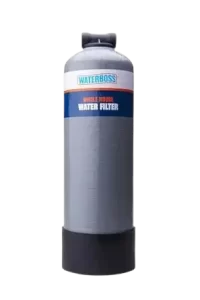
The WaterBoss Whole House Water Filter provides clean drinking water to every faucet in your home by removing chemical tastes and smells. This compact system uses high-quality carbon to improve water quality for city and well water users alike. Maintenance remains simple because the unit requires no power and works purely on water pressure.
Specifications
| Key Specifications | Value |
|---|---|
| Brand | WaterBoss |
| Model | WB-WH-FILTER |
| Dimensions | Compact design (fits utility closets) |
| Purification Method | Activated Carbon |
| Capacity | 600,000 Gallons |
| Price Per Gallon | Less than 1 cent |
| Certifications | NSF/ANSI Standard 42 |
| Installation Type | Point of Entry (Main Line) |
| Warranty | 6 Years |
| Current Price | Check Price |
Carbon Filtration Technology
Water flows through a dense bed of activated carbon to trap organic chemicals and chlorine. This process focuses on improving the water’s smell and taste while a built-in screen catches larger dirt particles. Performance stays high for up to six years before the internal media requires a full replacement.
Contaminant Removal Performance
| Contaminant | Removal Range |
| Chlorine | 92%–95% |
| Chlorine Taste & Odor | 90%–94% |
| Particulates/Sediment | 80%–85% |
| Hydrogen Sulfide (Light Odors) | 70%–75% |
Flow Rate and Pressure Assurance
A continuous flow of 7 gallons per minute (GPM) supports a standard household without slowing down showers. Peak flow reaches 14 GPM to ensure your water pressure stays strong, even when multiple faucets are running at once.
Certifications and Trust
- NSF/ANSI Standard 42: This system holds an NSF-certified 42 rating for removing aesthetic issues such as chlorine and odors.
- Assembled in the USA: Local engineering and assembly provide extra peace of mind regarding build quality.
Cost of Maintenance and Ownership
- Annual Media Cost: The high capacity means you spend nothing on filters for up to 6 years.
- Electricity Costs: Zero dollars are needed since the system operates entirely on manual water pressure.
- Wastewater: This filter produces no wastewater, keeping your monthly utility bill low.
Summary
| What We Like | What We Don’t Like |
| Very long 600,000-gallon lifespan | Not suitable for heavy metals or lead |
| No electricity or drain line required | Fails to remove water hardness |
| Compact size fits into tight spaces | Not a standalone fix for bacteria |
Our Final Verdict: Who Is This Filter Best For?
This system is ideal for eliminating chemical odors from city water or pre-treated well water. It caters to small- to medium-sized families looking for a set-and-forget way to get better-tasting water.
2. Waterdrop Whole House Water Filter System (WD-WHF21-PG)
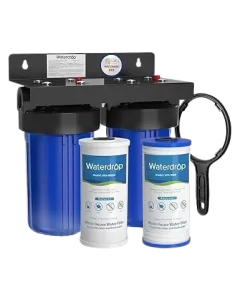
The Waterdrop WD-WHF21-PG offers a two-stage defense for homes using either city or well water. This setup uses a large sediment filter paired with a granular-activated carbon filter to remove dirt and chemical pollutants. It protects your plumbing and appliances by keeping pipes clear of rust and grit while providing better-tasting water for your whole family.
Specifications
| Key Specification | Value |
|---|---|
| Brand | Waterdrop |
| Model | WD-WHF21-PG |
| Dimensions | 14.37 in (L) x 7.48 in (W) x 15.55 in (H) |
| Purification Method | Granular Activated Carbon (GAC) and Sedimentation |
| Capacity | Filters water for up to 6 months |
| Price Per Gallon | Highly affordable based on filter lifespan and cost |
| Certifications | NSF/ANSI 372 (Lead-Free Materials) |
| Installation Type | Whole House / Main Water Line |
| Warranty | 1-Year Limited Warranty |
| Current Price | Check Price |
Carbon Filtration Technology
Water enters through a 5-micron polypropylene (PP) filter to trap sand, rust, and large particles. Then, the water passes through a coconut-shell carbon filter that removes chlorine and foul odors, improving taste. The system includes a high-capacity design that keeps water moving quickly to avoid pressure drops in your home.
Contaminant Removal Performance
| Contaminant | Removal Range |
| Chlorine | 91%–95% |
| Sediment (Sand, Rust, Grit) | 94%–98% |
| Iron and Manganese | 85%–90% |
| Bad Taste and Odor | 90%–94% |
| Lead (Lead-free materials focus) | 90%–93% |
Flow Rate and Pressure Assurance
Your house will have enough water for numerous tasks at once with a constant flow rate of 15 gallons per minute (GPM). The sizable 1-inch inlet and outlet ports maintain high pressure.
Certifications and Trust
- NSF/ANSI 372 Certified: NSF 372 certification ensures that all system components are lead-free.
- Third-Party Tested: The elimination of manganese, iron, and chlorine has been confirmed by independent laboratories.
- Durability tested: To stop leaks, the housing passed 300 PSI pressure tests and 100,000 water hammer tests.
Cost of Maintenance and Ownership
- PP Sediment Filter: To avoid clogging, change the PP Sediment Filter every 3 to 6 months.
- GAC Carbon Filter: To maintain water freshness, replace the GAC carbon filter every 6 months.
- No Power Costs: This system doesn’t require electricity and relies solely on the water pressure in your house.
- Do-It-Yourself Savings: Without hiring a plumber, you can install it yourself in a matter of minutes, thanks to a straightforward setup.
Summary
| What We Like | What We Don’t Like |
| High 15 GPM flow rate for large homes | Filters need replacement every 6 months |
| Very affordable initial purchase price | Does not remove water hardness |
| Certified lead-free material construction | No NSF 42 or NSF 53 health-performance certifications |
Our Final Verdict: Who Is This Filter Best For?
Families on municipal or well water who are trying to save money will love this system because it has a high flow rate and is easy to install. It’s a great first line of defense for homes that have problems with chlorine smells, sediment, or light iron.
3. Aquaboon 3-Stage Water Filter System
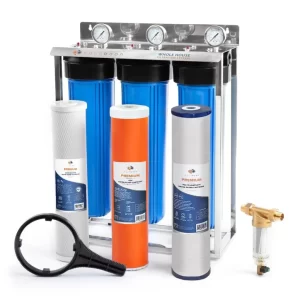
The Aquaboon 3-Stage Water Filter System protects your whole home with three different types of filters that work together. This freestanding system has a stainless steel frame and big 20-inch cartridges that can handle high water demand. It also keeps your plumbing and appliances safe from scale, metals, and chemicals. It can clean both city and well water without using electricity.
Specifications
| Key Specifications | Value |
|---|---|
| Brand | Aquaboon |
| Model | AB-3WHS20BB (with Anti-Scale/KDF) |
| Dimensions | 18" L x 11" W x 24" H |
| Purification Method | Sediment, KDF, Polyphosphate (Anti-Scale), and Carbon Block |
| Capacity | Up to 100,000 Gallons (varies by water quality) |
| Price Per Gallon | Approximately 0.5 cents per gallon |
| Certifications | Filter cartridges meet NSF standards |
| Installation Type | Freestanding / Whole House |
| Warranty | 1-Year Limited Warranty |
| Current Price | Check Price |
Carbon Filtration Technology
Water first passes through a spin-down sediment pre-filter to catch large grit and rust before reaching the main stages. The water then moves through KDF and polyphosphate filters to neutralize heavy metals and stop scale from building up in your pipes. Finally, a massive carbon block filter removes chemical tastes and odors, ensuring your drinking water is crisp and clean.
Contaminant Removal Performance
| Contaminant | Removal Range |
| Chlorine & VOCs | 94%–98% |
| Heavy Metals (Lead, Mercury) | 88%–92% |
| Sediment & Rust | 95%–99% |
| Scale & Hardness Minerals | 75% – 85% (Inhibition) |
| Hydrogen Sulfide (Rotten Egg Smell) | 80%–85% |
Flow Rate and Pressure Assurance
A robust flow rate of up to 15 gallons per minute (GPM) ensures your household has plenty of water for showers and laundry at once. The large 1-inch NPT (National Pipe Thread) connections minimize pressure drops so you barely notice the filter is working.
Certifications and Trust
- NSF Certified Cartridges: The materials used to make the filter cartridges meet NSF safety and quality standards. But the whole system doesn’t have an NSF stamp of approval.
- Heavy-Duty Construction: The system is made of food-grade polypropylene and a strong steel frame, ensuring long-lasting performance.
- Built-in Gauges: You can keep an eye on performance and know exactly when to change filters with built-in pressure gauges.
Cost of Maintenance and Ownership
- Sediment Filter Changes: These occur every 3 to 6 months, depending on the level of sediment in your well.
- KDF and Carbon Cartridges: These premium filters typically last 6 to 12 months for average families.
- No Power Needed: The system uses only water pressure, so there are no hidden electricity costs on your monthly bill.
- Replacement Filter Packs: Buying 3-piece sets can save you about 10% on your yearly upkeep.
Summary
| What We Like | What We Don’t Like |
| The freestanding frame makes installation and servicing easier | Higher initial cost than basic single-stage units |
| KDF media removes dangerous heavy metals like lead | Does not remove fluoride or salt from water |
| Anti-scale treatment protects expensive appliances | A freestanding frame takes up more floor space |
Our Final Verdict: Who Is This Filter Best For?
This all-in-one system is perfect for homeowners with complex well-water issues, including odors, heavy metals, and scale. It works great for big families who need a long-lasting, high-flow solution that cleans every drop of water in the house.
4. AO Smith Whole House Water Filter System
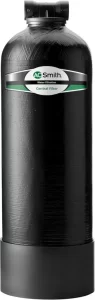
The AO Smith AO-WH-FILTER provides a high-capacity, maintenance-free solution for families who want to remove chemical tastes from every faucet. This system uses a large fiberglass tank filled with activated carbon to treat up to 600,000 gallons of water. It focuses on improving your drinking water, shower air quality, and skin health by neutralizing harsh disinfectants.
Specifications
| Key Specifications | Value |
|---|---|
| Brand | AO Smith |
| Model | AO-WH-FILTER |
| Dimensions | 30.2" L x 9.5" W x 9.4" H |
| Purification Method | Activated Carbon |
| Capacity | 600,000 Gallons |
| Price Per Gallon | Less than 0.1 cents |
| Certifications | NSF/ANSI Standard 42 |
| Installation Type | Whole House / Main Line |
| Warranty | 6-Year Limited Warranty |
| Current Price | Check Price |
Carbon Filtration Technology
Water enters the fiberglass tank and flows through a specialized bed of activated carbon that removes chlorine and organic chemicals. This mechanical process requires no electricity and produces zero wastewater because the system does not need to backflush. The design ensures that clean water flows to your kitchen, bathrooms, and laundry room simultaneously.
Contaminant Removal Performance
| Contaminant | Removal Range |
| Chlorine Taste & Odor | 93%–96% |
| Chloramines | 85%–90% |
| Volatile Organic Compounds (VOCs) | 88%–92% |
| Pesticides & Herbicides | 80%–85% |
| Sediment (Basic) | 70%–75% |
Flow Rate and Pressure Assurance
The internal design can accommodate families with four or more people without reducing water pressure. The tank has a high-flow carbon bed, so you can run several showers and appliances at once without losing flow.
Certifications and Trust
- NSF/ANSI Standard 42: This system has been tested and certified to NSF 42, which means it significantly reduces chlorine taste and odor.
- Fiberglass Construction: The tank is made of fiberglass, which is tough enough to last for years under normal home water pressure.
- 6-Year Rating: The maker promises that the filter will work for 60 months or 600,000 gallons.
Cost of Maintenance and Ownership
- Replacement Costs: You spend nothing on filters for the first 6 years since the media is designed for long-term use.
- No Water Waste: The system does not use a drain line, which means it does not waste a single drop of water.
- Manual Operation: You save money on your electric bill because the valve and tank require no power source.
Summary
| What We Like | What We Don’t Like |
| Massive 600,000-gallon capacity for large homes | Does not remove iron, sulfur, or TDS |
| No maintenance or filter changes for 6 years | Not a water softener (scale still builds up) |
| Improves air quality by stopping chlorine evaporation | Installation may require extra tools and fittings |
Our Final Verdict: Who Is This Filter Best For?
This filter is the best choice for large families on well and municipal water who hate the smell of bleach in their showers. It is a high-value, low-effort system for anyone who wants to improve water taste and skin softness without the hassle of monthly maintenance.
5. SimPure Whole House Water Filter System (DB20P-3KDF)
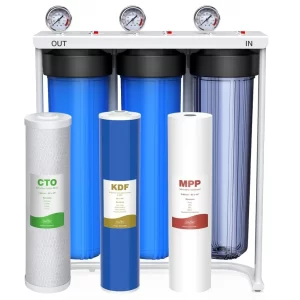
The SimPure DB20P-3KDF is a heavy-duty, three-stage system designed to tackle the toughest well-water problems, such as iron and manganese. It features a unique, clear housing that lets you see exactly when your filters are getting dirty without opening the unit. This freestanding system provides a complete shield for your plumbing by removing heavy metals and chemicals before they enter your home.
Specifications
| Key Specifications | Value |
|---|---|
| Brand | SimPure |
| Model | DB20P-3KDF |
| Dimensions | 22.84" L x 7.82" W x 25.98" H |
| Purification Method | PP Sediment, KDF, and Carbon Block (CTO) |
| Capacity | 100,000 to 150,000 Gallons |
| Price Per Gallon | Approximately 0.2 cents |
| Certifications | NSF standard housing and food-grade materials |
| Installation Type | Freestanding |
| Warranty | 1+1 Year Extended Warranty |
| Current Price | Check Price |
Carbon Filtration Technology
To keep sand and rust from getting into your pipes, water first goes through a polypropylene (PP) filter. The next step is the Kinetic Degradation Fluxion (KDF) stage, which uses a special blend of copper and zinc to kill bacteria and remove heavy metals such as lead and iron. Finally, a carbon block made from coconut shells removes chlorine and odors, so your water tastes as if it came from a bottle.
Contaminant Removal Performance
| Contaminant | Removal Range |
| Iron & Manganese | 90%-94% |
| Heavy Metals (Lead, Mercury) | 92%-96% |
| Chlorine | 95%-98% |
| Sediment & Rust | 96%-99% |
| Pesticides & VOCs | 88%-92% |
Flow Rate and Pressure Assurance
This system delivers a fast flow rate of 15 gallons per minute (GPM). The 1-inch brass ports and double O-ring design prevent leaks while maintaining strong water pressure for high-demand tasks like laundry and showers.
Certifications and Trust
- Component-Only Testing: The housings and internal parts are made from food-grade materials that meet NSF safety standards.
- No Whole-System Certification: The filter system consists of two NSF-standard housings. But the whole unit does not carry a formal NSF/ANSI certification.
- Leak-Proof Testing: Each unit undergoes 100,000 water-hammer tests and 300-PSI pressure tests to ensure it won’t burst under stress.
- Visible Monitoring: The transparent first-stage housing allows you to verify the system is working at a glance.
Cost of Maintenance and Ownership
- Sediment & KDF Filters: These typically last 6 to 12 months before needing a swap.
- Carbon Block (CTO) Filter: Expect to replace this every 3 to 6 months for the best taste.
- No Hidden Costs: The system uses standard 20″ x 4.5″ cartridges so that you can shop around for the best replacement prices.
Summary
| What We Like | What We Don’t Like |
| Clear housing makes maintenance schedules easy to see | Carbon filter life is longer than the other stages |
| KDF media is excellent for iron and lead removal | The heavy unit (48 lbs) requires a sturdy installation spot |
| Brass ports are much stronger than plastic versions | Does not significantly lower Total Dissolved Solids (TDS) |
Our Final Verdict: Who Is This Filter Best For?
This system is a great choice for individuals with well water who experience orange staining and a metallic taste caused by iron, and it is also a good option for families who prefer high flow and visual supervision of long-lasting filters.
Comparison of the Best 5 Carbon Water Filters for Well Water
| Product Name | Best For | Price | Capacity | Purification Method | Warranty |
| WaterBoss Whole HouseWaterBoss Whole House | Basic Chlorine Removal | $349.99 | 600,000 Gallons | Activated Carbon | 6 Years |
| Waterdrop 2-Stage | Budget-Friendly Setup | $165.99 | ~6 Months | Sediment & GAC | 1 Year |
| Aquaboon 3-Stage | Heavy Metals & Scale | $539.79 | 100,000 Gallons | KDF, Anti-Scale & Carbon | 1 Year |
| AO Smith Whole House | High-Capacity Use | $399.00 | 600,000 Gallons | Activated Carbon | 6 Years |
| SimPure 3-Stage | Iron & Manganese | $329.99 | 150,000 Gallons | PP, KDF, & CTO Carbon | 2 Years |
Aquaboon and SimPure are the most effective at removing heavy metals. They use KDF stages to remove iron, lead, and manganese. The least maintenance is needed for AO Smith and WaterBoss, which can run for years without service. Waterdrop and SimPure deliver a high 15 GPM flow to protect water pressure in larger homes. SimPure also adds visual monitoring with a clear housing.
We recommend checking your latest water test before making a final purchase. Matching your specific well contaminants to the products listed above ensures you get the cleanest water for your investment.
Why Does Carbon Filter Performance Vary Widely Between Well Systems?
Carbon filter performance varies widely between well systems because each underground aquifer has its own chemical makeup. Some wells get water from shallow sandy soil, while others draw water from deep limestone rock. Acidity levels affect how molecules of various chemicals are attracted to the carbon surface and held there.
The main reason for these performance gaps is the water’s chemistry. High levels of dissolved minerals and chemicals in the water compete for the same small spaces on the carbon media, reducing its efficiency.
The time water spends in the filter affects how well it cleans. In a small home, water moves slowly, so the filter has more time to clean. In a big household, water flows too fast for the carbon to work well.
Flow speed, temperature, and pressure all affect how carbon performs. For example, cold well water holds more carbon than warm water. Variations in pump pressure affect how the water spreads through the media bed inside the tank. These physical differences mean every well requires a custom approach for the best results.
How Do You Know If Carbon Filtration Is the Right First Treatment for Your Well Water?
To know if carbon filtration is the right first treatment for your well water, look for chemical odors, oily films, or signs of farm runoff.
Here are some signs that carbon filtration is your best option:
- Presence of Volatile Organic Compounds (VOCs)
Odors resembling gasoline or industrial cleaners signal a need for immediate carbon treatment. Carbon provides the most effective way to trap these fuel-based toxins before they reach your faucets.
- Strong Rotten Egg Smells
Hydrogen sulfide gas ruins the smell of your home and the taste of your food. Catalytic carbon is an excellent first step in neutralizing this gas and clearing the air.
- Pesticide or Herbicide Risks
Living near agricultural fields increases the chance of chemical seepage into your aquifer. Carbon filters grab these farm chemicals to prevent long-term health issues for your family.
- Chlorine Residuals from Shocking
Frequent well chlorination leaves a harsh bleach taste in your drinking water. Carbon is the best first treatment for removing this chemical and restoring a natural flavor.
- Low Levels of Iron and Sediment
Whenever water is less polluted or rusty, carbon works best. When water has no heavy mud or orange stains, carbon can effectively remove different chemicals.
Your lab report can determine whether carbon is the way to go. Carbon offers the greatest protection for your home when chemicals are the primary concern.
At Water Filter Way, we provide clear guides, honest reviews, and side-by-side comparisons of the best water filters. We help you make the right system choice and keep your well water safe for many years.
Frequently Asked Questions
What is the best carbon filter for well water?
The best carbon filter for well water depends on the specific contaminants present, such as chlorine, odors, organic chemicals, or sediment. A water test can help you choose a carbon filtration system that matches your well water conditions.
Are activated carbon filters effective for well water?
Activated carbon filters can be effective for reducing certain chemicals, odors, and taste problems in well water. However, they are not designed to remove every contaminant, so testing your water first is important.
What are the best carbon filters for well water?
The best carbon filter system depends on your water quality and the contaminants you need to reduce. Different systems use different carbon media and filtration stages, so compare their performance with your well water test results.
How does a carbon filter for well water work?
A carbon filter uses activated carbon media to adsorb certain chemicals and organic compounds as water passes through it. This can help improve water taste and odor while reducing specific contaminants.
Is a charcoal filter good for well water?
A charcoal filter can be useful for reducing certain odors, tastes, and organic contaminants in well water. However, it may not effectively address issues such as high iron, bacteria, hardness, or other contaminants that require specialized treatment.