
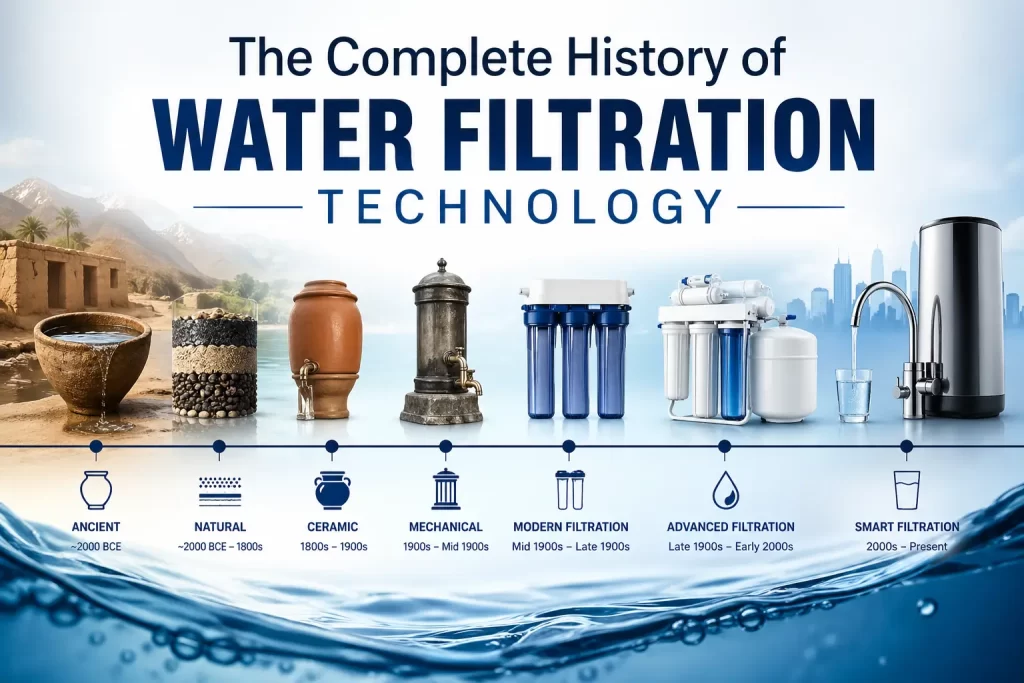
Water is the essence of life, but for most of human history, it was also a gamble. Long before we had the luxury of turning on a chrome faucet to receive a glass of crystal-clear liquid, our ancestors were engaged in a desperate, trial-and-error struggle to separate life-giving hydration from life-threatening contaminants.
At Water Filter Way, we believe that to truly appreciate the state-of-the-art reverse osmosis systems and whole-house filters of today, you have to understand the thousands of years of ingenuity that led us here. From ancient Sanskrit scrolls to the cholera-ridden streets of Victorian London, the evolution of water filtration is a story of human brilliance and scientific breakthroughs.
This isn’t just a timeline of pipes and sand; it is the history of how we learned to master our most precious resource. Let’s dive into the eras that defined the water you drink today.
1. Ancient Innovations: The Quest for Aesthetics (2000 BC–500 BC)
In the beginning, water filtration wasn’t about “germs,” because humans didn’t know they existed. It was about the “Three A’s”: Appearance, Aroma, and Aftertaste. If water looked cloudy or smelled like a swamp, ancient civilizations knew instinctively that it was “bad.”
The Sanskrit and Egyptian Methods (2000 BC)
The earliest recorded attempts at water treatment date back over 4,000 years. Ancient Sanskrit writings and Egyptian inscriptions suggest that people were already experimenting with purification. The Sushruta Samhita, an ancient Indian medical text, recommended boiling water and heating it under the sun. They also utilized crude filtration through sand and coarse gravel to strain out visible debris.
Egyptian Coagulation and the Use of Alum (1500 BC)
The Egyptians were the first to move beyond simple straining. By 1500 BC, they discovered the principle of coagulation. They used the mineral alum to clarify water. When alum is added to turbid (cloudy) water, it causes suspended particles to clump together and sink to the bottom, a process still used in municipal water treatment plants today.
The Hippocratic Sleeve (500 BC)
By the 5th century BC, Hippocrates, the “Father of Medicine,” connected water quality to the balance of the “four humors” in the human body. He realized that even clear-looking water could carry “bad smells” that caused hoarseness and fever. His solution was the Hippocratic Sleeve: a simple cloth bag used as a sieve to strain boiled water. The result was the world’s first “domestic” water filter.
Maya Limestone Filtration
While Europe was in its early stages of development, the Classic Maya at Palenque were engineering sophisticated systems in Mesoamerica. They utilized locally sourced limestone, carved into porous cylinders. This structure wasn’t just a bucket with a hole; it was a high-surface-area filtration device that mimicked the natural purification of an aquifer.
2. The Scientific Revolution: Identifying the Unseen (1600s–1700s)
After the Roman Empire fell, the way people cleaned water stayed the same for over a thousand years. It wasn’t until the Renaissance and the Age of Enlightenment that scientists finally got curious again. During these times, people began to study what was actually in their glasses of water. This new interest led to the first real experiments in modern water technology.
Desalination Experiments by Sir Francis Bacon
In 1627, Sir Francis Bacon published A Natural History of Ten Centuries. He began the first recorded scientific experiments in desalination. He believed that if he passed seawater through enough layers of sand, the sand would “snatch” the salt out of the water. While his theory was scientifically flawed (sand cannot remove dissolved salt), his focus on the “percolation” of water through media paved the way for modern sand filter beds.
Microscopy and the Discovery of Microorganisms
The 1670s brought about a significant breakthrough. Antonie van Leeuwenhoek and Robert Hooke perfected the microscope. For the first time in human history, we saw “animalcules,” tiny, swimming organisms, in a single drop of water. This discovery shifted the focus of filtration forever. It was no longer enough for water to look clean; it had to be biologically safe.
The First Patented Filters: Charcoal and Wool (1700s)
In 1750, Joseph Amy received the first patent for a water filter. This was the true ancestor of your modern countertop filter. His design didn’t rely on just one material; it used layers of charcoal, wool, and sponge. Amy understood that different materials trapped different types of particles, the beginning of “multi-stage” filtration that Water Filter Way recommends for modern homes.
Could We Survive Today Using Only Ancient Filtration Methods?
While the Hippocratic Sleeve and Maya limestone were revolutionary for their time, they would be dangerously ineffective against modern threats. Ancient methods were designed to remove sand, silt, and bad odors. Today, our water contains “invisible” threats like PFAS (forever chemicals), microplastics, and lead. Modern chemical and industrial pollutants require the high-pressure membranes and catalytic carbons that are found in today’s advanced systems, while we owe our lives to the foundations laid by ancient engineers. catalytic carbons found in today’s advanced systems.
Why Did It Take Thousands Of Years To Link Water To Disease?
The delay was primarily due to the “Miasma Theory,” the belief that diseases like cholera and the plague were caused by “bad air” or foul smells. Because many pathogens are tasteless and odorless, people assumed clear water was safe. It wasn’t until the mid-19th century, when microscopy and statistics (led by John Snow) collided, that humanity finally accepted that the most deadly predators weren’t in the air but in the water.
3. The Industrial Era: Protecting the Public (1800s–1890s)
As the Industrial Revolution drew people into densely populated, soot-covered cities, the water supply became increasingly vulnerable. With thousands of people living in close proximity, human waste often leaks into the same rivers used for drinking water. This era forced humanity to stop thinking about filtration as a personal choice and start treating it as a city-wide necessity.
The Rise of Municipal Slow Sand Filtration (1804)
The year 1804 marks the birth of modern municipal water. John Gibb, a bleachery owner in Paisley, Scotland, installed an experimental slow sand filter to provide clean water for his business. Surprisingly, he had a surplus of clean water, which he began selling to the public.
This sparked a trend. By 1829, engineer James Simpson had built a large-scale slow sand filtration system for the Chelsea Waterworks Company in London. These systems relied on gravity; water would slowly seep through layers of fine sand, which removed bacteria through a biological layer known as the Schmutzdecke. This was the first time an entire city population had access to treated water.
John Snow and the Broad Street Pump Discovery (1854)
While sand filters were working, scientists still didn’t understand why they were necessary. Most doctors believed in the “Miasma Theory”—the idea that diseases like cholera were caused by “bad air.”
In 1854, during a brutal cholera outbreak in Soho, London, Dr. John Snow challenged this. He meticulously mapped out the deaths and realized they all clustered around a single water pump on Broad Street. A nearby leaky cesspit contaminated the water, despite its apparent clarity. Snow’s work was the “Big Bang” of epidemiology. It proved that water was the primary vehicle for disease, leading to the first mandatory water regulations in history.
The Introduction of Chlorination and Chemical Disinfection
By the late 1800s, filtration alone wasn’t enough to satisfy the growing demand for safety. Scientists discovered that while sand could trap dirt, it couldn’t always kill every microscopic germ. This led to the introduction of chlorination. Initially used as a temporary measure during outbreaks, it eventually became a standard practice in the UK and the US by the early 1900s. Chlorination was the crucial intervention that ultimately put an end to the spread of typhoid and cholera in the developed world.
4. Modern Regulation and Advanced Technology (1900s–1980s)
As we entered the 20th century, the challenges changed. We had defeated the bacteria of the past, but we were beginning to face the man-made chemicals of the future.
The Evolution from Slow to Rapid Sand Filtration
Slow sand filters were great, but they were massive and slow. As city populations exploded, engineers developed rapid sand filtration. By using chemical “flocculants” to clump dirt together and high-pressure water to “backwash” the filters, plants could treat millions of gallons of water in a fraction of the space. This technology remains the backbone of most urban water treatment facilities you see today.
Ion Exchange and the Invention of Water Softening (1903)
In 1903, a new focus emerged: “Hard Water.” People realized that minerals like calcium and magnesium were destroying pipes and making soap useless. This led to the development of ion exchange. By using specialized resins to swap “hard” minerals for “soft” sodium ions, water treatment moved beyond health and into the realm of home maintenance and plumbing protection. At Water Filter Way, we continue to view ion exchange as the benchmark for salt-based water softening.
The Safe Drinking Water Act and Federal Oversight (1974)
By the 1970s, the public realized that industrialization had a dark side. Pesticides from farms and chemicals from factories were leaking into our aquifers. In 1974, the United States passed the Safe Drinking Water Act. This was a pivotal moment. The emphasis shifted from solely using chlorine to “kill germs” to removing complex organic chemicals, lead, and industrial sludge. It set the stage for the sophisticated home systems we use today.
5. Multi-Stage Home Systems (1990s–Present)
We are currently living in the “Golden Age” of water filtration. We no longer rely on a single bag of cloth or a pit of sand. Instead, we use physics and chemistry at a molecular level.
The Advent of Reverse Osmosis and Carbon Block Technology
In the late 20th century, reverse osmosis (RO) moved from industrial desalination plants into the American kitchen. By using a semi-permeable membrane to “push” water through holes so tiny that only water molecules can pass, RO systems began removing up to 99% of all dissolved solids. Homeowners finally had the power to create “bottled-water quality” straight from their tap by combining reverse osmosis with activated carbon blocks, which use a process called “adsorption” to chemically bond with toxins.
The Power of UV Purification and Pathogen Destruction
For those living on well water or in areas with aging infrastructure, ultraviolet (UV) purification has become a modern essential. Instead of using chemicals like chlorine, which can leave a bad taste and create “disinfection byproducts,” UV light scrambles the DNA of bacteria and viruses, making them harmless. It is the ultimate “green” disinfection technology.
The Water Filter Way: Selecting Modern Solutions
At Water Filter Way, we combine these historical lessons into modern recommendations. A system like the SpringWell water filter isn’t just one filter; it is a culmination of 4,000 years of history. It uses:
- Sediment Filtration (The legacy of Ancient Greece).
- KDF Media (The evolution of chemical coagulation).
- Catalytic Carbon (the perfection of Joseph Amy’s 1750 design).
- UV Technology (the 21st-century answer to John Snow’s discovery).
Is city-treated water actually “pure” when it reaches your home?
No, the city-treated water is actually not very pure when it reaches your home. Municipal plants do an incredible job of meeting federal standards; the journey from the plant to your house is often miles long. During that journey, water can pick up lead from old pipes, microplastics from modern infrastructure, and “disinfection byproducts” that are created when chlorine reacts with organic matter. Think of city treatment as a “rough draft”; at Water Filter Way, we believe home filtration is the “final edit” that ensures your water is truly safe at the point of consumption.
Why is “activated” carbon better than the charcoal used in the 1700s?
The activated carbon is better than the charcoal used in the 18th century because the charcoal is simply burnt wood. Modern activated carbon is “opened up” using high heat and steam, creating millions of tiny pores. A single gram of activated carbon has a surface area of over 500 m² (about a tenth of a football field). This massive surface area allows it to trap thousands of times more chemicals than the crude charcoal used by our ancestors.
How does modern lead removal differ from ancient sediment straining?
The modern lead removal differs from ancient sediment straining in many ways. Ancient straining was a purely physical process; it relied on the size of the gaps in a cloth or sand bed to stop large particles of dirt. Lead removal is far more complex because lead is often dissolved in the water and is invisible to the eye. Modern systems use ion exchange or specialized solid carbon blocks. These filters are engineered with a specific chemical charge that attracts lead ions like a magnet, “trapping” them within the filter structure while allowing the clean water molecules to pass through safely.
What are disinfection byproducts, and why did they change filtration history?
Disinfection byproducts (DBPs) are chemical contaminants, like trihalomethanes (THMs), that form when chlorine reacts with organic matter in water. They changed history by proving that “disinfected” water is not the same as “pure” water, forcing the industry to move beyond simple chlorination. This finding in the 1970s was a huge step forward for public health. While chlorine was excellent at killing bacteria, the realization that it created new, long-term health risks led to the development of specialized water treatment technologies.
Why is lead still a problem today if we know it’s dangerous?
Lead is still a problem today because it enters our water through aging infrastructure. Even if your city performs excellent water treatment, the liquid must travel through miles of underground pipes. Many older service lines were joined with lead solder. This is why many homeowners look for the best Brita filter for lead removal or similar point-of-use solutions; it provides a final safety barrier at the kitchen tap where it matters most.
What is the difference between filtering and purifying water?
The difference between “filtering” and “purifying” water is not very obvious, as filtering usually refers to the physical removal of dirt and sediment. A water purification system, however, goes much further. It is designed to remove or kill 99.9% of biological threats like bacteria and viruses or to strip away dissolved solids through processes like reverse osmosis. At Water Filter Way, we categorize systems based on their ability to handle both physical debris and invisible chemical markers.
How do I know which modern technology is right for my home?
To determine which modern technology is right for your home, choose between water filter types depending on your specific water source. If you have hard water that leaves scales on your fixtures, you likely need a Springwell Water Softener System. If your goal is the highest level of purity for drinking, a reverse osmosis unit is the gold standard. We recommend checking a water filter buying guide to match the historical technology (like carbon or membranes) to the specific minerals or chemicals present in your local supply.

