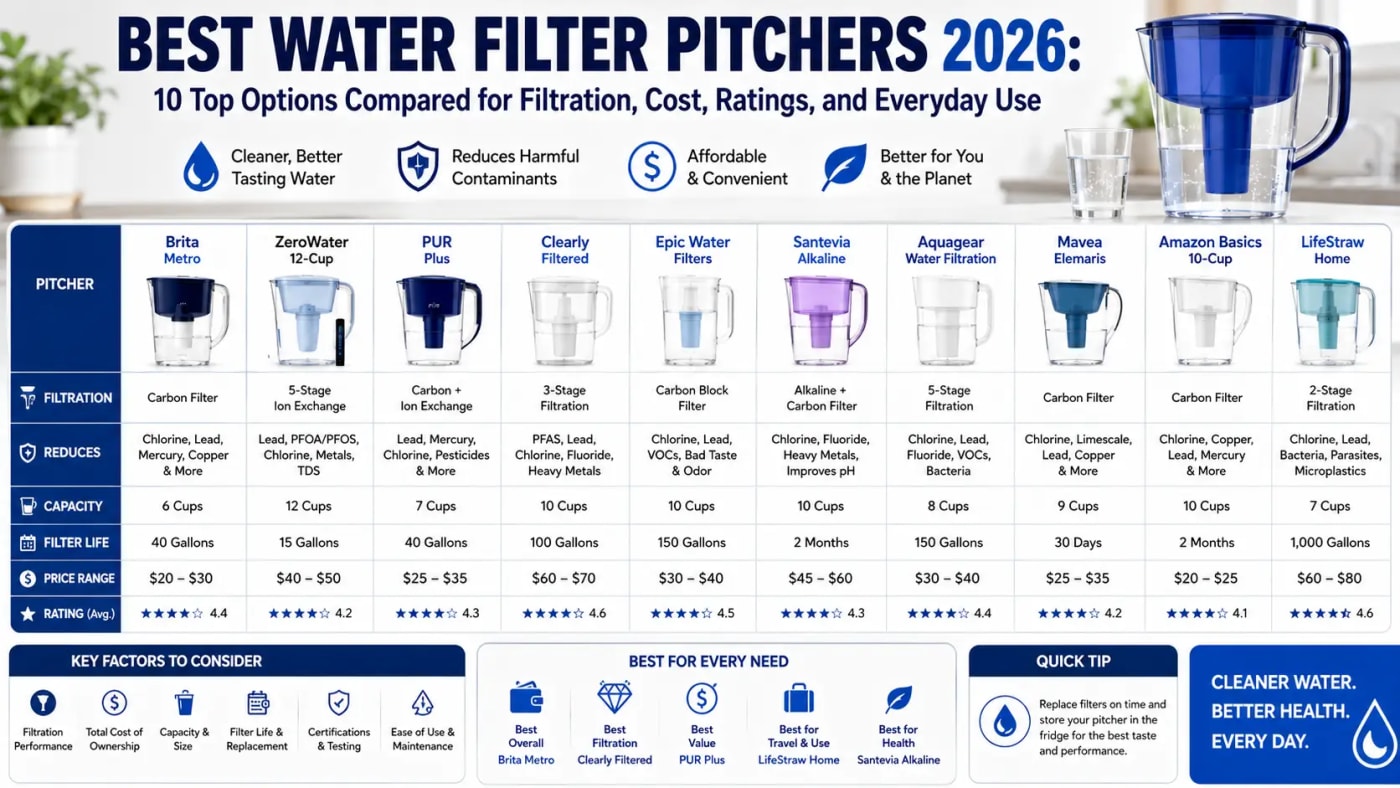
The best water filter pitchers for 2026 are the Culligan ZeroWater 10-Cup, Clearly Filtered Water Pitcher, LifeStraw Home, Brita Tahoe with Elite Filter, Epic Pure, PUR Plus 11-Cup, Waterdrop Lucid 10-Cup, Aquagear, LARQ PureVis, and Santevia MINA. Each one wins for a different reason. ZeroWater strips out the most dissolved solids and comes with its own TDS meter. Clearly Filtered covers the widest range of contaminants, including PFAS and fluoride, though it costs more and filters slowly. LifeStraw Home is the only pitcher on this list built to remove bacteria and parasites, not just chemicals. Brita Tahoe with Elite Filter is the simple, affordable pick for everyday chlorine and lead reduction. Epic Pure sits in the middle, with a long filter life and a fair price. PUR Plus 11-Cup is the cheapest entry point for basic lead reduction. Waterdrop Lucid gives fast filtration and a long filter life at a low price. Aquagear stands out for fluoride and heavy metal removal with a long lasting filter. LARQ PureVis adds a UV-C light that keeps the water clean inside the pitcher, at a premium price. Santevia MINA takes a different approach entirely. It adds minerals to your water instead of stripping them all out.
No single pitcher wins every category. Your own water quality and your own priority, whether that is taste, lead, PFAS, or convenience, decides which pitcher is right for you. Prices, ratings, and review counts shift often on Amazon and other stores, so treat the numbers below as a helpful guide and check the live listing before you buy. This article walks through all ten pitchers, then gives you a simple way to match a pitcher to your exact water problem and budget.
Choosing a water filter pitcher used to be a simple choice between a few well known brands. That is no longer true. New pitchers now target specific problems such as PFAS, fluoride, or bacteria, while others focus on long filter life or low upfront cost. This comparison looks at ten pitchers on the market right now and judges them across price, customer rating, review volume, contaminant coverage, certification, filter lifespan, capacity, filtration speed, ease of use, and the type of household each one suits best. The right pitcher for you depends entirely on what is actually in your tap water and what you personally care about most. Read on for a full breakdown of each option, then use the decision sections near the end to find your match quickly.
Which water filter pitchers are being compared for 2026, and how should their differences be judged?
Water filter pitchers compared for 2026 are judged using a consistent set of measures, not just brand name or price tag. The measures used in this comparison are price, average customer rating, number of reviews, contaminant coverage, third-party certification, filter lifespan, replacement filter cost, pitcher capacity, filtration speed, everyday usability, pitcher material, and fit for a specific use case such as a family, a renter, or a well water household.
Certification deserves special attention. A certification only counts when it is tied to a specific contaminant claim, not a general safety label. The EPA explains that public water systems are tested and regulated for many contaminants, and a home filter should be chosen based on what your own water actually contains rather than general fear of tap water. NSF International runs the main certification programs used across this industry, and a pitcher certified under one standard number is not automatically certified for every possible contaminant. Keep this distinction in mind as you read through the ten products below.
The table below compares all 10 pitchers side by side.
Rank | Product | Price | Filter Life | Key Certification | Main Filtration Strength | Best For |
1 | Culligan ZeroWater 10-Cup | Around 35 to 40 dollars | About 20 to 40 gallons, shorter in hard water | NSF 42 and 53, IAPMO for lead, chromium, PFOA/PFOS | Maximum TDS and dissolved solids reduction | Buyers who want the lowest possible TDS reading |
2 | Clearly Filtered Water Pitcher | Around 90 to 110 dollars | 100 gallons | NSF 42 and 372, plus WQA certified PFAS reduction | Widest contaminant coverage, including PFAS and fluoride | Buyers who want broad protection and do not mind a higher price |
3 | LifeStraw Home | Around 50 to 65 dollars | Membrane 264 gallons, carbon filter 40 gallons | NSF 42, 53, 401, and P473 and P231 performance testing | Bacteria, parasites, and microplastics | Households worried about biological contamination, not just chemicals |
4 | Brita Tahoe with Elite Filter | 41.99 dollars | 120 gallons, about 6 months | NSF/ANSI certified, 99 percent lead reduction | Everyday value for chlorine and lead | Everyday municipal tap water use on a normal budget |
5 | Epic Pure | Around 65 to 79 dollars | 150 gallons | Independent lab testing, not NSF certified | Long filter life at a fair running cost | Buyers who want fewer filter changes without a premium price |
6 | PUR Plus 11-Cup | Around 25 dollars | 40 gallons, up to 2 months | WQA certified for lead, NSF certified for microplastics | Lowest upfront cost with real lead reduction | Budget conscious buyers who still want certified lead protection |
7 | Waterdrop Lucid 10-Cup | Around 30 dollars | 200 gallons | NSF 42 and 372 | Fast flow rate and long filter life | Renters and busy households who want speed and low upkeep |
8 | Aquagear | Around 70 to 120 dollars | 120 gallons | NSF 42, 53, and 401 | Fluoride, chromium 6, and chloramine reduction | Households with fluoride or chloramine concerns |
9 | LARQ PureVis | Around 110 to 150 dollars | 40 to 60 gallons | Independently tested to NSF 42, 53, and 401, not NSF certified | UV-C self cleaning plus carbon filtration | Buyers who want smart features and a bacteria resistant reservoir |
10 | Santevia MINA | Around 50 to 55 dollars | About 80 gallons, 2 months | Tested to NSF 42, 53, and 401 | Adds minerals back into filtered water | Buyers who want alkaline, mineral tasting water |
Prices, ratings, and review counts change often, so confirm the current numbers on the retailer or manufacturer page immediately before you publish or buy.
Which 10 water filter pitchers rank highest when filtration evidence, price, ratings, reviews, and ownership value are compared?
The 10 water filter pitchers that rank highest when filtration evidence, price, ratings, reviews, and ownership value are compared are listed in the table above, in order from strongest all around performer to most specialized pick. Each product is explained in full detail in the sections below, covering what makes it stand out and what its main drawback is.
Which water filter pitcher fits different water-quality problems and household situations?
The water filter pitcher that fits your situation depends on the specific problem in your water and the way your household actually uses a pitcher day to day. The sections below turn everything covered above into a direct decision, without repeating the full product details again.
Which pitcher is suitable for chlorine taste, lead, PFAS, fluoride, bacteria, or high TDS?
Match your water concern to the pitcher built for it:
Chlorine taste and odor only: Brita Tahoe with Elite Filter, since it is affordable and built specifically for everyday municipal water
Lead on a tight budget: PUR Plus 11-Cup, since it carries a WQA lead certification at one of the lowest prices here
PFAS and the widest contaminant range: Clearly Filtered Water Pitcher, since it targets more contaminants than any other option on this list
Fluoride specifically: Aquagear, since its filter is built and tested around fluoride and chromium 6 reduction
Bacteria or parasites, such as after a boil water notice: LifeStraw Home, since it is the only pitcher here with a true membrane microfilter
Highest possible TDS reduction: Culligan ZeroWater 10-Cup, since its 5 stage filter brings TDS closest to zero
Which pitcher works best for renters, apartments, families, and small refrigerators?
Match your household situation to the right pitcher:
Renters and apartment dwellers: any pitcher on this list works well, since none require installation, though Waterdrop Lucid and PUR Plus stand out for their slim, fridge friendly shape
Families with high daily water use: Epic Pure or Waterdrop Lucid, since both offer a long filter life that reduces how often you need to refill or replace parts
Small refrigerators with limited door or shelf space: PUR Plus 11-Cup, since its slim design was built specifically for narrow fridge shelves
Buyers who want the least amount of ongoing maintenance: Waterdrop Lucid or Aquagear, since both combine a long filter life with a simple replacement process
Which water filter pitcher has the best balance of upfront price and long-term filter cost?
The water filter pitcher with the best balance of upfront price and long term filter cost depends on how often you have to buy new filters, not just what the pitcher costs on day one. A pitcher with a low sticker price can still cost more over a year if its filter needs replacing every month.
ZeroWater is the clearest example of this trade off. Its upfront price is reasonable, but the filter life shortens fast in hard or high TDS water, sometimes lasting only a few weeks, which pushes the yearly cost higher than it first appears. On the other end, Waterdrop Lucid and Aquagear both offer long filter lives of 120 to 200 gallons, which spreads the filter cost out over many months and lowers the effective cost per gallon. Epic Pure and Brita Tahoe with Elite Filter sit in a comfortable middle ground, offering a reasonable filter life without the premium price tag of Clearly Filtered or LARQ PureVis. Before buying, look at the manufacturer's stated gallon rating and divide the replacement filter price by that number, since this single calculation tells you more about true ownership cost than the sticker price on the box.
Which filter certifications should buyers check before choosing a water filter pitcher?
Buyers should check filter certifications before choosing a water filter pitcher because a certification number only proves a claim for the specific contaminant it lists, not a general safety guarantee. NSF International and similar certification bodies test filters against a defined standard, and each standard number covers a distinct category of contaminant. A pitcher certified under one number is not automatically certified for contaminants covered by a different number.
The table below shows what each common standard actually covers.
Standard | What It Covers |
NSF/ANSI 42 | Chlorine taste and odor reduction, along with basic particle filtering |
NSF/ANSI 53 | Health related contaminants such as lead, mercury, and certain organic chemicals |
NSF/ANSI 401 | Emerging contaminants including some pharmaceuticals and chemical compounds |
NSF P231 | Microbiological water purifier performance, covering bacteria and parasites |
NSF P473 | PFOA and PFOS, a specific class of forever chemicals |
The EPA notes that public water systems are already tested and regulated for a wide range of contaminants, so the right filter certification for you depends on what your own water report actually shows, not on marketing language claiming to remove hundreds of unnamed substances.
What should buyers check before ordering a water filter pitcher from Amazon?
Buyers should check the exact model number, the specific filter version included, the current price, the current rating and review count, and the certification claim tied to that exact filter before ordering a water filter pitcher from Amazon. Many pitcher lines sell more than one filter version under a similar name, and each version can carry a different certification or contaminant claim. Confirm that replacement filters for your chosen model are easy to find and reasonably priced, and check the filter life rating in gallons so you can estimate your real yearly cost. Always verify these details on the current listing immediately before buying, since prices, review counts, and even filter versions can change without much notice.
How often should a water filter pitcher filter be replaced?
A water filter pitcher filter should be replaced based on the manufacturer's stated gallon or time based rating, adjusted for your own water conditions. Hard water or water with a high level of dissolved solids can shorten a filter's practical life well below its published rating. For a full breakdown of replacement schedules across different pitcher brands, see our dedicated guide: Water Filter Replacement Guide.
Do water filter pitchers remove PFAS?
Some water filter pitchers remove PFAS and some do not, so this claim needs to be checked for the exact model and filter version before you rely on it. The EPA treats PFAS as a contaminant of real concern in drinking water, and a pitcher should carry a specific PFOA or PFOS certification, such as NSF P473 or a WQA equivalent, rather than a general contaminant reduction claim. For a full list of pitchers verified to reduce PFAS, see our dedicated guide: Water Filters That Remove PFAS.
Do water filter pitchers remove fluoride?
Fluoride reduction varies a great deal between water filter pitchers and must be verified for the exact cartridge you plan to buy, since many everyday pitchers do not target fluoride at all. For a complete comparison of pitchers and other filters built specifically for fluoride reduction, see our dedicated guide: Best Water Filters for Fluoride.
Do Brita filters remove lead and other contaminants?
Brita filters remove lead and other contaminants depending on which exact filter version is installed, since Brita's Elite filter carries a different, stronger claim than its standard filter. Brita's own current product data confirms the Elite filter reduces 99 percent of lead, while the standard filter is built mainly for chlorine taste and odor. For a full model by model breakdown, see our dedicated guide: Brita Water Filters Guide.
How does ZeroWater compare with Brita and PUR?
ZeroWater compares with Brita and PUR by prioritizing total dissolved solids reduction above everything else, while Brita and PUR focus on everyday value and basic contaminant reduction at a lower running cost. For the full head to head comparison, see our dedicated guide: ZeroWater vs Brita vs PUR.
Are water filter pitchers enough for well water?
Water filter pitchers are enough for well water only in some cases, since private well water can contain contaminants that a standard pitcher filter was never designed to handle. Well water owners should test their water first to identify exactly what needs to be removed, rather than assuming any single pitcher covers every possible well water problem. For a complete guide to filtering well water, see our dedicated guide: Best Water Filters for Well Water.
Are water filter pitchers safe to use every day?
Water filter pitchers are safe to use every day when the filter is replaced on schedule and matched to the actual contaminants in your water source. Skipping filter changes or using a pitcher on water it was never designed to treat reduces its effectiveness over time. For full maintenance guidance, see our dedicated guide: Water Filter Safety and Maintenance Guide.
What is the difference between a water filter pitcher and reverse osmosis?
The difference between a water filter pitcher and reverse osmosis is that a pitcher needs no installation and filters water through gravity, while a reverse osmosis system uses a membrane under pressure and usually needs a dedicated water line or countertop setup. For a full explanation of how RO systems work and when they make more sense than a pitcher, see our dedicated guide: Reverse Osmosis Water Filters Guide.