
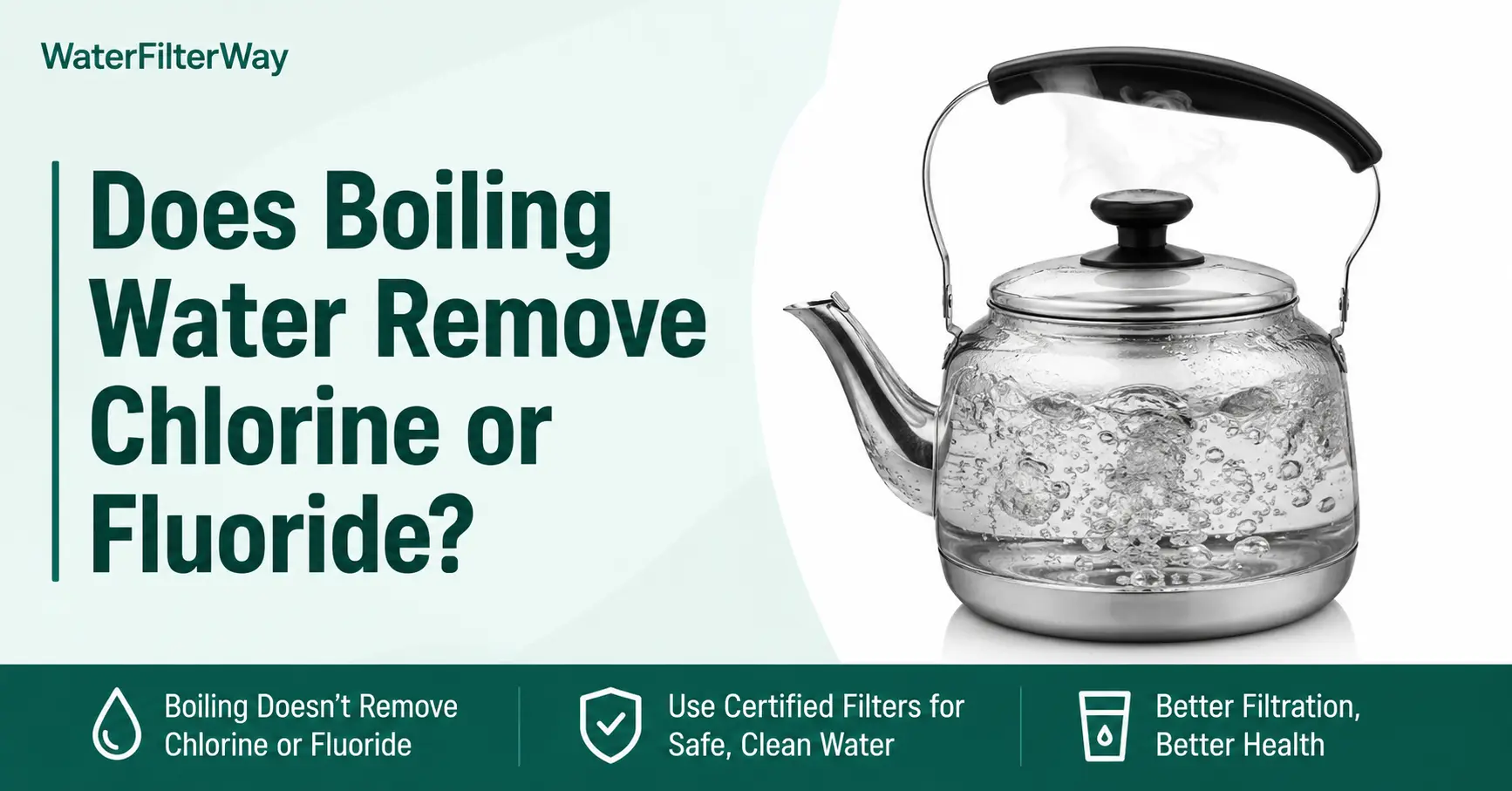
Boiling water and chlorine behave very differently once heat is involved. Boiling reduces free chlorine because it evaporates out of the water as a gas, and a sustained boil of about 15 to 20 minutes will bring levels down noticeably. Fluoride works the opposite way. It is a dissolved mineral ion, not a gas, so heat does not remove it from water. Instead, as water evaporates during boiling, the fluoride that was in it stays behind, and the remaining water ends up with a slightly higher fluoride concentration than before.
The reason for this difference comes down to physical form. Chlorine behaves like a gas dissolved in water, while fluoride behaves like a mineral dissolved in water. One escapes with heat, the other does not.
Does Boiling Water Remove Chlorine From Tap Water?
Yes, boiling reduces free chlorine in tap water. An uncovered pot brought to a rolling boil causes measurable chlorine loss within 15 to 20 minutes, since chlorine escapes as a gas well before the water itself reaches its boiling point. The sections below explain why this happens, how long it actually takes, and where the method starts to fall short, particularly with chloramine and disinfection byproducts.
What Happens To Chlorine When Water Boils?
Chlorine has a boiling point of about minus 34 degrees Celsius, far below the 100 degrees Celsius needed to boil water, a property confirmed by Britannica’s entry on chlorine. Because of this gap, chlorine turns into a gas and begins escaping the water long before the water itself starts bubbling. This is a physical change, not a chemical reaction. The chlorine molecules are not being destroyed, they are simply leaving the liquid and moving into the air.
An open pot lets this gas escape freely, which is why boiling chlorinated water uncovered speeds up the process. A covered pot traps the gas above the water instead of letting it vent, which slows things down and can leave more chlorine behind than expected.
How Long Does Water Need To Boil To Remove Chlorine?
For chlorine specifically, plan on a rolling boil of about 15 to 20 minutes. This is a different target than the boil recommended for killing pathogens, which the CDC sets at just one minute at a rolling boil, or three minutes at elevations above 6,500 feet. That one minute figure makes water biologically safer, but it is nowhere near long enough to meaningfully reduce chlorine.
How much chlorine actually leaves the water depends on a few practical factors: how much water you are boiling, how wide the pot is, whether the lid is on, and how much chlorine was in the water to begin with. Even after a full 15 to 20 minute boil, chlorine levels typically drop enough for taste and smell to improve substantially, but that does not guarantee the level reaches exactly zero.
| Boiling Goal | Recommended Time | What It Achieves |
| Kill pathogens (bacteria, viruses, parasites) | 1 minute rolling boil, 3 minutes above 6,500 feet | Makes water biologically safer, per CDC guidance |
| Reduce free chlorine | 15 to 20 minutes rolling boil, uncovered | Lowers chlorine enough to improve taste and odor, does not guarantee zero |
Does Boiling Remove Chloramine The Same Way As Chlorine?
No. Many water utilities have switched from free chlorine to chloramine, a compound formed by combining chlorine with ammonia, because it holds up longer inside distribution pipes. The same stability that makes chloramine useful for utilities makes it stubborn for anyone trying to boil it away at home. Chloramine does not evaporate the way free chlorine does, so even an extended boil often fails to bring levels down meaningfully.
If you are not sure which disinfectant your water uses, your local utility’s water quality report will say. This matters because the chlorine removal timeline above only applies to free chlorine. If your water runs on chloramine instead, boiling is not a reliable fix, and a filter rated specifically for chloramine is a better option.
Does Boiling Water Remove Chlorine Byproducts Like THMs?
Chlorine and chloramine can react with organic matter in water to form byproducts such as trihalomethanes, often shortened to THMs, and haloacetic acids, or HAAs. Research on how boiling affects these byproducts, found that trihalomethanes are actually reduced substantially by boiling, often by 64 to 98 percent, since many of them are volatile in a similar way to chlorine itself. Haloacetic acids behave differently and are more resistant to boiling, and in some cases part of that group increases slightly during a short boil before decreasing with longer boiling times.
The practical takeaway is that boiling does not reliably clear either group of byproducts, and results vary depending on which specific compounds are present and how long the water boils. If disinfection byproducts are a specific concern for your water supply, filtration rated for these compounds is a more consistent solution than relying on boiling time alone.
Does Boiling Water Remove Fluoride From Tap Water?
No, boiling does not remove fluoride, and it can raise the concentration slightly instead. This surprises a lot of people, since boiling is often treated as a catch all way to purify water. The sections below explain why fluoride does not evaporate the way chlorine does, why concentration rises instead of falls, and roughly how much that rise amounts to in practice.
Why Doesn’t Fluoride Evaporate When Water Boils?
Fluoride exists in water as a dissolved ion, written as F minus, rather than as a gas or a compound with a low boiling point like chlorine. Heat does not break the bond holding that ion in solution, and fluoride has no equivalent to chlorine’s low boiling point that would let it escape as water heats up. In practical terms, there is nothing about reaching 100 degrees Celsius that pulls fluoride out of the water.
This is the same contrast covered in the chlorine section above, just from the other direction. Chlorine leaves because it behaves like a gas dissolved in water. Fluoride stays because it behaves like a mineral dissolved in water, and boiling does not change that.
Does Boiling Water Increase Fluoride Concentration?
Yes, and the reason is straightforward once you see the logic behind it. The total amount of fluoride in a pot of water does not change during boiling, only the amount of water does. As steam escapes, the water volume shrinks while the fluoride stays behind, so the same amount of fluoride ends up dissolved in less water, which raises the concentration per liter.
Say a pot starts at the commonly recommended fluoridation level of 0.7 milligrams per liter, a figure set by the U.S. Public Health Service and referenced by the EPA. If a quarter of that water boils away, the remaining water holds the same total fluoride in a smaller volume, so the reading per liter climbs above 0.7. The effect is small during typical everyday boiling, such as making tea or pasta, but it becomes more noticeable the longer water is reduced, which matters most for anyone repeatedly concentrating water on purpose.
How Much Does Fluoride Concentration Rise When Water Boils?
As a rough rule, if half the water in a pot evaporates, the fluoride concentration in what remains roughly doubles, since the same total amount of fluoride is now packed into half the volume. For context, the EPA’s enforceable maximum contaminant level for fluoride sits at 4.0 milligrams per liter, well above the 0.7 milligrams per liter target used for dental health benefits, so a typical fluoridated water supply has a wide margin before boiling concentration becomes a meaningful concern.
This is a predictable, mechanical outcome rather than a sign that something has gone wrong with your water. Ordinary stovetop boiling for cooking or making a hot drink does not evaporate anywhere near enough water to push levels into a concerning range. The effect only becomes worth paying attention to if water is being reduced significantly and repeatedly, such as concentrating water for infant formula.
| Water Evaporated | Approximate Effect on Fluoride Concentration |
| None | Stays at starting level, for example 0.7 mg per liter |
| 25 percent | Rises to roughly 0.93 mg per liter |
| 50 percent | Roughly doubles, to about 1.4 mg per liter |
Does Letting Water Stand Remove Fluoride The Way It Removes Chlorine?
No. Leaving water uncovered for 24 to 48 hours reduces free chlorine through the same slow evaporation principle as boiling, just at room temperature instead of at a rolling boil. Fluoride does not follow that pattern, since it is not volatile at room temperature any more than it is volatile at boiling temperature. Letting a jug of water sit on the counter overnight will do nothing to lower its fluoride level.
This is worth repeating because it is easy to assume that if standing water removes one disinfectant, it works the same way for other substances in the water. It does not. The chlorine versus fluoride distinction covered earlier on this page applies here too, regardless of which method, boiling or standing, is being used.
What Is The Difference Between How Boiling Affects Chlorine And Fluoride?
The two threads covered above come down to one core distinction: chlorine behaves like a gas, fluoride behaves like a dissolved mineral, and boiling only helps with the first one.
| Property | Chlorine | Fluoride |
| Physical form | Dissolved gas | Dissolved ion |
| Boiling point | About -34 C, far below water’s | Not volatile, no comparable boiling point applies |
| Effect of boiling | Evaporates out of the water | Stays in the water, concentration rises slightly |
| Typical time needed | 15 to 20 minutes for meaningful reduction | No amount of boiling time removes it |
What Should You Consider Before Using Boiled Water To Reduce Chemicals?
Boiling is a reasonable stopgap for the taste and odor caused by free chlorine, but it stops there. It does not touch chloramine reliably, it does little for disinfection byproducts, and it actively concentrates fluoride rather than reducing it. It also has nothing to offer against heavy metals or most other dissolved chemical contaminants.
What you actually need next depends on your specific goal. Someone preparing baby formula has different priorities than someone trying to remove fluoride long term, and someone comparing filter types needs different information than someone just trying to figure out what is in their water to begin with. The sections below cover each of these situations in more depth.
Is Boiled Water Safe For Baby Formula If It Contains Fluoride?
Boiling is still the right step for the bacterial safety of formula water, typically a rolling boil of about one minute followed by cooling before mixing. That step has nothing to do with fluoride, though, and boiling longer than necessary will slightly concentrate any fluoride already present rather than reduce it.
Because infants are more sensitive to fluoride intake relative to their body weight, some pediatric and dental guidance suggests parents in fluoridated areas consider ready to feed formula or low fluoride bottled water as an alternative, while still following standard boiling steps for bacterial safety. This is not medical advice, and the right choice really depends on your specific water supply and your child’s situation, something we go through in more detail in a guide to preparing safe baby formula water.
Does Boiling Water Remove Other Contaminants Like Lead Or Bacteria?
Boiling is genuinely effective against biological contaminants. Health authorities recommend a one minute rolling boil specifically because it kills bacteria, viruses, and parasites reliably. Where boiling falls short is with dissolved chemical contaminants. Lead, arsenic, nitrates, PFAS, and similar substances do not evaporate with heat, and boiling can leave them slightly more concentrated as water volume drops, the same pattern already described for fluoride.
If you are trying to figure out what your water actually needs treatment for beyond disinfection, we have broken down each contaminant category, and what boiling can realistically be expected to handle, in a full breakdown of what boiling water does and does not remove.
Which Method Removes The Most Fluoride: RO, Activated Alumina, Bone Char, Or Distillation?
Since boiling does not work, the practical question becomes which method actually does. A few options are commonly used for fluoride specifically, each with different tradeoffs in cost, upkeep, and how much fluoride they realistically remove.
| Method | Approximate Fluoride Reduction | Practical Note |
| Reverse osmosis | 85 to 95 percent | Effective but uses several gallons of water per gallon filtered |
| Activated alumina | 90 to 95 percent | Performance depends on water pH and flow rate |
| Bone char filtration | Around 90 percent | Less common, works through mineral adsorption |
| Anion exchange | 80 to 90 percent | More common in larger or whole house systems |
| Distillation | 95 to 99 percent | Effective but slow and energy intensive for daily use |
It is worth being direct about one common assumption: standard carbon pitcher filters, including popular brands like Brita or Pur, are not built to remove fluoride, since fluoride ions pass through standard carbon media largely unaffected. The cost and upkeep differences between these methods often matter more than the removal percentages alone, and we get into that in a comparison of fluoride removal methods.
What Is The Best Way To Remove Chlorine From Drinking Water?
Activated carbon filtration is the standard answer here, since it works quickly on both free chlorine and chloramine without the time and energy cost of a 15 to 20 minute boil. Letting water sit uncovered for 24 to 48 hours is a slower, no equipment alternative, but it only works for free chlorine and does nothing for chloramine, the same limitation boiling runs into.
Boiling remains usable in a pinch, but of the available options it is the least practical for daily drinking water. We cover filter types, maintenance, and how to tell which disinfectant your water actually contains in a guide to removing chlorine and chloramine from tap water.
Does Reverse Osmosis Remove Both Chlorine And Fluoride?
Yes, when set up correctly. A full reverse osmosis system, typically paired with a carbon pre-filter stage, addresses chlorine or chloramine through the carbon stage and fluoride through the membrane itself. This is the main practical advantage reverse osmosis has over boiling: boiling only partially helps with one contaminant and makes the other slightly worse, while a properly configured RO system handles both at once.
How the membrane and pre-filter stages work together, and what to look for when comparing systems, is something we get into further in our reverse osmosis systems guide.
Is Distillation Different From Boiling For Removing Fluoride?
Yes, and the difference matters even though both start with the same step. Distillation begins with boiling water, but instead of letting the steam simply escape into the air, it captures that steam and condenses it back into liquid inside a separate, clean container. Fluoride and other dissolved minerals stay behind in the original vessel rather than traveling with the steam, which is why distillation actually reduces fluoride while plain boiling does not.
That single extra step, capturing and condensing the steam separately, is really the whole story. We go through how these systems work and what to expect from one at home in a guide to water distillation.
How Do You Test Your Tap Water For Chlorine And Fluoride Levels?
The fastest starting point is your water utility’s annual water quality report, sometimes called a Consumer Confidence Report in the United States, which lists measured chlorine and fluoride levels for your supply. Beyond that, at home test strips give a quick, rough chlorine reading, while an accurate fluoride reading usually requires a certified lab test rather than a strip.
Knowing your actual starting numbers is what makes the rest of this decision easier, since it tells you whether boiling, a specific filter, or no action at all makes sense for your water. We walk through each of these testing options, including where to find your local utility’s report, in more detail in our water testing guide.
Is Fluoride In Drinking Water Actually Harmful To Health?
This question is really what drives the whole boiling conversation for a lot of people, so it deserves a fair, sourced answer. The CDC and WHO consider fluoridated water at the recommended 0.7 milligrams per liter level both safe and effective for reducing tooth decay, a position that has been the basis for community water fluoridation programs for decades. At the same time, some independent researchers have raised concerns based on studies of higher natural fluoride exposure and effects on childhood cognitive development, and dental fluorosis, a cosmetic mottling of tooth enamel, is a recognized risk at higher intake levels, which is part of why the EPA maintains a separate, stricter guideline of 2.0 milligrams per liter specifically to guard against it.
This page is not the place to settle that debate, and nothing here should be taken as medical advice. If fluoride exposure is a specific health concern for you or your family, talk to a doctor or dentist directly. We have laid out both sides of that debate in more depth, each attributed to its source, in a separate overview of the fluoride safety debate.
Does A Water Softener Remove Fluoride Or Chlorine?
Not on its own. A standard ion exchange water softener works by swapping positively charged ions, mainly calcium and magnesium, for sodium. Fluoride carries a negative charge, so it simply is not the kind of ion a softening resin is built to capture, and softening has no meaningful effect on fluoride levels.
Some softener setups include a carbon pre-filter stage ahead of the resin tank, and that stage can reduce chlorine taste and odor, but that is the pre-filter doing the work, not the softening process itself. How the ion exchange process actually works, and what it does and does not address, is something we explain further in our water softener guide.
Does Bottled Water Contain Fluoride?
Sometimes, and it depends entirely on the source. A lot of bottled water is drawn from municipal supplies that already contain fluoride, so the bottle can carry roughly the same fluoride level as local tap water unless it has been specifically treated. Water labeled as distilled or produced through reverse osmosis is typically low in fluoride or free of it, since both processes remove it during production.
The only reliable way to know is to check the label or the brand’s published water quality report rather than assume based on the word purified alone, since that term does not guarantee fluoride removal. We cover how to read those labels, and which types are actually fluoride free, in a comparison of bottled water quality.
Does A Standard Carbon Filter Like Brita Remove Chlorine Or Fluoride?
It removes chlorine, not fluoride. Standard activated carbon pitcher and fridge filters, including well known brands like Brita and Pur, are genuinely effective at reducing chlorine taste and odor, which is what most of these filters are designed and marketed for. Fluoride ions are not captured by standard carbon media, so these same filters pass fluoride through largely unaffected.
If fluoride reduction matters to you, a standard carbon filter alone will not get you there, no matter how often you replace the cartridge. Which filter types actually address fluoride, and which ones are built for chlorine and taste alone, is something we break down in a comparison of carbon filters and Brita style systems.
Frequently Asked Questions
Does boiling water get rid of chlorine taste?
Yes. A rolling boil of 15 to 20 minutes removes most free chlorine, which is usually what causes the taste and smell people notice.
Can boiling water remove fluoride for baby formula?
No. Boiling kills bacteria in formula water but does not reduce fluoride, and can concentrate it slightly if the water boils longer than needed.
Does boiling water work on chloramine?
Not reliably. Chloramine is far more stable than free chlorine and generally does not evaporate with normal boiling times.
Is it bad to drink boiled water with fluoride in it?
Not typically. Everyday boiling for cooking or tea does not evaporate enough water to raise fluoride to a concerning level.
What actually removes fluoride if boiling doesn’t?
Reverse osmosis, activated alumina, bone char filtration, anion exchange, and distillation are the methods that actually reduce fluoride.