Yes, reverse osmosis removes most of the minerals naturally found in water. Depending on the source water, RO systems typically strip out 92 to 99 percent of calcium and magnesium, along with potassium, sodium, and most trace elements. Whether that makes RO water bad for you is a separate question, and a more complicated one, since most people get the bulk of their minerals from food rather than water. The rest of this page works through what actually gets removed, what the research says about health effects, and what your options are if you want to add minerals back.
Why Does Reverse Osmosis Remove Minerals From Water?
Reverse osmosis works by forcing water through a semi-permeable membrane under pressure. The membrane is fine enough to block most dissolved substances, letting only water molecules pass through in large numbers. That includes contaminants like lead, arsenic, and chlorine, but it also includes dissolved minerals like calcium, magnesium, potassium, and sodium, since these are physically similar in size to many of the substances the membrane is designed to catch.
The membrane itself does not distinguish between something harmful and something beneficial. It simply blocks dissolved particles above a certain size, which is why mineral loss is really an unavoidable side effect of how thorough RO filtration is, rather than a flaw in a specific system.
Which Minerals Does Reverse Osmosis Remove and How Much?
The reduction is substantial across the board. RO systems typically remove somewhere between 92 and 99 percent of calcium and magnesium, and an even higher share of trace minerals, along with most of the potassium and sodium naturally present in the source water.
Each of these minerals plays a specific role worth knowing, since it is part of why their absence gets flagged as a concern in the first place.
Mineral | Role in the Body | Approximate RO Removal |
Calcium | Bone and teeth strength | 92 to 99 percent |
Magnesium | Energy metabolism and muscle function | 92 to 99 percent |
Potassium | Fluid balance and organ function | Majority removed |
Sodium | Fluid balance, contributes to taste | Majority removed |
Phosphorus | Bone and teeth formation | Majority removed |
Zinc | Immune function and blood health | Majority removed |
Trace amounts of some of these can still show up in filtered water depending on the source and the system, but the overall mineral content ends up far lower than what went in.
Is Reverse Osmosis Water the Same as Distilled Water?
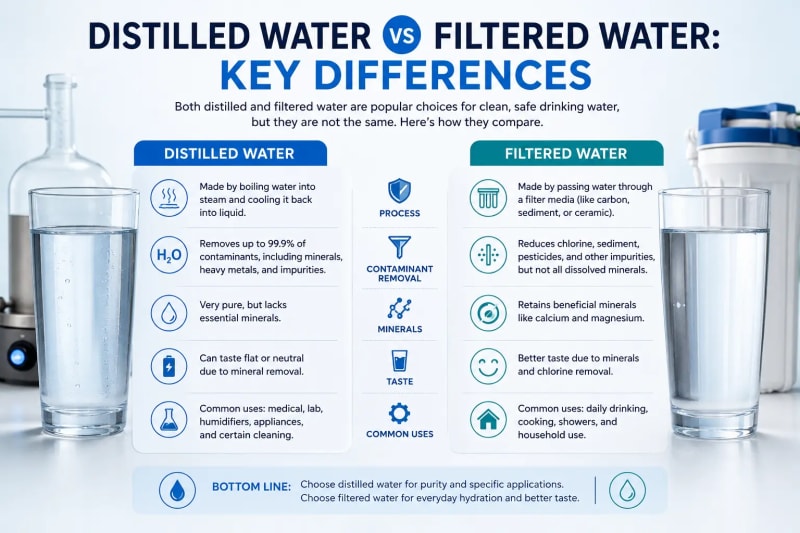
Not quite, though they end up close. Distillation heats water into steam and then condenses it back into liquid, leaving almost everything else behind, including minerals. That produces water that is very close to pure H2O.
Reverse osmosis uses a membrane instead of heat, and while it blocks the vast majority of dissolved minerals, it can still let through some very small dissolved substances that distillation would remove more completely. In practical terms, both processes leave water low in minerals, but distillation tends to get closer to zero than RO does.
Is Reverse Osmosis Water Bad for Your Health?
This is really where the disagreement lives, and it is worth laying out both sides plainly rather than picking one.
On one side, most nutrition and public health research finds no solid evidence that drinking RO water regularly causes clinically significant mineral deficiency in healthy adults eating a normal diet. The reasoning is straightforward: the majority of your mineral intake comes from food, not water, so losing the minerals in your drinking water does not meaningfully change your overall intake if your diet is reasonably varied.
On the other side, the World Health Organization convened an expert group back in 2003 that reached a more cautious conclusion. That group found demineralized water without remineralization is not considered ideal for regular consumption, pointing to an inverse relationship in some population studies between calcium and magnesium levels in drinking water and rates of ischemic heart disease.
Neither side is making things up. A lot of the WHO-cited evidence comes from older, population-level studies with real methodological limitations, and population trends do not guarantee anything about what happens to a specific healthy individual. But it is also fair to say the question is not fully closed the way some reassurance-only articles suggest.
What Does the WHO Report Actually Say About Demineralized Water?
This report gets misquoted constantly, so it is worth going straight to what it actually says rather than relying on secondhand summaries. The document itself came out of a November 2003 expert meeting in Rome, where the World Health Organization brought together nutrition, medical, and scientific specialists specifically to examine the health consequences of long-term consumption of demineralized water, the kind produced by desalination or membrane treatment processes like RO.
The group’s conclusion was that demineralized water left unremineralized is not considered ideal drinking water, based partly on population studies that found higher rates of certain health conditions in areas supplied with lower-mineral water. Worth noting: the Water Quality Association publicly pushed back on the draft version of this report, raising concern that it could be used to unfairly influence consumer attitudes and government regulations around water treatment products.
The report itself is the primary source here, and it is worth reading directly rather than trusting how any single blog chooses to summarize it, since summaries on both sides of this debate tend to lean harder than the original document does.
Do You Get Enough Minerals From Food if You Drink RO Water?
For most healthy adults, yes. A varied diet with dairy, leafy greens, nuts, and meat provides far more calcium, magnesium, and potassium than water typically would, even water that retained every mineral it started with. This is the main practical reason many health sources treat RO water’s mineral loss as low risk for the average person.
That said, it is worth being specific about who this reasoning applies to. People with already restrictive diets, conditions that affect nutrient absorption, or other specific dietary limitations may want to pay closer attention to where their minerals are actually coming from, rather than assuming diet alone closes every gap. This is not medical advice, just a reason to think about your specific situation rather than a blanket rule.
Is Reverse Osmosis Water More Acidic Than Tap Water?
Slightly, yes. Removing minerals like bicarbonate and calcium takes away some of the natural buffering that keeps water’s pH closer to neutral, so RO water often lands a bit lower on the pH scale than tap water.
This tends to get more attention than it deserves. The body’s own buffering systems handle small pH differences from water without any trouble, and there is no strong evidence that mildly acidic RO water causes health problems on its own. If taste is your concern rather than a health worry, a remineralization filter can raise pH back up a bit as a side benefit.
Does Drinking RO Water Cause Electrolyte Imbalance or Dehydration?
Both of these come up a lot once someone learns RO strips minerals, and both deserve a straight answer.On electrolyte imbalance: in a healthy person eating a reasonably balanced diet, electrolyte levels are tightly regulated by the body regardless of how mineral rich or mineral poor their drinking water is. Some older studies did note changes in electrolyte levels tied to demineralized water, but those studies generally were not specific to modern RO systems or well nourished populations, which limits how much they actually tell us about someone drinking RO water today.
On dehydration: hydration comes down to how much total water you drink and your overall diet, not the specific mineral content of that water. There is no credible evidence that RO water hydrates you any less effectively than tap water. The exception worth mentioning is restrictive diets or malabsorption conditions, where it is worth talking to a doctor about your specific situation rather than assuming everything works the same as it would for anyone else.
Does Drinking RO Water Pull Minerals Out of Your Body?
This is a genuinely common claim, the idea that very pure water actively pulls minerals out of your body as it passes through you. It does not hold up scientifically. Mainstream research finds no solid biological basis for it, since your body’s mineral stores and blood chemistry are regulated by your gut and kidneys, not by how many dissolved solids happen to be in a glass of water you just drank.
This idea seems to come from confusion with distilled water discussions, since both RO and distilled water are low in minerals and get lumped together in a lot of casual claims online. Neither one has been shown to extract minerals from tissue in a healthy person. It is a reasonable thing to wonder about, just not one the evidence actually supports.
Who Should Be More Cautious About Drinking Unremineralized RO Water?
The broad health discussion above is useful, but it is more helpful to narrow it down to who actually has more reason to think about remineralizing.
People with restrictive or limited diets, certain medical conditions that affect how the body absorbs minerals, and households in regions where population studies have shown a link between low-mineral water and specific health outcomes probably have more reason to remineralize than a generally healthy adult with a varied diet.
Worth addressing directly since it is a common parental worry: pediatric nutrition guidance does not recommend against RO water for otherwise healthy children eating a balanced diet, since children also get the large majority of their minerals from food rather than water. This is a practical risk-narrowing exercise, not medical advice, so anyone with a specific health concern is better off asking a doctor or pediatrician directly rather than relying on general guidance like this.
Should You Remineralize Your Reverse Osmosis Water?
Strictly speaking, no, it is not necessary for a healthy adult with a reasonably good diet. But it is a low-cost, low-effort step that closes the gap entirely rather than leaning on diet alone to make up the difference, and it comes with a side benefit: remineralized water usually tastes better and sits at a slightly higher pH than water straight out of an RO system.
Whether that is worth the extra cost and small amount of upkeep is really a personal call rather than a health requirement. If you already eat well and are not in one of the more cautious groups covered above, skipping it is a reasonable choice. If you would rather not think about it at all, remineralizing removes the question completely.
What Should You Know Before Choosing How to Treat Your RO Water’s Mineral Content?
If you have decided minerals matter enough to do something about, there are a few practical paths worth understanding before picking one: how remineralization filters actually work, how they stack up against mineral drops and alkaline pitchers, how RO compares to filtration methods that leave more minerals intact in the first place, what RO actually costs in wasted water, how to test your own water to know where you are starting from, and whether RO handles fluoride the same way it handles minerals. The sections below go through each of these.
How Do Remineralization Filters Add Minerals Back to RO Water?
Remineralization filters sit downstream of the RO membrane and pass the filtered water through a mineral rich media, usually calcite or a blend of calcium and magnesium compounds, before it reaches the tap. This restores some of what the membrane removed and nudges the pH back up slightly at the same time.
Not every RO system comes with one built in, so it is often something you add on to an existing setup, or a feature to look for specifically if you are shopping for a new system. One thing worth ruling out early: adding a pinch of Himalayan salt or sea salt to your water is not a real substitute for this. The World Health Organization has pointed out that the amount of salt you would actually need to add for any meaningful mineral benefit would be exceedingly high, well past the recommended daily sodium intake of about two grams, so that kitchen shortcut does not really work the way it gets marketed.
If you want to understand the mechanics and how to pick the right one for your setup, our guide to remineralization filters and add-ons covers how they work and how to choose one.
How Do Mineral Drops Compare to a Remineralization Filter for RO Water?
Mineral drops are a liquid concentrate you add manually, glass by glass. A single bottle typically treats around 200 gallons and costs somewhere between 20 and 50 dollars depending on the mineral blend, and the appeal is control, you decide exactly how much to add each time.
A remineralization filter does the same job automatically as part of the system, with no extra step at the tap. The tradeoff is really convenience against control: drops let you fine tune things but require remembering to use them, while a filter just runs quietly in the background. Our comparison of mineral drops and remineralization filters gets into the cost and convenience differences in more depth.
Can an Alkaline Pitcher Fully Replace a Remineralization Filter for RO Water?
Not really, and this is worth correcting directly since it is a common assumption. Alkaline pitchers are built primarily to raise water’s pH, and while many do add some minerals in the process, the amount is typically less than what is needed to fully make up for what RO filtration removed.
So an alkaline pitcher can be part of the picture, but it is not a one for one replacement for dedicated remineralization. If you are weighing whether an alkaline pitcher covers what you need, our breakdown of alkaline water pitchers explains what they actually do and do not do.
How Does Reverse Osmosis Compare to Other Water Filters That Retain More Minerals?
RO is not the only option, and it is worth knowing where it sits relative to methods that leave more of the original mineral content intact. Gravity fed carbon filters and ion exchange systems generally do not strip dissolved solids the way a membrane does, so they retain more minerals, though that comes at the cost of narrower contaminant removal overall.
For a quick sense of the tradeoffs: activated carbon removes chlorine and improves taste but does not eliminate everything, distillation removes minerals about as thoroughly as RO but is slow and uses a lot of energy, and UV filters handle bacteria and viruses well but do nothing for chemical contaminants or mineral content either way. Our full comparison of water filters by mineral retention and contaminant removal lays these differences out side by side.
How Much Water Does a Reverse Osmosis System Waste Compared to Other Filters?
This is a common tradeoff people run into once they understand RO’s mineral removal, and it is worth knowing about before you commit to a system. RO produces wastewater alongside the filtered water you actually drink, since the membrane has to flush away whatever it traps rather than letting it build up. That wastewater carries the removed salts and contaminants, not the minerals you might be trying to preserve, so it is not something you would want to drink anyway.
Newer high-efficiency RO systems are designed to cut down on this waste significantly compared to older models. If water waste is a real concern for your household, our explainer on reverse osmosis water waste and efficiency goes deeper into the numbers and what to look for.
How Do You Test Your RO Water’s Mineral Content or TDS Level?
A TDS meter is the quickest way to get a rough sense of your water’s mineral content before and after RO filtration, since total dissolved solids is a reasonable stand in for overall mineral load even though it does not break down which specific minerals you are looking at. If you want a precise breakdown of individual minerals, a certified lab test gets you there in a way a home meter cannot.
Testing is really the practical first step before deciding whether remineralizing makes sense for your specific water, rather than guessing based on general numbers. Our guide to TDS meters and water testing walks through how to actually do this at home.
Does Reverse Osmosis Remove Fluoride Along With Minerals?
Yes. RO removes fluoride effectively alongside the other dissolved minerals it strips out, which matters if reducing fluoride exposure is actually part of why you are considering RO in the first place, separate from the general contaminant removal.
If fluoride specifically is what brought you here, our breakdown of fluoride removal methods covers RO alongside distillation and other options for anyone weighing which approach fits best.