
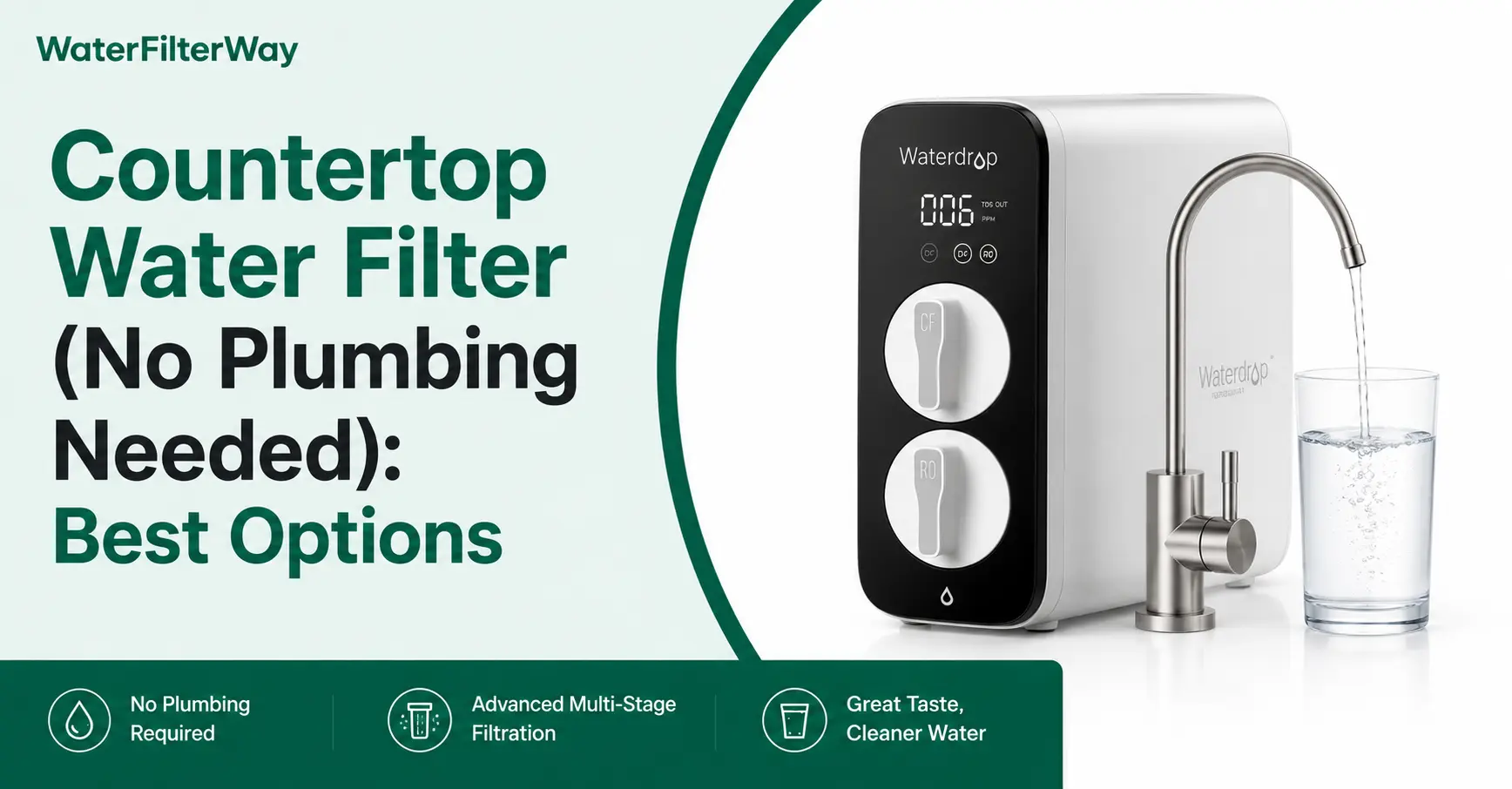
A countertop water filter sits on the kitchen counter and improves tap water without any plumbing modification. That makes it a common pick for renters, small kitchens, and anyone who wants stronger filtration than a pitcher without installing an under-sink system. The category actually covers a few genuinely different technologies, gravity-fed systems, countertop reverse osmosis, powered carbon units, and faucet-diverter systems, and each one comes with its own tradeoffs on speed, noise, and certification.
What Is a Countertop Water Filter and How Does It Work Without Plumbing?
A countertop water filter treats water using gravity, an electric pump, or a simple carbon cartridge, all without connecting permanently to household plumbing, though some models use a temporary faucet adapter to fill. That’s different from an under-sink system, which ties directly into the water line under the sink. The appeal of this whole category comes down to one thing: filtration strength that gets closer to an under-sink system while keeping the installation simplicity of a pitcher.
What Are the Main Types of Countertop Water Filters?
There are really four types here, not three, and the differences matter more than the shared label suggests. Gravity-fed systems use ceramic or carbon elements and rely on nothing but gravity to pull water through. Countertop reverse osmosis systems use an electric pump to force water through a membrane and fill a reservoir. Powered carbon units also use an electric pump, but push water through dense carbon without an RO membrane, which means they deliver filtered water almost instantly instead of making you wait through a fill cycle. Faucet-diverter countertop units connect directly to the tap and dispense filtered water immediately with no reservoir at all. The term countertop water filter alone doesn’t tell you much about actual performance until you know which of these four you’re looking at.
| Type | How It Works | Speed |
| Gravity-fed | Ceramic or carbon elements, no power | Slow, minutes to hours per batch |
| Countertop RO | Electric pump forces water through a membrane into a tank | Moderate, ten to fifteen minutes per cycle |
| Powered carbon | Electric pump pushes water through dense carbon, no membrane | Fast, near instant |
| Faucet-diverter | Connects directly to the tap, no reservoir | Instant, on demand |
Does a Countertop Water Filter Really Require No Installation at All?
Gravity-fed systems are fully standalone. You just fill the upper chamber with water and that’s it. Countertop RO units are plug-and-play too, with zero drilling, though some connect briefly to the faucet through an included adapter just to fill their tank rather than tapping permanently into the water line. Faucet-diverter units install in about ten minutes on a standard faucet, but they’re often incompatible with pull-down or pull-out sprayer-style faucets, so it’s worth checking your fixture before buying one. One thing worth being clear about: no plumbing doesn’t mean no maintenance. Reservoirs still need refilling and filters still need regular replacement no matter which type you pick.
How Do Countertop Reverse Osmosis Systems Compare to Gravity-Fed Countertop Filters?
This is really the biggest decision point in the whole category. The right choice depends on how much you value speed and broad contaminant removal versus silence, simplicity, and off-grid reliability.
How Much Contaminant Reduction Does Countertop Reverse Osmosis Actually Provide?
Countertop RO systems like AquaTru use a genuine reverse osmosis membrane, the same core technology found in under-sink RO units. Models certified to NSF/ANSI 58 have shown lab-verified reduction of fluoride, PFAS, lead, and microplastics down to non-detectable levels in independent testing. That makes countertop RO the closest a no-plumbing system gets to under-sink-level purification.
How Much Contaminant Reduction Does a Gravity-Fed Countertop Filter Provide?
Gravity-fed systems rely on ceramic and carbon elements to reduce contaminants like chlorine, sediment, and in some cases bacteria and viruses, without a membrane or electric pump. Performance varies a lot by brand and by whether the specific model carries independent certification, since some well-known gravity brands haven’t pursued NSF/ANSI certification despite making performance claims. That certification question gets its own full section further down, since it’s a big enough issue to deserve one.
Are Countertop Reverse Osmosis Systems Loud?
Yes, to a noticeable degree. Countertop RO systems produce an audible hum from the internal pump during filtration cycles, comparable to a running refrigerator, and a typical cycle runs about ten to fifteen minutes per batch. Gravity-fed systems, by contrast, are completely silent since they rely only on gravity. This is a genuine deciding factor for apartment living or open-plan kitchens, not a minor detail to skip past.
Does a Countertop Water Filter Need Electricity?
Gravity-fed systems need no electricity at all, which is exactly why they’re a common choice for off-grid or emergency preparedness use. Countertop reverse osmosis systems need a standard electrical outlet to run their internal pump. Large carbon dispensers generally don’t require electricity either, relying on gravity or manual dispensing the same way a pitcher does.
Is Countertop Reverse Osmosis Actually More Convenient Than Under-Sink RO?
Not always, and it’s worth being honest about that. Hands-on testing has found that countertop RO units can be bulkier than expected, need their reservoir refilled repeatedly since tank volume is limited, require manually emptying collected wastewater, and run their pump with no cabinet around them to muffle the sound. All of that can make daily use less convenient than a properly installed under-sink RO system. This doesn’t cancel out the real advantage of skipping installation entirely, it just means convenience should be weighed against daily usability rather than assumed automatically.
Why Is Berkey Not NSF Certified, and Should That Change Your Decision?
This is a genuine trust point in the category and worth addressing head on. Berkey, one of the most recognized gravity-fed brands, doesn’t currently hold NSF/ANSI certification from an accredited body, and the company has relied on its own independent lab testing rather than pursuing formal third-party certification. Sources online genuinely disagree on how to describe this. Some reference testing by a county health department or independent labs, while others call the filters flatly uncertified. Critics point out that without accredited certification there’s no independent verification of long-term performance claims. Supporters point to Berkey’s decades of use and its own published lab data as reassurance. Neither side is simply wrong here, so it’s worth laying out the facts rather than picking a side for you.
Why Do Sources Disagree About Whether Berkey Filters Are Certified?
Some sources describe Berkey filters as tested and certified by a county health department and independent labs to NSF standards 42 and 53, while others, including a well known consumer testing outlet, describe the same filters as uncertified, since no accredited NSF, IAPMO, or WQA body has issued a formal certification. A county health department review or a manufacturer-commissioned independent lab test isn’t the same thing as accredited third-party certification, and that distinction is likely where the conflicting descriptions come from. Here’s a more useful data point than the certification question alone: independent lab testing found the Travel Berkey removed all of the lead and PFAS in test samples but none of the arsenic, uranium, or fluoride it’s marketed to reduce. Checking performance claims contaminant by contaminant tells you more than trusting one overall certification claim.
Why Are Berkey Water Filters Banned or Unavailable in Some States?
The actual regulatory history is more specific than the ‘banned’ framing you’ll see online. California has required all in-home water filters to meet NSF/ANSI certification since 2009, and because Berkey hasn’t pursued that certification, full-size Berkey models aren’t sold within the state, with similar restrictions in Iowa. Separately, the EPA has pursued its own dispute with Berkey over classifying certain filtration claims under pesticide-related registration rules, and that matter has involved ongoing litigation. The situation is unresolved and still evolving rather than settled, so it’s worth checking current availability directly if this matters to you.
Is a Water Filter Without NSF Certification Still Trustworthy?
NSF/ANSI certification is the only way to independently verify a specific performance claim, and its absence means you’re relying entirely on the manufacturer’s own testing. That doesn’t automatically mean a product fails to perform, but it does mean there’s no third-party check on the claim. There’s a related, common source of confusion worth flagging here too: some countertop systems have their individual filter cartridges certified by a third party like SGS or IAPMO, while the assembled unit itself isn’t listed as NSF-certified in the official database. That’s a real and recurring gap between component-level and whole-system certification. If independently verified proof matters to you, check both the cartridge and the assembled unit’s certification status. If you’re comfortable with a brand’s own published lab data, that’s a valid choice too, as long as you know the tradeoff you’re making.
How Do You Spot a Counterfeit Countertop Filter Cartridge?
A price that seems too good to be true is the biggest red flag. After that, watch for packaging that looks overly glossy or cheaply made, certification marks that are unusually tiny or hard to read, and a cartridge that feels unusually light, which can mean it’s missing the proper filtration media inside. The safest habit is buying replacement filters directly from the manufacturer or an authorized retailer rather than an unfamiliar third-party seller.
How Much Does a Countertop Water Filter Cost to Buy and Maintain?
Gravity-fed systems typically carry the lowest long-term operating cost, with some models running as low as about two cents per gallon, while annual filter costs across the category generally range from about 50 to 110 dollars depending on the system. Countertop RO systems carry the highest upfront price in the category but remain cheaper long-term than bottled water.
| Type | Typical Upfront Cost | Typical Annual Filter Cost |
| Gravity-fed | $190 to $400 | $30 to $85 |
| Countertop RO | $350 to $650 | $60 to $130 |
| Powered carbon | $150 to $250 | $100 to $150 |
| Large carbon dispenser | $75 to $230 | $100 to $185 |
How Much Counter Space Does a Countertop Water Filter Need?
Gravity-fed systems and large dispensers tend to have the biggest footprint since they stack two chambers vertically. Countertop RO units are more compact but still need clearance for the tank and pump housing. Every type needs enough vertical clearance for filling and for reaching cabinets above it. It’s worth measuring your available counter space before choosing a specific model rather than assuming any countertop unit will fit the spot you have in mind.
How Long Do Countertop Water Filter Cartridges Last?
Most countertop systems recommend filter changes every three to six months depending on usage and water quality. RO membranes in countertop units generally last longer between replacements than the carbon pre-filters and post-filters that come with them. Gravity system elements often last considerably longer than either, sometimes rated for thousands of gallons before they need replacing.
Is a Countertop Water Filter Good Enough for Renters and Small Kitchens?
Countertop filters are generally considered ideal for renters specifically because they require no plumbing modifications. A unit can be set up in minutes and removed just as quickly when you move out. The tradeoff is that countertop units take up visible counter space that an under-sink system would hide away, which matters more in a small kitchen than in a larger one.
Can You Take a Countertop Water Filter With You When You Move?
Yes, and this is one of the clearest advantages of the whole category. Since nothing is permanently installed, a countertop filter, whether gravity-fed or RO, can be unplugged or taken apart and brought to a new home without leaving anything behind or needing a landlord’s permission. Compare that to an under-sink system, which usually stays with the property or takes real work to remove.
How Does a Countertop Water Filter Compare to Other Types of Water Filters?
A countertop filter isn’t the only option out there, and it isn’t always the right one. A pitcher costs less and takes up less space, but holds far less water and usually uses a single filtration stage. Under-sink reverse osmosis offers similar or better filtration without taking up any counter space at all, at the cost of a real installation project. Whole-house systems treat every tap in the home, not just drinking water. Faucet-mount filters sit somewhere between a pitcher and a countertop unit on both cost and capacity.
What Is the Best Water Filter Pitcher, and How Does It Compare to a Countertop System?
A pitcher costs less upfront and takes up less space, but holds far less water and generally uses a single filtration stage compared to the multi-stage filtration common in countertop systems. A pitcher makes sense for smaller households or tighter budgets, while a countertop unit is the natural step up once capacity or contaminant coverage starts to matter more.
What Is the Best Under-Sink Reverse Osmosis System?
An under-sink RO unit offers similar or better filtration than a countertop RO system without taking up any counter space at all, though it does mean committing to a real installation project. That’s the natural next step for anyone who has outgrown countertop convenience and is ready to make it permanent.
Is a Whole-House Water Filter Worth It Instead of a Countertop System?
A whole-house system treats every tap in the home, including showers and laundry, which matters if your concern goes beyond just drinking water. It’s a meaningfully bigger investment and installation project than any countertop option, so it’s worth being sure that’s actually what you need.
What Is the Best Water Filter for Removing PFAS at Home?
PFAS removal varies quite a bit across countertop filter types. Certified RO units generally perform best, while gravity or basic carbon systems need a specific PFAS certification to be trusted rather than a general marketing claim, which echoes the same certification-versus-marketing gap covered earlier in this guide. The PFAS Water Filters guide goes deeper into that specific concern for anyone whose main worry is forever chemicals.
What Is the Best Water Filter for Well Water or Off-Grid Use?
Gravity-fed countertop systems are often marketed specifically for off-grid and well water use, since they work without electricity and in some cases can handle untreated water sources. Well water brings its own concerns though, sediment, iron, and bacteria among them, so it’s worth checking a system’s specific certification for those contaminants rather than assuming general countertop performance covers it. The Best Water Filter for Well Water guide breaks down what to actually look for there.
How Do You Read Your Water Quality Report Before Choosing a Filter?
Checking a municipal water quality report before buying any countertop system helps match the right technology, gravity, RO, or carbon dispenser, to what’s actually in your water rather than choosing based on marketing alone. The How to Read Your Water Quality Report guide walks through what each section of that report actually means.
What Is the Best Faucet-Mount Water Filter?
A faucet-mount filter is the closest lower-cost alternative to a countertop system. It also requires no plumbing modification and attaches directly to the tap, giving on-demand filtering without a separate reservoir, though typically with a narrower contaminant list than a full countertop unit. It’s the right call if you want simplicity over capacity. The Best Faucet-Mount Water Filter guide covers that option in more depth.
Frequently Asked Questions
Is a countertop water filter as good as an under-sink system?
It depends on the type. Countertop RO systems can match under-sink RO performance, while gravity-fed filters prioritize portability and easy setup over filtration depth.
Does a countertop water filter need electricity?
Gravity-fed systems don’t require electricity. Countertop RO and other powered systems use an electric pump during the filtration process.
Is Berkey NSF certified?
No. Berkey is not currently certified by NSF, IAPMO, or WQA. Its performance claims are based on company and independent lab testing rather than third-party certification.
Are countertop reverse osmosis systems loud?
Yes. Most produce a low humming sound while filtering, similar to a refrigerator. Gravity-fed countertop filters operate silently.
Can I take a countertop water filter with me when I move?
Yes. Countertop filters are portable and require no permanent installation, making them easy to move and reuse in a new home.