

Arsenic is a naturally occurring element that gets into groundwater through rock erosion and sometimes through industrial or agricultural runoff, and it has no taste, odor, or color, so a lab test is the only way to know it is there. Which removal method actually works depends on which form of arsenic is present, arsenite or arsenate, and the right approach also depends on the household situation, since a private well calls for a different plan than a public supply, and treating one tap is a different decision than treating the whole house.
What Is Arsenic and Why Does It End Up in Drinking Water?
Arsenic is a naturally occurring metalloid found in rock and soil, and it dissolves into groundwater as rain and snow filter through arsenic bearing rock formations. That is why private wells are affected far more often than treated surface water drawn from rivers or reservoirs. Mining, smelting, and agricultural pesticide runoff can add to arsenic levels in some regions, though the geological source is the more common cause nationally. Arsenic itself is invisible in water, with no taste, odor, or color at any concentration, which is why testing is the only way to detect it.
What Is the Difference Between Arsenic III and Arsenic V?
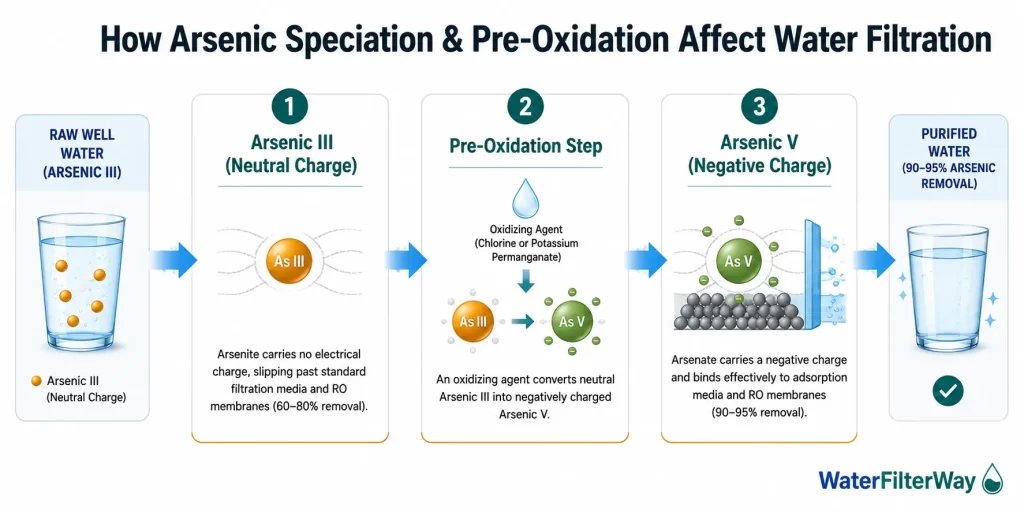
Water contains two inorganic forms of arsenic. Arsenite, also called arsenic III, carries a neutral electrical charge, which makes it harder for most filtration media to bind to. Arsenate, or arsenic V, carries a negative charge and is easier to remove with standard adsorption or ion exchange media. Arsenic III is also the more toxic of the two. A standard lab report gives a single combined total arsenic figure, and a separate speciation test is needed to see the individual III and V levels.
What Are the Health Risks of Arsenic in Drinking Water?
The EPA classifies arsenic as a known human carcinogen. Long term exposure has been linked to bladder, lung, and kidney cancer as well as skin lesions, while short term exposure at very high levels can cause acute symptoms. The EPA’s own estimate suggests that lifetime exposure at the legal limit of 10 ppb could still cause up to 600 additional cancers per million people, which is part of why some public health researchers argue that meeting the legal limit is not the same thing as a safety guarantee.
Can You Taste, Smell, or See Arsenic in Water?
No. Arsenic has no taste, odor, or color even at dangerous concentrations, which is why homeowners are often caught off guard when a lab result comes back high on water that looked and tasted completely normal. This is exactly why testing matters more than judging water by appearance.
How Often Should You Test Your Well Water for Arsenic?
Test private well water when moving into a home or drilling a new well, then at least once a year, or every three years at minimum according to some state extension guidance, with more frequent testing recommended in known high arsenic regions. Public water customers should read their yearly Consumer Confidence Report and only test their own tap if they have a specific concern or rely on an additional private source.
| Water Source | Recommended Testing Schedule |
| Private well, new home or new well | Test immediately, then annually |
| Private well, established | At least once a year, every 3 years at minimum in low-risk areas |
| Public water supply | Review the annual Consumer Confidence Report; test only for specific concerns |
Should You Test for Arsenic Speciation, Not Just Total Arsenic?
A standard lab report gives one combined total arsenic number, but it does not say how much is arsenic III versus arsenic V, and that split determines which treatment will actually work. If total arsenic comes back above the MCL and a treatment system is being considered, a speciation test from a specialized lab is worth the extra step. Recommending treatment without knowing the split is a common and costly mistake, since a system built for arsenic V can underperform badly against water that is mostly arsenic III.
Can an At-Home Arsenic Test Kit Give You an Accurate Reading?
At-home test kits and strips can indicate whether arsenic is present, but they generally do not provide an accurate quantitative ppb reading the way a certified laboratory test does. A certified private lab or a public health service test is the better choice for anyone deciding whether to install treatment. A home kit works fine as a rough first check, but it should not be the basis for a purchase decision.
What Are the Most Effective Ways to Remove Arsenic From Drinking Water?
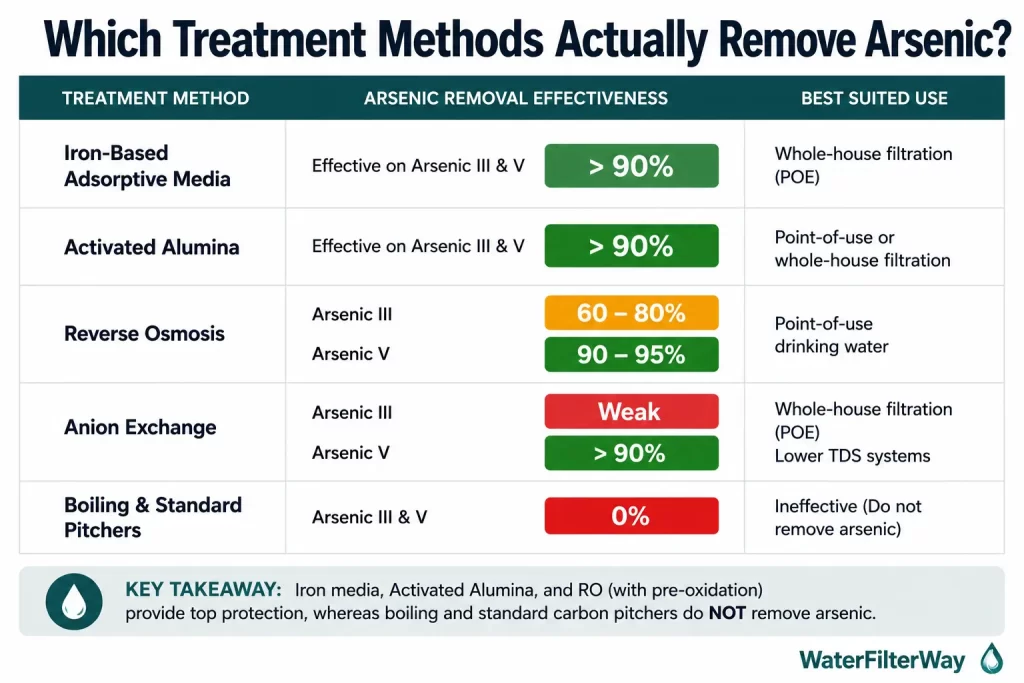
The right method depends heavily on whether the arsenic present is mostly arsenic III, arsenic V, or a mix of both, which is why a single blanket recommendation does not work for every household. The most relevant home treatment options are reverse osmosis, activated alumina, iron-based adsorptive media, anion exchange, and distillation, while boiling and standard carbon filtration are commonly misunderstood as solutions even though neither one reliably removes arsenic. Coagulation and electrodialysis also remove arsenic, but they are used almost exclusively at the municipal treatment plant scale rather than in home systems.
| Method | Effective on Arsenic III? | Effective on Arsenic V? | Best Suited For |
| Reverse osmosis | Partial (60 to 80%) without pre-oxidation | Yes (90 to 95%) | Point-of-use drinking water |
| Activated alumina | Yes | Yes | Point-of-use or whole-house cartridges |
| Iron-based adsorptive media | Yes | Yes | Utility scale and point-of-use systems |
| Anion exchange | Weak unless pre-oxidized | Yes | Whole-house systems on lower TDS water |
| Distillation | Yes | Yes | Small batch drinking and cooking water |
| Boiling | No | No | Not effective, can concentrate arsenic |
| Standard carbon filter | No | No | Not effective without specialty media |
Does Reverse Osmosis Remove Arsenic From Water?
Reverse osmosis is one of the most effective home treatment methods for arsenic, generally removing 90 to 95 percent of total arsenic, but that figure applies mainly to arsenic V. RO alone removes only about 60 to 80 percent of arsenic III, since its neutral charge lets some of it slip through the membrane, which is why pre-oxidation is often paired with RO for well water containing significant arsenic III. A typical under-sink RO system runs about 150 to 500 dollars.
How Does Activated Alumina Remove Arsenic From Water?
Activated alumina works by adsorption, meaning arsenic ions bind to the surface of a porous alumina media as water passes through it. It is effective for both arsenic III and arsenic V, though performance is sensitive to water pH and competing ions like sulfate and silica. The media eventually becomes saturated and needs replacement or regeneration, and this method shows up often in point-of-use or whole-house cartridge systems.
Is Iron-Based Adsorptive Media the Most Common Way Utilities Remove Arsenic?
Iron-based adsorptive media, sometimes sold as iron hydroxide or iron oxide media, is the approach most municipal water utilities actually use. A 2014 industry assessment found that roughly 80 percent of U.S. utilities removing arsenic relied on this type of media rather than reverse osmosis or ion exchange. It works on the same adsorption principle as activated alumina but binds arsenic more strongly, which allows for simpler, safer disposal of the spent media afterward. It is also available in smaller point-of-use cartridges for home use, not only at utility scale.
How Does Anion Exchange Remove Arsenic From Water?
Anion exchange uses resin beads to swap arsenic ions for harmless ions such as chloride. It works well for arsenic V, which carries a negative charge, but is far less effective for arsenic III unless it has first been oxidized. High sulfate or high total dissolved solids in the source water can reduce the resin’s effectiveness, and spent resin regeneration can produce a concentrated arsenic waste stream that requires proper disposal.
Does Distillation Remove Arsenic From Water?
Distillation works by boiling water and condensing the steam, which leaves arsenic and other dissolved solids behind in the boiling chamber. That makes it technically effective for arsenic removal. The tradeoff is that distillation is slow, uses energy, and produces water in small batches, which makes it more practical for drinking and cooking water than for whole-house use.
Does Boiling Water Remove Arsenic?
No. Boiling does not remove arsenic and can actually increase its concentration, since water evaporates as steam while arsenic stays behind in the remaining liquid. Boiling is useful for killing bacteria and viruses, not for removing metals or metalloids like arsenic, and this mix-up is one of the more common points of confusion around water treatment.
Can a Standard Carbon Filter or Pitcher Remove Arsenic?
Standard activated carbon filters, including most basic pitcher filters, are built to improve taste and odor by targeting chlorine, not to remove metals like arsenic, and they generally do not reduce it in any meaningful way. Some confusion comes from the fact that plain granular activated carbon behaves very differently from a specialty carbon block blended with iron-based or alumina adsorption media, which some manufacturers also market loosely as an activated carbon product. The safest approach is checking for an explicit, tested arsenic reduction claim rather than assuming any carbon filter, pitcher included, covers arsenic.
Why Does Arsenic III Need to Be Oxidized Before Treatment?
Arsenic III’s neutral charge makes it difficult for reverse osmosis, activated alumina, and anion exchange to remove efficiently on their own. An oxidizing agent such as chlorine or potassium permanganate is often installed ahead of the main treatment system to convert arsenic III into arsenic V, which each of those methods can then remove far more effectively. This is the same reason a speciation test matters before choosing a system, since it tells you whether this oxidation step is even necessary.
How Much Does It Cost to Remove Arsenic From Water?
Home water testing kits run about 20 to 150 dollars, and professional lab testing runs about 50 to 300 dollars. Under-sink point-of-use RO systems run about 150 to 600 dollars installed, while whole-house filtration systems run roughly 1,000 to 5,000 dollars or more depending on tank size and media type. Ongoing costs for media replacement or resin regeneration add to the whole-house figure over time, while testing is a small, recurring cost that should happen both before and after installing any system.
| Item | Typical Cost |
| Home arsenic test kit | $20 to $150 |
| Professional lab test | $50 to $300 |
| Under-sink point-of-use RO system, installed | $150 to $600 |
| Whole-house filtration system | $1,000 to $5,000 or more |
Is Bottled Water a Reasonable Alternative to Treating Arsenic at Home?
Bottled water avoids the upfront cost of a treatment system and can work as a short-term stopgap while waiting on lab results or a system installation, but it is not a verified long-term fix. Bottled water sources are not required to be arsenic-free, and quality can vary by brand and source. A household drinking primarily bottled water still needs treated water for cooking, ice, and other daily uses, which is where the ongoing cost comparison against a point-of-use system becomes relevant.
Should You Choose a Point-of-Use or Whole-House Arsenic System?
A point-of-use system such as an under-sink RO unit treats only the water used for drinking and cooking at one tap, at a lower cost, while a whole-house point-of-entry system treats every tap, including showers and laundry, at a higher upfront cost. Since arsenic is mainly a drinking-water health concern rather than a skin-contact hazard in most cases, many households choose point-of-use treatment for the kitchen tap and reserve whole-house systems for very high source-water levels or additional contaminants that call for broader treatment.
How Do You Know an Arsenic Treatment System Is Actually Working?
Retest treated water a few days after installation using the same method as the original test, then retest on a regular schedule, such as every three months, or as recommended by the system manufacturer or a water treatment professional. If treated water tests above roughly 5 ppb, the filter media or cartridge should be replaced even if it has not reached its rated capacity.
How Does Arsenic Compare to Other Contaminants Found in Well and Tap Water?
Arsenic rarely shows up as the only issue in a water test. Other heavy metals such as lead and uranium can share the same geological source and groundwater pathway, a broader well water test often turns up more than one concern at once, and the systems used to treat arsenic, reverse osmosis, whole-house filters, and pitchers, overlap heavily with what is used for other contaminants too. The sections below look at how arsenic fits into that wider picture.
What Should You Do If You’re Buying a House With Arsenic in the Water?
A water test showing arsenic above 10 ppb during a home inspection is a real negotiating point, not something to address after closing, since installing treatment or negotiating a repair credit before the sale closes protects the buyer. A well can taste and look completely normal while still failing an arsenic test, which is exactly why testing during inspection matters. Anyone buying a home on a private well benefits from working through a full private well inspection checklist rather than treating the arsenic result as an isolated issue.
What Is the Best Water Filter for Well Water?
Arsenic is one of several concerns specific to well water, alongside iron, manganese, sulfur, and bacteria, none of which municipal-style carbon filtration was ever built to address. Arsenic treatment works best as one piece of a broader well water treatment plan rather than a standalone purchase, and a closer look at what makes a good water filter for well water helps put arsenic in context alongside everything else a well can turn up.
How Do You Read Your Water Quality Report Before Choosing a Filter?
Public water customers can check their utility’s annual Consumer Confidence Report for arsenic and other contaminant levels before assuming treatment is needed, while private well owners have no equivalent report and must rely on their own lab testing instead. Knowing how to read a water quality report line by line makes it much easier to tell which contaminants actually need attention before buying any filter.
What Is the Best Under-Sink Reverse Osmosis System?
Not all RO systems handle arsenic III well without a pre-oxidation stage, so a system’s arsenic-specific certification matters more than a general contaminant reduction claim. Readers ready to shop should look at how the best under-sink reverse osmosis systems compare with that arsenic-specific detail in mind rather than choosing on price alone.
Is a Whole-House Water Filter Worth It for More Than One Contaminant?
A whole-house system starts to make more sense once a household is also dealing with iron, hardness, or a need to protect showers and laundry water, not just drinking water at one tap. For anyone who has already decided point-of-use treatment alone is not enough, working through whether a whole-house water filter is worth the investment is the natural next question.
What Other Heavy Metals Should You Test Your Well Water For?
A well that tests positive for arsenic is often worth testing for other geological heavy metals too, such as lead, uranium, and manganese, since they can share the same source rock and groundwater pathway. A broader look at which heavy metals commonly show up in well water gives a fuller picture than an arsenic-only test on its own.
What Is the Best Water Filter Pitcher, and Can It Help With Arsenic at All?
Standard pitcher filters are not built or certified for arsenic removal, so a pitcher should not be the primary defense against a confirmed arsenic result. That said, plenty of buyers still want one for everyday taste and chlorine reduction alongside a dedicated arsenic system, and the current best water filter pitchers are worth comparing for that separate, general-purpose use.
Frequently Asked Questions
Can you taste or smell arsenic in water?
No. Arsenic has no taste, odor, or color, so the only reliable way to detect it is through a certified water test.
Does boiling water remove arsenic?
No. Boiling does not remove arsenic and may increase its concentration as water evaporates.
What is the most effective way to remove arsenic from drinking water?
Reverse osmosis, activated alumina, and iron-based media are the most effective options. The best choice depends on whether your water contains arsenic III or arsenic V.
Can a Brita or other pitcher filter remove arsenic?
No. Standard pitcher filters are designed to reduce chlorine and improve taste, not remove arsenic.
How much arsenic in water is considered safe?
The EPA’s legal limit is 10 parts per billion (ppb), although its health-based goal for arsenic in drinking water is zero.