
The difference is that ROES-PHUV75 has a UV sterilization stage while ROES-PH75 does not. APEC ROES-PH75 works as a 6-stage reverse osmosis system, whereas the APEC ROES-PHUV75 works as a 7-stage water purification system. Both units work as a 75 GPD system with identical APEC filters and RO membrane specifications. A UV water filter becomes important only when treating well water or water sources with a known microbial risk. For standard municipal water, the 6-stage filtration stages provide sufficient contaminant removal without the extra UV lamp. This RO system comparison shows that adding a UV stage kills biological threats but does not change chemical filtration performance. The RO comparison between these models requires checking your specific water source safety before deciding on the ROES-PHUV75 upgrade.
| Image | Model | Filtration Stages | UV Sterilization | Daily Capacity | Water Source Target | Current Price |
|---|---|---|---|---|---|---|
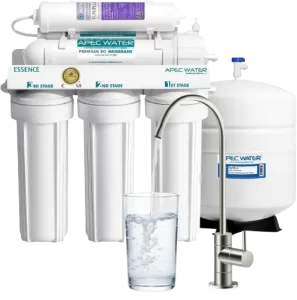 | ROES-PH75 | 6 Stages | No | 75 GPD | Treated City Water | Check Price |
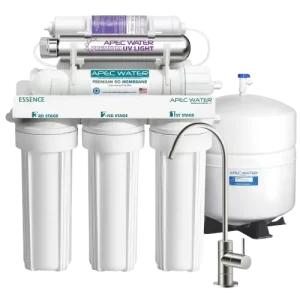 | ROES-PHUV75 | 7 Stages | Yes | 75 GPD | High-Risk/Well Water | Check Price |
What Is the Difference Between APEC ROES-PH75 and ROES-PHUV75?
The difference between APEC ROES-PH75 and ROES-PHUV75 is the addition of a UV sterilization stage in the PHUV75. Buyers find that both RO systems have the same filtration stages for the first six steps. The difference is only in the 7th stage, which is the UV lamp. This UV stage difference changed the system design, making the ROES-PHUV75 larger for the UV hardware and its power supply. The RO vs UV is important to understand. Reverse osmosis handles dissolved solids and chemicals, while water sterilization handles living organisms. The feature difference does not mean the PHUV75 filters chemicals better than the PH75. Both have exactly the same reduction in total dissolved solids (TDS) and heavy metals. When you compare both products, you will find that the UV lamp targets biological hazards exclusively. The 7-stage water purification system requires a nearby electrical outlet to power the UV lamp, changing the installation setup compared to the non-electric 6-stage system. Choose the PHUV75 only if your water requires targeted microorganism neutralization.
How Does the UV Stage in ROES-PHUV75 Actually Work?
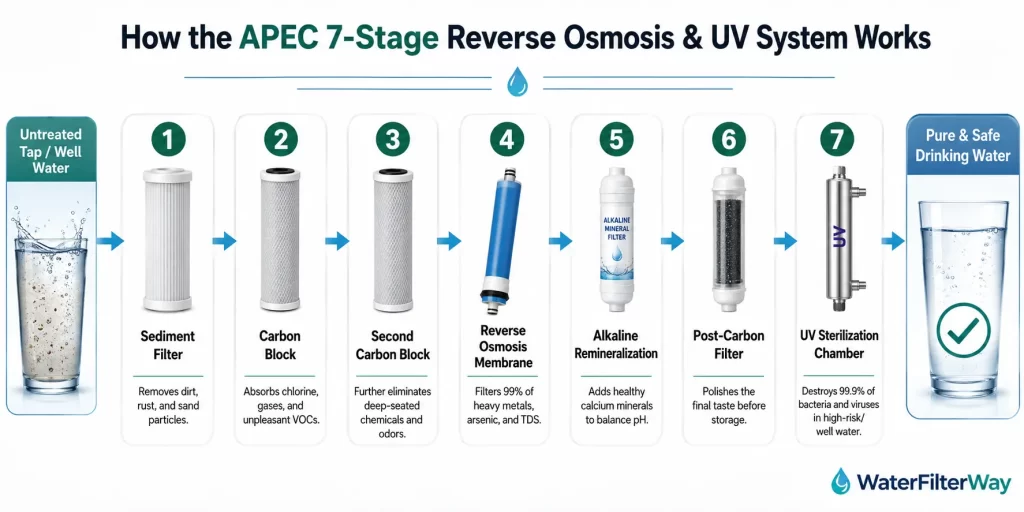
UV light kills microorganisms by damaging their DNA and stopping reproduction. The UV sterilization process uses a specific UV wavelength 254nm, which enters the cell walls of bacteria, viruses, and cysts. The APEC RO UV system positions this UV water filter after the primary RO membrane in a specialized contact chamber. As water flows through this chamber, the post filtration UV exposure disinfects the water without adding chemicals into the water purification system. According to water treatment standards, the effectiveness of the microorganism removal depends on water clarity and contact time. Because the water enters the UV chamber after passing through the reverse osmosis membrane, it is highly transparent, allowing maximum UV penetration for bacterial control. This sterilization process does not remove heavy metals, chlorine, or dissolved solids. The UV stage exclusively neutralises living microbes, ensuring the water remains safe even if the water source contains biological contaminants. The water disinfection occurs as the water passes the UV lamp, making the RO UV system efficient for biological water safety concerns.
Do You Actually Need UV Filtration in a Home RO System?
UV filtration is only needed when water has a risk of microbial contamination. Finding the UV requirement for your home depends directly on your water source type. A municipal water vs well water comparison shows the core filtration decision. City water facilities use chlorination to destroy bacteria before the water reaches your home; therefore, urban homes do not need a UV filter most of the time. While private well water lacks municipal treatment, and has a high bacterial contamination risk that makes UV necessary. Homeowners must buy the filter according to the water source cleaning requirements. Using a UV-equipped system on treated city water provides no additional health benefits because the municipal chlorination has already neutralized biological threats. Investing in UV sterilization is a mandatory filtration decision for well water users but an unnecessary expense for standard municipal tap water consumers.
How Do Filtration Performance and Water Quality Compare Between These Models?
Both systems provide the same filtration for dissolved contaminants because they use the same RO membrane. The water quality comparison between the ROES-PH75 and ROES-PHUV75 shows matching RO performance across all chemical and physical filtration metrics. Both units use the exact same pre-filters, 75 GPD reverse osmosis membrane, and post-filter mineral stage. The filtration efficiency for contaminant removal including heavy metals, chlorine, fluoride, and arsenic is the same. The RO system output differs only in biological sterilization, not chemical purity. Buyers often mistakenly believe the 7-stage system generates chemically cleaner water. The UV stage does not catch dissolved particles, change the pH, or enhance the taste profile which was done by the earlier stages. Therefore, if the water source lacks bacteria, both APEC systems will provide the same drinking water quality.
What Are the Installation and Maintenance Differences?
PHUV75 needs additional maintenance due to the UV lamp, while PH75 is simpler. The installation complexity of the PHUV75 is higher because the UV system needs a continuous 110V electrical outlet under the sink to power the bulb. The PH75 works on water pressure, and needs no electricity. The filter replacement schedule for the first six stages is the same for both, but the UV system maintenance is an extra step. RO maintenance for the PHUV75 includes a mandatory UV lamp replacement every 9 to 12 months. This UV bulb replacement is important because UV light degrades over time, reducing the sterilization effectiveness even if the bulb still appears illuminated. This ongoing maintenance cost makes the PHUV75 more expensive in the long-term. Water system care for the PH75 involves replacing standard filters, offering easier RO servicing. Ignoring the UV lamp replacement schedule in the PHUV75 compromises the biological defense layer, meaning users must commit to stricter filter maintenance for proper water system care.
Which System Costs More and Is It Worth the Price Difference?
PHUV75 costs more due to the UV stage, and the extra cost is only for microbial risk scenarios. The initial RO system cost for the PHUV75 is higher than the PH75, because of the UV filter price and its contact chamber. Buyers must also calculate the long term expense. The PHUV75 requires an annual UV bulb replacement, which increases the ongoing water system pricing. The UV value depends on the water source. If a home uses untreated well water, the price difference provides water safety, making the filtration investment worthwhile. However, for municipal water users paying for the PHUV75 has no benefit. Buying the PH75 for city water, saves from the unnecessary upfront price difference and the maintenance cost of the UV stage.
Does a Higher Stage Count Mean Better Filtration?
No, more stages do not mean better filtration. A common RO stages myth is that a 7-stage system chemically purifies water better than a 6-stage system. System performance depends on the specific function of each stage, not the stage count. The filtration quality for dissolved solids and chemicals depends on carbon blocks and the RO membrane. Adding a UV stage in RO design increases the stage count to seven, but this stage provides zero chemical filtration. It is for biological sterilization. The buyer should understand filtration logic rather than simply counting stages. A 6-stage unit removes 99% of TDS and gives the same water purification systems output as a 7-stage unit. The 7th stage is for biological disinfectants. This myth leads buyers to overspend on features they do not require for their specific water profile.
Which APEC System Should You Choose Based on Your Water Source?
Choose PH75 for treated municipal water and PHUV75 for untreated or high-risk water sources. Buying relies on a water source. APEC system selection becomes straightforward when dividing shoppers into four distinct buyer profiles. Profile 1 is the city water user; they should select the PH75 because municipal chlorination already manages bacteria. Profile 2 is the well water user; they must choose the PHUV75 to neutralize active biological threats.Profile 3 represents the budget buyer; the PH75 is the correct filtration choice, giving lower initial costs and cheaper maintenance. Profile 4 is a user with high-risk contamination, such as a localized boil-water advisory zone; they require the PHUV75 system recommendation. Proper water treatment selection avoids paying for redundant technologies. Finalizing the RO is based on an accurate water test of your supply, so that your filtration planning matches with your specific profile.
1. Product Comparison Chart
| Feature | ROES-PH75 | ROES-PHUV75 |
|---|---|---|
| Filtration Stages | 6 Stage | 7 Stage |
| UV Sterilization | No | Yes |
| Daily Capacity | 75 GPD | 75 GPD |
| RO Membrane | Same | Same |
| Electricity Required | No | Yes |
| Best For | City Water | Well Water / High-Risk Water |
| Maintenance Cost | Lower | Higher |
| UV Lamp Replacement | Not Required | Every 9-12 Months |
| Current Price | Check Price | Check Price |
Does UV Filtration Change Water Taste or TDS Levels?
No, UV filtration does not change taste or TDS because it only targets microorganisms. The UV does not affect because the purification process involves no chemicals. The UV filtration dictate cannot trap minerals, salts, or metals, meaning it has zero impact on water quality metrics like TDS levels. Understanding the RO vs UV filtration difference clarifies that UV function is for biological neutralization.
How Long Does a UV Lamp Last in RO Systems?
UV lamps last 9 to 12 months before needing replacement. The UV lamp lifespan is limited by UV degradation. The light intensity drops below effective sterilization levels even if the bulb still glows. The replacement is important for system performance and proper RO maintenance.
Can RO Systems Remove Bacteria Without UV?
Yes, RO systems can remove most bacteria because the membrane has very tiny pores that block germs during filtration. However, UV adds an extra layer of protection by killing bacteria that grow later inside the system. RO handles most of the cleaning, while UV helps improve long-term water safety.
Is ROES-PHUV75 Necessary for City Tap Water?
No, UV is usually unnecessary for properly treated municipal water. City water filtration relies on heavy chlorination to destroy biological threats before the water enters your home. The municipal water treatment ensures water source safety; therefore, the UV is unnecessary for urban residents.
What Happens If You Skip UV Maintenance in PHUV75?
Skipping UV maintenance reduces sterilisation effectiveness over time. The UV light loses the specific intensity that damages bacterial DNA. This UV failure compromises the entire water purification efficiency, allowing active microbes into the drinking supply. Strict system upkeep and filtration system care is important for performance in water treatment systems.
FAQ’s:
Q1: Does UV Filtration Change Water Taste or TDS Levels?
No. UV sterilization only targets microorganisms and involves no chemical process, so it has zero effect on TDS levels, minerals, or salts. It doesn’t change taste. UV’s role is purely biological neutralization, separate from RO filtration.
Q2: How Long Does a UV Lamp Last in RO Systems?
A UV lamp typically lasts 9 to 12 months. Even if the bulb still glows, its UV intensity degrades over time and can drop below effective sterilization levels, so timely replacement is important for system performance.
Q3: Can RO Systems Remove Bacteria Without UV?
Yes. The RO membrane’s tiny pores block most bacteria during filtration on their own. UV simply adds an extra layer of protection by killing bacteria that may grow later inside the system, improving long-term water safety.
Q4: Is ROES-PHUV75 Necessary for City Tap Water?
No, UV is generally unnecessary for properly treated municipal water. City supplies are already heavily chlorinated to eliminate biological threats before reaching your home, so urban users typically don’t need the extra UV stage.
Q5: What Happens If You Skip UV Maintenance in PHUV75?
Skipping UV lamp maintenance reduces its sterilization effectiveness over time, since the light loses the intensity needed to damage bacterial DNA. This can compromise the system’s biological protection, allowing microbes into the drinking water — regular upkeep is essential.
