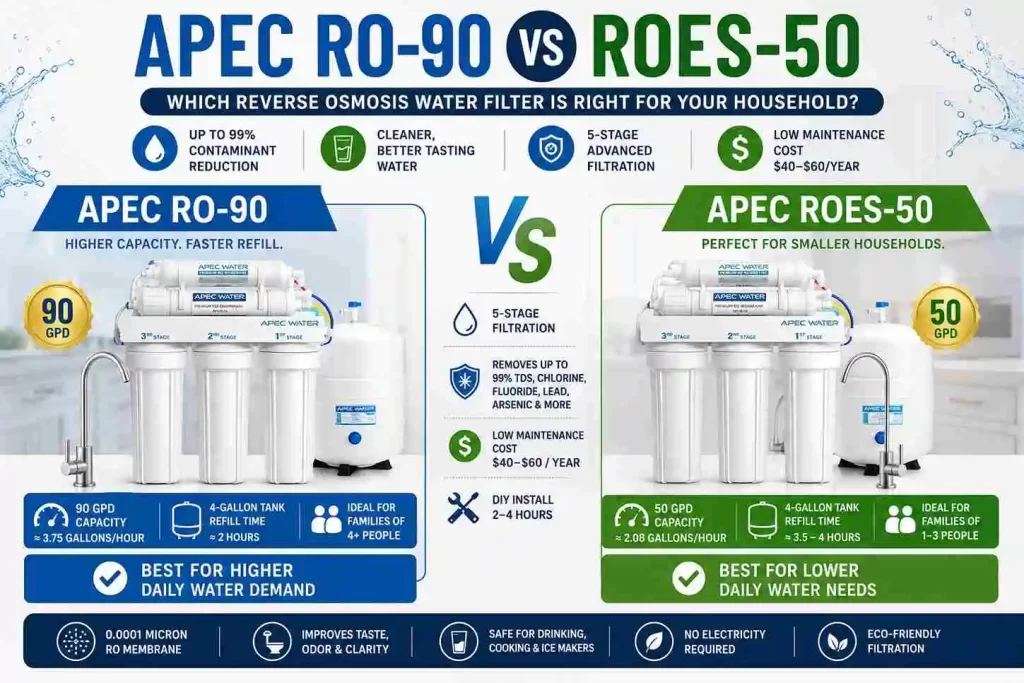
The APEC RO-90 and ROES-50 are under-sink reverse osmosis systems that use the same 5-stage filtration systems, but they differ in RO system capacity and water production speed. This reverse osmosis differs in 90 GPD and 50 GPD output, which directly affects refill speed, not purification quality.
Both systems have similar total dissolved solid reduction levels (95 to 99%) and use the same core filtration structure, including sediment filtration, carbon block stages, RO membrane, and post-carbon polishing. The main difference in these water filters is membrane capacity, where the RO-90 produces more water per day than the ROES-50, making it more suitable for higher household water demand.
The following table shows the features of both the water filter:
| Feature | RO-90 | ROES-50 |
|---|---|---|
| GPD Rating | 90 GPD | 50 GPD |
| Filtration Stages | 5-stage | 5-stage |
| System Type | Under sink RO | Under sink RO |
| Efficiency | Higher output speed | Standard output |
| Tank Design | Similar storage tank | Similar storage tank |
| Current Price | Check Price | Check Price |
Households choosing between these filtration system review options should focus on RO performance based on daily usage. Larger families benefit from faster refill cycles, while smaller households maintain efficiency with lower capacity systems.
What Is the Core Difference Between APEC RO-90 and ROES-50 Systems?
APEC RO-90
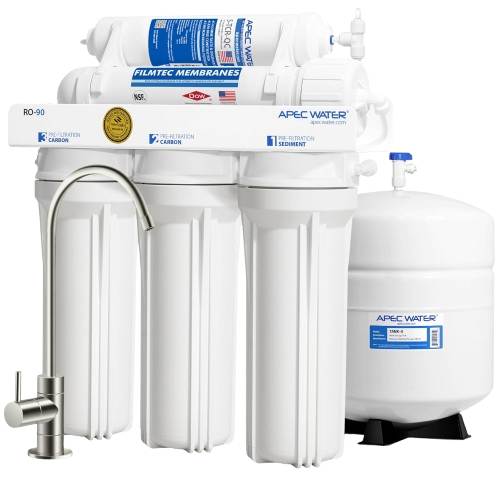
The APEC RO-90 is a high-capacity reverse osmosis system that produces 90 gallons of purified water per day. It uses a larger reverse osmosis membrane that cleans and produces water faster than a standard filter. Under optimal conditions — 60 PSI water pressure and 77°F water temperature — the RO-90 purifies water at a rate of 3.75 gallons per hour, making it ideal for larger households or high-demand usage.
APEC ROES-50
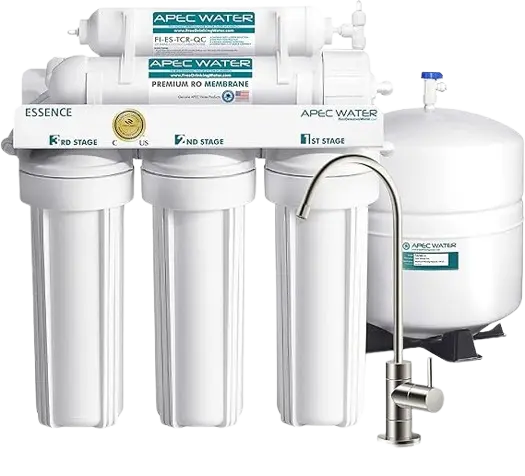
The APEC ROES-50 is a standard reverse osmosis system that produces 50 gallons of purified water per day. It uses a standard-sized reverse osmosis membrane suited for everyday household use. Under the same optimal conditions of 60 PSI and 77°F, the ROES-50 outputs approximately 2.08 gallons per hour — reliable and sufficient for average-sized families.
How Do Filtration Stages and Components Compare Between RO-90 and ROES-50?
The RO-90 and ROES-50 use nearly the same filtration stages and system components. Both reverse osmosis systems include a residue filter, two carbon block filters, an RO membrane, and a post carbon filter for taste improvement. The filter removes dirt, rust, sand, and large particles that can damage the filter design. The carbon block stages reduce chlorine, volatile organic compounds, chemical taste, and odour. The RO membrane is the main purification layer for removing dissolved solids, fluoride, arsenic, lead, chromium, and other microscopic contaminants. The post-carbon filter polishes the water’s taste before dispensing. The difference between the two water purification layers is membrane production speed, not filtration quality. The RO-90 uses a higher-capacity RO membrane that produces purified water faster than the ROES-50. Buyers often assume the RO-90 includes upgraded filters because of the higher gallon-per-day rating, but both systems use a highly similar filtration architecture. Stage count does not determine performance. NSF-related filtration testing focuses on contaminant removal capability, filter efficiency, and membrane performance instead of adding extra filtration stages.
How Does Water Production Speed and Tank Refill Time Differ?
The RO-90 refills a standard 4-gallon storage tank in 2 hours, and the ROES-50 requires 3.5 to 4 hours to fill the same volume. Water production speed depends on the home’s incoming water pressure. When a household draws 2 gallons of water for cooking, the tank pressure drops. The RO-90 recovers this lost volume rapidly, for continuous pressure at the drinking point. The ROES-50 takes nearly twice as long to refill those 2 gallons, which can lead to a slow flow at the faucet if multiple people use the system consecutively.
Which System Is More Efficient in Terms of Water Waste?
Both systems work at a standard 3 ratios 1 pure-to-waste water ratio, which means three gallons of water are sent to the drain for every one gallon of purified water produced. Neither system includes an electric permeate pump by default. Because reverse osmosis needs water pressure to push molecules through a 0.0001-micron membrane, the rejected water carries away the concentrated total dissolved solids. Since the design of the manifold and the underlying pressure requirements are the same for both models, the efficiency ratio becomes the exact same regardless of the GPD rating.
What Are the Installation and Maintenance Differences?
The RO installation and maintenance process is nearly identical for the RO-90 and ROES-50. Both systems use the same under-sink setup, similar plumbing setup connections, and compatible replacement filters. The installation process includes connecting the feed water valve, drain line, storage tank, and faucet under the kitchen sink. Most homeowners complete the DIY install in 2 to 4 hours using basic plumbing tools. Both systems have colour-coded tubing and similar applying hardware to simplify setup. The maintenance cost for both reverse osmosis systems averages $60 to $100 per year, depending on filter usage, local water quality, and replacement schedule. Sediment and carbon block filters typically require filter replacement every 6 to 12 months. The RO membrane usually works for 2 to 3 years under normal conditions.
The filter lifespan requirements remain nearly the same because both units use similar filtration architecture and filter compatibility standards. Amazon reviews frequently mention confusion about replacement kits because many APEC replacement filters work with both systems. The main long-term difference is water production speed, not servicing complexity, maintenance schedule, or replacement procedures.
Which System Is Better for Different Household Sizes and Water Usage?
The RO-90 is best suited for households of 4 or more people with high daily water consumption, while the ROES-50 is ideal for smaller families of 1 to 3 people. A family of five using filtered water for drinking, boiling pasta, washing vegetables, and supplying a refrigerator ice maker will drain a 4-gallon tank quickly. The RO-90 prevents the tank from emptying completely during heavy usage periods. A single user or a couple will rarely consume the 50 GPD limit of the ROES-50, making the smaller capacity perfect for their daily needs.
Is It True That Higher GDP Means Better Filtration Quality? (Myth)
It is a myth that a higher GPD rating means better filtration quality; both the 90 GPD and 50 GPD membranes remove up to 99% of total dissolved solids. GPD measures the volume of water processed over 24 hours. The pore size of the reverse osmosis membrane is 0.0001 microns in both the RO-90 and the ROES-50. Water passing through either system achieves the same level of purity. The only difference is the surface area of the membrane material, which is used for the flow rate.
Which Buyers Should Choose APEC RO-90 vs ROES-50?
The best water system selection depends on household needs, daily water demand, and refill speed expectations. The ROES-50 is better for smaller households, while the RO-90 is good for higher daily purified water usage. Single users and couples usually benefit more from the ROES-50 because a 50 GPD reverse osmosis system produces enough filtered water for drinking, coffee, cooking, and light appliance use. The lower upfront cost also improves long-term ownership value for lower-consumption households. Medium-sized families of 3 to 5 people use the RO-90 because the higher-capacity membrane refills the storage tank faster during daily usage. Homes using filtered water for cooking, reusable water bottles, ice makers, and pets typically notice the faster production rate.
What Is the Difference Between RO Systems and Carbon Filters?
RO systems push water through a semi-permeable membrane with a 0.0001-micron pore size to remove dissolved heavy metals and fluoride, and carbon filters primarily remove chlorine, odours, and larger particles. A carbon filter alone cannot reduce total dissolved solids, whereas an RO system purifies the water entirely of these micro-contaminants.
How Do You Calculate the Right GPD for Your Home?
You calculate the right GPD by multiplying your household size by 1.5 gallons for daily drinking and cooking, then tripling that number to account for tank refill inefficiencies and low water pressure variables. For example, a 4-person home uses 6 gallons a day. Tripling this yields 18 gallons of required daily capacity, which both the 50 GPD and 90 GPD systems safely support.
Can You Upgrade ROES-50 to a 90 GPD System?
Yes, you can upgrade from ROES-50 to a higher capacity through membrane replacement, where the RO membrane is changed to a higher GPD rating to increase water output. This GPD upgrade increases filtration improvement in production speed, not contaminant removal quality. System upgrade compatibility depends on pressure requirements because the RO membrane needs sufficient water pressure to function correctly. In many cases, system modification is limited by the flow restrictor, which must match the new membrane rating to maintain the correct wastewater ratio. A change in the membrane without a restrictor can affect system performance. Proper RO customisation ensures a stable water output increase without damaging filtration balance.
Do RO Systems Require Electricity to Operate?
Standard RO systems like the APEC RO-90 and ROES-50 do not require electricity to work; they rely entirely on your home’s incoming water pressure. The minimum required water pressure for these systems is 40 PSI, with 60 PSI being the optimal target.
What Happens If Water Pressure Is Too Low for RO Systems?
If water pressure drops below 40 PSI, the RO membrane cannot push water through its pores, which causes very low pure water production and excessive wastewater being sent to the drain. In low-pressure situations, homeowners must install a booster pump to force the water through the pores efficiently.
How Much Does It Cost to Run an RO System Annually?
The annual maintenance cost for both the APEC RO-90 and ROES-50 is about $40 to $60. This includes pre-filter replacement and the long-term cost of the RO membrane. Neither system uses electricity, so the running costs are low. The only cost is the replacement filters and wastewater disposal charges.

