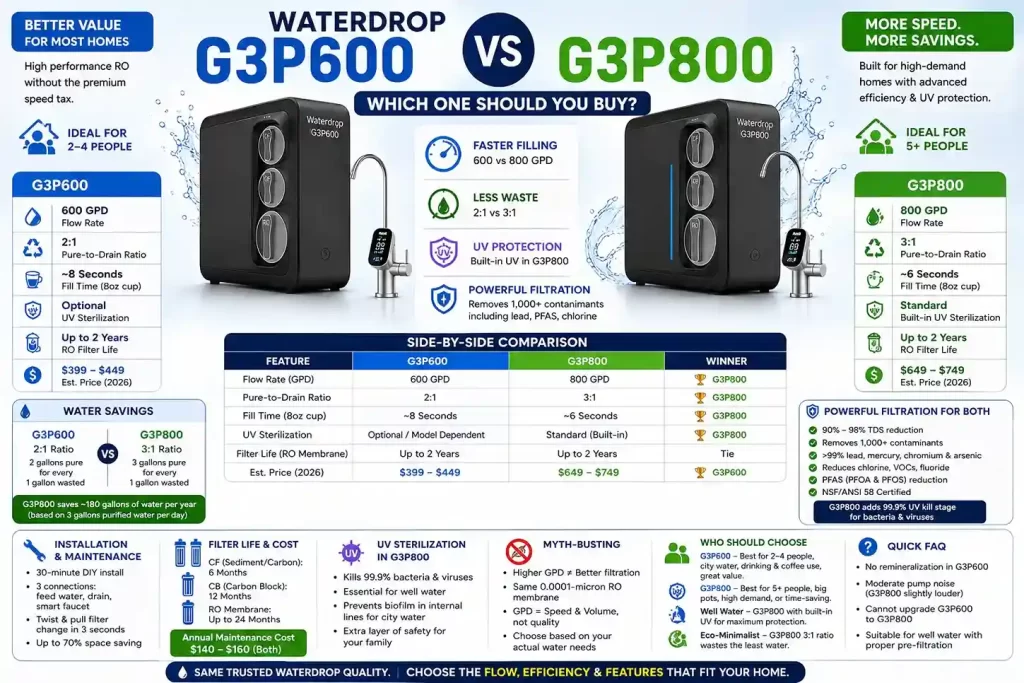
The Waterdrop G3P600 is the better value for most standard households, while the Waterdrop G3P800 is the superior choice for high-demand environments and those prioritizing maximum water conservation. Flow rate and RO efficiency of wastewater ratio are the main differences. The G3P600 provides 600 gallons per day (GPD), but the G3P800 provides 800 GPD and fills much faster for large pots or pitchers.
Furthermore, the G3P800 often features a more advanced 3:1 pure-to-drain ratio, meaning it wastes only one gallon of water for every three gallons purified, a significant upgrade over the G3P600’s 2:1 ratio. But at roughly $200 to $300, the G3P600 is still the practical choice for small-to medium families needing a high-performance tankless RO system without the premium “speed tax.”
Comparison: G3P600 vs. G3P800
| Feature | Waterdrop G3P600 | Waterdrop G3P800 |
|---|---|---|
| Flow Rate (GPD) | 600 GPD | 800 GPD |
| Pure-to-Drain Ratio | 2:1 | 3:1 |
| Fill Time (8oz cup) | ~8 Seconds | ~6 Seconds |
| UV Sterilization | Optional / Model Dependent | Standard (Built-in) |
| Filter Life (RO) | Up to 2 Years | Up to 2 Years |
| Current Price | Check Price | Check Price |
What Is the Real Difference Between the Waterdrop G3P600 and G3P800?
The main difference between the G3P600 and G3P800 is flow rate, wastewater efficiency, and the inclusion of premium UV filtration in the G3P800. While both systems utilize the same high-performance 0.0001-micron RO membrane technology to remove contaminants like lead and PFAS, the G3P800 is engineered for speed and sustainability.
The Performance Difference in Practice
In a side-by-side RO system comparison, GPD capacity (gallons per day) dictates how quickly you fill a glass. The G3P600 pumps out about 0.42 gallons a minute, which fills about 8 seconds of a standard cup. The G3P800 bumps that up to 800 GPD, cutting that wait time to 5-6 seconds, a tiny but important difference when you fill large pots for cooking.
Furthermore, the water purifier specs look more efficient. The G3P600 operates at a 2:1 pure drain ratio, and the G3P800 gets a 3:1. It is one of the greenest units. It also has an integrated LED UV sterilizer that kills 99.9% of bacteria and viruses in the internal lines that the G3P600 lacks. For a larger household or if you want the fastest, most effective home filtration setup, the G3P800 wins hands down; otherwise, the G3P600 provides the same chemical filtration for a lower price.
Which System Has Better Filtration Performance and Contaminant Removal?
Both systems deliver nearly identical filtration performance because they use the same advanced reverse osmosis membrane technology at their core. Choosing the G3P600/G3P800 means you get a 90% – 98% TDS reduction system that strips dissolved solids from your drinking water quality.
Contaminant Removal Capabilities
Both models are high-performance purifiers that effectively target over 1,000 common water contaminants. According to their filtration performance data, both systems provide the following:
- Heavy Metals Removal: Over 99% reduction of lead, mercury, and hexavalent chromium.
- Chemical Filtration: Superior chlorine removal and reduction of VOCs, fluoride, and arsenic.
- PFAS Protection: Targeted reduction of PFOA and PFOS (“forever chemicals”).
Certification and Safety
What really matters is NSF certification. Both units meet NSF/ANSI Standard 58 for water purity and reverse osmosis performance. Still, the G3P800 comes with a 99.9% kill stage for bacteria and viruses, an added layer of biological safety. If your main concern is chemical removal & heavy metal removal, the G3P600 suffices; you want absolute assurance of biological sterility with the G3P800.
How Does Flow Rate (600 vs. 800 GPD) Actually Impact Daily Use?
The higher 800 GPD only matters if you need faster filling speed for high-volume tasks or serve a household of four or more people. In a tankless system flow environment, there is no storage tank to act as a buffer, meaning the water flow rate you see at the faucet is exactly what the membrane is producing in real-time.
Real-World Usage
When looking at real-world usage, the difference between 600 and 800 gallons per day translates directly to the time you spend standing at the sink:
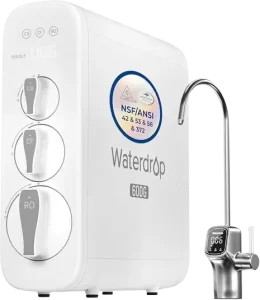
- Waterdrop G3P600: Fills a standard 8-oz cup in roughly 8 seconds. This is perfectly adequate for a glass of water or a coffee reservoir.
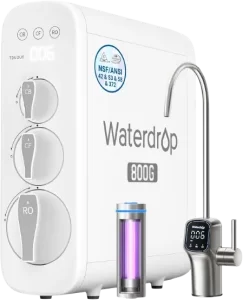
- Waterdrop G3P800: Fills the same cup in about 6 seconds. While a 2-second difference seems negligible for a single glass, it becomes significant during heavy kitchen usage.
Is 800 GPD Worth It?
For large family needs, the G3P800 comes out on top. If you fill frequently 2-quart pitchers, large pasta pots, or multiple sports bottles at a time, the high-flow RO eliminates the waiting game that slow units can cause. But if your water demand is mainly for drinking water and occasional tea, the water speed of the G3P600 is more than enough, and the G3P800 is a waste for smaller households.
Does the G3P800 Waste Less Water Than the G3P600?
The G3P800 is slightly more efficient, but the difference is relatively small in real-world use for the average household. In the world of reverse osmosis waste, efficiency is measured by the pure-to-drain ratio, which dictates how much wastewater is sent down the drain to produce one gallon of purified water.
Efficiency Comparison: 2:1 vs. 3:1
The RO efficiency of these two models represents the current gold standard for water conservation in tankless designs:
- Waterdrop G3P600: Operates at a 2:1 ratio, meaning it produces two gallons of pure water for every one gallon wasted.
- Waterdrop G3P800: Boasts a 3:1 ratio, producing three gallons of pure water for every one gallon wasted.
Real-World Impact on Water Saving
While a 3:1 water-waste ratio sounds much better than 2:1, the actual eco-efficiency benefit is based on your daily volume. For a family of three gallons of purified drinking water a day, the G3P600 wastes 1.5 gallons, and the G3P800 wastes one gallon. One year, the G3P800 saves about 180 gallons of water. Despite this win for water saving, you pay less than $5 a year on average on your utility bills. The G3P800 is the better choice for those looking for a strictly “green” home water system, but the G3P600 remains an extremely efficient filtration efficiency option compared to tank-based systems that waste 3 to 4 gallons per gallon saved.
Why Is the G3P800 More Expensive, and Is It Worth the Extra Cost?
The Waterdrop G3P800 costs more because it features a higher-output reverse osmosis membrane, an integrated smart faucet with a TDS display, and built-in UV sterilization. In a value comparison, the G3P800 is positioned as a premium “pro-grade” unit, whereas the G3P600 is designed as the high-performance standard for the average kitchen.
The Premium Features vs. Cost
The price gap is typically between $200 and $300, and it is justified by three specific hardware upgrades:
- Higher Flow Capacity: The G3P800 uses a larger membrane capable of 800 GPD. This is more expensive to manufacture but provides the highest cost efficiency for users who value time and faucet speed.
- Smart Monitoring: While both have system alerts, the G3P800 often includes a more sophisticated faucet interface, providing real-time water filter price and health data directly at the sink.
- Integrated UV Stage: This is the primary driver of the filtration cost increase. The UV light adds a physical layer of protection against biological contaminants that a standard RO membrane alone cannot provide.
Long-Term Value: Is It Worth It?
In most homes, the G3P600 is the better budget vs. premium option; chemical removal has a nearly identical filtration quality. But for a large family or high-volume kitchen usage profile where hours of wait time annually could be worth the investment, the G3P800 may be worth the investment. In addition to the long-term cost, the RO membrane for the 800 GPD model often lasts just as long as the 600 GPD version, so your system pricing pays off in durability and convenience.
How Do Installation and Maintenance Compare Between Both Systems?
Both systems have nearly identical RO installation and maintenance workflows because they share the same sleek, tankless design. Whether you choose the G3P600 or the G3P800, you are looking at a 30-minute DIY install that requires no professional plumbing experience.
The Installation Process
For both units, the plumbing setup is pretty basic with just three connections: The feed water adapter for your cold water line, the drain saddle, and the dedicated smart faucet. The G3P800 adds a small step to connect the power for the embedded UV sterilization module, but otherwise, the footprint and installation difficulty are the same. Both systems are extremely compact and use up to 70% of the under-sink system space that traditional RO tanks require.
Maintenance and Filter Lifespan
The ownership experience is where these systems truly shine. Both utilize a “twist-and-pull” filter change mechanism that takes only 3 seconds and requires zero tools.
- Filter Lifespan
The CF (Sediment/Carbon) filter lasts 6 months, the CB (Carbon Block) lasts 12 months, and the core reverse osmosis membrane lasts up to 24 months.
- Maintenance Cost
The annual maintenance cost of both systems is $140-$160. The slightly more expensive G3P800 membrane with 800 GPD capacity but interchangeable pre-filters across the G3 series, makes system upkeep predictable and easy on the wallet.
Is the UV Sterilization in G3P800 Actually Useful or Just Marketing?
The UV sterilization feature in the G3P800 is a highly effective safety layer, but its “usefulness” depends entirely on your specific water source. It is not just marketing; it is a specialized tool for microbial contamination that acts as a final fail-safe after the filtration process.
Well Water vs. City Water Relevance
- For Well Water Users
The UV stage is essentially a necessity. Private wells are not treated with chlorine and are susceptible to sudden bacteria removal challenges from runoff or groundwater changes. In this scenario, the RO UV filter provides critical protection against cysts, viruses, and bacteria that might bypass a compromised membrane.
- For City Water Users
If you are on a municipal system, your water is already chemically disinfected. In this case, the UV feature acts primarily as a “re-purification” step. It prevents biofilm from growing inside the internal lines of the system, a common issue in home filtration, where water may sit stagnant in the tubes for several hours between uses.
Water Safety
While the RO membrane itself is a formidable barrier, the UV light offers water safety that is independent of physical pore size. It works by scrambling the DNA of pathogens, rendering them harmless. If you live in an older building with questionable plumbing or simply want the highest tier of water purification UV available for your family, the G3P800’s integrated UV system is a valuable hardware upgrade rather than a hollow marketing gimmick.
Is a Higher GPD System Always Better for Home Use? (Myth-Busting)
No, a higher GPD rating does not mean the system provides better filtration performance or cleaner water. A common RO myth is “800 GPD is purer than 600 GPD.” In fact, GPD (Gallons per Day) is a measure of water speed and volume, not how many contaminants are removed.
Capacity vs. Quality
The filtration facts are simple: A 600 GPD and an 800 GPD system generally use the same multi-stage technology with a 0.0001-micron reverse osmosis membrane. The membrane pore size is identical, so water filter performance for lead, arsenic, and chlorine removal is the same. Higher GPD is obtained by either increasing the membrane surface area or increasing the power of the internal pump to force water through faster instead of “filtering harder.”
The Downside of Over-Sizing
In system sizing terms, bigger is not necessarily better. A high-capacity system is more expensive upfront and often has a higher filtration efficiency cost when maintained. Whether you are single or married, an 800 GPD system is “overkill”; you are paying for a GPD misunderstanding that will not affect your daily experience. Higher GPD is only “better” if you use your home water to fill large containers or serve a large family; otherwise, you want a 600 GPD unit for your water system selection.
Which Waterdrop System Should You Choose Based on Your Needs?
The decision between the G3P600 and the G3P800 comes down to balancing your daily water volume with your specific safety requirements. Choose the G3P600 for exceptional value and typical household use, and the G3P800 for higher demand or advanced microbial features.
Few profile examples for you
- The Budget-Conscious Family (2–4 People)
If you use your RO for drinking and coffee only and are on city water, the G3P600 is your RO system of choice. You get the same chemical and heavy metal removal as the premium model without paying for a flow rate you don’t need.
- The Large Household (5+ People)
For busy cooks who fill large pasta pots, humidifiers and gallon jugs for the gym, the G3P800 is the RO system for you. That extra 200 GPD saves time during peak meal prep hours.
- The Well Water Homeowner
The G3P800 is recommended for home water because well water does not have municipal chlorination. The integrated UV sterilization protects against bacterial spikes.
- The Eco-Minimalist
For sustainability, maximizing filtration choice is your goal; the G3P800’s 3:1 ratio is the best water drop comparison metric, sending the least water to the drain.
Does the Waterdrop G3P600 include remineralization, and does it matter?
No, there is no remineralization stage built into the Waterdrop G3p600; its focus is on total removal of contaminants. As RO filters strip away almost all water minerals, you may get a “flat” or slightly acidic filtration taste. Even though this does not affect the water quality for safety reasons, some users add an external remineralization postfilter to restore crisp, alkaline water balance.
How loud are the G3P600 and G3P800 during operation?
Both systems produce moderate pump noise during operation due to the internal motor driving water through the membrane without a storage tank. Normal home usage will produce a hum under the sink when the faucet is open; the G3P800 is slightly louder due to the larger RO pump inside. The appliance noise is comparable to a quiet dishwasher but much more pronounced than traditional, non-electric tank systems, users say.
How long do filters last in G3P600 vs G3P800?
Both systems use a similar replacement schedule to ensure filter durability. The sediment/carbon CF filter lasts 6 months; the Activated Carbon CB lasts 12 months, and the high efficiency RO membrane lasts 24 months. Although the pre-filter cost is the same as $30 each, the 800 GPD membrane costs slightly more than the 600 GPD and thus marginally raises the system upkeep cost for the G3P800 over a period of time.
Can you upgrade from G3P600 to G3P800 later?
No, you cannot swap filters to make a g3P600 a g3P800. They’re independent filtration upgrade systems with separate internal pumps and power requirements. Although they share similar system compatibility for pre-filters, the G3P800’s housing is sized for a larger membrane and includes integrated UV circuitry. If you plan to upgrade the RO model’s flow rate or the UV protection later on, you can just buy the G3P800 now and not have to replace the whole system.
Is the Waterdrop G3 series suitable for well water?
Yes, the G3 series can be used with well water filtration as long as the water source has adequate pre-filtering for heavy sediment & iron. Large particle sizes and high iron levels can prematurely clog the RO membrane and shorten its life. Installing a dedicated spin-down sediment filter and an iron-removal stage before the RO unit is necessary for a good well water system setup, and no need for frequent maintenance.

