
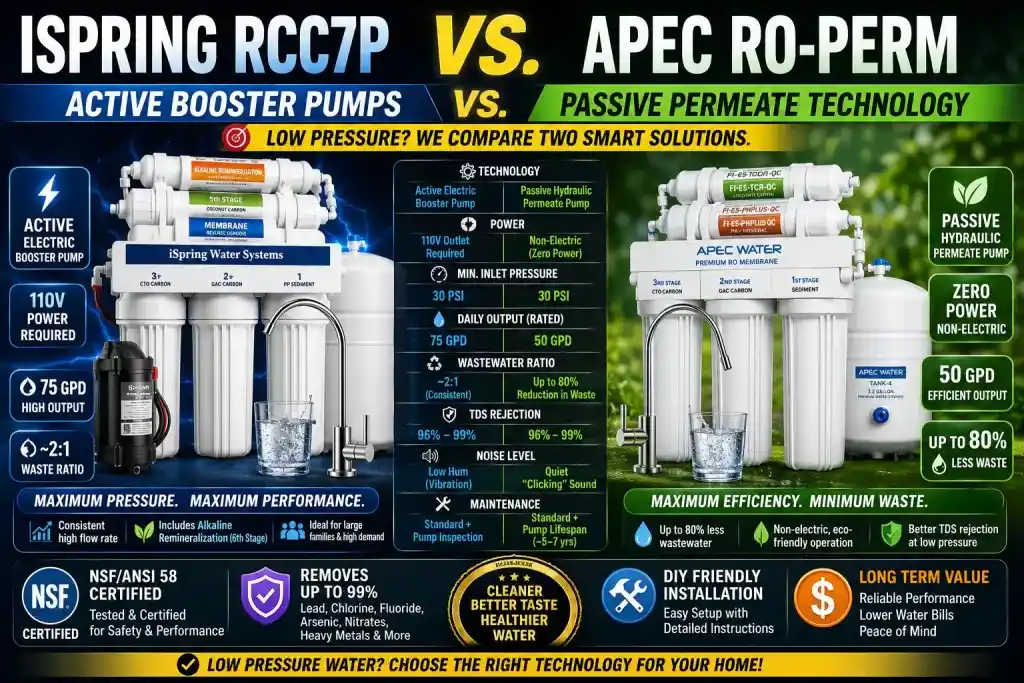
Standard reverse osmosis systems suffer a massive performance drop when feed water pressure falls below 40 PSI, leading to slow tank refills and excessive water waste. To do this, the iSpring RCC7P and APEC RO-PERM use two different engineering approaches. ISpring RCC7P uses an active 24V electric booster pump to physically increase the water pressure entering the system to achieve maximum performance regardless of home plumbing. The APEC RO-PERM, however, uses a zero-watt passive hydraulic permeate pump that draws energy from the wastewater to relieve backpressure on the RO membrane. This active versus passive trade-off is important for households on private wells or older municipal areas where pressure is low or variable.
Performance Comparison Table
| Feature | iSpring RCC7P | APEC RO-PERM |
|---|---|---|
| Technology Type | Active Electric Booster Pump | Passive Hydraulic Permeate Pump |
| Power Requirement | 110V Outlet Required | Non-Electric (Zero Power) |
| Min. Inlet Pressure | 30 PSI | 30 PSI |
| Daily Output (Rated) | 75 GPD | 50 GPD |
| Wastewater Ratio | ~2:1 (Consistent) | Up to 80% reduction in waste |
| TDS Rejection | 96% – 99% | 96% – 99% |
| Noise Level | Low Hum (Vibration) | Quiet "Clicking" Sound |
| Maintenance | Standard + Pump Inspection | Standard + Pump Lifespan (~5-7 yrs) |
| Current Price | Check Price | Check Price |
The iSpring RCC7P supports raw power. The increased pressure at the start of the process forces water through the 0.0001-micron TFC membrane very fast. This makes for the most consistent flow and fastest tank refill time in its class.
The APEC RO PERM is an efficiency guru. And its permeate pump keeps the storage tank’s “backpressure” from slowing down the filtration process as the tank fills. This fills the tank to a greater capacity and increases the wastewater ratio without plugging into a wall. The tactical choice is the APEC, a silent, eco-friendly solution that lowers your water bill. Want the best flow rate and an outlet? The iSpring is a heavy-duty winner.
How Does the RCC7P Electric Pump Differ from the APEC Hydraulic Drive?
The primary difference between these systems lies in how they manipulate water pressure to overcome the resistance of the reverse osmosis membrane. While both are designed for low-pressure environments, the iSpring RCC7P uses an active, external power source, whereas the APEC RO-PERM relies on the internal physics of the water flow itself.
iSpring RCC7P: Active Electric Pressure Boosting
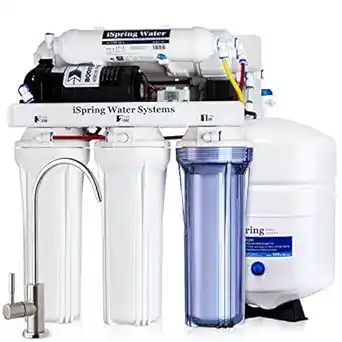
A dedicated 24V electric booster pump pumps up the feed pressure before water reaches the membrane of the RCC7P. The system pushes the water molecules as fast as possible through the TFC membrane by increasing the inlet pressure often to the ideal 80 PSI. This gives the maximum daily production with a constant low wastewater ratio. But being an electric motor, the RCC7P needs a 110V under-sink outlet, and there is a slight but persistent motor hum during the filtration cycle.
APEC RO-PERM: Passive Hydraulic Efficiency
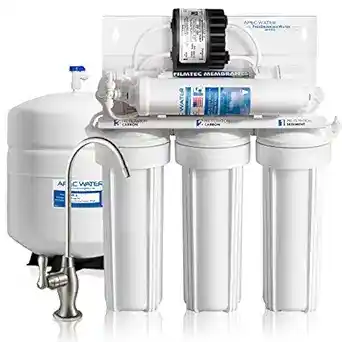
The RO-PERM uses a non-electric hydraulic permeate pump. Instead of pumping up the incoming water, this pump uses energy in the “brine” of wastewater going for the drain to push the “permeate” of pure water into the storage tank. This eliminates “backpressure” that a filling tank normally creates on the membrane, and the system behaves as though it were filling an empty tank almost full. The RO-PERM requires no electricity and can be used either off-grid or under the sink. It operates almost silently operation-wise, but users may experience a soft thudding or clicking as the hydraulic piston cycles.
Which System Achieves Better TDS Rejection at Low Feed Pressure?
In low-pressure environments, the APEC RO-PERM generally maintains a slight edge in filtration purity over the iSpring RCC7P, but both systems outstrip standard non-pump units. In technical terms, the APEC has an average TDS rejection rate of 98-99%, and the iSpring has a rejection rate of 95-97%. This is due to how each pump acts with the osmotic pressure of the RO membrane and “TDS creep.”
Pressure vs. Backpressure
The iSpring RCC7P pumps its electric booster pump to raise the inlet pressure to ram water through the membrane. This increases output but does not change the “backpressure” created as the storage tank fills. In contrast, the permeate pump of the APEC RO PERM isolates the membrane from tank pressure. Without this backpressure, the membrane operates at a higher net pressure differential, so it rejects salts more effectively even when the storage tank is nearly full.
Combatting TDS Creep
One of the biggest hurdles in low-pressure RO is TDS creep, the gradual rise of dissolved solids in the “idle” water sitting inside the membrane housing.
- The APEC Advantage: Since the permeate pump permits the system to achieve shut-off pressure more quickly and decisively, the membrane is allowed to sit in a high-concentration brine environment for less time.
- The iSpring Approach: The booster pump ensures high rejection while running, but if your home’s baseline pressure is extremely low, the system may cycle more frequently to keep the tank topped off, leading to more “start-up” water with slightly higher TDS levels.
For example, if your tap water is at 300 ppm, the RO-PERM might consistently deliver water at 3–6 ppm, whereas the RCC7P might oscillate between 9–15 ppm depending on how recently the tank was emptied.
Does the APEC RO-PERM Significantly Reduce Wastewater Ratios?
The APEC RO-PERM is one of the most water-efficient traditional RO systems on the market, achieving a wastewater ratio of roughly 1:1 to 1:1.5. This is a massive improvement over standard units, which often waste 3 to 5 gallons for every gallon of pure water produced.
The Efficiency of Hydraulic Isolation
Backpressure is the reason standard RO systems are so wasteful. The internal air bladder pushes back against the membrane as a storage tank fills with water. At 80% capacity, a standard system could be wasting water at a 10:1 ratio by the time the tank is full. 1 or 20: To top off those last few ounces, 1 ratio. The hydraulic pump on the RO-PERM solves this problem by isolating the membrane from the tank pressure and making the RO-PERM work as if it were filling an empty bucket, even when the tank is almost full.
Real-World Impact
- Monthly Savings: For a family using 3 gallons of RO water a day, switching from a standard 4:1 system to the RO-PERM can save over 300 gallons of water per month.
- Septic & Well Protection: If you are on a private well, this 80% reduction in waste significantly lowers the load on your pump and prevents your septic drain field from being unnecessarily saturated with “reject” water.
- Consistency: Unlike the iSpring RCC7P, which uses an electric pump to maintain a steady ~1:2 ratio, the APEC’s passive design naturally adjusts to your usage, offering the lowest waste profile available in a non-electric unit.
Why Does the iSpring RCC7P Offer Better Mineralization for Well Water?
The iSpring RCC7P-AK is specifically engineered for low-pressure well water environments where neither pressure nor water chemistry is a common issue. While reverse osmosis is highly effective at removing contaminants, it also strips away the natural minerals that give well water its character, often leaving the output slightly acidic and “flat.”
The 6th Stage: Alkaline Remineralization
Unlike the standard APEC RO-PERM, which is a 5-stage system focused on pure, mineral-free output, the iSpring RCC7P-AK includes a dedicated alkaline remineralization stage.
· Mineral Restoration: As the water passes through this 6th stage, it interacts with a blend of calcite (calcium carbonate) and red mineral stones. This process reintroduces essential calcium and magnesium back into the water.
· pH Correction: Well water often has a lower baseline pH. Standard RO can drop this further to 6.0 or below. The iSpring’s AK filter acts as a buffer, raising the pH level to a balanced 7.5–8.5, which neutralizes acidity and mimics the taste of natural spring water.
Why It Matters for Well Users
For well water users, an electric booster pump with remineralizing stage is “the best of both worlds.” The pump provides the pressure to filter out heavy metals or nitrates that are common in rural areas, and the mineral stage prevents the purified water from being corrosive to your teeth or plumbing. If you would like the APEC RO PERM but need this feature, you would need to buy an add-on APEC pH + filter kit, which is not included in the base 5-stage configuration.
Are DIY Installers Experiencing More Leaks with iSpring or APEC Fittings?
When it comes to the “drip factor,” DIY installers report different challenges for each brand. While neither system is inherently prone to failure, the iSpring RCC7P and APEC RO-PERM have specific mechanical vulnerabilities that often lead to leaks if not handled with care during setup.
iSpring: The Challenge of Side-Loading Stress
User reports on Amazon and Reddit indicate that iSpring systems are more susceptible to leaks caused by side-loading stress. Because iSpring often uses lighter-weight plastic elbow fittings on its filter housings, any tension from misaligned or overly tight tubing can pull the fitting at an angle, breaking the internal O-ring seal.
iSpring includes blue locking clips for its John Guest-style fittings. Many DIYers skip these, which can lead to the tubing slowly backing out over time, especially during the high-pressure surges of an electric booster pump cycle.
APEC: Housing Precision and PTFE Application
This APEC RO-PERM is described as having thicker, “industrial-feeling” housings but still susceptible to leaks. The common failure points of APEC are usually related to housing O-rings/threaded connections.
- O-Ring Compression: If the O-rings aren’t properly lubricated (with food-grade silicone) or if the housing is cross-threaded even slightly, the APEC can develop a slow, persistent drip.
- PTFE Tape Mistakes: APEC’s manual is very specific about PTFE tape application on threaded parts like the tank ball valve. DIYers often use too little tape or wrap it in the wrong direction, leading to seeps that only appear after the system reaches full pressure.
Warning: Before you finalize your install, place a dry paper towel under both the drain saddle and the main unit. Run the system for 20 minutes and check for even a single damp spot; it’s much easier to fix a loose fitting now than to deal with a warped kitchen cabinet a month later.
What Are the Annual Maintenance Costs for Electric vs. Hydraulic RO?
The long-term cost of ownership for these systems is surprisingly competitive, though their “bundle strategies” differ. For the iSpring RCC7P, you should budget approximately $85–$95 per year, while the APEC RO-PERM runs slightly higher at $110–$130 per year.
The Filter
The price difference largely stems from filter availability and membrane costs.
- iSpring Bundle Savings: iSpring is highly aggressive with its “multi-year” filter packs. You can often find a 3-year replacement bundle for about $160, which drops your effective annual cost under $60. Furthermore, iSpring’s standard 10-inch filters are universally sized, allowing you to use cheaper third-party alternatives if needed.
- APEC Ultimate Series: The RO-PERM uses APEC’s “Ultimate Series” filters, which are higher-capacity and 100% US-made. While these filters last a full 12 months even in harsh water, they command a premium price; a full 5-stage replacement set typically costs around $125.
Mechanical Longevity
The pump types create other long-term risks beyond the filters. The iSpring electric booster pump lasts about 5-8 years; a replacement pump costs $80. No electrical parts are to burn out in the APEC hydraulic permeate pump, but internal moving diaphragms may wear out after 7 to 10 years. Because the APEC is non-electric, you save about $5-$10 per year on electricity, which covers its slightly higher filter price over a 10-year period.
Which Brand Provides Superior Customer Support for Pump Troubleshooting?
Instant help when a pressured system starts making odd noises like ASO valve chatter or stutter pump is critical compared to APEC in response speed and live troubleshooting access. iSpring consistently beats APEC in both response speed and access to live troubleshooting.
ISpring offers live chat and phone support from the US with technicians who can set up an electric booster pump right away. Their video support is especially strong; they’ll send links to particular YouTube walkthroughs of pump priming or pressure switch settings.
APEC instead works on a documentation-first basis. Their written manuals and online troubleshooting guides rank among the best in the business, but human interaction is limited to email or a formal ticketing system. This can result in a 24-to 48-hour delay if stuck midway through installation. For the beginner DIYer, iSpring gives you immediate access to a technician for mechanical troubleshooting that APEC’s static guides cannot provide.
APEC RO-PERM vs. iSpring RCC7P: Which Should You Buy?
Choosing between the APEC RO-PERM and the iSpring RCC7P depends on whether you value mechanical simplicity or high-flow performance. For households with low water pressure (under 40 PSI), the choice is rarely “which is better” but rather “which engineering solution fits your home.”
- The Eco-Conscious or Off-Grid Home: Do you need no electrical outlet under your sink, or do you want to save on your water bill? Buy the APEC RO-PERM. The non-electric permeate pump reduces wastewater by 80% over standard units. It is the best option for private well owners who wish to avoid excessive volume entering their pump and septic field.
- The Large Family Needing Speed: For a busy kitchen with an available 110V outlet, buy the iSpring RCC7P. The electronic booster pump provides a constant 75 GPD output despite home pressure variations. In addition, the RCC7P version has remineralization step to solve the “flat taste profile” of rural wells.
- The Purity Purist: For primary use, the APEC RO-PERM gets you that low TDS reading. Its hydrostatic design isolates the membrane from tank backpressure and allows it to achieve 98-99% rejection rates that powered systems can not maintain as the tank fills.
If your home pressure is consistently above 60 PSI, neither of these “pumped” models is necessary. In high-pressure environments, a standard APEC ROES-50 or iSpring RCC7 will perform perfectly without the added complexity of a booster or permeate pump.
How does the ERP-1000 permeate pump improve RO efficiency?
The ERP-1000 permeate pump uses the hydraulic energy of the wastewater stream to physically isolate the RO membrane from the backpressure of the storage tank. The internal air bladder pushes back when the tank fills in a standard system, causing slower filtration and more waste. Because the “brine” flow drives a small internal piston, the permeate pump permits the membrane to operate near-atmospheric pressure regardless of tank capacity. This allows for quicker fill rates, better water purity & up to 80% wastewater reduction with just one watt of electricity consumption.
How can I fix booster pump vibrations and noise?
While some slight hum is normal for the iSpring RCC7P operation, excessive vibration or “knocking” is usually caused by surface resonance or loose components. As a mechanical motor, the pump may vibrate against the cabinet floor or transfer energy through plastic tubing when touching a hard surface. To fix this: Mount the pump on its rubber vibration-damping feet or place a special rubber mounting pad beneath the unit. Also, check that all John Guest fittings are secured, and the tubing is clipped to prevent “pipe chatter” during high-pressure cycles.
Can high iron levels damage my pump-driven RO system?
High iron levels threaten pump-driven systems for well water users. Dissolved iron can quickly “foul” the RO membrane and stick inside the valves of an electric booster pump or the piston of a permeate pump. That buildup leads to a permanent drop in PSI and can cause the pump to seize. Should your well water have a metallic taste or leave orange stains, you must install pre-filtration, like a manganese greensand or specialized sediment filter, to protect your RO investment.
What is the significance of NSF/ANSI 58 for high-pressure systems?
The NSF/ANSI 58 certification is the industry’s gold standard, verifying that an RO system can safely withstand internal pressure while effectively reducing contaminants like lead and arsenic. This is particularly crucial for boosted systems where the pressure is artificially increased, putting more stress on the housings and fittings. When using an APEC RO-PERM, it is important to note that the rhythmic “clicking” or “thumping” sound you hear is the hydraulic pump cycling; it is a sign of a healthy, certified system working correctly, not a mechanical defect.

