
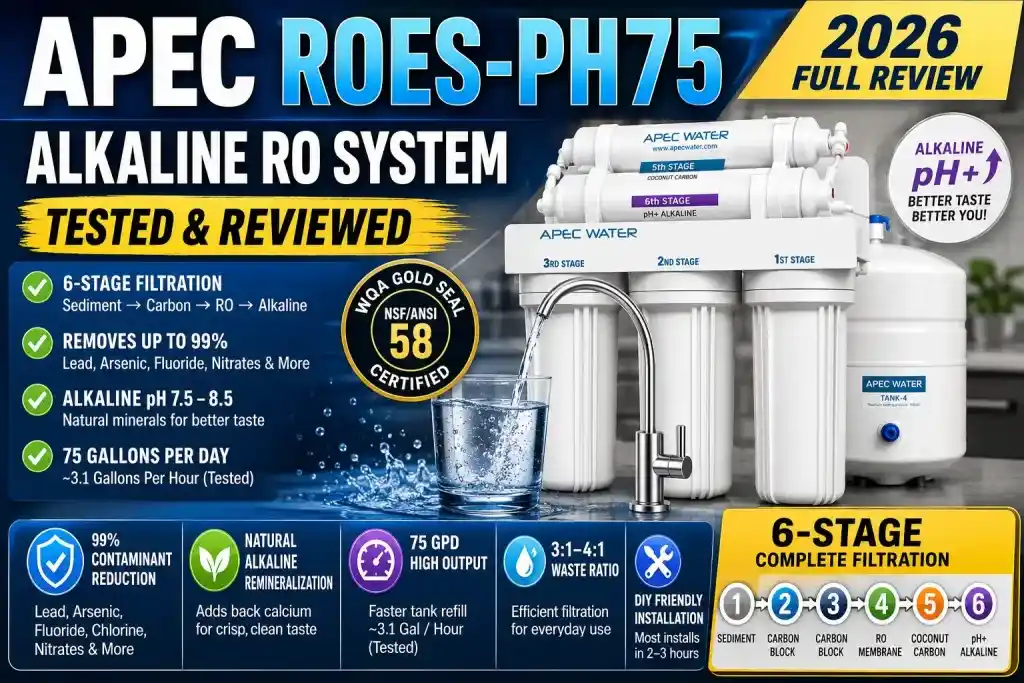
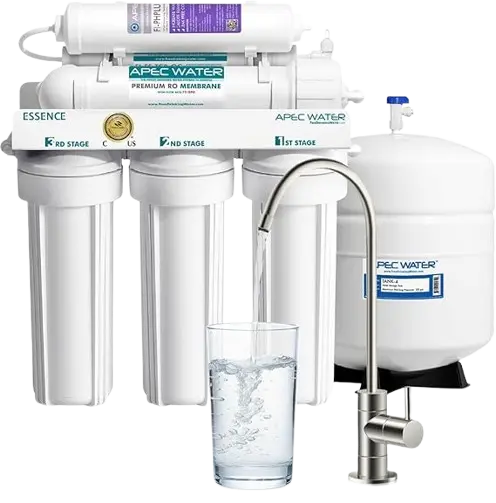
The APEC ROES-PH75 is a 6-stage under-sink reverse osmosis filtration system featuring an alkaline remineralization stage and a production capacity of 75 gallons per day (GPD). While standard RO methods are usually criticized for creating “flat” or maybe somewhat acidic water, the ROES is created to bridge the gap between high-purity filtration and an all-natural spring water taste. It relies on a typical TFC (Thin Film Composite) membrane to strip away as much as 99% of contaminants, followed by a food-grade calcium carbonate filter, which reintroduces essential minerals to balance the water’s pH.
This product is a main option for homeowners who wish to take out heavy metals such as lead and arsenic, but discover the flavor of fresh RO water unappealing. By incorporating the remineralization stage right into the 6-stage process, APEC targets those searching for an “alkaline” experience without the high cost of standalone ionizers. Tested in 2026 real-world settings, the device keeps a consistent output, although its footprint and wastewater ratio stay characteristic of classic tank-based designs.
APEC ROES-PH75 Technical Specs
| Feature | Specification / Test Metric |
|---|---|
| Filtration Stages | 6 Stages (Sediment, 2x Carbon, RO, Coconut Carbon, pH+) |
| Membrane Capacity | 75 GPD (Tested ~3.1 Gallons per Hour) |
| Tank Capacity | 4.0 Gallon Pressurized Tank (Holds ~2.8–3.2 gal) |
| Waste Water Ratio | ~3:1 to 4:1 (Feed pressure dependent) |
| Remineralization | Calcite pH+ Calcium Carbonate Filter |
| TDS Reduction | 93% – 97% (Average Tested) |
| pH Enhancement | Increases pH by 0.5 – 1.2 (Tested 7.5 – 8.5 range) |
| Certifications | WQA Gold Seal to NSF/ANSI 58 |
| Warranty | 2-Year Limited (with registration) |
| Current Price | Check Price |
What Filtration Stages Does the APEC ROES-PH75 Use and How Do They Work?
The APEC ROES-PH75 uses a six-stage process to transform tap water into high-purity alkaline water. While the “six-stage” label sounds impressive, it is important to understand that the stages work as a team: the first three protect the system, the fourth does the heavy lifting, and the final two refine the taste.
The Sequential Pathway
Stage 1: Sediment Pre-Filter (5 Micron)
This is your “bodyguard.” It holds large particles such as rust, dust, and silt! Catching these early prevents costly internal filters from logging.
Stages 2 & 3: Double Carbon Blocks (100 Micron)
In these stages, activated carbon “soaks up” chlorine, bad odors and cloudiness. By using 2 blocks in a row, all of the chlorine is removed before it can reach the RO membrane and damage it.
Stage 4: High-Rejection RO Membrane 0.0001 Micron
This is the core of the system. It rejects up to 99% of the dissolved solids, such as lead, nitrates, arsenic, and fluoride, via a semipermeable membrane incorporating microscopic pores.
Stage 5: Coconut Shell Refining Carbon
After sitting in the storage tank, water passes this last carbon stage to polish the flavor and remove any remaining “tank taste.”
Stage 6: pH+ Alkaline Remineralization
Since RO water is slightly acidic by nature, this stage also adds food-grade calcium carbonate back into the water. This raises the pH & restores the crisp mineral taste of natural spring water.
Many people believe that more stages equal cleaner water. Indeed, the RO membrane does virtually all the purification work. The remaining stages serve only to protect that membrane and make sure the end product tastes great.
Does the APEC ROES-PH75 Actually Produce Alkaline Water?
Yes, the APEC ROES is created especially to create alkaline water, though it is crucial to recognize the “how” and “why” behind the chemistry.
Regular reverse osmosis (RO) water is usually somewhat sour, frequently measuring between pH. 5.5 and 6.5. This occurs because the purification procedure is very successful; it strips away the natural nutrients, which typically act like a “buffer.” Without those nutrients, the water quickly absorbs carbon dioxide out of the atmosphere, which becomes vulnerable carbonic acid and drops the pH.
The Role of the Mineral Cartridge
The “PH” in this system’s name refers to the sixth stage: the calcite remineralization filter. As the purified water leaves the storage tank, it flows through an alkaline mineral cartridge filled with food-grade calcium carbonate (derived from crushed marble or limestone).
- pH Shift
This contact adds a controlled amount of calcium back into the water, typically raising the RO water pH level to a range of 7.5 to 8.5.
- TDS Impact
Because the minerals are being added back in, your total dissolved solids (TDS) reading will increase somewhat (10-30 ppm) over “pure” water coming out of the membrane in stage four.
The result is more pH than that. It is water that has a more “rounded” taste. While this system isn’t an electric water ionizer that uses electrolysis, it does solve the problem that RO water tastes too empty or too sharp.”
What Contaminants Can the ROES-PH75 Remove From Drinking Water?
The APEC ROES-PH75 is designed for heavy-duty RO contaminant removal, stripping away a vast library of impurities that are common in both city and well water. Its fourth stage, the high-rejection TFC reverse osmosis membrane, is used to achieve a TDS rejection rate of up to 99%.
The Heavy Hitters
Because the RO membrane has pores as small as 0.0001 microns, it blocks particles thousands of times smaller than a human hair. That means it is very effective for:
- Arsenic and Fluoride Reduction
They are two of the hardest contaminants to remove. More than 93-99% arsenic filtration and significant fluoride reduction are certified with the ROES-PH75.
- Lead Removal
It is an ideal RO system for older homes because lead is always blocked from reaching your faucet.
- Nitrates & Heavy Metals
It removes chromium, radium, and barium from groundwater.
Modern Threats and Chemicals
Beyond minerals, the two carbon block stages (stages two and three) work like a substance sponge. They normally use adsorption to remove chlorine, volatile organic compounds (VOCs), and herbicides. Recently, there’s been growing concern over “forever chemicals” as PFAS and pharmaceutical residues. Because these particles are big enough to be found by the membrane or perhaps caught by the activated carbon, the ROES provides a great defense against these emerging risks.
By taking out the great bulk of dissolved solids, the device guarantees that your water is as clean as you can get prior to the last phase, which gives the “good” minerals back in for taste.
How Does the ROES-PH75 Perform in Real-World Household Usage?
In a typical home, the APEC ROES-PH75 is designed to keep up with the drinking and cooking needs of a family of 3 to 4 people. While it is technically a 75 GPD RO system (gallons per day), that number is a laboratory rating based on perfect conditions: 77°F water and 65 PSI of pressure. In a real kitchen, where water is colder and pressure is often lower, you should realistically expect a reverse osmosis output rate of about 40 to 60 gallons over a 24-hour period.
The Role of the Storage Tank
Because RO filtration involves slow “drips,” the system includes a 4-gallon pressurized storage tank. This tank ensures you turn on the faucet and get instant water flow.
- Refill Time: Once you drain the tank completely (filling large pots or multiple pitchers), it takes 2 to 3 hours to refill completely, depending on your home water pressure.
- Usable Water: It is a 4-gallon tank, but the air bladder inside takes up space, so you have about 2.5 to 3.2 gallons of actual water on hand at all times.
Pressure Dependency
Your water pressure RO system performance is very important. The ROES-PH75 requires at least 40 PSI for operation. When the pressure in your home is less than that, which is common in older apartments or homes on a well, the system will run very slowly and pour more water down the drain. Low-pressure homes may add a “permeate pump” to speed up the output and keep the tank full.
How Easy Is It to Install the APEC ROES-PH75 Under a Kitchen Sink?
Installing the APEC ROES-PH75 is a standard DIY project that typically takes between 2 and 3 hours for a first-timer. While the box includes a detailed RO system installation guide, there are five specific plumbing connections that require a steady hand and a few basic tools, like a drill and an adjustable wrench.
The Five Key Connections
- Feed Water Valve
You connect a cold water supply line adapter. Often seen here, a valve is not fully piercing the line or is too tightly tightened, causing slow drips.
- Faucet Mounting
Install the dedicated chrome faucet over your sink. Without a pre-drilled hole like an extra sprayer hole, you will drill through your countertop or sink rim, a step that many beginners fear.
- Storage Tank
Your RO tank connects to your sink via one yellow tube under your sink. This is the easiest part, but it takes up a lot of “real estate” in your cabinet.
- Drain Saddle
Probably the most critical component in an under-sink RO installation. You drill a little hole in the drain pipe and then wrap the drain saddle RO around it. Not having the gasket over the hole properly causes it to leak.
- Tubing Lines
Color-coded tubes and John Guest quick-connect fittings are used in the system. Push the tube in till it locks. Most of the “leaks” reported in reviews are tubes not pushed in far enough to the inner O-ring.
Documented Installation Friction
Most DIYers on forums say saddle placement is the biggest headache. If you install the drain saddle too low or too close to a garbage disposal, you may hear a “gurgling” noise or have frequent clogs. Also important is ensuring the feed valve is fully seated; otherwise, the system won’t build up enough pressure to fill the tank.
What Maintenance and Filter Replacements Does the ROES-PH75 Require?
Keeping the APEC ROES-PH75 running effectively requires a consistent RO filter replacement schedule. Because this is a 6-stage system, different filters wear out at different speeds. Neglecting the early stages can allow sediment or chlorine to reach the expensive RO membrane, significantly shortening its life.
The Standard Maintenance Schedule
| Filter Stage | Filter Type | Replacement Interval |
| Stages 1, 2, & 3 | Sediment & Carbon Pre-filters | Every 6–12 Months |
| Stage 4 | High-Rejection RO Membrane | Every 2–3 Years |
| Stage 5 | Post-Carbon Polishing Filter | Every 2–3 Years |
| Stage 6 | pH+ Alkaline Mineral Filter | Every 6–12 Months |
Factors That Affect Your Filter Lifespan
- Sediment Levels
If you have a well or live near old city pipes, you may only need to change your sediment filter every 4-6 months. If your first-stage filter looks brown or black, swap it out.
- Water Hardness
Increasing calcium and magnesium content (hard water) may cause scale buildup on the RO membrane life. If you notice the water tank takes longer than 3 hours to refill, the membrane may be scaled over and needs early replacement.
- Usage Volume
The 6-12 month guideline assumes average household use (3-5 gallons a day). For large families or indoor gardening that uses much more, choose the shorter end of the replacement window.
Though the membrane and post-carbon filter may last three years on average, APEC recommends replacing the O-rings in the filter housings every few years to prevent leaks during a routine filter change.
How Much Water Does the ROES-PH75 Waste During Filtration?
Reverse osmosis is obviously a “rinse” procedure, meaning the device must utilize a little water to clean away contaminants so that they do not clog the membrane. For the APEC ROES, the usual RO wastewater ratio is about 3:1. What this means is that for each 1 gallon of purified drinking water you receive, approximately 3 gallons of RO drain water are sent down the sink’s drain pipe.
Yearly Water Usage and Efficiency
If the three gallons wasted for each one used sounds high, here’s how it affects your utility bill. A typical family of four uses 3 gallons of drinking and cooking water per day. At a 3:1, this converts to roughly 9 gallons of waste per day, or 3,300 gallons per year. It costs less than $15 to $20 on your annual water bill in most U.S. cities, less than the price of one bottled water pack.
Factors That Affect Waste
Your home environment plays a big part in your reverse osmosis efficiency.
- Water Pressure
When your pressure is low (40 PSI), the waste ratio may reach 4:1 or higher. The process is much more efficient at higher pressures (> 60 PSI).
- Water Temperature
RO membranes function more slowly in cold water and may require slightly more rinse water.
- Comparison
Newer, higher-end tankless RO systems can even achieve a 1:3 ratio, but older RO systems can only achieve a 1:1 or even a 2:1 ratio. They tend to be much more expensive upfront and use electricity to run their internal pumps. The ROES-PH75 is for many a compromise between cost and conservation, a reliable middle ground.
What Certifications and Quality Standards Does the ROES-PH75 Meet?
The APEC ROES-PH75 is made and tries to meet several of the largest impartial standards in the bath treatment sector. The device has the WQA Gold Seal Certification, which is a prestigious mark from the Water Quality Association. This is not only a “quality sticker”; it indicates the device has undergone weeks of rigorous lab tests to confirm that it really does exactly what the box states it’ll do
The NSF/ANSI 58 Standard
The core of its performance is the NSF ANSI 58 RO system standard. This is the American National Standard for point-of-use reverse osmosis systems. When a system meets this standard, it is proven in three key areas:
- Material Safety
Every plastic housing, tube, and O-ring that touches your water is tested for leaking chemicals like BPA or lead into your drinking water.
- Structural Integrity
The system is put through high-pressure “stress tests,” so it won’t pop out or leak in the kitchen cabinet.
- Contaminant Reduction
The specific rejection rates for arsenic, fluoride, and lead are verified with the RO system testing standard. For example, the arsenic rejection rate of this model was confirmed by WQA testing at 99%.
Why These Standards Matter
Unlike uncertified makes, the WQA gold seal certification guarantees that APEC’s production facility is audited annually to keep these high standards. It offers a quality of water safety you cannot get from a system that merely promises to be “built with NSF-compliant parts.” By meeting these benchmarks, the ROES gives homeowners documented evidence that their water is now being purified to an expert, lab-verified level.
What Are the Real Pros and Cons of the APEC ROES-PH75?
The APEC ROES-PH75 is widely considered the “standard” against which other alkaline RO review models are measured. While it consistently ranks as a top seller in 2026, it is not without its flaws. Understanding the RO system’s pros and cons depends on whether you value simple, proven technology over modern, high-tech convenience.
Pros
- Superior Flavor Profile
The biggest benefit is during remineralization phase. With calcium back in the water, the standard RO water no longer tastes bitter or acidic, like premium bottled spring water.
- Industry-Leading Reliability
It has fewer parts to break because it is a traditional non-electric design. The ‘Essence’ series lasts 10+ years with simple filter changes.
- Massive Contaminant Rejection
This is not about taste alone. The WQA Gold Seal certifies stripping out up to 99% lead, arsenic, and fluoride to hospital-grade purity before adding back the minerals.
- Low Maintenance Cost
Instead of proprietary twist-lock systems, this unit uses standard 10-inch vertical filters, much cheaper and easier to find from multiple brands.
Cons
- The “Cabinet Hog”
It is a big system with six vertical filter housings & a 4-gallon RO tank! With a deep sink or garbage disposal, it’s a squeeze.
- Slower Recovery Time
Compared with modern tankless RO units, which produce 800 GPD, this 75 GPD system runs slowly. A large family that fills a 2-gallon pot with pasta will fill the tank about 2 hours later.
- Wastewater Generation
The 3:1 waste ratio is higher than on the newer eco-friendly models. The cost is low, but environmentally conscious buyers may find the drain water hard to justify.
- Hard Water Clogging
A common complaint in hard-water regions is that the mineral cartridge can clog or scale over, and the water flow will slow to a trickle before the year is up.
Who Should Buy the APEC ROES-PH75 and Who Should Choose a Different RO System?
The APEC ROES-PH75 is a top-tier under-sink RO recommendation for many, but it isn’t a universal “perfect” fit. Your RO system buying decision should be based on your household’s daily water volume, your kitchen’s storage space, and your personal taste preferences.
The Three Best-Fit Buyer Profiles
- The “Spring Water” Enthusiast
If you find standard purified water tastes “flat” or “empty,” this is the system for you. This alkaline RO buyer guide pick is specifically designed for people who want the safety of reverse osmosis but the crisp, rounded mouthfeel of bottled alkaline brands.
- The Reliability Seeker
If you want a system that works without electricity, apps, or complex sensors, the ROES-PH75 is worth it. Its non-electric, traditional tank design has fewer points of failure than high-tech units, making it ideal for those who want a “set it and forget it” solution.
- The Well Water Homeowner
Because it uses standard-sized vertical filters, this system is highly adaptable. Well owners who deal with varying sediment load or occasional sulfur smells can easily find specialised 10-inch pre-filters to fit this housing, which is harder to do with proprietary “twist-and-lock” brands.
Who Should Choose a Different System?
While the ROES-PH75 is excellent, you should look elsewhere if:
- You Have a Very Large Family
If you have 6+ people regularly filling large pots for cooking, a 75 GPD system may struggle to keep the tank full. In this case, a 100 GPD or a high-capacity tankless system like the Waterdrop G3P800 would be a better choice for faster output.
- You Have Zero Cabinet Space
If your under-sink area is cramped with a garbage disposal and a pull-out trash bin, the bulky 4-gallon tank may not fit. You should opt for a compact tankless RO design instead.
- You Want Instant Flow
If you hate waiting for a tank to refill after heavy use, a tankless system provides an unlimited, on-demand stream that a traditional tank-based system simply cannot match.
How does the ROES-PH75 compare to the APEC ROES-50?
The primary difference between the two is the remineralization stage and total water output. The ROES 50 is a traditional 5-stage process that creates fresh but “flat” water with an everyday capacity of fifty gallons. The ROES gives a 6th stage, a basic mineral cartridge, which restores calcium to enhance taste and also raises the pH. Furthermore, the PH75 comes with a greater 75 GPD output, enabling it to refill the storage container about 50% faster than the budget-friendly ROES 50.
How does the ROES-PH75 compare to the iSpring RCC7AK alkaline RO system?
Both systems are 6-stage units that use calcite remineralization to produce alkaline water, and both carry the NSF/ANSI 58 certification. But the iSpring RCC7AK is cited in 2026 reviews as having a slightly higher flow rate (rated at 75 GPD but testing faster in low-pressure homes) and transparent first-stage housing for easier filter monitoring. Usually a higher price but often favored due to its “heavy-duty” US-assembled parts and leak-free performance, the APEC ROES PH75 is also known to be leak-free.
What is the difference between tank and tankless reverse osmosis systems?
Traditional tank systems like the ROES-PH75 filter water slowly and store it in a pressurized 3-to-4-gallon tank so it’s ready when you turn the faucet. Tankless systems have a powerful internal pump that filters water as you pour it. Tankless designs use 70% less space, and there is no longer any “stale” water in a tank, but they do require an electrical outlet and tend to be more expensive to replace if the internal pump goes bad.
How long do reverse osmosis systems typically last?
With routine maintenance, a high-quality RO system can last 10 to 15 years. Plastic filter housings and metal storage tanks are very tough, but moving parts like the automatic shut-off valve may need to be replaced after a decade. To reach this RO system lifespan, you need to swap your sediment and carbon filters once a year and replace the RO membrane every 2-4 years. When this inner rubber bladder begins to lose pressure, the tank itself will need to be replaced sometime between 7 and 10 years old.
When should you consider a high-flow or commercial RO system instead?
You should consider a high-flow RO system if your household consumes more than 20 gallons of purified water daily or if you have a very large family (6+ people). Standard residential units can struggle to keep the tank full if you are simultaneously using the water for drinking, a large ice maker, and a refrigerator water dispenser. Commercial-grade systems are also necessary for small businesses like coffee shops or for homes with “problem water” that requires a much higher TDS rejection rate and constant operation.

