
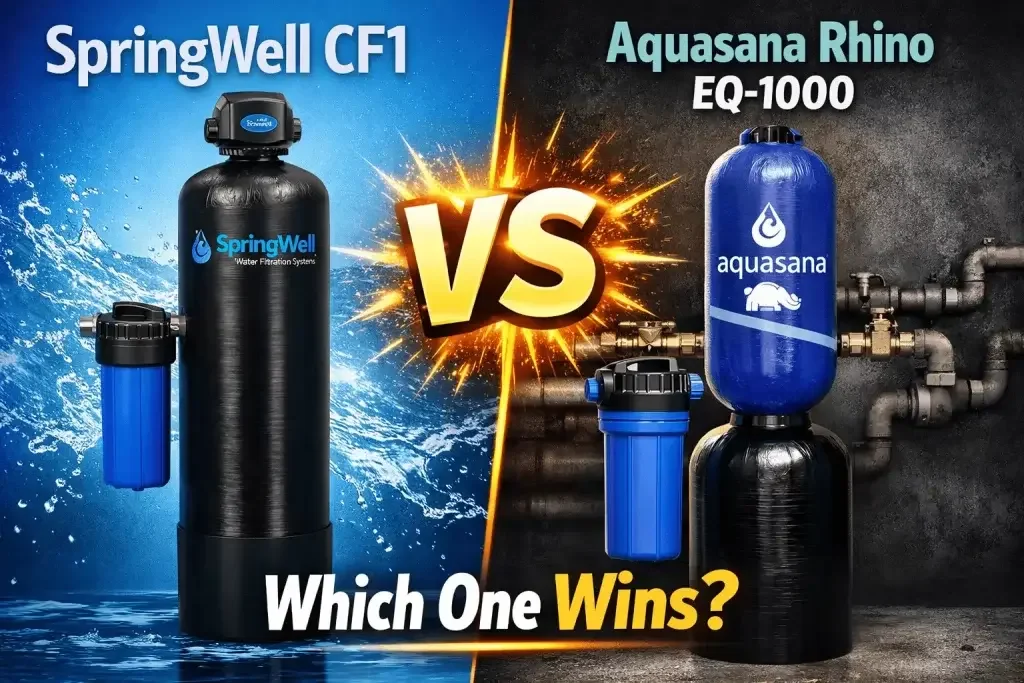
This model-level deep dive moves past general brand reputation to address the most decisive functional difference between these two systems: how they handle chloramine, a complex disinfectant that most standard filters fail to fully remove. Though both models target chlorine, the catalytic carbon in the SpringWell CF1 confers a technical advantage in modern city water that the base Aquasana Rhino EQ-1000 lacks.
We also break down your “break-even” point for your investment, which year of ownership the SpringWell CF1 becomes, in total cost, cheaper than the Aquasana Rhino, despite being more expensive upfront. Most buyers only look at the initial invoice; the long haul on media replacements speaks volumes for your wallet.
This guide also identifies a major maintenance bottleneck, the prefilter housing design that many homeowners only find frustrating after the first 6-month service interval. One system is for a tool-less, 5-minute swap; the other often takes a special wrench and a lot of muscle.
We end with a direct recommendation for your household needs. So whether your priority is a verified NSF certification, a high flow rate for multiple showers, or the best chloramine defense, you will leave this page knowing which serial number belongs in your utility room.
| Comparison Factor | SpringWell CF1 | Aquasana Rhino EQ-1000 |
|---|---|---|
| Filtration | 4-stage: KDF + catalytic carbon + upflow | 3-stage: copper-zinc + GAC + sediment |
| Flow Rate | 9 GPM | 7 GPM base model |
| Chloramine Removal | YES — catalytic carbon, lab-verified | DEBATED — limited effectiveness at 7 GPM |
| PFAS Removal | YES — catalytic carbon + KDF, lab-tested | Not a primary certified claim |
| NSF Certification | Components certified — system NOT in IAPMO directory | IAPMO certified NSF/ANSI 42+53 (70+ contaminants) |
| Pre-Filter Frequency | Every 6-9 months | Every 2-3 months |
| Annual Maintenance Cost | ~$30-40/year | ~$120/year |
| Annual Pre-Filter Changes | 1-2 times per year | 4-6 times per year |
| Annual Maintenance Minutes | ~15-30 minutes/year | ~60-90 minutes/year |
| 10-Year Total Cost | ~$1,550 | ~$2,400 |
| Cost Crossover Point | CF1 cheaper at ~23 months | — |
| Warranty | Lifetime on tanks and valves | 10 years on system |
| Return Policy | 6-month money-back (25% restocking fee) | 90-day (restocking fee applies) |
| Smart Features | Optional Bluetooth app add-on | None |
| Best For | Chloramine cities, PFAS concern, lower 10-yr cost | NSF documentation required, low simultaneous demand |
| Price (2026) | Check Price | Check Price |
Does the Aquasana Rhino EQ-1000 Actually Remove Chloramine?
This is the most critical functional difference between these two specific models. The SpringWell CF1 utilizes catalytic carbon designed to break down chloramine at whole-house flow rates. In its independent testing of the CF1, QualityWaterLab states clearly: The CF1 removes chloramine only. In contrast, the Aquasana Rhinos EQ-1000 base model uses GAC plus copper-zinc KDF media. GAC handles chlorine well but is marginally effective against chloramine at flow rates of 7-9 GPM required for a whole-house system.
Chloramine is made from chlorine and ammonia and breaks down much more slowly than pure chlorine. In a slow-flow under-sink filter, standard carbon may have sufficient “contact time” to process it. But in a whole-house tank moving more than 7 gallons per minute, water leaves the media too fast for standard GAC to act. Catalytic carbon is more reactive than slow adsorption and therefore works well even at high speeds.
How to Check Your City’s Water
Check to see if this matters to you: Look for your local utility’s Consumer Confidence Report, CCR. Look under “Disinfection/Residuals.” If it lists chloramine, the CF1 gains a functional advantage. In that case, the standard carbon in the EQ-1000 will work well for taste and odor as long as it lists only chlorine.
It should be noted that Aquasana offers a specialized Rhino Chloramines model for this issue only. However, that is a different, more expensive configuration than the base EQ-1000 and is not a fair price comparison when comparing the standard Rhino unit to the CF1.
The Pre-Filter Gap: How Much More Work Is the Aquasana?
The most visible difference in owning these two systems isn’t the water taste; it’s how often you’ll be in your utility room with a wrench. The Aquasana EQ-1000 requires a pre-filter replacement every 2–3 months, while the SpringWell CF1 only needs a swap every 6–9 months.
The Real-World Maintenance Math
- Aquasana EQ-1000
You should be changing 4-6 filters a year. This translates to 60-90 minutes of active maintenance per year and a pre-filter cost of $60-$90/year.
- SpringWell CF1
The filter will probably only be changed every 15-30 minutes or so each year. Your annual filter cost drops to roughly $20-$30/year.
Why the Frequencies Differ
The sediment pre-filter is “the front line” of defense in the Aquasana setup; it captures particles before water reaches the main tank. A 7 GPM continuous flow through a tiny cartridge exhausts it quickly. In the SpringWell system, the multi-stage media of the large tank do most of the work first, so the sediment filter takes in far less debris and remains clean longer.
Choosing the Aquasana requires a calendar reminder every 10-12 weeks. Missing a change means excess sediment bypasses the filter and may “foul” expensive main media. Want a “set and forget” experience? The twice-yearly maintenance schedule of the CF1 is a significant quality-of-life advantage.
NSF Certification: Aquasana Has Full System Certification, CF1 Does Not
In this model comparison, Aquasana has the stronger formal certification position. The Aquasana Rhino EQ-1000 is independently certified to NSF/ANSI Standard 42 for chlorine, taste, and odor reduction of 97%. A neutral third party has tested the whole assembled system, not just the media inside, and published the verified results to show the tank design and flow rate actually meet the marketing promises.
The CF1’s Lab-Test Position
The SpringWell CF1 does something different. While individual components like the tank and KDF media are NSF-certified for material safety, the complete CF1 system is not listed in the official NSF or IAPMO performance directories. For this reason, SpringWell uses independent lab testing. The three major organizations, QualityWaterLab (3-year Tap Score data), WaterFilterGuru, and BOS Water, all performed lab tests that showed the CF1 matches or exceeds certified system reduction rates for chlorine and THMs.
When Does This Distinction Matter?
For the average homeowner wanting good water at every tap, both systems are good performers. Independent testing reveals the CF1 does what it says it does. But the formal IAPMO/NSF certification is required if you need “official” documentation. This includes:
- Legal/Insurance Requirements: Some local codes or homeowner policies require certified systems.
- Medical Needs: A certified filtration level is prescribed by a doctor for a particular health condition.
- Landlord/Tenant Agreements: Where a lease requires NSF-certified installed water treatment.
If your priority is a “stamped and verified” paper trail, Aquasana is your only option here. If lab-verified performance is your priority and the CF1 needs less maintenance, an official badge is probably not an issue.
Does the 2 GPM Flow Rate Difference Matter for a Real 3-Bathroom Home?
How much of that 2 GPM gap between the SpringWell CF1 (9 GPM) & the Aquasana Rhino EQ-1000 (7 GPM) matters depends entirely on your “peak demand” habits. A 3-bathroom home’s functional performance baseline is 7 GPM, with little margin for error on a busy morning.
The 7 GPM Reality Check
Can 7 GPM handle a 3-bathroom home? In a typical household, a standard shower draws about 2 GPM and a washing machine up to 3 GPM. If two people shower while the laundry runs, you need exactly 7 GPM. This puts the base Aquasana EQ-1000 at its mechanical limit. A third person flushing a toilet or starting a dishwasher will probably cause a drop in pressure in showers. A critical 2 GPM buffer is built into the SpringWell CF1’s 9 GPM flow rate so that that extra faucet can run without affecting anyone else’s water pressure.
When 7 GPM is Perfectly Fine
Unless your household has just two or three residents who stagger their routines, rarely running two showers and a high-flow appliance at once, then the Aquasana EQ-1000’s 7 GPM is more than enough for your household. No change in daily performance if your peak usage stays below that threshold.
The “Max Flow” Alternative
For those concerned primarily with flow rate, the fair comparison is the base Rhino versus the Aquasana Rhino Max flow at 11.8 GPM. It beats the CF1’s 9 GPM but goes for $200-$300 more than the base EQ-1000, placing it in another price bracket entirely.
What Is the True 10-Year Ownership Cost for Each Model?
The biggest difference between these two systems is not the price on the receipt; it is the “hidden” cost of maintenance. For more than a decade of use, the SpringWell CF1 costs about $850 less than the Aquasana AQ-1000. Although Aquasana is often sold at a lower price upfront during sales, the frequent filter changes that keep it running eventually weigh in SpringWell’s favor.
The 10-Year Cost Breakdown
- SpringWell CF1
Upfront (~$930) + 10 years of sediment pre-filters (~$300 at 1.5 changes/year) + professional installation (~$300) = Approximately $1,530 total.
- Aquasana Rhino EQ-1000
Upfront (~$999) + 10 years of pre-filters (~$1,100 at 5–6 changes/year) + professional installation (~$300) = Approximately $2,399 total.
The Crossover Point: 23 Months
Many comparison pages leave out the crossover calculation. Even if you score the Aquasana $150 cheaper than the SpringWell initially, the CF1 costs about $80 cheaper a year to maintain. After 1.9 years, the SpringWell CF1 is the cheaper system, divided by that $150 upfront saving multiplied by that $80 annual maintenance advantage. If you plan on staying in your home longer than 23 months, the mathematically superior CF1 is your investment.
Does “Water for Life” Help?
For life subscribers, Aquasana offers 15% off filters and free shipping. Though this closes the gap somewhat and brings your annual filter spend down to about $90-$100, the SpringWell remains roughly $60-$70 cheaper per year to run. The break-even point only moves by about 2.5 years, even with the discount.
Which Model Should You Actually Buy: CF1 or Aquasana EQ-1000?
The final verdict for 2026 is straightforward: for the vast majority of 1–3 bathroom city water homes, the SpringWell CF1 is the superior long-term value. It offers a higher flow rate, handles the complex chloramine used in modern city disinfection, and saves you approximately $850 in maintenance costs over a decade. However, there are specific scenarios where the Aquasana remains the smarter mechanical or legal choice.
Profile 1: You Need Official Documentation
If you are a renter with a strict lease, have specific medical requirements, or need to satisfy an insurance provider that your filter is “certified,” buy the Aquasana EQ-1000. Its IAPMO certification to NSF/ANSI 42 and 53 provides a verified paper trail that the CF1 currently lacks at the system level.
Profile 2: Low Demand & Simple Chemistry
If your city water report shows only standard chlorine (not chloramine) and your household consists of 1–2 people who rarely run multiple fixtures at once, the Aquasana EQ-1000 is a solid, budget-friendly choice. At low simultaneous demand, 7 GPM is perfectly adequate.
Profile 3: The “Value & Performance” Homeowner
If your city uses chloramine, you have concerns about “forever chemicals” (PFAS), or you simply want the lowest 10-year total cost of ownership, buy the SpringWell CF1. Its catalytic carbon and KDF media provide more robust filtration, and the lifetime warranty on the tanks offers peace of mind that Aquasana’s 10-year warranty cannot match.
Profile 4: High Demand with an Aquasana Preference
If you have three bathrooms and a high-occupancy home but prefer the Aquasana brand, do not buy the base EQ-1000. Instead, upgrade to the Aquasana Rhino Max Flow (11.8 GPM). It costs more upfront, but prevents the frustrating pressure drops you would otherwise experience during peak morning hours.
Profile 5: The Tech-Savvy User
If you want to track your water usage and receive automatic maintenance reminders on your phone, buy the SpringWell CF1 with the optional Bluetooth smart head. The Aquasana EQ-1000 is a purely mechanical system with no app integration or smart monitoring features.
How Do These Models Fit Into the Broader SpringWell and Aquasana Lineups?
Understanding where the CF1 and EQ-1000 sit within their respective brand families helps ensure you aren’t overbuying or missing a critical feature. Here are the three most important context notes for the 2026 market.
- The Aquasana Hierarchy
The EQ-1000 is the 1-million-gallon standard model. For a larger 3-4 bathroom home where flow rate is a constant concern, the Rhino Max flow (up to 14 GPM) is the better functional match for the CF1, but it costs $200-$300 more upfront. In homes that need one tank for chloramine and hard water, Aquasana suggests the OptimH2O system.
- The SpringWell CF Series
The CF1 is the entry-level tank in this series, sized for 1–3 bathrooms at 9 GPM. If you have a larger home, the CF4 (12 GPM) and CF+ (20 GPM) use the exact same catalytic carbon and KDF technology but in larger tanks to maintain pressure across 4–6 or 7+ bathrooms. You get the same water quality regardless of the model; you are simply paying for the “width of the pipe.”
- The Pelican NSF Alternative
If you hate the CF1’s lack of formal system-level certification but like its price tag, the Pentair Pelican PC600 is the closest thing to a middle ground. It is a certified IAPMO NSF/ANSI 42 at a similar price to the CF1, but the trade-off is media life; the Pelican media requires a full replacement every 5 years, as opposed to the CF1’s 10-year rating.
Does the CF1’s Bluetooth App Work Better Than Aquasana’s Manual Tracking?
No, there are no smart features or app-based tracking on the Aquasan EQ-1000. You must manually enter your 3-month pre-filter schedule on a calendar; it’s easy to forget. An optional Bluetooth smart head monitors real-time water usage and filter life on the SpringWell CF1. They send you maintenance alerts right to your phone. This automation is a major step up from Aquasana’s manual tracking for busy homeowners.
Can You Upgrade the Aquasana EQ-1000 for Chloramine If You Already Own One?
No, the base EQ-1000 is not field-upgradeable for chloramine. The dual-chamber tank uses a fixed blend of standard carbon and KDF-55. If your city switches to chloramine, you would need to replace the unit with a model like the Aquasana OptimH2O or an under-sink RO system for drinking water. For confirmed chloramine areas, SpringWell CF1 is the more effective “buy it once” solution at first purchase.
What Is the Aquasana Rhino EQ-1000 Pre-Filter Change Process Like vs the CF1?
Both syisems employ standard, tool-less cartridges that swap in about 15 minutes. The physical difficulty is similar. But the time commitment varies dramatically: You can perform this task up to 6 times a year with the Aquasana EQ-1000 and just once with the SpringWell CF1. Though one change may seem simple, the Aquasana requires much greater annual total maintenance effort.
Which System Is Better for a Home That Has Both Chloramine and Hard Water?
For both problems, the SpringWell CSF1 combo is the better option. It pairs the chloramine-fighting CF1 with FutureSoft salt-free conditioner for scale prevention. Although Aquasana includes a similar bundle with their SCM conditioner, the base EQ-1000 still struggles with chloramine at whole-house flow rates. Using chloramine in your city and hard water? The SpringWell CSF1 offers more durable, lab-verified protection.

