
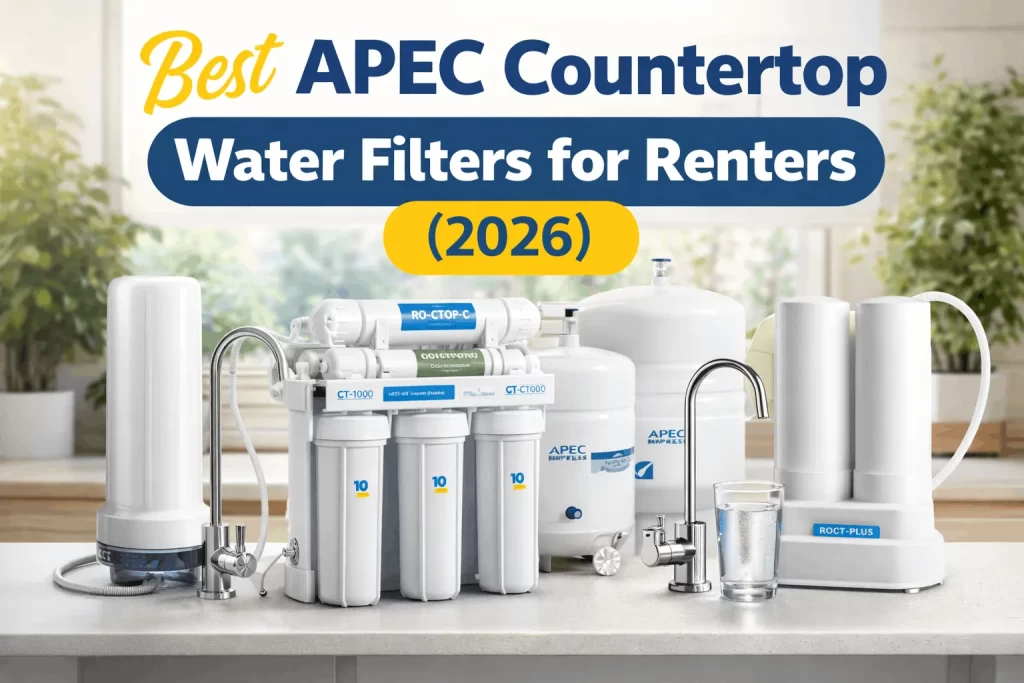
Finding a high-quality water filter as a renter is often a balancing act between performance and your security deposit. It is written for those who cannot install a permanent under-sink system. Whether you live in a student dorm, a professional high-rise apartment, or a temporary rental, these APEC systems let you get clean water without having to call a plumber or drill holes in your counters.
But picking the right APEC countertop model is more than just about budget: it depends on the faucet type and local water chemistry. APEC has several portable options varying in what they can take away. While one model might work well for basic chlorine taste, another handles heavy metals and fluoride, so the filter must be matched to the “cocktail” of chemicals your city adds to the water.
The practical realities of living with a countertop system are broken down in sections below. We cover the faucet compatibility check that most often results in these units being returned, the chloramine question, and how to deal with the slow fill speeds of portable reverse osmosis. We also cover the legal stuff, confirming that these systems sit on your counter without breaking the “no modifications” clause in most standard leases.
It closes out with a direct head-to-head comparison of each 2026 APEC countertop option. Compare upfront costs, filter replacement schedules, and specific contaminant removal rates to see which portable unit best fits your kitchen space and health goals.
Which APEC Countertop Filter Is Right for Your Apartment?
APEC offers four primary countertop options that range from approximately $65 to $430. Making the right decision for your rental is more than just the price tag. These use totally different technologies to solve different water problems. The most common renter mistake is choosing the wrong one to avoid breaking their landlord’s no-plumbing rules.
The Single-Stage Option: APEC CT-1000 (~$65)
This is a basic carbon block filter that screws on your faucet aerator. It is the cheapest and smallest option APEC offers. It gets rid of sediment, cysts, and that chlorine taste in “pool water.”
- The Catch: It does not remove chloramine (a mix of chlorine and ammonia used by many modern city water plants), nor does it remove fluoride or heavy metals like lead.
- Best For: Renters on a tight budget in cities that still use standard free chlorine who just want better-tasting coffee and drinking water.
The Performance Option: APEC RO-CTOP-C (~$250–$270)
This is a 4-stage reverse osmosis (RO) system housed in a portable case. It connects to your faucet but provides the same filtration power as a massive under-sink unit, removing up to 99% of contaminants like lead, PFAS, fluoride, and chloramine.
- The Catch: It has no storage tank, so it filters water in “real-time” at a slow trickle (about one gallon every 15–20 minutes).
- Best For: Renters who want the highest possible water purity and have a standard faucet that can accept the adapter.
The Taste-Focused Option: APEC RO-CTOP-PH (~$275–$300)
It is a version of the RO-CTOP-C with a 5th stage. Sometimes reverse osmosis leaves water tasteless because everything is removed, even good minerals. In this model, calcium is returned to the water to even out the pH and improve flavor.
- Best For: Renters who want ultra-pure water but find the taste of standard RO water too clinical or bland.
The All-In-One Option: APEC ROCT-PLUS (~$420)
The ROCT-PLUS is a self-contained “plug-and-play” station that requires no faucet connection. You simply fill the back reservoir with tap water, and it dispenses purified water at the touch of a button. It even includes a built-in heating element for instant tea or coffee (up to 203°F).
- Best For: Renters with “designer” or pull-out spray faucets that won’t fit a standard filter adapter or those who want a dedicated hot water dispenser.
Will an APEC Countertop Filter Work with Your Apartment Faucet?
The most common reason renters return countertop filters is realizing too late that their kitchen faucet isn’t compatible. Most APEC countertop models, including the CT-1000, RO-CTOP-C, and RO-CTOP-PH, connect directly to your faucet by replacing the aerator (the small threaded screen at the very tip of the spout).
The 30-Second Compatibility Check
To see if an APEC faucet-connected filter will work, look at the end of your kitchen faucet right now:
- The “Yes” Faucet: If your faucet is a stationary, curved metal neck with a small round tip that you can unscrew by hand (or with pliers), you have a standard aerator. APEC’s faucet-connected models will fit perfectly.
- The “No” Faucet: If your faucet head pulls out on a hose, has a “spray” button, or is a modern “designer” shape with a flat or hidden aerator, the standard APEC adapters will not work.
You don’t have to drop APEC if you have a pull-out or spray faucet. Your choice is APEC ROCT PLUS. It’s a “standalone” system, no faucet connection necessary. It has a water reservoir that you fill at the sink manually, and it filters the water in its own tank inside of it. So it works in any apartment, whatever your faucet design. If you have a compatible faucet, the aerator removal is reversible. Just put the original screen in the back of a kitchen drawer and screw it back on when the lease ends to receive your full security deposit back.
Does Your City Use Chloramine? This Changes Which APEC Model You Need
Most US city water had been disinfected with free chlorine. Yet increasingly many municipalities are using chloramine, a compound of chlorine and ammonia that stays active in water pipes for much longer. By 2026, approximately 30-40% of US metropolises will make use of chloramine as a primary or secondary disinfectant.
This change in disinfection methods affects your APEC choice. The APEC CT-1000 and CS-2500 use a standard carbon block filter, which removes chlorine well but almost ineffectively removes chloramine. For chloramine stripping, you need extended contact time with specialized catalytic carbon, not possible in a small, flow-through countertop unit or high-rejection reverse osmosis. One buyer on TrustPilot said they bought the CT-1000 and then learned their city uses chloramine, so the filter is basically useless for their water profile.
Check your city’s disinfection method before buying. Look at your city water utility’s website for the Consumer Confidence Report or the Water Quality Report. These must be published annually by law. See the disinfection section; it will say chlorine or chloramines. Or type in your zip code into the EWG Tap Water Database: ewg.org/tap water.
Using chloramine in your city? Skip the basic carbon filters and go with a reverse osmosis model. The APEC RO-CTOP-C, RO-CTOP-PH, and the standalone ROCT-PLUS all use an RO membrane to remove chloramine. If your city uses chloramines, do not buy the CT-1000.
How Do You Deal with the Slow Fill Speed of a Countertop RO?
The APEC RO-CTOP-C and RO-CTOP-PH do not have a storage tank. To make it portable and “lease-safe,” APEC dropped the bulky pressurized tank found in under-sink models. That means the system filters water at a trickle.
At standard municipal water pressure, the RO-CTOP-C can handle 90 gallons per day. In a real apartment setting, this translates to about one gallon every 16 or 20 minutes. Trying to fill a glass of water on demand will leave you at the sink for almost two minutes, something that many Amazon and Home Depot reviews point out as a common frustration.
Successful renters manage this slow flow by changing their “water habits” rather than waiting at the sink:
- The Pitcher Method: Keep two 1-gallon glass or BPA-free pitchers next to the unit. Every morning, while you make breakfast, turn the system on to fill a pitcher. By the time you’re done eating, you have a full day’s supply ready for the fridge.
- The Overnight Fill: Some users set a large container to fill overnight (ensuring it’s secure in the sink basin to prevent spills) so they wake up to 2–3 gallons of purified water.
- The ROCT-PLUS Alternative: If you cannot deal with a 20-minute wait, the APEC ROCT-PLUS is the better choice. It features an internal storage tank that fills itself automatically from its reservoir, allowing you to dispense a full glass of water instantly whenever you need it.
Is an APEC Countertop Filter Truly Portable and Safe for Your Lease?
Yes. The faucet-connected filters from APEC, the RO-CTOP and CT-1000, are “lease-safe,” meaning they require no permanent changes to your plumbing.
Apartment contracts forbid “permanent plumbing modifications.” APEC countertop filters are equivalent to swapping a showerhead or attaching a Brita pitcher. It involves unscrewing your aerator cap near the tip of your faucet and installing APEC’s diverter valve. It involves neither drilling nor cutting of pipes and usually no tools at all. You aren’t changing the building’s infrastructure, so it is not a modification.
When it’s time to move, the process is entirely reversible:
- Unscrew the APEC diverter valve.
- Screw the original faucet aerator back into place.
- The faucet is now exactly as it was when you moved in.
Tape the original aerator inside the cabinet under the sink or keep it in a labeled bag. If you lose it, a replacement only costs about $5 at any hardware store, so your security deposit remains safe.
The RO-CTOP-C weighs only 7 lbs. and is almost the size of a large toaster. It fits easily into a medium moving box. As long as your next apartment has a standard faucet, you can be up and running with purified water in under 10 minutes.
Is the APEC RO-CTOP-C Worth the Money Compared to a Pitcher Filter?
The answer depends on what is in your specific city’s water. For some renters, a $35 Brita is a perfect fit; for others, it’s a waste of money that doesn’t solve their actual safety concerns.
A typical pitcher filter was built for aesthetic reasons. It has been certified to reduce chlorine taste and odor, some copper and mercury. If you live in a newer building with modern plumbing, there are no local reports of heavy metals, and your water tastes like a swimming pool, a $30-$40 pitcher is a good, low-cost option.
- Annual Filter Cost: ~$45–$60.
The RO-CTOP-C is a must-upgrade if you live in an older city with lead pipe infrastructure (like Chicago or Newark) or near industrial zones with PFAS (“forever chemicals”) concerns. While expensive pitchers like the Brita Elite are certified for 99% lead reduction, reverse osmosis cannot compete for TDS (Total Dissolved Solids), fluoride, arsenic, or nitrates. The APEC system strips these contaminants to nearly zero levels that a carbon pitcher cannot reach.
- Annual Filter Cost: ~$100–$150.
An APEC RO-CTOP-C costs roughly $260 more upfront than a standard pitcher. You will spend between $600 and $700 on the APEC over five years with filter replacements alone. But is that premium “worth it”? That depends on how much peace of mind you have about the chemicals and metals that your local utility or your old pipes from your building are putting into your glass.
Which APEC Countertop Filter Should You Buy? Quick Reference Guide
Use this table to match your renter situation to the right APEC countertop product.
| Images | Your Situation | Best APEC Product | Why Choose It | Internal Link | Price |
|---|---|---|---|---|---|
 |
Tight budget, city uses chlorine | CT-1000 | Cheapest option, removes chlorine taste and odor | APEC CT-1000 Review | Check Price |
 |
City water uses chloramine | RO-CTOP-C | RO filtration removes chloramine, lead, PFAS, and fluoride | APEC RO-CTOP-C Review | Check Price |
 |
Want better taste with RO purification | RO-CTOP-PH | Same as RO-CTOP-C plus mineral restoration for better taste | APEC RO-CTOP-PH Review | Check Price |
 |
Pull-out faucet or want hot water | ROCT-PLUS | No faucet connection required, provides hot water | APEC ROCT-PLUS Review | Check Price |
What Do You Do with the Wastewater from an APEC Countertop RO in an Apartment?
Every RO system produces wastewater, the concentrated discharge left after contaminants are stripped away by the membrane. With the APEC RO-CTOP-C, you need no extra plumbing! The wastewater tube runs back to your faucet diverter valve & down your kitchen sink. Such a system produces about 2 gallons of wastewater for every 1 gallon of purified water (a 2:1 ratio). Many environmentally conscious renters save this “drain water” to water houseplants or mop floors instead of pouring it down the drain.
Can Students Use the APEC RO-CTOP-C in a Dorm Room?
Yes, but first do a quick check. Most dorm kitchenettes have standard faucets that work with the APEC faucet adapter, though some dorm bathrooms and newer suites have designer pull-out spray faucets that aren’t compatible. For all those with non-standard faucets in your dormitory, the APEC ROCT PLUS is the much better choice since it is self-contained and requires no faucet connection whatsoever. For students on a tight budget who want to ditch the “dorm tap” taste, the CT-1000 for about $63 is a great small option.
How Do You Replace Filters on the APEC RO-CTOP-C in a Small Apartment Kitchen?
The RO-CTOP-C makes filter replacement in a tight apartment easier than traditional under-sink models. The filters themselves are cartridges that twist on & off by hand; no tools or a wrench is required. Replace the Stage 1 and Stage 2 filters every 6 months (about $20-$35 for the set), and an RO membrane lasts 2-3 years. Since the unit is sitting directly on your counter, no need to clear out any under-sink storage or worry about water spilling into cabinets during the five-minute swap.
Is the APEC ROCT-PLUS Worth the Extra Cost over the RO-CTOP-C?
The ROCT-PLUS costs roughly $130–$140 more than the RO-CTOP-C, and that premium covers three major upgrades: a self-contained reservoir (no faucet connection needed), an instant hot water dispenser (perfect for tea or noodles), and a sleeker, all-in-one design. Recent 2026 testing confirmed that the ROCT-PLUS effectively removes 100% of chlorine and nitrates and 85% of fluoride. If you have a pull-out spray faucet or a daily tea habit, the convenience of the ROCT-PLUS is well worth the investment. However, if you have a standard faucet and just want the cheapest path to pure water, the RO-CTOP-C remains the best value.

