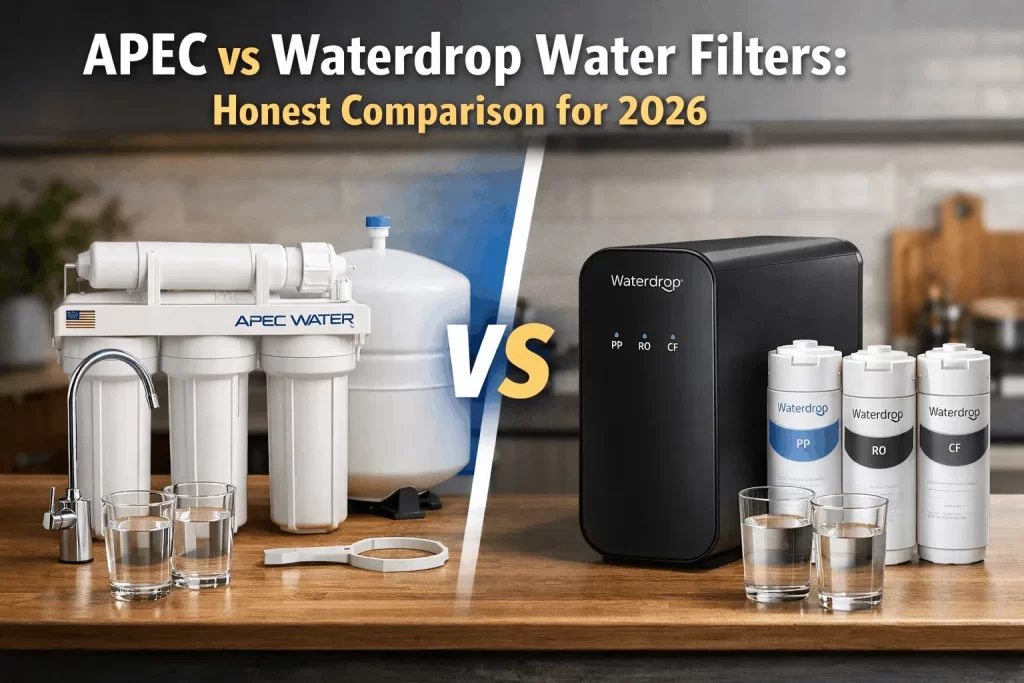
If you want the most reliable and cost-effective system and don’t mind losing some cabinet space, APEC is the way to go. Buy Waterdrop if you want a high-tech system that doesn’t take up a lot of space and are willing to pay extra for it.
APEC and Waterdrop are not competing for the same buyer because they solve different problems. The APEC ROES-50 (~$200–$230) is a no-frills, US-assembled, tank-based system. It runs without electricity, uses affordable universal filters (~$75–$80/year), and has over 25 years of reliability data. It is the “workhorse” choice for those who want a set-it-and-forget-it solution.
The Waterdrop G3P600 (~$430–$539) is a sleek, tankless system with a smart faucet. It takes up half the under-sink space and filters a massive 600 gallons per day. However, you pay for that convenience: the replacement filters are proprietary and cost roughly $145 per year. Over 10 years, owning a Waterdrop will cost you about $900 more than the APEC. You are paying that premium for aesthetics, smart features, and 3-second filter changes, not necessarily for better water quality.
| What We’re Comparing | APEC ROES-50 | Waterdrop G3P600 |
|---|---|---|
| System Type | Tank-based (traditional) | Tankless (modern) |
| Water Output (GPD) | 50 gallons per day | 600 gallons per day |
| Wastewater Ratio | 4–5:1 (wastes more water) | 2:1 (wastes less water) |
| Under-Sink Space Used | Large (tank + 5 canisters) | Small (slim vertical unit) |
| Needs Electricity? | No — runs on water pressure only | Yes — requires a power outlet |
| Filter Type | Standard 10-inch (buy anywhere) | Proprietary (Waterdrop only) |
| Annual Filter Cost | ~$75–80 per year | ~$145 per year |
| Filter Change Process | Wrench + housing unscrew (~10–15 min) | Twist-and-lock (~3 seconds) |
| Smart Features | None — no TDS display, no filter indicator | Smart faucet: TDS display + filter life alert |
| Certification | WQA Gold Seal (NSF/ANSI 58 + 372) | NSF/ANSI 42, 53, 58, 372 (8 certified contaminants) |
| Where Made | USA assembled, USA primary filters | Made in China, California address |
| Brand History | Founded 1997 (25+ years) | Founded 2015 (9 years) |
| Works Without Power? | Yes — fully passive operation | No — pump needs electricity |
| Well Water Compatible? | Yes (with standard pre-treatment) | Requires pre-treatment + warranty caution |
| Warranty | 1-year + lifetime technical support | 1-year standard + paid extended option |
| Best For | Budget, US-made, no electricity, well water | Small space, smart features, fast flow, easy maintenance |
| Upfront Price (2026) | Check Price | Check Price |
Is Waterdrop’s Tankless Design Worth the Extra $200–$300?
If under-sink space is your main constraint, the Waterdrop is absolutely worth the premium. But if you have a standard cabinet and want the best deal, it’s probably not worth it.
The Space Reality
The APEC ROES-50 space under the sink is a major factor for small kitchens. It uses a 4-gallon pressurized tank (about the size of a large beach ball) alongside five separate filter canisters. This setup typically claims about 70% of the storage space under a standard sink. In contrast, the Waterdrop compact design is tankless. The Waterdrop G3P600 is a slim, vertical unit about the size of a tall computer tower, leaving the rest of your cabinet free for cleaning supplies or a trash can.
On-Demand vs. Stored Water
There is a key functional trade-off in the tankless vs. tank RO system debate:
- APEC (Stored)
It keeps 4 gallons of water ready to go. You get a fast initial pour, but if you drain the tank (e.g., filling a large pasta pot), you must wait about 20 minutes for it to refill.
- Waterdrop (On-Demand)
It filters water instantly at 600 GPD (gallons per day). You never “run out” of water, though the stream is slightly slower than a full APEC tank.
The Power Constraint
One detail buyers often miss is that the Waterdrop requires electricity to run its internal pump, while the APEC runs entirely on water pressure. If you don’t have a power outlet under your sink, installing a Waterdrop G3P600 compact system will require extra electrical work.
If your cabinet is cramped or you hate waiting for a tank to refill, pay the extra for Waterdrop. If you want a simple, non-electric system that saves you $200 upfront, stick with APEC.
What Are the Real Annual Filter Costs for Each Brand?
APEC runs much cheaper annually because it uses universal parts, whereas Waterdrop locks you into a proprietary system.
The Annual Cost Breakdown
APEC ROES 50 annual maintenance is $75–$80 per year. It’s because APEC uses standard 10-inch filter cartridges, the most common format in the industry. You can get APEC-branded replacements or high-quality generic versions at $6–$15 per filter from most hardware stores.
The Waterdrop G3P600 maintenance cost is double, $145 per year. Waterdrop utilizes composite cartridges with a twist-and-lock design. These filters fit only Waterdrop systems, & you can buy them only from Waterdrop. Since the price is fixed and controlled by one supplier, there are no generic alternatives.
10-Year Ownership Total
When you look at the APEC vs waterdrop 10 year cost, the gap is massive:
- APEC ROES-50: ~$750–$800 total over 10 years.
- Waterdrop G3P600: ~$1,450 total over 10 years.
Including the initial purchase price, a Waterdrop system will run you about USD 900-USD 1,000 over a decade.
The Convenience Trade-Off
One big upside of the waterdrop filter lock-in: it works! A filter change takes just 3 seconds. You twist the old one out, then click the new one in. The standard filters from APEC require you to unscrew heavy plastic housings with a wrench in about 15 minutes, and can be messy if you’re not careful.
It is like paying a convenience tax of $70 per year to not use a wrench once every 12 months. On a budget, APEC wins; if you value time and hate maintenance, then Waterdrop is pricey
Does the Huge GPD Difference Between APEC and Waterdrop Actually Matter?
For most families, the 600 GPD (gallons per day) rating of a Waterdrop system is a luxury, not a necessity. A 50 GPD rating for the standard APEC 50 indicates that it provides 50 gallons of filtered water per 24 hours. With an average family of four using only 3–5 gallons a day for drinking and cooking, the APEC output is more than enough for a family of four.
The average 50 GPD system uses about 2 gallons of water per hour. As this water is stored in a 4-gallon pressurized tank on the APEC ROES-50, you have a few gallons ready to pour immediately. You won’t notice the slower production speed unless you’re filling a five-gallon aquarium all at once.
When 600 GPD is Actually Useful?
The 600 GPD threshold is necessary if your household has unique needs that go beyond a few glasses of water.
- High-Volume Cooking: You frequently fill large 5+ gallon stockpots for brewing or canning.
- Large Households: You have 6 or more people constantly filling gym bottles and pitchers back-to-back.
- Appliance Connections: You want to run a dedicated line to a high-volume ice maker or a refrigerator with a very fast water dispenser.
- Instant Gratification: You hate waiting for a tank to refill and want a consistent, “endless” stream directly from the membrane.
If you just want clean water for your family to drink, is 50 GPD enough? Yes, absolutely. You only need to pay the premium for a 600+ GPD system if you have high-volume demands that would consistently drain a 4-gallon storage tank.
Does It Matter That Waterdrop Is Made in China and APEC Is Made in the USA?
For water safety, it doesn’t matter; for supporting domestic industry, it does. Both brands provide safe, high-quality water, but their manufacturing origins are completely unique.
The Manufacturing
- Waterdrop
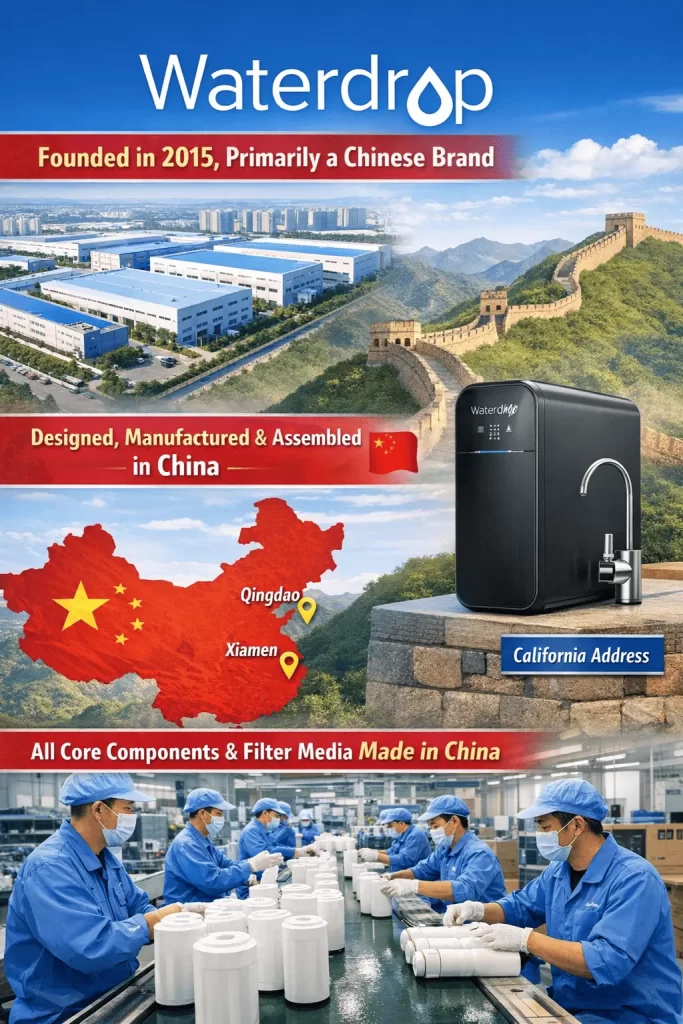
Founded in 2015, Waterdrop is primarily a Chinese brand with a global presence. China (with major facilities in cities like Qingdao and Xiamen) designs, manufactures, and assembles its systems. Despite using a California business address for US marketing, Waterdrop manufactures all core components and filter media in China.
- APEC
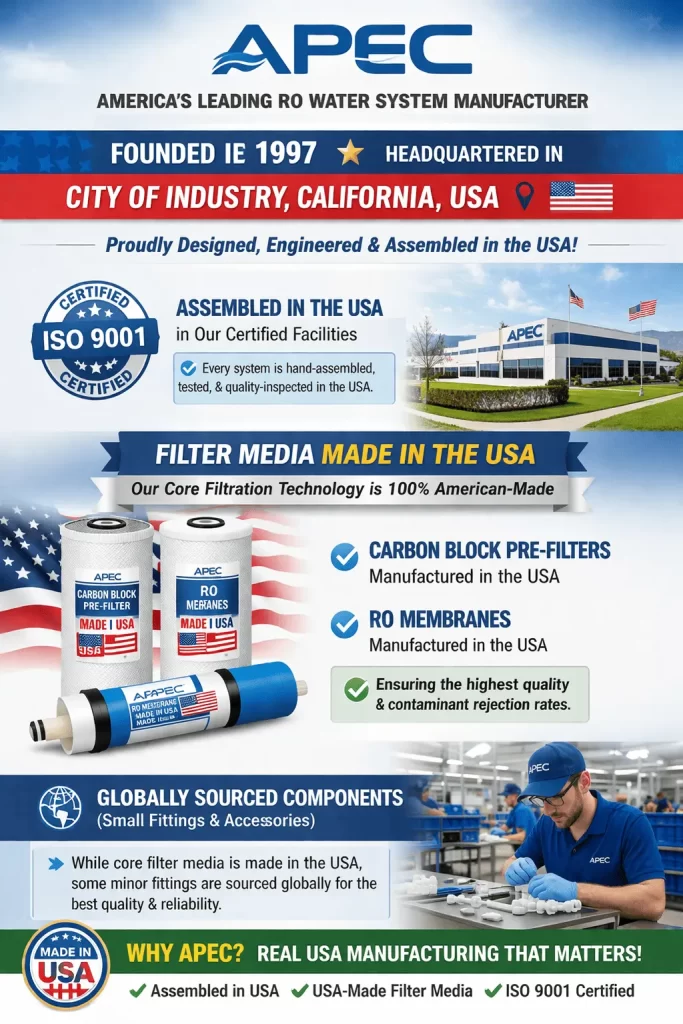
Founded in 1997 and headquartered in the City of Industry, California, APEC is a leading US manufacturer. Their systems are assembled in the USA under ISO 9001 certification. Most importantly, APEC’s primary filter media, the carbon block pre-filters and RO membranes, are manufactured in the USA, though some smaller fittings are sourced globally.
Does Origin Affect Safety?
In terms of water purity, a “Made in China” label is not a safety concern if the system is NSF certified. Independent US labs have rigorously tested Waterdrop’s systems, resulting in certifications for NSF/ANSI 42, 53, and 58. This means they meet the exact same American safety standards for contaminant removal as any US-made filter.
If you want to support American jobs and domestic manufacturing, APEC is your winner. If your only concern is finding a safe, certified system to fit your budget or design, Waterdrop is Chinese, but it does not lower the quality of the water it produces.
Do Waterdrop’s Smart Features Justify the Higher Price?
The Waterdrop G3P600 costs more because it acts as a “smart” appliance, while the APEC ROES-50 is a purely mechanical tool. Whether those features are worth the extra $200 depends entirely on how much you value real-time data versus passive reliability.
The Waterdrop G3P600 features a smart LED faucet that provides two critical pieces of information:
- Real-Time TDS Display: This shows exactly how many dissolved solids are in your water as you pour it. It confirms the membrane is working and alerts you instantly if water quality drops.
- Color-Coded Filter Life: The faucet glows blue (good), yellow (replace soon), or red (replace now). This removes the need to mark calendars or guess when a filter is “clogged.”
The APEC ROES-50 has no smart features. To check your water quality, you must use a handheld TDS meter, and to track filter changes, you have to keep your own manual records.
The Power Trade-Off
The biggest flaw is Waterdrop’s power dependency. Because it is tankless, an internal electric booster pump filters water on demand. Without power, the Waterdrop will not make water. Conversely, the APEC ROES-50 does not require power. It runs entirely off your home water pressure and holds 4 gallons of filtered water in an enclosed pressurized tank. Even during a power outage, you can still drink all that stored water.
For those who love tech and want to know when their water is pure, Waterdrop has created a smart faucet that adds great value. But if you live in a place where blackouts are common or want a 100% plug-free system, APEC is the smarter choice with its simple passive design.
Which Brand Has Stronger Water Safety Certifications?
More certifications don’t necessarily mean a “safer” system; they just mean the manufacturer paid for more specific tests. Both APEC and Waterdrop are independently verified, but they use different bodies to prove their performance.
APEC: The WQA Gold Seal
The APEC ROES-50 carries the WQA Gold Seal (Water Quality Association). This is a respected certification that shows the system is built with safe materials and effectively reduces Total Dissolved Solids (TDS) as per the NSF/ANSI 58 standard. APEC’s 5-stage RO technology not only reduces TDS but also effectively removes lead, arsenic, and fluoride. APEC trusts its long-standing reputation and the Gold Seal to show overall quality.
Waterdrop: Multiple NSF Marks
The Waterdrop G3P600 holds a wider array of specific certifications. It is certified against:
- NSF/ANSI 58: For TDS reduction (the core RO standard).
- NSF/ANSI 42: For chlorine, taste, and odor.
- NSF/ANSI 372: Verifying that the entire system is “lead-free.”
- NSF/ANSI 53: Select configurations are tested for health-related contaminants like cysts and VOCs.
Another source of confusion is the “lead gap.” Lead-free certification for both systems is Standard 372, but lead reduction certification is a separate test, Standard 53 or 58. Waterdrop lists dozens of contaminants in its marketing, but its official NSF-certified scope is usually limited to TDS and chlorine. APEC, for its part, is a “WQA Certified System”, a similar foundation of trust.
You want an American pedigree brand with a WQA Gold Seal? Choose APEC. Want a modern system with a library of individual NSF standard stickers for specific contaminants? Waterdrop has documented paperwork for that as well.
Which One Should You Actually Buy — APEC or Waterdrop?
Choosing between these brands isn’t about which is “better,” but about whether you prioritize long-term savings or modern convenience.
Here is the easy guideline for your specific situation:
- You want the lowest total cost and American-made parts
Buy the APEC ROES-50. It costs ~$230 upfront and only ~$75/year to maintain. Because it uses universal filters and no electricity, it is approximately $1,000 cheaper than Waterdrop over 10 years of ownership.
- You have zero cabinet space and want “smart” features
Buy the Waterdrop G3P600. This tankless unit takes up 70% less space, shows your water purity (TDS) in real-time on the faucet, and lets you swap filters in 3 seconds without a wrench.
- You have frequent power outages or use a private well
Buy the APEC ROES-50. Since it runs on water pressure alone, it works when the lights go out. Its 4-gallon tank provides a reliable backup supply that tankless systems cannot offer.
- You want the “top of the line” with UV sterilization
Buy the Waterdrop G3P800. This is the premium choice for those who want the fastest flow rate (800 GPD) and an added layer of UV protection against bacteria.
How Do the APEC ROES-50 and Waterdrop G3P600 Compare on Wastewater?
The APEC ROES-50 wastewater ratio is approximately 4:1—meaning for every 1 gallon of purified water produced, 4 gallons are sent down the drain. This is standard for traditional tank-based systems that rely on backpressure. The Waterdrop G3P600 wastewater ratio is significantly more efficient at 2:1, wasting only half a gallon for every gallon of clean water. While the financial impact of this “waste” is small (typically $10–$20 per year on a city water bill), the Waterdrop is the clear winner for eco-conscious buyers or those on limited-yield private wells.
Is the APEC ROES-50 Still Worth Buying in 2026 When Tankless Systems Exist?
Yes. The extreme reliability and low long-term costs make the APEC ROES 50 2026 worth buying. Despite the flashy tankless systems, the APEC is still the cheapest way to get certified RO water, about $1,000 less than Waterdrop after a decade of use. It has no computer boards, no sensors that fail, and no electricity; it is a set-it-and-forget-it system that is basically bulletproof. And for buyers with cabinet space and looking for a proven, US-assembled workhorse, the APEC ROES-50 is not just dated; it’s the gold standard for value.
Does Waterdrop Work with Well Water — and What Does the Warranty Say?
This is a major gap in the Waterdrop well water warranty conditions, as the system is designed for municipal tap water. Using it on a well requires a pre-filtration system, or your warranty will be voided. In other words, your well water must be within limits (pH 6.5-8.5 and TDS under 750 PPM). In the reverse, the APEC ROES-50 well water compatibility is built in. It handles water naturally with standard sediment and carbon blocks. For rural homes without pretreatment setups, APEC is the safer and legally covered choice.
What Are Waterdrop’s Best-Selling Models Besides the G3P600?
If the G3P600 isn’t quite right, Waterdrop offers two higher-tier models:
- Waterdrop G3P800: Ups the flow to 800 GPD and adds UV sterilization to kill bacteria and viruses, ideal if you are worried about biological contaminants.
- Waterdrop X12: A powerhouse 1200 GPD system designed for large families who want a glass of water filled in 3 seconds flat.
Both use the same proprietary “twist-and-lock” filters as the G3P600 and require an under-sink power outlet. While faster, they are significantly pricier, often costing double the price of an APEC system.
How Does APEC Compare Against Other Modern RO Brands Beyond Waterdrop?
If you aren’t sold on Waterdrop, the most common APEC ROES-50 alternatives are iSpring and Frizzlife. Against iSpring (RCC7AK), APEC wins on US-made filter quality, but iSpring offers an “alkaline” stage that adds minerals back for better taste. Against Frizzlife (PD600), APEC is much cheaper to maintain annually (~$80 vs. ~$130) but loses on space-saving. Compared to AquaTru, APEC is a permanent under-sink solution that doesn’t take up counter space or require a plug, making it the better choice for homeowners

