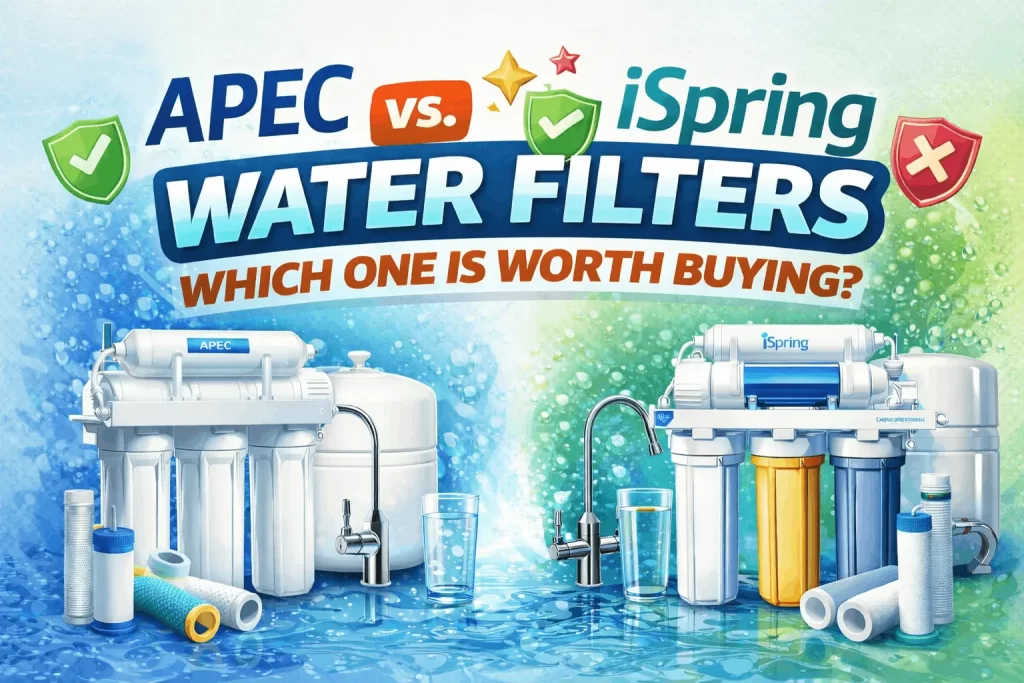
APEC vs. iSpring Water Filters: Which One Is Worth Buying?
iSpring wins this comparison for most homeowners because it offers better water taste, less water waste, and faster output. APEC is the better choice only if you prioritize the absolute lowest TDS (Total Dissolved Solids) count or want filters made specifically in the USA. While both brands offer high-quality systems for under $300, the iSpring RCC7 series provides more daily water and includes remineralization features that APEC Essence models lack.
APEC vs iSpring Comparison
| What We’re Comparing | APEC ROES-50 | iSpring RCC7AK |
|---|---|---|
| Filtration Stages | 5 stages | 6 stages (includes alkaline remineralization) |
| Daily Output (GPD) | 50 gallons per day | 75 gallons per day |
| Wastewater Ratio | 3:1 to 5:1 (wastes more water) | 2:1 (wastes less water) |
| Remineralization | No — water tastes flat | Yes — adds back calcium and magnesium |
| TDS Output (PPM) | ~5 PPM (purer water) | ~10–14 PPM (slightly less pure) |
| Carbon Filter Life | 12 months | 6–12 months |
| Annual Filter Cost | ~$70–75 per year | ~$95 per year |
| Storage Tank | 4 gallons | 3.2 gallons |
| Certification | WQA Gold Seal (NSF/ANSI 58) | NSF/ANSI 58 tested (check WQA status for RCC7AK) |
| Where It Is Assembled | USA-manufactured | Globally sourced components |
| Where Main Filters Are Made | City of Industry, California, USA | Alpharetta, Georgia, USA |
| Warranty | 1-year limited warranty only | 1-year + optional 3 or 5-year extended |
| Customer Support | Documentation + limited live access | Phone, email, and live chat |
| Best For | Max purity, US-made filters, lower cost | Better taste, less water waste, better support |
| Price (2026) | Check Price | Check Price |
Furthermore, iSpring wins in flavor and efficiency for active households. The popular RCC7AK model includes a remineralization stage that adds healthy minerals back into the water to balance the pH level and prevent a “flat” taste. This system also produces 75 gallons of water per day with a low 2:1 waste ratio, meaning it saves more water than most budget rivals. It is the best choice if you enjoy the taste of bottled mineral water and want a faster flow at your faucet.
APEC is the industry standard for users who want the cleanest possible water and American-made parts. Lab tests show APEC Essence models consistently hit a TDS count of 5 PPM or lower, which is superior to the 10-14 PPM average from iSpring. These filters are made in the USA and carry the WQA Gold Seal certification for safety and quality. APEC is also cheaper to maintain over five years because its annual filter sets cost roughly $70 compared to $95 for iSpring.
Which System Produces Better-Tasting Water?
The iSpring RCC7AK produces better-tasting water than the base APEC ROES-50. Reverse osmosis removes almost everything from your water, including natural minerals like calcium and magnesium. While this process makes the water very pure, it also makes the reverse osmosis water taste flat, empty, or slightly acidic. These minerals are what give high-quality spring water its clean and smooth flavor.
The iSpring remineralization stage is the reason for this taste advantage. The RCC7AK model includes a special sixth filter that puts healthy calcium and magnesium back into the water after the purification process. This alkaline remineralization RO step balances the pH level and improves the flavor. This feature addresses the most common APEC ROES-50 flat water taste complaint found in thousands of user reviews.
If you want the high purity of APEC but also want great taste, the ROES-50 is the wrong model to buy. You must compare the iSpring RCC7AK vs. the APEC ROES-PH75. The ROES-PH75 is the premium APEC version that includes its own stage for remineralizing calcium and magnesium. In this specific matchup, APEC keeps its edge in purity while matching the iSpring system for flavor.
Quick Taste Decision Guide
- Best Value for Taste: iSpring RCC7AK (~$235). It includes the alkaline filter at a budget price.
- Premium Choice for Taste: APEC ROES-PH75 (~$300+). It offers American-made filters with added minerals.
- Purest but Flattest Taste: APEC ROES-50. This model has no mineral return and is for users who prefer distilled-quality water.
Which System Wastes Less Water?
iSpring wins clearly on water efficiency. The iSpring RCC7 2:1 ratio generates approximately 2 gallons of wastewater for every gallon of filtered water it produces. The APEC ROES-50 wastewater ratio is higher, wasting about 3 gallons at normal water pressure and up to 5 gallons in homes with lower pressure.
Annual Water Waste Calculation
A family of four that drinks 2 gallons of filtered water per day creates a significant difference in reverse osmosis water waste over one year.
- iSpring Efficiency: Wastes 4 gallons per day, or 1,460 gallons per year.
- APEC Waste: Wastes between 6 and 10 gallons per day, or up to 3,650 gallons per year.
At a typical US water rate, the extra cost from APEC is only about $3 to $13 per year. This is not a large financial burden for most homeowners. However, if you use a private well or care about your environmental footprint, the iSpring efficiency vs. APEC difference is a major factor. Wasting over 2,000 extra gallons of water per year is a real concern for RO water waste eco buyers.
If water waste is your biggest priority, both brands fall behind modern technology. Tankless RO systems often run at a 1:1.5 ratio, which is even better than iSpring. But between these two traditional tank models, iSpring is the better choice for saving water.
Is APEC Actually Made in the USA—and Does iSpring Qualify Too?
APEC uses the phrase “Assembled in the USA,” while iSpring manufactures its primary filters in the United States. APEC builds its carbon block filters and reverse osmosis membranes in California. The parts are assembled by an ISO 9001-certified company. Although some small parts, such as plastic fittings, are purchased by APEC from other countries, the machine’s “heart” is American-made.
ISpring constructs its water systems in Alpharetta, Georgia. But iSpring reveals it buys the individual filters, membranes, and plastic housings from global suppliers in Taiwan and China. In 2019, the Federal Trade Commission told iSpring it should stop declaring its products “all or virtually all made in the USA” because so many parts are imported.
All these differences in manufacturing do not affect your water safety! Ideally, a filter would pass independent tests such as NSF/ANSI 58. Both APEC and iSpring pass these tests. It means all plastics and carbon used in both brands are removed effectively without lead or other chemicals.
To support American factories, you receive APEC. They actually claim to have US-made filters. If you simply consider the packing and testing of the final box in America, both brands hold equal importance.
Which Brand Has Stronger Water Filter Certifications?
NSF/ANSI 58 is the gold standard for reverse osmosis systems in the USA. This rulebook tests if a filter removes lead, arsenic, and tiny pieces of rock called dissolved solids. Therefore, when a company claims to have “tested” its system to this standard, it is actually a lab test. A WQA Gold Seal is more proof. It means an independent group called the Water Quality Association tested the lab results, verified the factory, and listed the product in their official public directory.
This APEC ROES-50 certification has the WQA Gold Seal. This confirms the system meets NSF/ANSI 58 safety and performance requirements. With this seal, you see third-party proof that the system is tough and filters contaminants, as the company claims. For many experts, this long-standing, public listing in the WQA directory gives the APEC certification a stronger reputation.
ISpring does its paperwork differently depending on the model. It is equivalent to APEC status for a 5-stage iSprING RCC7 WQA listing with a Gold Seal. But for the 6-stage iSpring RCC7AK certification, the certification is sometimes listed as “tested to NSF/ANSI 58 by a third-party lab” rather than the full Gold Seal in the WQA directory. As an informed buyer, check the current directory at wqa.org to see if the model you want is listed today.
Both systems are safe and clean your water for most families. You only need to worry about the specific WQA vs. NSF certification details if you need official documents. This happens if you have a weak immune system or if your landlord requires a certified filter in your rental agreement.
What Are the Real Annual Costs After the Initial Purchase?
APEC is generally cheaper to run annually because its standard system has fewer filters to replace. For the APEC ROES-50 annual maintenance, you can expect to spend about $75 to $80 per year. This includes replacing the first three stages (sediment and carbon blocks) every 12 months, while the RO membrane and the final coconut shell post-filter are only replaced every 2 to 4 years.
The iSpring RCC7AK annual cost is slightly higher, averaging around $95 to $110 per year. The extra expense comes from the sixth filter stage, the alkaline remineralization cartridge, which usually needs replacing every 6 to 12 months to maintain that bottled-water taste. Additionally, if you have very hard water, iSpring recommends checking the pre-filters every 6 months, which can further increase your iSpring RCC7AK filter replacement frequency compared to APEC’s high-capacity blocks.
10-Year Ownership Total
When you look at the long-term RO system annual cost comparison, the gap becomes clearer:
- APEC ROES-50: Approximately $750 to $800 total over 10 years.
- iSpring RCC7AK: Approximately $950 to $1,100 total over 10 years.
The $200–$300 difference over a decade is roughly the same as the higher upfront price you would pay for APEC’s premium alkaline model (the ROES-PH75). A fantastic money-saving tip for iSpring owners is to buy the iSpring 3-year filter bundle. These sets often cost around $220, which brings your average yearly cost down significantly compared to buying individual filters every few months.
Which Brand Has Better Customer Support and Warranty?
iSpring wins on support and warranty depth. Both APEC and iSpring include a standard 1-year limited warranty that covers manufacturing defects. However, iSpring offers much better long-term security. You can purchase or register for an optional 3-year or 5-year extended warranty that covers both parts and labor. APEC does not offer this extended coverage, which makes iSpring the safer choice for people who want a longer safety net.
Support access is another area that iSpring leads on. APEC has good manuals and email support, but users on Reddit and Amazon say they cannot get a live person quickly. Multiple customers say iSpring tech support is quick and helpful with questions during installation.
That difference matters most if you are installing your first reverse osmosis system. Most owners never use their warranty, but having a live person on the phone or chat is helpful if you have a leak or problem while you are setting up your machine. You want the best long-term protection? The iSpring 5-year extended warranty is an offer few budget brands can match.
iSpring vs APEC detailed comparison
This video provides a head-to-head test of the top models from both brands to help you see how the support and installation process works in real life.
Which One Should You Actually Buy: APEC or iSpring?
Choosing between these two depends on whether you prioritize the science of the water (purity) or the experience of drinking it (taste). Both are reliable, but they serve different types of homeowners.
- You want the best-tasting water and a fast flow
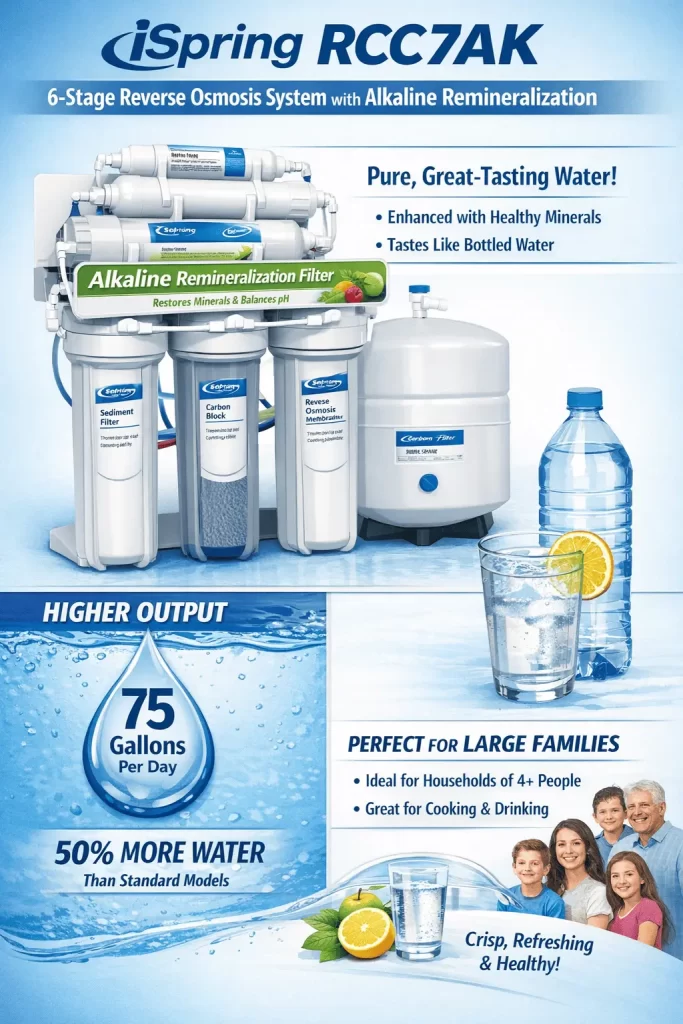
Buy the iSpring RCC7AK. Because it includes a 6th-stage alkaline remineralization filter, it produces water that tastes more like bottled mineral water rather than “flat” distilled water. It also produces 75 gallons per day, which is 50% more than the base APEC model, making it the better choice for large families.
- You want maximum purity and US-made parts
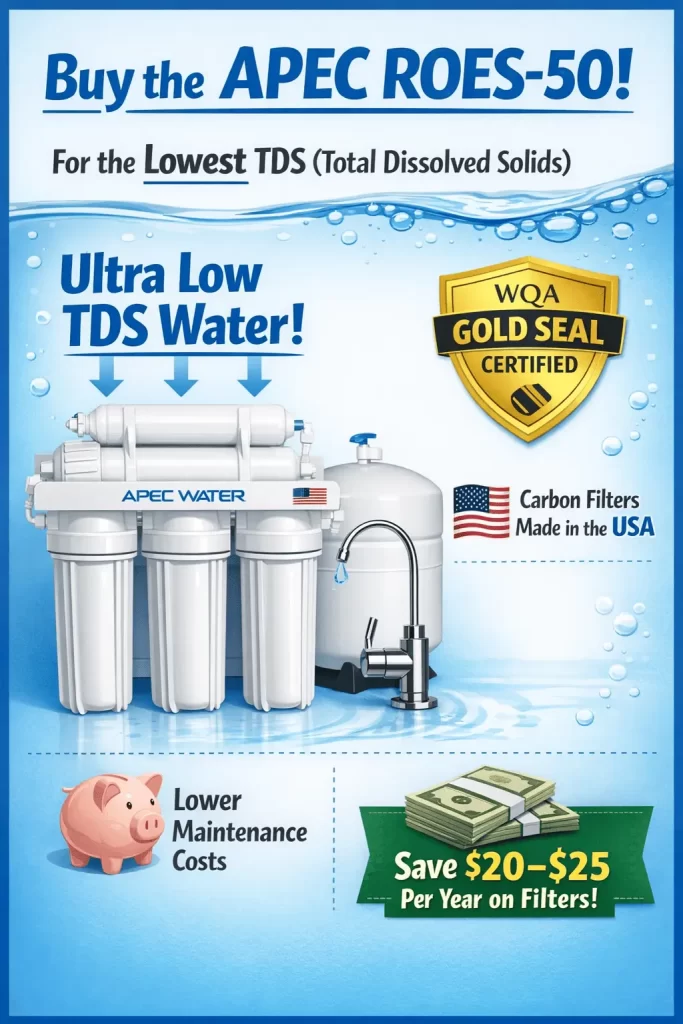
Buy the APEC ROES-50. If your main goal is reaching the lowest possible TDS (Total Dissolved Solids) count, APEC is the winner. It holds a WQA Gold Seal certification and uses carbon filters made in the USA. It is also cheaper to maintain, saving you about $20–$25 every year in filter costs.
- Your home has low water pressure (below 40-50 PSI)
Do not buy either base model. A standard RO system will waste too much water and fill the tank too slowly at low pressure. Instead, look at the iSpring RCC7P (which has an electric booster pump) or the APEC RO-PERM (which uses a non-electric permeate pump).
How Does the APEC ROES-50 Specifically Compare to the iSpring RCC7AK?
The APEC ROES-50 vs iSpring RCC7AK matchup covers the two most popular flagship RO systems on the market. While they look similar, the iSpring RCC7AK produces 75 gallons per day (GPD) and includes a 6th-stage alkaline filter to improve taste. The APEC ROES-50 focuses on maximum purity with 50 GPD and holds a prestigious WQA Gold Seal certification. Choose the iSpring RCC7AK for better taste and higher output, or the ROES-50 for verified APEC ROES-50 TDS vs. iSpring RCC7AK performance and the cleanest possible water.
Is the APEC ROES-PH75 a Better Choice If You Want Alkaline Water from APEC?
The ROES-PH75 is the correct APEC alkaline RO system to compare against the iSpring RCC7AK. It adds a 6th-stage remineralization filter that fixes the “flat” taste of pure RO water while maintaining APEC’s high manufacturing standards. However, the ROES-PH75 usually costs ~$300, which is about $60–$90 more than the iSpring equivalent. If you want the safety of a WQA Gold Seal and American-made filters with great taste, the APEC ROES-PH75 vs. iSpring RCC7AK choice is worth the extra money.
Which System Is Better for Homes with Low Water Pressure?
Standard RO systems like the ROES-50 or RCC7AK need at least 40–60 PSI to work correctly; otherwise, they waste too much water and fill very slowly. For low-pressure homes, both brands offer specialized models: the iSpring RCC7P (includes an electric booster pump) and the APEC RO-PERM (uses a non-electric permeate pump). Before buying, use a $15 pressure gauge from a hardware store to check your sink’s pressure. If your pressure is under 40 PSI, the iSpring RCC7P vs. APEC RO-PERM models are your only reliable options.
What Is the Difference Between 5-Stage and 6-Stage RO Systems?
In the 5-stage vs. 6-stage RO system debate, the first five stages are always the same: they remove dirt, chemicals, and heavy metals to make water safe. The 6th stage in a system like the iSpring RCC7AK is an alkaline remineralization stage that adds calcium and magnesium back into the water. This extra stage is not for safety; it is purely to improve the taste and balance the pH level. Both 5-stage and 6-stage systems provide the same level of filtration, but the 6th stage makes the water taste more like natural spring water.
How Do APEC and iSpring Compare for Long-Term Reliability?
Both brands have excellent APEC vs. iSpring reliability records, with many users reporting 10 to 15 years of use with proper care. Commercial and government clients trust APEC, which has a longer history dating back to 1997. iSpring has been a top-rated brand since 2005 and maintains nearly perfect 4.8-star ratings across thousands of reviews. To ensure a long APEC RO system lifespan, you must replace the pre-filters every year to protect the membrane and check your storage tank’s air pressure every few years.

