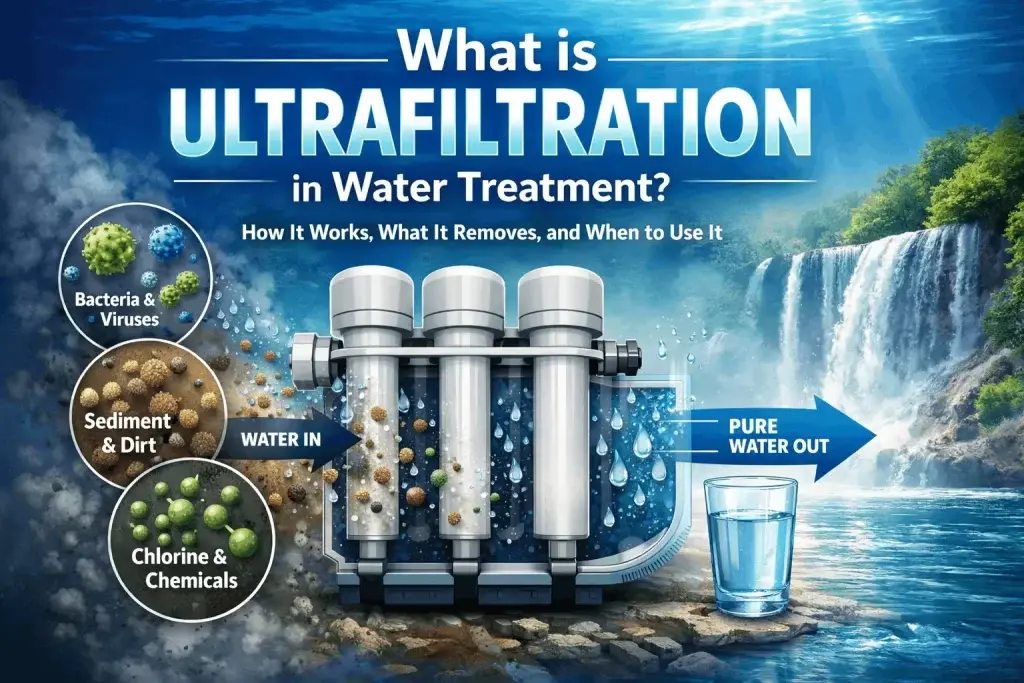
Many people are tired of drinking water that tastes like chlorine and worry about hidden contaminants. Ultrafiltration (UF) is a sustainable purification method that offers clean, safe drinking water without the drawbacks of traditional systems. UF uses a precise 0.01-micron membrane to remove bacteria, cysts, and microplastics while preserving essential minerals. The result is laboratory-grade purification with no wastewater, no electricity, and a more natural-tasting final product. UF is a true game-changer for anyone seeking efficient, eco-friendly water treatment.
But choosing the right model can be complex, as performance varies widely with size, flow, and the quality of secondary filters. We’ve taken the guesswork out of the process by thoroughly testing and analyzing the market’s leading models to bring you a definitive comparison of the best systems available right now.
The top 5 ultrafiltration water systems we reviewed are:
- iSpring CU-A4 Ultrafiltration System
- Waterdrop TSU-W Ultrafiltration Under-Sink System
- Ecoviva 0.01 μm Ultra-Filtration Under Sink Filter
- PureDrop PDR-3CUW Ultra-Filtration Under Sink System
- Purewell 8-Stage 0.01 μm Ultra-Filtration System (Gravity-Fed)
This review looks at how these filters work, how well they clean water, and what users can expect from them. Water Filter Way shares clear, simple information to help readers understand the technology and choose what best fits their needs.
1. iSpring CU-A4 Ultrafiltration System

The iSpring CU-A4 is a high-performance under-sink filter system engineered to deliver safe, mineral-rich drinking water with zero wastewater. Its advanced 4-stage filtration utilizes a 0.01-micron Ultrafiltration (UF) membrane, coupled with an essential KDF/GAC stage for enhanced defense against heavy metals like lead and challenging contaminants such as chloramine. This tankless, compact unit is designed for easy DIY installation and features simple twist-on filter cartridges, making it a powerful, maintenance-friendly solution that retains healthy minerals unlike traditional Reverse Osmosis (RO) systems.
Key Specifications
| Feature | Detail |
| Brand | iSpring |
| Price | $158.99 |
| Rating | 4.6 out of 5 |
| Model Name | CU-A4 |
| Type | Under-Sink / Point-of-Use (POU) |
| Filtration Stages | 4-Stage (PP, UF, KDF/GAC, Carbon) |
| UF Pore Size | 0.01 micron |
| Wastewater | Zero Wastewater |
| Required Pressure | 20−80 psi |
| Rated Flow Rate | 0.56 GPM at the rate of 45 psi |
| Max Feed TDS | ≤1000 ppm |
| Filter Life | 6−12 months (Staged Replacement) |
Filtration Technology and Performance
The iSpring CU-A4 cleans your water through a powerful 4-stage layered process:
- Stage 1: PP Sediment Filter
This initial filter acts as a coarse screen, trapping larger particles like sand, dirt, and rust (5 microns) to protect the finer filters that follow.
- Stage 2: Ultrafiltration (UF) Membrane
This is the core purification stage. Its 0.01 micron pores provide a physical barrier, effectively blocking microscopic threats such as bacteria, viruses, and protozoa while allowing beneficial minerals to pass through.
- Stage 3: KDF/GAC Hybrid Filter
This specialized stage uses a mix of Kinetic Degradation Fluxion (KDF) media and Granular Activated Carbon (GAC). This powerful combination works like a magnet to target and reduce heavy metals like lead and arsenic, along with persistent contaminants like chloramine.
- Stage 4: Post Activated Carbon Filter
The final filter provides a finishing “polish” to the water, absorbing any residual traces of chlorine or bad odors to ensure a clean, crisp taste.
This water filter is highly effective for removing the following contaminants:
| Contaminant | Reduction Performance Range |
| Bacteria | Over 99.99999% Removed |
| Protozoa (Cysts) | Over 99.9999% Removed |
| Chlorine | Up to 99% Removed |
| Heavy Metals (Lead and Arsenic) | Up to 98% Removed |
| Healthy Minerals (TDS) | NOT Removed |
Flow Rate and Pressure Assurance
The iSpring CU-A4 doesn’t need a big water storage tank like some other filters; the clean water flows out of the faucet quickly, letting one fill up the glass right away without waiting. This speed is called the flow rate, and it’s 0.56 gallons every minute, which is fast for a small filter. The machine needs the water pressure to be just right, between 20 psi and 80 psi; if your home’s water pressure is too strong or too weak, you might need a small helper machine to keep the system working perfectly.
Certification and Trust
The reliability of the iSpring CU-A4 is established by its commitment to safety standards, as all its water-contacting components, including the filters and tubing, are built to comply strictly with the rules set by official groups like the NSF/ANSI (National Sanitation Foundation/American National Standards Institute) for water quality and material safety. This compliance assures consumers that the parts are high-quality and free from harmful materials, ensuring the system performs as promised by removing lead and chlorine without adding any unsafe substances back into the drinking water.
Cost of Ownership and Maintenance
Having and maintaining the iSpring CU-A4 is simple and affordable.
- Filter Change Frequency: The maintenance is staggered. The Sediment (Stage 1), KDF/GAC (Stage 3), and Final Carbon (Stage 4) filters should be changed every 6 to 12 months. The main Ultrafiltration (UF) membrane (Stage 2) lasts longer, requiring replacement only every 12 months under normal water conditions.
- Annual Replacement Cost: The standard replacement pack (F4-CUA4, containing all four filters) costs approximately $90 to $110.99. This pack covers one full annual replacement cycle.
- Ease of Maintenance: The tankless design and “Twist On / Twist Off” cartridges mean changing filters takes less than a minute and can be done easily by anyone without calling a plumber.
- No Wastewater Cost: This system produces zero wastewater, meaning you save money on your water bill every time you use the system.
Summary
| What We Like | What We Dislike |
| Mineral Retention: This filter keeps the healthy minerals in your drinking water, unlike the systems that remove everything. | Staggered Maintenance: You have to remember to change some filters every 6 months and others every 12 months, which can be tricky to track. |
| Defense Against Heavy Metals: The extra KDF stage provides better protection against hidden heavy metals like lead than a simple carbon filter. | Lower Flow Rate: 0.56 GPM is fast for a small filter, but it is noticeably slower than many water filters. |
| Zero Wastewater: The design is highly efficient and saves money because no water is sent down the drain during the cleaning process. | Proprietary Filters: Only iSpring brand filters will fit this system, so you cannot shop around for cheaper filters from other companies. |
| Easy Filter Swap: The quick “Twist On / Twist Off” cartridges make filter changes simple, fast, and mess-free for anyone to do. | No TDS Reduction: If your water has very high levels of total dissolved solids, this system will not reduce them. |
| Tankless Design: It takes up very little space under the sink, leaving room for cleaning supplies and other items. | Initial Flushing Required: You must run water through the system for several minutes when new filters are installed to remove carbon dust. |
Our Final Verdict: Who Is This Filter Best For?
After reviewing its features, the iSpring CU-A4 is an outstanding choice that particularly suits these people:
- Mineral Lovers: It is best for those who want high-level cleaning protection but insist on keeping the healthy, natural minerals (TDS) in their drinking water.
- Space Savers: The compact, tankless design is ideal for apartment dwellers, RV owners, or anyone with limited space under their kitchen sink.
- Eco-Conscious Users: Since this system produces zero wastewater, it is perfect for people who want the most efficient filter possible and do not want to waste water.
- Users with City Water Concerns: The strong UF membrane combined with the special KDF stage provides an excellent defense against pathogens and heavy metals like lead, which are common concerns in municipal supplies.
- DIYers Who Value Time: The simple, tool-free “Twist On / Twist Off” filter change system makes maintenance exceptionally easy and quick.
2. Waterdrop TSU-W Ultrafiltration System

The Waterdrop TSU-W is a modern, compact ultrafiltration system that puts user convenience first by incorporating an innovative Smart Indicating System. This tankless, under-sink unit utilizes a powerful 0.01 micron UF membrane in a 3-stage process to eliminate contaminants like chlorine and heavy metals while keeping healthy, essential minerals in the water. Its key feature is the Integrated Waterway, which prevents leaks and allows for quick, simple filter changes without needing to turn off the main water supply, making it an ideal choice for hassle-free purification.
| Feature | Detail |
| Brand | Waterdrop |
| Price | $189.99 |
| Rating | 4.5 out of 5 |
| Model Name | TSU-W |
| Type | Under-Sink / Point-of-Use (POU) |
| Filtration Stages | 3-Stage (PP, UF, CT) |
| UF Pore Size | 0.01 micron |
| Wastewater | Zero Wastewater |
| Required Pressure | 14.5–87 psi |
| Rated Flow Rate | 0.6 GPM (Gallons Per Minute) |
| Filter Life | Staggered: 6, 12, 24 months |
| Special Feature | Smart Filter Life Indicator Panel |
Filtration Technology and Performance
The Waterdrop TSU-W cleans water through three distinct, powerful stages:
- Stage 1: PP Cotton Filter
This first filter acts as a strong screen, catching big particles like dirt, sand, and rust. This initial step protects the finer filters that follow.
- Stage 2: Ultrafiltration (UF) Membrane
This is the core cleaning stage. The 0.01 micron pores physically block microscopic threats like bacteria, viruses, and colloids, providing high-level safety while allowing healthy minerals to pass through.
- Stage 3: CT (Carbon Block) Filter
The final filter chemically removes bad contaminants, attracting and trapping things like chlorine, bad odors, and harmful chemicals to ensure a fresh, polished taste.
This water filter is highly effective for removing the following contaminants:
| Contaminant | Reduction Performance Range |
| Chlorine | Reduces up to 99.99% |
| Bacteria and Microorganisms | Effectively Blocked (0.01 micron) |
| Heavy Metals (Lead and Arsenic) | Upto 96.7 % |
| VOCs (Invisible Chemicals) | More than 95% |
| TDS (Total Dissolved Solids) | NOT Removed |
Flow Rate and Pressure Assurance
The Waterdrop TSU-W is designed to deliver water quickly with a steady flow rate of 0.6 gallons per minute (GPM), which is fast enough to fill bottles and glasses without the long wait associated with older tank-based systems. Because it is tankless and uses the water pressure from your home, it needs the pressure to be within a wide and very flexible range of 14.5 to 87 psi to work correctly. This wide range means it is likely compatible with almost any home’s water pressure, but it is important to remember that the faster you use water, the quicker the flow will be, as it cleans the water instantly.
Certification and Trust
The Waterdrop TSU-W builds trust through advanced safety design and smart technology, ensuring the water you drink is clean and the system is reliable. The system is certified to NSF/ANSI 42 for the reduction of chlorine, taste, and odor, ensuring your water tastes clean. Crucially, the components are also certified to NSF/ANSI 372 for lead-free compliance, confirming that the materials touching your water will not leach harmful substances. While it claims to filter out bacteria (due to the 0.01 micron size), the TSU-W does not carry the comprehensive NSF/ANSI 53 or P231 health certifications for the entire system.
Cost of Ownership and Maintenance
The Waterdrop TSU-W is built for low-effort ownership, offering long-lasting filters and a smart system to simplify maintenance. The integrated waterway design means changing filters is quick and requires no tools, as the water supply does not need to be shut off to perform the swap.
- Filter Change Schedule: The system uses a staggered schedule. The sediment filter needs changing every 6 months, the carbon filter every 12 months, and the main ultrafiltration membrane lasts up to 24 months.
- Maintenance Indicator: A helpful smart panel powered by three AA batteries tells you exactly when each specific filter is due for a change, so you never have to track the dates yourself.
- Annual Cost Estimation: The cost for the three replacement filters (PP, CT, and half the UF lifespan) averages to approximately $107 to $120 per year, depending on purchasing a pack or individual cartridges.
- Zero Water Waste: A significant long-term cost benefit is that the UF technology ensures zero wastewater, resulting in major savings on your utility bills compared to water-wasting systems.
Summary Table
| What We Like | What We Dislike |
| Smart Indicator System: The panel tracks filter life for you, eliminating the guesswork of when to change cartridges. | Relies on Batteries: The smart indicator needs three AA batteries to work, meaning the system loses its smart feature when the batteries die. |
| Integrated Waterway: The unique design allows for filter replacement without turning off the water supply, preventing mess and speeding up maintenance. | Complex Cost Schedule: With three filters lasting 6, 12, and 24 months, tracking which filter to buy and when, even with the indicator, remains complicated. |
| Excellent Mineral Retention: The UF technology ensures all the healthy minerals in your water remain, improving the final taste. | Proprietary Filters: The system only accepts Waterdrop’s custom filters, limiting your choices and price comparison when buying replacements. |
| High Flexibility: The very wide operating pressure range (14.5 to 87 psi) makes it compatible with nearly all home water supplies. | No KDF Stage: Unlike some competitors, this system lacks the specialized KDF media for enhanced removal of challenging heavy metals like arsenic and certain VOCs. |
| Zero Wastewater: The tankless ultrafiltration system is highly efficient and saves money by sending no water to the drain. | Requires Faucet Hole: Installation requires drilling a new 1-inch hole in your countertop for the dedicated filtered water faucet. |
Our Final Verdict: Who Is This Filter Best For?
The Waterdrop TSU-W offers a modern, high-tech approach to point-of-use filtration, focusing heavily on user convenience and maintenance ease. This system is the ideal choice for people who fit these categories:
- Smart Home Enthusiasts: It is perfect for those who value the Smart Indicating Panel and want to be electronically reminded when it’s time to change their specific filter cartridge.
- Beginner DIYers: The revolutionary integrated waterway and twist-to-lock filter design make it one of the easiest UF systems to maintain without creating a mess or needing tools.
- High-Flow Seekers: With a 0.6 GPM flow rate, this system provides excellent speed, ensuring fast filling of cooking pots and water bottles.
- Anyone Seeking Pathogen Safety: The core 0.01 micron ultrafiltration membrane is highly effective at physically blocking microscopic threats like bacteria and cysts.
- Water Savers: Like all UF systems, its zero-wastewater operation offers significant environmental benefits and savings over traditional systems.
3. Ecoviva 0.01 μm Ultra-Filtration Under Sink Filter

The Ecoviva Ultra-Filtration system is a modern, high-performance under-sink filter marketed as a superior alternative to Reverse Osmosis (RO) by offering fast flow and zero wastewater. Despite its exceptionally compact size (12 times 4.5 times 10.9 inches), it uses an advanced 9-stage combination of filtration media centered around its core 0.01 micron UF membrane. This tankless system is designed for quick installation (claimed to be three minutes) and maintains healthy minerals while powerfully targeting a wide range of chemical threats, including PFAS, heavy metals, and chlorine.
Key Specifications
| Feature | Detail |
| Brand | Ecoviva |
| Price | $179.99 |
| Rating | 4.3 out of 5 |
| Model Name | UF800G (Generic) |
| Type | Under-Sink / Point-of-Use (POU) |
| Filtration Stages | 3 Cartridges, 9 Internal Stages |
| UF Pore Size | 0.01 micron |
| Wastewater | Zero Wastewater |
| Required Pressure | 15 psi – 60 psi |
| Rated Flow Rate | 0.42 GPM (2.0 L/min) |
| Special Feature | Tankless, Zero Electricity, Filters PFAS/PFOS |
Filtration Technology and Performance
The Ecoviva uses an advanced multi-layered filtration process that packs nine different cleaning stages into three quick-change filter cartridges. This layering is designed to catch a huge variety of contaminants:
- Stage 1: PAC Composite Filter
This pre-filter uses multiple layers of material to capture fine particles and sediment, protecting the core membrane.
- Stage 2: UF Membrane
This is the heart of the system, a 0.01 micron UF membrane that physically removes bacteria, viruses, large molecules, and colloids, providing high-level microbial safety.
- Stage 3: CTO Filter
The final carbon block uses chemical attraction to efficiently reduce chlorine, bad taste, and other hard-to-remove contaminants like heavy metals and PFAS (per- and polyfluoroalkyl substances) before the water reaches your faucet.
This water filter is highly effective for removing the following contaminants:
| Contaminant | Reduction Performance Range |
| PFAS/PFOS (Forever Chemicals) | Reduces 98% |
| Heavy Metals (Lead, Cadmium, Mercury) | Reduces 98% |
| Chlorine | Reduces 99% |
| Bacteria and Viruses | Effectively Blocked (0.01 micron) |
| Fluoride | Effectively Reduced |
| TDS (Total Dissolved Solids) | NOT Reduced |
Flow Rate and Pressure Assurance
The Ecoviva is designed to eliminate the common issue of slow water flow associated with many small filters. It delivers a rapid and consistent flow rate of 0.42 gallons per minute (GPM), which is fast enough to fill a glass in about five seconds, a speed that feels like your regular faucet. Crucially, this ultrafiltration system requires no electricity and operates solely on the pressure of your home’s cold water line, thriving in the broad pressure range of 15 to 60 psi. This design ensures continuous, on-demand clean water without the need for a noisy pump or a bulky storage tank that would slow down the process.
Certification and Trust
The Ecoviva system provides strong confidence through its adherence to high safety standards and commitment to complex contaminant removal. The manufacturer states that the 9-stage filtration system is NSF Certified, meaning its components meet strict NSF/ANSI standards for materials safety, ensuring the system itself does not add harmful substances like lead into your drinking water. By explicitly claiming to reduce over 98% of difficult contaminants like PFAS/PFOS and fluoride, Ecoviva establishes itself as a credible choice for modern water quality issues. This reliability is further supported by a 1-year warranty that is extendable through registration, providing long-term peace of mind.
Cost of Ownership and Maintenance
The Ecoviva system is designed to be highly cost-effective and convenient for long-term use.
- Filter Change Schedule: The system uses three separate cartridges with staggered lifespans. The PAC filter (Stage A) should be changed every 6 to 12 months, the CTO filter (Stage C) lasts 12 to 18 months, and the crucial UF membrane (Stage B) lasts the longest, up to 24 months (two years).
- Annual Cost Estimation: The cost of the three replacement filters averages to approximately $70 to $80 per year, which is extremely competitive among advanced filtration systems.
- Installation and Maintenance Ease: Replacing filters is simple, involving a quick twist-and-lock motion that requires no tools and allows the cartridge swap to be completed in seconds, making the system easy for anyone to maintain independently.
- Warranty: Ecoviva provides a standard 1-year warranty on the system, which can be extended for an additional year through product registration.
Summary Table
| What We Like | What We Dislike |
| Exceptional Flow Rate: Delivers water at 2.0 L/min (0.42 GPM), providing tankless flow that feels as fast as the main kitchen faucet. | PFAS/Fluoride Claims: While the claims are strong, the system lacks public, authoritative NSF/ANSI 53 certification for these health-related contaminants. |
| Zero Waste and No Electricity: Operates without a pump, saving money and thousands of gallons of water annually compared to other systems. | Narrow Pressure Range: The maximum operating pressure is low (only 60 psi), requiring a pressure regulator for homes with high water pressure. |
| Advanced 9-Stage Filtration: Packs multiple layers (including UF, PAC, and CTO) into a tiny footprint to target complex contaminants like PFAS and heavy metals. | Staggered Maintenance: The three filters have different lifespans (6-12 months, 12-18 months, and 12-24 months), which makes manually tracking replacement dates complex. |
| Ultra-Compact Design: The slim system saves huge amounts of under-sink space, fitting easily into crowded apartment cabinets. | Requires Faucet Hole (Likely): Although advertised as easy, it requires installation of the included dedicated faucet, which usually means drilling a hole in the countertop. |
| Low Annual Ownership Cost: Estimated replacement filters cost approximately $70–$80 per year, offering great long-term value. | Proprietary Filters: The system requires specific Ecoviva-branded filters, limiting where consumers can shop for replacements and accessories. |
Our Final Verdict: Who Is This Filter Best For?
The Ecoviva system offers a unique blend of high performance and convenient size, positioning it as an ideal choice for the modern, efficiency-focused home. This high-flow, low-waste UF filter is best suited for:
- Busy Urban Households: The rapid 0.42 GPM flow rate is perfect for high-demand situations, filling bottles quickly without causing a bottleneck in the kitchen.
- Small Kitchens and Renters: The ultra-slim, tankless design requires minimal under-sink space and is promoted for its simple installation that can be completed in minutes.
- Health-Focused Buyers with PFAS Concerns: It is one of the few UF systems that explicitly claims a strong reduction of hard-to-remove chemicals like PFAS and fluoride in its carbon stages.
- Budget-Conscious Long-Term Users: With a low unit price and an estimated annual filter cost of only about $70 to $80, it provides excellent high-level filtration at a very affordable maintenance rate.
- Eco-Advocates: Since it is both electricity-free and produces zero wastewater, it is one of the most environmentally sustainable choices for daily filtered drinking water.
4. PureDrop PDR-3CUW Ultra-Filtration Under Sink System

The PureDrop PDR-3CUW is a highly compact, space-saving ultrafiltration system that is ideal for small kitchens and apartments. This affordable, 3-stage, tankless model uses an industry-leading 0.01 micron UF membrane to achieve ultra-fine contaminant removal, while ensuring that the essential minerals that give water its natural taste are left behind. Its design focuses on simplicity, featuring electricity-free operation and the clever Integrated Waterways technology that minimizes leak risk and makes filter replacement a simple, mess-free task.
Key Specifications
| Feature | Detail |
| Brand | PureDrop |
| Price | $149.00 |
| Rating | 4.0 out of 5 |
| Model Name | PDR-3CUW |
| Type | Under-Sink / Point-of-Use (POU) |
| Filtration Stages | 3-Stage (Composite Pre-Filter, UF, Post Carbon) |
| UF Pore Size | 0.01 micron |
| Wastewater | Zero Wastewater |
| Required Pressure | 15 psi – 60 psi |
| Rated Flow Rate (Max) | Up to 0.4 GPM (Gallons Per Minute) |
| Special Feature | Integrated Waterways (Leak Prevention) |
Filtration Technology and Performance
The PureDrop PDR-3CUW is an economical 3-stage filtration system that uses three specific cartridges working together to ensure clean drinking water:
- Stage 1: Composite Pre-Filter (PP + CB)
This filter is the first defense, combining a sediment layer (PP) to capture large particles like sand and rust with a carbon block (CB) to begin the removal of chemicals and bad tastes.
- Stage 2: Ultrafiltration (UF) Membrane
This is the high-performance core. The 0.01 micron pores physically screen the water, blocking tiny contaminants like bacteria, viruses, large molecules, and suspended solids, which are too small for the first filter to catch.
- Stage 3: Post Carbon Filter
This final carbon stage polishes the water, eliminating any residual chlorine odors and ensuring that the water delivered through the faucet has a crisp, refreshing, and clean taste.
This water filter is highly effective for removing the following contaminants:
| Contaminant | Reduction Performance Range |
| Chlorine | Reduces up to 99% |
| Microorganisms (Bacteria and Viruses) | Effectively Blocked (0.01 micron) |
| Sediment and Suspended Solids | Reduces up to 99% |
| Heavy Metals (Lead and Arsenic) | Effectively reduced up to 96% |
| TDS (Total Dissolved Solids) | NOT Reduced |
Flow Rate and Pressure Assurance
The PureDrop PDR-3CUW is highly efficient, delivering filtered water quickly with a maximum 0.4 gallons per minute (GPM). This rate is fast enough for all drinking and cooking needs without a storage tank. One of its key advantages is its flexible operation, as it runs smoothly across a low water pressure range of 15 to 60 psi, meaning it is well-suited for homes with weak incoming water pressure and requires no electricity or noisy pumps to operate. If your home pressure drops below 15 psi, a small booster pump is recommended to maintain the advertised flow rate.
Certification and Trust
The trust in the PureDrop PDR-3CUW comes from its design integrity, using the specialized Integrated Waterways technology to minimize internal connections and prevent leaks, which is a major confidence booster for any under-sink system. The core 0.01 micron ultrafiltration membrane is independently tested (SGS) to verify its ability to eliminate contaminants. Furthermore, the system includes a standard 1-year limited manufacturer’s warranty and is backed by U.S.-based customer service, which assures the customer of support and helps to solidify the brand’s reliability and commitment to product quality. The system itself has no major NSF/ANSI performance certifications, meaning third-party verification for specific health claims like lead reduction should be sought separately by the buyer.
Cost of Ownership and Maintenance
The PureDrop PDR-3CUW offers one of the most budget-friendly long-term costs among our tankless UF systems, thanks to its extended filter life and simple maintenance features:
- Filter Change Schedule: This system offers a clear, staggered schedule: the composite and post-carbon filters need replacement every 12 months, while the ultrafiltration membrane itself lasts for an exceptional 24 months (two years).
- Annual Cost Estimation: The estimated yearly cost for replacement cartridges is roughly $74, calculated by replacing the two 12-month filters and budgeting for half of the UF membrane cost each year. This makes the day-to-day operation very affordable.
- Ease of Replacement: Maintenance is hassle-free because the quick-change cartridges use a simple twist-and-lock mechanism that requires no tools and allows the change to happen without cutting off the main water supply.
- Zero Utility Cost: A core feature of this UF system is the zero wastewater operation, meaning there is no additional expense on your water bill associated with the filtration process.
Summary
| What We Like | What We Dislike |
| Ultra-Compact Size: This is one of the smallest UF systems reviewed, making it ideal for tiny kitchen cabinets and very limited spaces. | Slower Flow Rate: The 0.4 GPM maximum flow rate is the lowest among the under-sink models we reviewed, requiring slightly more time to fill a large container. |
| Exceptional Filter Lifespan: The main UF membrane lasts for a full 24 months, offering excellent long-term value and reducing the frequency of changes. | Low Operating Pressure: The 15 to 60 psi range is narrow on the high end; it requires a pressure regulator if your home water pressure exceeds 60 psi. |
| Integrated Waterways: The system is engineered to minimize connections and leak risk, and filter changes can be done safely without shutting off the water. | No Filter Change Indicator: Unlike competitors, this model relies solely on manually tracking the filter replacement dates, which can lead to missed maintenance. |
| Low Annual Cost: With an estimated yearly filter cost of around $74, it is one of the most budget-friendly options for high-level filtration. | Limited Certification Data: The system lacks major third-party certifications like NSF/ANSI 53 for specific contaminant reduction claims. |
| Tankless & Zero Waste: It retains healthy minerals, saves space, and conserves water by producing no wastewater. | Requires Faucet Hole: Installation is simple, but still requires drilling a 1-inch hole for the included dedicated faucet. |
Our Final Verdict: Who Is This Filter Best For?
The PureDrop PDR-3CUW is a highly practical and budget-conscious choice, focusing on maximizing filter life and minimizing under-sink clutter. This system is the ideal fit for people who meet the following criteria:
- Apartment and Small Home Owners: The system’s ultra-compact size (only 3.7 inches wide) makes it one of the easiest ways to fit a robust filter into tight, crowded spaces.
- Cost-Conscious Buyers: The low unit price, combined with an estimated annual filter cost of around $74, offers an exceptional long-term financial value compared to most competitors.
- Patients of Water Pressure: It is designed to work efficiently with low water pressure (as low as 15 psi), making it reliable for many homes that struggle with weak water flow.
- DIY Maintainers: The integrated waterways and simple twist-and-lock design deliver the quickest, cleanest filter replacement experience, perfect for users who value ease of maintenance.
- Those Who Want Mineral Retention: Like all UF systems, it maintains the healthy mineral content in the water while providing a high degree of protection from biological and particulate contaminants.
5. Purewell 8-Stage 0.01 μm Ultra-Filtration System

The Purewell 8-Stage system is a unique, gravity-fed ultrafiltration model that brings high-level, 0.01-micron filtration to the countertop without needing plumbing or electricity. Built with a durable 304 food-grade stainless steel housing, it uses the natural pull of gravity to slowly push water through multiple filtration layers, including UF and activated carbon, guaranteeing a high reduction of contaminants like chlorine and heavy metals. Designed for versatility, this system is an excellent, eco-friendly option for home use, emergencies, or off-grid situations where electricity is unreliable.
Key Specifications
| Feature | Detail |
| Brand | Purewell |
| Price | $208.99 |
| Rating | 4.3 out of 5 |
| Model Name | PW-OB-CF (8-Stage Gravity System) |
| Type | Countertop / Gravity-Fed |
| Total Filtration Stages | 8-Stage (Layers within the cartridges) |
| UF Pore Size | 0.01 micron |
| Wastewater | Zero Wastewater |
| Capacity (Unit Size) | 2.25 Gallons |
| Flow Rate | 4 GPH (Gallons Per Hour) |
| Power Source | Non-Electric (Gravity) |
Filtration Technology and Performance
The Purewell uses the weight of gravity to slowly push water through multiple layers, which it calls 8-Stage Filtration, contained within two main filter elements (Black Carbon and White Fluoride).
- Stage 1: Hollow-Fiber UF Membrane
This core filter uses 0.01 micron pores to physically block all larger contaminants, providing military-grade defense against microscopic organisms.
- Stage 2: Silver Ion & Activated Carbon
The carbon layers adsorb chemicals like chlorine and heavy metals, while the silver ion membrane is added to prevent bacterial growth within the filter itself.
- Stage 3: Fluoride Reduction Media
This filter uses advanced material, not traditional alumina, to specifically target and reduce fluoride and intercept additional chlorine, acting as a powerful secondary chemical cleaner.
This water filter is highly effective for removing the following contaminants:
| Contaminant | Reduction Performance Range |
| Bacteria | Removes 99.9999% |
| Parasites (Cysts) | Removes 99.9% |
| Fluoride (Optional Filter) | Reduces up to 90% |
| Heavy Metals (Lead and Mercury) | Reduces 99.8% |
| Chlorine | Reduces up to 99.6% |
| TDS (Total Dissolved Solids) | NOT Reduced |
Flow Rate and Pressure Assurance
The Purewell is a gravity-fed system, meaning it uses no electricity or external pressure and instead relies entirely on the weight of the water to push it through the filters. This results in zero required water pressure (psi), making it ideal for any location or emergency situation. The trade-off for this non-electric operation is speed: the flow rate is very slow, achieving only about 4 gallons per hour (GPH) when full. To maintain a consistent flow, the user must ensure the upper tank stays full, as the filtration rate naturally slows down the more empty the top chamber becomes.
Certification and Trust
The Purewell filter system offers high trust by meeting important third-party standards, unlike many gravity-fed options. The system and its filters are NSF/ANSI 42 certified, which assures customers that it genuinely reduces chlorine, bad tastes, and odors to improve the quality of the drinking water. It is also NSF/ANSI 372 certified, confirming that the 304 stainless steel housing and all parts are made with lead-free materials, preventing new contaminants from entering the water. These certifications, combined with the extreme microbial removal rate of the 0.01 micron UF membrane, solidify Purewell’s reputation as a reliable filter for home and emergency use.
Cost of Ownership and Maintenance
The Purewell is an economical system for high-volume filtration, particularly because its durable filters are built to last a long time before needing full replacement. The cleaning process is simple and requires no power or plumbing expertise.
- Black Filter Replacement (Core System): The pair of main Black Carbon filters, which contain the UF membrane, should be replaced about every 12 months for optimal performance, costing approximately $79.99 for the pair.
- Fluoride Filter Replacement (Optional): If you use the optional white fluoride filters, they should be replaced every 12 months as well, costing about $48.00 for the pair.
- Simple Cleaning: If the water flow becomes slow, you don’t always need new filters. You can remove the existing filters and gently scrub the outside with a soft brush under running water to clear sediment and restore the flow rate.
- Zero Recurring Costs: Because the system uses gravity, there is zero electricity cost and zero wastewater, meaning the only ongoing expense is the cost of replacement filters.
Summary
| What We Like | What We Dislike |
| Emergency Preparedness: Requires absolutely no electricity or plumbing, making it the best choice for camping, RVs, and emergency water backup. | Very Slow Flow Rate: Filtration speed is limited by gravity, filtering only around 4 GPH, meaning you must wait to fill the container before drinking. |
| Extreme Microbial Removal: The 0.01 micron UF membrane provides exceptional defense (over 99.9999%) against bacteria and parasites. | Countertop Space: The two-chamber, 20-inch-tall stainless steel design takes up significant space on your kitchen counter. |
| Durable Construction: Built with heavy-duty 304 food-grade stainless steel that is designed to last for many years. | Manual Operation: Requires manual refilling of the top chamber after each cycle and monitoring the water level to prevent overflow. |
| Optional Fluoride Reduction: Users can add the separate filter element to target and reduce fluoride by up to 90%. | Filter Cleaning Required: If the flow slows down, you must manually remove and scrub the filters to restore their speed. |
| NSF Certified Aesthetics: The filters are certified to NSF/ANSI 42, confirming their tested ability to reduce chlorine, bad taste, and odor. | Lifespan vs. Time: The filters should be replaced every 12 months for optimal performance, regardless of whether you hit the high 10,000-gallon capacity. |
Our Final Verdict: Who Is This Filter Best For?
The Purewell 8-Stage Gravity System is the most versatile and resilient option on our list, designed for use wherever modern plumbing and electricity are unavailable. This system is the ideal fit for people who meet the following criteria:
- Emergency Preppers and Off-Grid Users: Because it requires absolutely no power, plumbing, or installation, it is the best emergency water solution and is perfectly suited for cabins, RVs, and remote living.
- Well Water Users Seeking Microbial Defense: The exceptional 0.01 micron UF membrane and the added silver ion layer make it highly effective at safely filtering stream, lake, or untreated well water.
- Users Concerned about Fluoride: The option to add the separate filter element that targets and reduces fluoride by 90% makes it a standout choice for addressing this specific chemical.
- Eco-Friendly and Durability Focused Buyers: The system’s use of durable 304 stainless steel and its ability to drastically reduce plastic bottle waste make it a long-term, sustainable purchase.
- Households with Low Water Demand: It is best for individuals or small families who need a consistent supply of mineral-rich drinking water but do not require the fast, instant flow of a pressurized under-sink system.
Comprehensive Comparison of the Top 5 Ultrawater Filters
| Feature | iSpring CU-A4 | Waterdrop TSU-W | Ecoviva UF Filter | PureDrop PDR-3CUW | Purewell 8-Stage System |
| Price | $158.99 | $189.99 | $179.99 | $149.00 | $208.99 |
| Type / Installation | Under-Sink (POU) | Under-Sink (POU) | Under-Sink (POU) | Under-Sink (POU) | Countertop (Gravity-Fed) |
| Core Filtration | 4-Stage (UF + KDF) | 3-Stage (PP + UF + CT) | 9-Stage (Multi-Layered) | 3-Stage (Composite + UF) | 8-Stage (UF + Carbon + Silver) |
| UF Pore Size | 0.01 micron | 0.01 micron | 0.01 micron | 0.01 micron | 0.01 micron |
| Flow Rate | 0.56 GPM (Fast) | 0.6 GPM (Fastest POU) | 0.42 GPM (Rapid) | Up to 0.4 GPM | 4 GPH (Very Slow) |
| Wastewater | Zero Waste | Zero Waste | Zero Waste | Zero Waste | Zero Waste |
| Electricity Required? | No | No (Batteries for Monitor) | No | No | No |
| Annual Filter Cost (Est.) | approx. $110 (Full Pack) | approx. $107–$120 | approx. $70–$80 | approx. $74 | approx. $80–$120 (W/ Fluoride Filter) |
| Special Feature | KDF Media for Heavy Metal Defense | Smart Indicator Panel (Filter Life) | Claims reduction of PFAS/PFOS | Ultra-Compact (3.7 in width) | Portable/Off-Grid Operation |
| Ideal For | Best Overall Balance / Heavy Metal Concern | Highest Flow / Smart Tracking | Advanced Chemical Concerns / Budget | Most Space-Constrained Kitchens | Emergency Prep / Cabin Use |


After a complete comparative analysis of the top 5 ultra water filters, the iSpring CU-A4 emerges as the strongest overall winner, offering the best balance of price and proven performance for the average home. While the Waterdrop TSU-W technically provides the fastest flow rate (0.60 GPM) and the Ecoviva and PureDrop models tie for the lowest annual running cost (around $70 – $75), the iSpring CU-A4 sets itself apart by including the specialized KDF media stage for reliable heavy metal defense, giving it a superior and verified contamination defense profile that none of the other under-sink models directly match. For a small budget, the PureDrop PDR-3CUW offers the lowest initial cost and excellent long-term filter life, making it the best value investment, while the Purewell 8-Stage System is the undisputed champion for off-grid and emergency use due to its non-electric, gravity-fed operation.
How To Pick The Right Ultra Water Filter?
To pick the right ultrafiltration system, buyers must look beyond the initial price and focus on the technical specifications that guarantee long-term performance, safety, and convenience. Since UF systems share a common 0.01 micron physical screen, the key differences lie in how they handle maintenance, flow rate, and hard-to-remove chemicals.
To pick the right ultrafiltration system, buyers must consider these factors:
- Filter Technology and Targeted Contaminants
The core benefit of any UF system is its 0.01 micron rating, which physically blocks bacteria, protozoa, and viruses. However, look closely at the secondary filter stages (like the carbon blocks). If you are concerned about specific health risks like PFAS/PFOS or Lead, choose a system (like the Ecoviva or iSpring CU-A4) that uses specialized media like KDF or catalytic carbon and explicitly claims to reduce those contaminants.
- Annual Cost of Ownership
The true cost of ownership is defined by how often you replace filters. Some systems, like the PureDrop and Ecoviva, achieve the lowest estimated annual cost (around $70 – $75) because their membranes last up to 24 months. While the iSpring CU-A4 costs slightly more annually, its superior performance stages may justify the expense. Always check if the filter life is rated by volume (gallons) or time (months).
- Water Flow Rate (GPM) and Pressure Source
Flow rate determines how fast your cup fills. Pressurized systems like the Waterdrop TSU-W (0.60 GPM) offer the fastest flow and are ideal for busy kitchens. For emergency preparedness or use in remote areas, a gravity-fed system like the Purewell is the only choice, as it requires no water pressure, but its speed is significantly slower (4 GPH).
- TDS Retention vs. TDS Removal
The biggest decision point for UF is minerals. Ultrafiltration systems are explicitly designed to NOT reduce Total Dissolved Solids (TDS), ensuring you retain healthy minerals like calcium and magnesium. If your source water has very high TDS (over 500 ppm) and you need to remove these dissolved solids, a Reverse Osmosis (RO) system is the only correct choice, regardless of the higher cost and water waste.
- Certifications and Trust Seals
A system’s trust level goes up if it is certified. At a minimum, look for NSF/ANSI 42 (chlorine reduction, taste/odor) and NSF/ANSI 372 (lead-free materials). Systems that carry the rigorous NSF/ANSI 53 seal for contaminants like Lead, or NSF Protocol P231 for microbiological purification, offer the highest level of proven and independently verified safety.
Selecting an ultra water filter for clean and pure water is one of the most important choices you make for your comfort. To help you on your journey, Water Filter Way provides detailed, unbiased reviews, clear comparison charts, and straightforward buying guides. Our experts translate the technical details into simple language so you can confidently find the perfect, high-performance filter that truly cleans your water while protecting both your family and the planet.
What is the key difference between Ultrafiltration (UF) and Reverse Osmosis (RO)?
The key difference between Ultrafiltration (UF) and Reverse Osmosis (RO) lies in mineral retention and wastewater. UF systems, with a 0.01 micron barrier, physically remove pathogens and sediment but retain healthy minerals (TDS), and importantly, produce zero wastewater. RO systems use a tighter 0.0001 micron membrane to remove virtually everything, including minerals, and generate 3-5 gallons of waste for every gallon of pure water produced. Choose UF if you want mineral-rich, efficient water.
Does a 0.01 micron ultrafiltration system remove bacteria and viruses?
Yes, a 0.01 micron ultrafiltration system effectively removes bacteria and viruses. The UF membrane acts as a physical barrier, with pores small enough to block over 99.9999% of bacteria and pathogens like Giardia and Cryptosporidium. This level of filtration provides excellent defense against microbial threats in your drinking water. This capability is a significant advantage over simple carbon filters, which are not designed to remove these microscopic organisms.
Is the annual filter replacement cost high for ultrafiltration systems?
Generally, no, especially when compared to the combined costs of water waste and filter replacement for RO systems. Our top UF models, such as the PureDrop and Ecoviva, have an estimated annual filter cost of only $70 to $80. Additionally, many UF membranes, like those in the Waterdrop TSU-W, can last up to 24 months, which further minimizes the hassle and expense of ongoing maintenance.
Can ultrafiltration systems be used for well water safety and purification?
Yes, ultrafiltration systems can be used for well water safety and water purification because their exceptional removal of microorganisms. The UF membrane is excellent at filtering the microbial and particulate matter often found in untreated well sources. However, UF filters do not remove dissolved chemicals like dissolved iron, hardness minerals, or certain heavy metals. For comprehensive safety with well water, experts often recommend pairing the UF system with pretreatment for chemicals or a UV purifier.
How does a gravity-fed UF system, like the Purewell, work without electricity?
A gravity-fed UF system, like the Purewell, works without electricity by relying solely on hydrostatic pressure (the weight of the water). Untreated water is poured into the upper chamber, and gravity slowly forces it through the dense 0.01 micron filter elements into the clean lower tank. This method is quiet, requires zero plumbing installation, and is essential for off-grid living, camping, or emergency preparedness when power is unavailable, providing safe water anywhere.
Do ultrafiltration water filters preserve the healthy minerals in drinking water?
Yes, ultrafiltration water filters preserve the healthy minerals in drinking water. This is a core feature of UF technology, setting it apart from RO. Since the UF membrane’s pores are small enough to block contaminants such as bacteria but large enough to allow dissolved mineral salts (like calcium and magnesium) to pass through, the final water has a balanced pH and a natural, mineral-rich taste that is often preferred for optimal hydration.
Why is the flow rate of tankless ultrafiltration systems generally faster than that of RO systems?
The flow rate of tankless ultrafiltration systems is generally faster than RO systems, primarily because of the membrane pore size. The UF membrane’s pores are thousands of times larger than those used in RO membranes, allowing water to pass through with much less resistance. This process requires lower operating pressure and eliminates the need for slow-filling storage tanks, enabling fast, on-demand water dispensing (up to 0.6 GPM) directly from the dedicated faucet.
Which ultrafiltration system is the best value for money regarding performance?
The iSpring CU-A4 is arguably the best ultrafiltration system value for money regarding performance. It offers a low initial price point and includes the highly valuable KDF media stage for enhanced removal of heavy metals like lead and challenging chemicals like chloramine. This addition provides a measurable boost to contaminant reduction and longevity beyond what a basic UF or standard carbon system can achieve, securing its rank as the top choice for overall protection and affordability.
Are ultrafiltration systems certified to reduce modern contaminants like PFAS?
Ultrafiltration systems are highly effective at physically removing particles, and some models claim to reduce modern contaminants like PFAS in their carbon stages. For instance, the Ecoviva system specifically advertises the removal of PFAS and fluoride via its multi-layered filtration. When purchasing, check the product’s documentation for NSF/ANSI 53 (Health Effects) or specific manufacturer test reports to confirm the independent validation of these challenging contaminant reduction claims.
How often should the 0.01 micron UF membrane be replaced for optimal filtering?
The 0.01 micron UF membrane should be replaced according to the manufacturer’s recommended timeline for optimal filtering, which is typically every 12 to 24 months for most residential under-sink models. Filters like the Waterdrop TSU-W boast a 24-month lifespan for the UF membrane, offering excellent maintenance convenience. Failure to replace the membrane as recommended may lead to reduced flow rate, clogging, and diminished performance over time.