Ultrafiltration (UF) is a water treatment technology that uses semi-permeable membranes to provide a physical barrier against contaminants. It works with pore sizes ranging from 0.01 to 0.1 microns and is a bridge between traditional sand filtering and the high-pressure reverse osmosis process. It removes microscopic impurities without chemical additives for consistent water quality.
It works with mechanical size exclusion under hydrostatic pressure. Feed water enters through hollow fiber membranes and is usually forced against the membrane surface. Molecules of water and dissolved solutes permeate through the microscopic pores, while particles larger than the pore size are trapped on the intake side. This physical separation guarantees a definitive filtration boundary independent of chemical reactions or sedimentation time.
Ultrafiltration removes 99.99% of all pathogens, including viruses, bacteria, protozoans, cryptosporidium, and giardia. It removes suspended solids, silt, colloids, and heavy metals that cause turbidity. Still, the membrane permits the passage of dissolved ions, essential minerals, and salts in applications where maintaining the water's natural mineral balance is important.
Use ultrafiltration when you need sterile, clear water but do not want the high energy bills and mineral removal of reverse osmosis. It's the standard for surface water treatment, wastewater recycling & dairy processing. UF is also an important pretreatment of reverse osmosis systems to remove silt and microbes that contribute to membrane fouling and equipment failures.
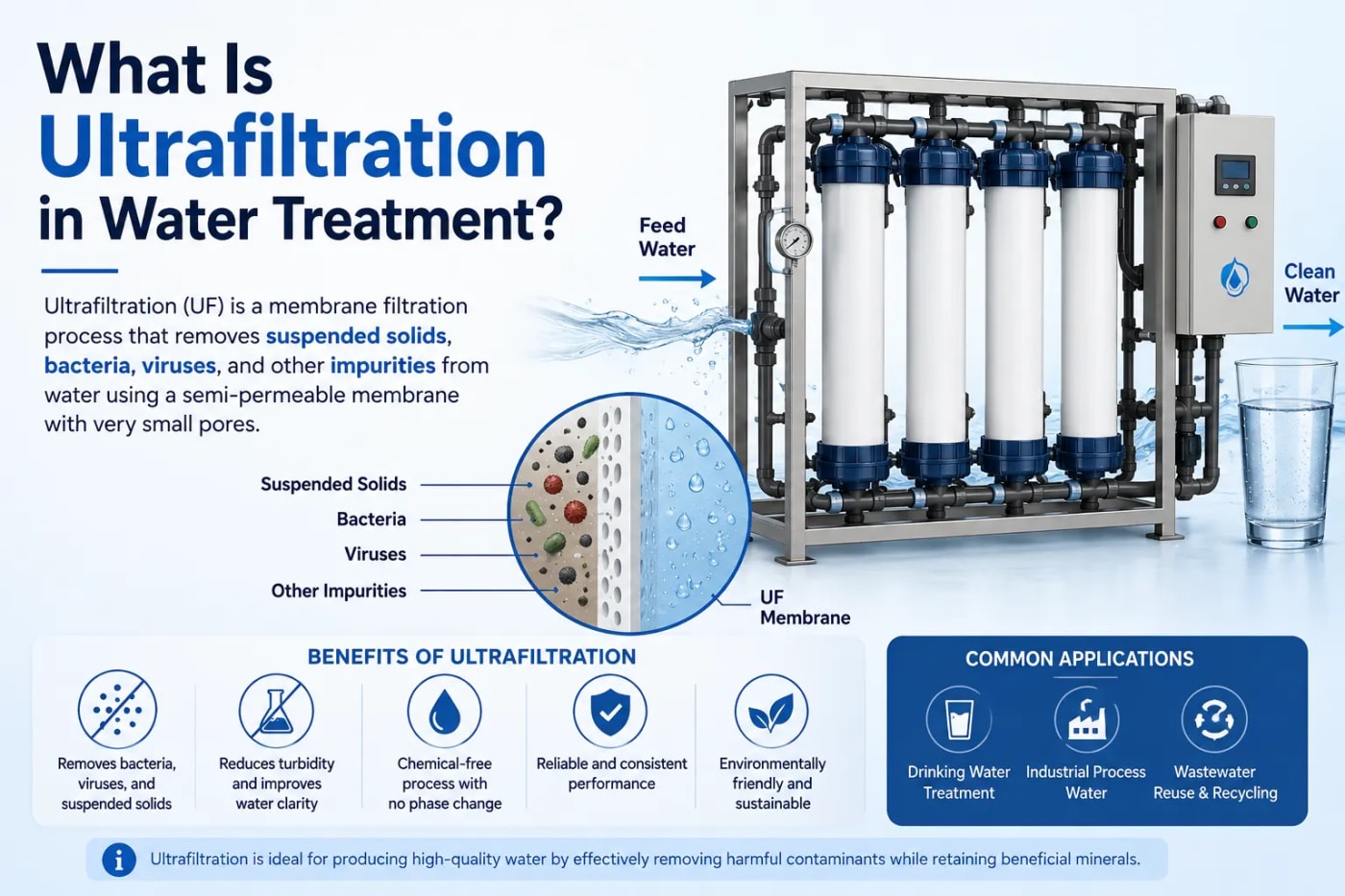
What Is Ultrafiltration (UF) in Water Treatment?
Ultrafiltration (UF) is a membrane filtration process that uses hydrostatic pressure to push water through a semi-permeable hollow fiber membrane with pore sizes typically ranging from 0.01 to 0.1 micron. This ultrafiltration definition classifies the technology as a mechanical size exclusion method, where the membrane acts as a physical sieve to trap microscopic particles while allowing water and dissolved minerals to pass through. Unlike traditional chemical treatments, UF provides a definitive barrier that produces consistent water quality without altering the water's chemical composition.
UF is a pressure-driven process that falls between microfiltration and nanofiltration on the filter spectrum. Microfiltration removes bigger suspended solids and bacteria, whereas ultrafiltration has a smaller pore size that captures much smaller pathogens, including viruses. But it is less restrictive than nanofiltration or reverse osmosis and doesn't filter out dissolved salts or essential minerals such as calcium and magnesium.
For the water treatment, the UF meaning is defined as the performance of a membrane filtration stage with no chemical additives required for clarity. The process involves only physical separation and is therefore a low-energy and sustainable solution for residential, industrial and municipal applications. This classification makes it a suitable instrument for any application requiring high-purity water without the maintenance work of total desalination systems.
How Does Ultrafiltration Work? The Membrane Process Explained
The UF process follows a mechanical sequence where water is purified by passing through a membrane module. To understand how ultrafiltration works, imagine a very fine sieve shaped like a straw. Raw water enters and is forced against a hollow fiber membrane. Movement is caused by transmembrane pressure, pushing water molecules through the tiny pores of the filter.
Moving water through the membrane causes a physical separation based on size. Any particles, bacteria, or viruses larger than the pore diameter are blocked on the feed side; this leftover byproduct is called the concentrate. Filtered clean water that passes through the membrane wall is called permeate or ultrafiltrate. Filtration ensures only pure water and dissolved minerals reach the outlet.
There are two ways that water flows from these systems: Dead-end filtration & cross-flow filtration. In dead-end systems, typical of residential units, all water is pushed against the membrane until it enters through. In industrial cross-flow, water flows parallel to the membrane surface to sweep debris away and prevent the filter from clogging too quickly.
The system must be backwashed to remove trapped particles. In a backwash cycle, clean water is pumped in the permeate direction through the feed side to lift and flush out accumulated solids. This automatic cleaning step is required to extend the life of the hollow fiber membrane and maintain a constant flow rate over a long time.
What Does Ultrafiltration Remove from Water?
The big win with a UF system is its ability to act as a physical wall against the "living" stuff. If you're wondering if UF removes bacteria, the answer is undoubtedly yes. It functions as a physical barrier, capturing bacteria, protozoa (such as the harmful Giardia cysts), and the majority of viruses before they make contact with your glass. It’s also one of the best ways to tackle the question of whether UF removes microplastics, because those tiny plastic bits are too large to fit through a 0.01-micron hole.
However, here is where it gets a little chaotic for people: it doesn't touch the "invisible" stuff that’s actually dissolved in the water. If it’s dissolved, like salt or sugar, it’s going right through. That's why UF reducing TDS (Total Dissolved Solids) is a "no." It’s also not the right tool for determining whether UF removes fluoride or nitrates, because those ions are just too small.
To keep it simple, here’s the breakdown of ultrafiltration's ability to remove contaminants:
UF Removes
Bacteria & Protozoa: Effectively eliminates 99.99% of these biological contaminants.
Most Viruses: Captures the majority of viral pathogens, excluding only the absolute smallest varieties.
Microplastics: Filters out plastic fibers and particles that have entered the water supply.
Silt, Sand, and Turbidity: Clears up "cloudy" water by removing the physical debris causing the haze.
Heavy Metals (Partial): This method only removes heavy metals that are physically bonded to sediment or large particles.
UF Does NOT Remove
TDS / Dissolved Salts: It will not lower the Total Dissolved Solids, meaning minerals like calcium and sodium pass right through.
Fluoride & Nitrates: These ions are too small for a standard UF membrane to catch.
Chlorine: UF does not have chemical adsorption properties; you still need an activated carbon filter for this.
PFAS & Dissolved Chemicals: Synthetic chemicals and "forever chemicals" remain in the water.
Hardness: It does not soften water or prevent scale buildup since the minerals remain dissolved.
One quick reality check on removal for heavy metals: it only works if those metals are attached to larger particles. If you have lead dissolved in your water, UF isn't going to save you; you'd need a different filter for that. Removal of PFAS works the same way; since PFAS are usually dissolved "forever chemicals," they will slip right through the membrane pores.
Ultrafiltration vs. Reverse Osmosis: What Is the Difference?
Choosing between ultrafiltration and reverse osmosis typically depends on the specific contaminants you need to remove from your water. They look similar when seated under a sink, but the internal size of the "sieve" is different. Ultrafiltration pore size is about 0.01 micron, useful for blocking bacteria & gunk but letting minerals through. The other is the RO pore size, which is only 0.0001 micron, about 100 times smaller, and thus strips away virtually every dissolved molecule from the water.
The big difference between UF and RO is more than size; it's about attitude & culture. It is all about the "reject" water. Reverse osmosis consumes a significant amount of water because it needs to flush the membrane every few gallons of clean water that drains. UF is more efficient because it does not require the same "cross-flow," and it does not require a storage tank or electricity because it uses your home's standard water pressure."
Feature | Ultrafiltration (UF) | Reverse Osmosis (RO) |
Pore Size | ~0.01 Micron | ~0.0001 Micron |
TDS Removal | No (Keeps minerals) | Yes (Removes 95%+) |
Water Waste | Zero to Very Low | High (2–4 gallons wasted per 1 gallon kept) |
Removes Fluoride? | No | Yes |
Installation | Simple, no tank needed | Complex, requires storage tank |
Which is better, UF or RO? If your water is essentially safe but you're concerned about bacteria, cysts, or microplastics from an old city pipe, UF is your best option, as it preserves the healthy minerals. But if you have high TDS removal needs, meaning your water tastes "salty," contains fluoride, or has heavy chemical contamination, you need the heavy-duty power of reverse osmosis vs. ultrafiltration. Honestly, many high-end home systems now use a UF filter as a "pre-filter" to protect the more sensitive RO membrane from clogging.
Where Is Ultrafiltration Used? Main Applications in Water Treatment
While many homeowners recognize ultrafiltration water treatment systems as under-sink units, the technology is a powerhouse across several massive industries. Because it provides a physical barrier without using harsh chemicals, it is a go-to solution for large-scale purification. Here are the primary ultrafiltration applications in use today.
Municipal Water Treatment
Urban and local governments frequently use UF as a primary defense in municipal water treatment plants when sourcing from rivers or lakes. The ultra-fine barrier is able to capture Cryptosporidium and Giardia parasites that can survive standard chlorine disinfection.
Industrial Ultrafiltration
For example, in manufacturing, high-purity process water requires industrial ultrafiltration. With these systems, factories remove colloidal silica and suspended solids that may damage delicate machinery or stain high-end electronics and pharmaceuticals.
Wastewater Treatment and Reuse
UF forms part of the membrane bioreactor (MBR) process in modern wastewater treatment. By filtering effluent through such membranes, plants recycle water for non-potable uses, such as industrial cooling, irrigation, or toilet flushing, thereby reducing local water stress.
Ultrafiltration in Food Industries
The impact of ultrafiltration in the food industry is huge, used only for "cold processing" where heat would destroy the product. This is used to clarify juices of fruits, remove sediment from wine, and concentrate proteins in dairy products for special milk products and cheeses.
Whole House Ultrafiltration
Rural homes or homes on well water have whole-house ultrafiltration. Point-of-entry systems provide a "biological shield" around the entire home. One UF water system at the main water line protects all taps, from showers to kitchens, against sediment, bacteria, and microplastics.
How to Choose the Right Ultrafiltration System for Your Needs?
Selecting an UF water system involves matching the membrane’s technical specs to your specific household or facility requirements. Start by evaluating the quality of your source water; if your water is relatively clear but you are concerned about "living" contaminants, ultrafiltration is the best option. Choose whether your contamination is biological or chemical. UF will stop bacteria and parasites but will not stop dissolved lead or fluoride.
Then calculate your daily flow rate. A small unit can serve one tap, but you need an industrial ultrafiltration setup or a whole-house ultrafiltration system if you need high volume output for many appliances simultaneously. Next, decide if you need a single point of use filter for targeted drinking water or a complete entry point to shield your entire plumbing infrastructure from sediment and silt. These affect the size, membrane type & backwashing frequency of your final installation.
What Is Microfiltration and How Is It Different from UF?
A microfiltration membrane uses larger pore sizes, usually between 0.1 to 10 microns, which is great for catching sand, algae, and most bacteria. Microfiltration vs. ultrafiltration basically comes down to how "tight" the filter is. However, it’s not strong enough to stop viruses or smaller colloids, which is exactly why you’d move up to the tighter 0.01-micron pores of MF water treatment's successor, ultrafiltration.
What Is Reverse Osmosis, and When Should You Use It?
Reverse osmosis water treatment utilizes a semi-permeable RO membrane with microscopic pores to effectively strip away dissolved solids, salts, and heavy chemicals. It is the standard for TDS removal and is the only RO system to consider if your water contains fluoride, nitrates, and PFAS. It is powerful but requires more resources than ultrafiltration; for households with generally excellent source water that require only biological protection, RO is usually the more efficient UF system.
What Is a UF Membrane and How Long Does It Last?
An ultrafiltration membrane is typically a bundle of hollow fiber membrane tubes made from durable polymers like PVDF or PES. If you stay on top of your backwashing UF schedule and perform with occasional chemical cleanings, the lifespan of your UF membrane can realistically reach 3 to 7 years. You'll know it’s time for a replacement when you see a permanent drop in your flow rate or a sudden spike in water turbidity.
Does Ultrafiltration Remove PFAS from Drinking Water?
No, UF does not remove PFAS from drinking water. It is because PFAS are "forever chemicals" dissolved at a molecular level; they are simply too small for the ultrafiltration PFAS pores to catch. To achieve reliable PFAS removal from water, you really need to use activated carbon or reverse osmosis unless you are using a very specific, experimental PFAS water treatment membrane with special coatings.
What is Ultrafiltration in Industrial Water Treatment?
Ultrafiltration is a high-capacity membrane filtration process designed to remove fine suspended solids and microorganisms from large volumes of water. In industrial water filtration, ultrafiltration systems are massive workhorses used for everything from making semiconductors to processing milk. These aren't your typical under-sink filters; an industrial UF system is usually built on a large UF skid designed for continuous cross-flow and high-volume output. They are specifically engineered for clean-in-place (CIP) cycles, allowing the system to be chemically scrubbed without tearing the whole thing apart.