Water nanofiltration sits between two well known membrane technologies, reverse osmosis and ultrafiltration, and choosing the right method depends on what your water actually needs, not on which technology sounds the most advanced. This article compares nanofiltration with reverse osmosis, ultrafiltration, microfiltration, activated carbon, ion exchange, conventional treatment and distillation, based on contaminant removal, selectivity, dissolved solids, pressure, water recovery, energy use and application fit. It explains what nanofiltration removes, what it lets through, and where each alternative method outperforms it. It also covers pressure and energy differences, water recovery, common maintenance challenges, and how to measure performance correctly. No single method wins in every situation. The right answer always follows from your specific water quality goal, so this guide maps goals to methods rather than declaring one technology universally best.
How does nanofiltration differ from other methods?
Nanofiltration differs from other methods mainly through its position on the membrane filtration spectrum, sitting between ultrafiltration and reverse osmosis in terms of tightness. Nanofiltration, often called NF, is a pressure driven membrane process. Water is pushed through a membrane with very small pores, and the membrane separates certain dissolved substances from the water that passes through.
Membrane selectivity depends on pore size, sometimes described using a value called molecular weight cut off, or MWCO. A tighter membrane, with a smaller MWCO, blocks smaller particles and molecules. A looser membrane allows more through. The water that passes through the membrane is called permeate, and the concentrated stream left behind, carrying the rejected substances, is called concentrate or reject.
The table below shows where nanofiltration sits compared to microfiltration, ultrafiltration and reverse osmosis:
Method | Typical Pore Size Range | What It Mainly Targets |
Microfiltration (MF) | Largest pores | Suspended particles, some bacteria |
Ultrafiltration (UF) | Smaller than MF | Bacteria, viruses, larger organic molecules |
Nanofiltration (NF) | Smaller than UF | Divalent ions, dissolved organics, some larger molecules |
Reverse osmosis (RO) | Smallest pores | Most dissolved salts, including monovalent ions |
This spectrum view, supported by WHO and CDC technical guidance, sets the stage for the detailed comparisons that follow.
What contaminants does nanofiltration remove?
Nanofiltration removes a specific range of contaminants that fall between what ultrafiltration and reverse osmosis handle. It is important to separate what NF reliably removes from what it only reduces, and from what it may reduce depending on conditions.
Contaminant categories affected by nanofiltration:
Hardness ions: Calcium and magnesium, the main minerals behind water hardness, are removed effectively.
Divalent ions: Ions carrying a double charge, similar to calcium and magnesium, are generally well rejected.
Dissolved organic matter: Larger dissolved organic compounds, including some that cause water color, are reduced.
Color: Water color linked to organic matter is commonly reduced through NF treatment.
Selected synthetic organic compounds: Some larger synthetic organic molecules are reduced, though results vary by compound and membrane.
Microorganisms: Bacteria and larger microorganisms may be reduced, though NF is not designed as a primary disinfection method.
Actual performance always depends on the specific membrane, the feed water chemistry and the target compound, so "removes" for one substance does not guarantee the same result for another.
Which dissolved substances can nanofiltration let through?
Nanofiltration lets through many monovalent ions, meaning it does not reduce total dissolved solids as thoroughly as reverse osmosis. Sodium and chloride, both monovalent ions carrying a single charge, pass through an NF membrane far more easily than calcium and magnesium, which carry a double charge.
This behavior explains why nanofiltration can reduce hardness significantly while still leaving a meaningful amount of dissolved solids in the treated water. The membrane is selective by ion type, not by total dissolved solids as a single number.
The table below shows expected NF behavior by ion class:
Ion Class | Example Ions | Expected NF Behavior | Practical Effect |
Monovalent ions | Sodium, chloride | Passes through more easily | TDS reduction is limited |
Divalent ions | Calcium, magnesium | Rejected more effectively | Hardness is reduced |
Rejection percentages vary with membrane type and feed water chemistry, so treat any single number as an estimate rather than a guarantee for every situation.
How does nanofiltration compare with reverse osmosis?
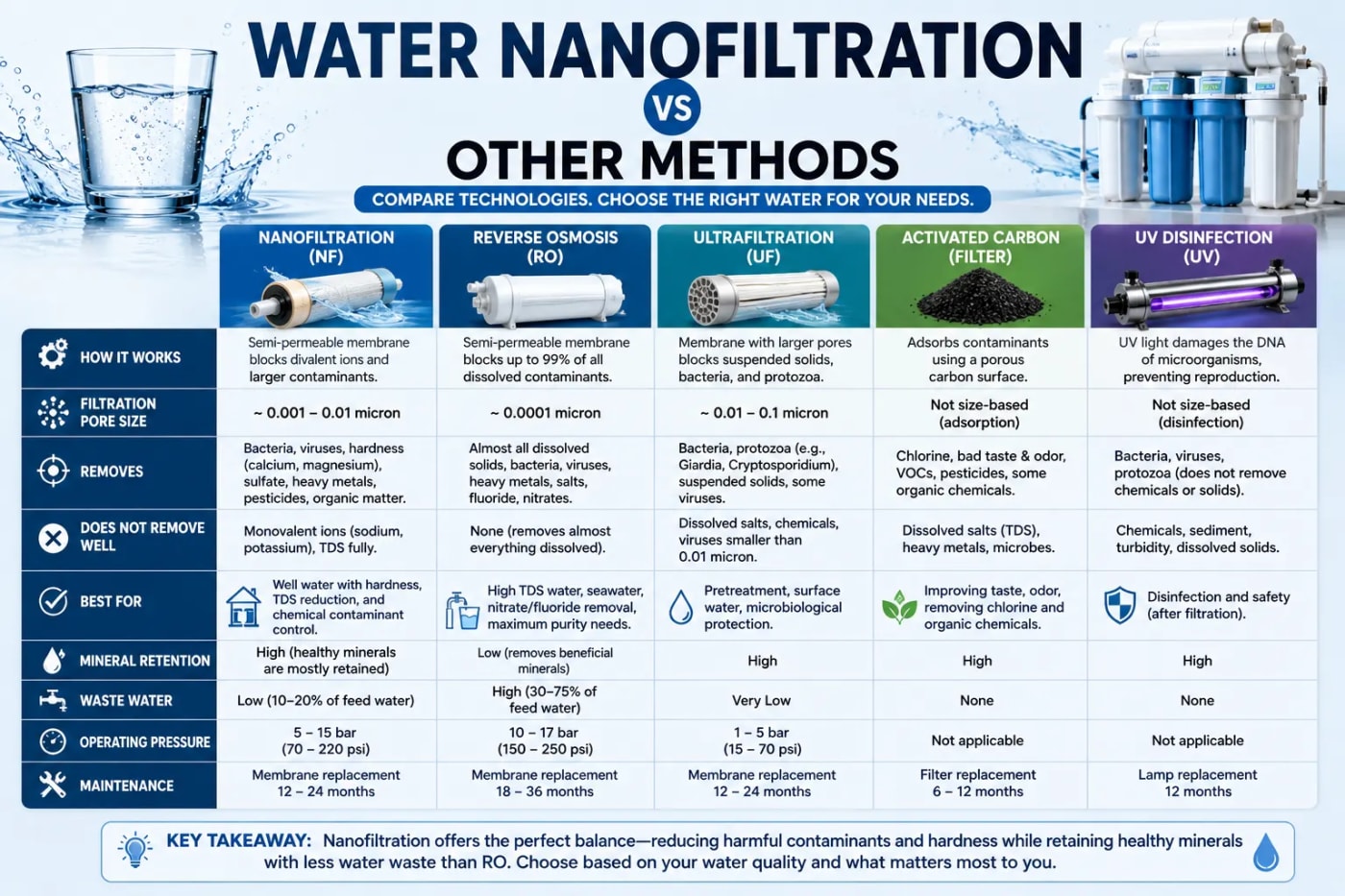
Nanofiltration compares with reverse osmosis as a looser membrane process that removes less of the total dissolved solids while using less pressure and energy. Reverse osmosis is the closest major alternative to NF, since both are pressure driven membrane technologies, but they differ in how tightly they separate dissolved substances.
The table below compares nanofiltration and reverse osmosis across key attributes:
Attribute | Nanofiltration | Reverse Osmosis |
Separation tightness | Looser membrane | Tighter membrane |
Dissolved salt removal | Partial, favors divalent ions | Broad removal, including monovalent ions |
Hardness removal | Effective | Effective |
Mineral retention | Retains more minerals | Retains fewer minerals |
Operating pressure | Generally lower | Generally higher |
Water recovery | Often higher | Often lower |
Energy use | Generally lower | Generally higher |
Typical application | Selective softening, partial demineralization | Full demineralization, desalination |
Neither method removes everything, and neither wastes zero water. Actual pressure, recovery and energy figures depend on the membrane, the feed water and the system design, so treat these as general tendencies rather than fixed numbers.
When is nanofiltration better suited than reverse osmosis?
Nanofiltration becomes the better fit when the goal is selective treatment rather than complete demineralization.
Scenarios where nanofiltration fits well:
Hard water: When hardness is the main concern, NF reduces calcium and magnesium without removing all dissolved minerals.
Selected organic matter: When color or specific dissolved organic compounds need reduction, NF often performs this role efficiently.
Partial softening: When some mineral content in the finished water is acceptable, or even preferred, NF avoids over treatment.
Applications where full demineralization is unnecessary: When the water use does not require near zero dissolved solids, NF avoids the extra energy and pressure that reverse osmosis requires.
EPA guidance and membrane application research support NF as an appropriate technology for these selective treatment goals.
When is reverse osmosis better suited than nanofiltration?
Reverse osmosis becomes the better fit when the target water quality requires strong rejection of monovalent salts, not just divalent ions.
Conditions favoring reverse osmosis:
High salinity: Water with high salt content needs the tighter separation RO provides.
Desalination: Removing dissolved salts from seawater or brackish water requires RO level rejection.
Very low dissolved solids requirements: Applications needing near zero TDS depend on RO rather than NF.
High purity applications: Certain industrial or specialized uses require water purity beyond what NF alone can achieve.
The EPA recognizes reverse osmosis as the appropriate technology when the treatment goal centers on comprehensive dissolved solids removal.
How does nanofiltration compare with ultrafiltration?
Nanofiltration compares with ultrafiltration as a tighter membrane that extends treatment into dissolved substances, while ultrafiltration primarily addresses larger particles and microorganisms.
The table below compares nanofiltration and ultrafiltration:
Attribute | Ultrafiltration | Nanofiltration |
Membrane tightness | Looser | Tighter |
Dissolved salts | Passes through largely untouched | Partial removal, favors divalent ions |
Hardness | Not significantly reduced | Reduced |
Organic molecules | Removes larger molecules | Removes a broader range, including smaller dissolved organics |
Bacteria | Effectively removed | Effectively removed |
Viruses | Often removed, depending on membrane | Often removed, depending on membrane |
CDC and WHO guidance confirms that ultrafiltration primarily targets particles, bacteria and viruses, while nanofiltration extends into dissolved ionic and organic species that UF does not significantly affect.
How does nanofiltration compare with microfiltration?
Nanofiltration compares with microfiltration across a much larger separation gap than the NF versus UF comparison, since microfiltration targets only the largest particles.
The table below compares nanofiltration and microfiltration:
Attribute | Microfiltration | Nanofiltration |
Suspended particles | Removed effectively | Removed effectively |
Turbidity | Reduced | Reduced |
Bacteria | Often removed | Often removed |
Dissolved ions | Passes through | Partially removed |
Organic matter | Larger particles only | Dissolved organic matter also reduced |
WHO technical guidance confirms that microfiltration operates at the coarse end of the membrane spectrum, leaving dissolved substances almost entirely untouched, which is where nanofiltration provides additional treatment value.
How does nanofiltration compare with activated carbon?
Nanofiltration compares with activated carbon as two fundamentally different mechanisms, membrane separation versus adsorption, each suited to different contaminant types.
Activated carbon works through adsorption, meaning contaminants stick to the surface of the carbon material as water passes through. This process is particularly effective for improving taste and odor, and for reducing chlorine and certain organic contaminants. Nanofiltration, by contrast, physically separates dissolved substances based on membrane pore size and ionic charge, targeting hardness, divalent ions and a broader range of membrane separated compounds.
Key differences between activated carbon and nanofiltration:
Mechanism: Activated carbon uses adsorption, while nanofiltration uses membrane separation.
Typical target: Activated carbon focuses on taste, odor, chlorine and selected organic contaminants, while nanofiltration focuses on hardness and dissolved organic and ionic species.
Certification dependence: Actual contaminant reduction from activated carbon filters depends heavily on the specific product and its certification.
The CDC notes that activated carbon is primarily used in many consumer filters to improve taste and smell, and that product specific certification determines the actual contaminants a given filter reduces. Neither technology should be assumed to remove all chemicals universally.
How does nanofiltration compare with ion exchange?
Nanofiltration compares with ion exchange as a broader membrane process versus a targeted ionic treatment method. Ion exchange works by swapping unwanted ions in the water for other ions held on a resin, making it particularly effective when a specific ionic contaminant or a hardness problem is the main concern.
Key distinctions between nanofiltration and ion exchange:
Targeting approach: Ion exchange targets specific ions, while nanofiltration separates multiple contaminant classes at once.
Mechanism: Ion exchange relies on chemical exchange with a resin, while nanofiltration relies on physical membrane separation.
Best fit: Ion exchange fits situations focused on one ionic issue, such as hardness or nitrate, while nanofiltration fits situations needing broader treatment across dissolved organics and divalent ions together.
Choosing between the two depends on whether the water problem is narrow and ion specific, or broader across several contaminant classes at once.
How does nanofiltration compare with conventional treatment?
Nanofiltration compares with conventional treatment as a membrane based process versus a chemical and physical process built around coagulation, flocculation, sedimentation and filtration.Conventional treatment uses chemical dosing to clump smaller particles into larger ones, called flocs, which then settle out during sedimentation, followed by filtration to remove remaining particles. This process handles turbidity and suspended solids well but is less effective at removing dissolved organic matter and color compared to nanofiltration.
Research shows that nanofiltration can be added to a conventional treatment train as an upgrade step, specifically to achieve additional removal of dissolved organic matter and color that conventional methods alone do not fully address.
How does nanofiltration compare with distillation?
Nanofiltration compares with distillation as two entirely different separation principles, pressure driven membrane filtration versus thermal phase change.
Distillation heats water into vapor, then cools that vapor back into liquid, leaving dissolved solids and many other contaminants behind in the process. Nanofiltration instead pushes water through a membrane under pressure, separating substances based on size and charge rather than through a change of state.
The table below compares nanofiltration and distillation:
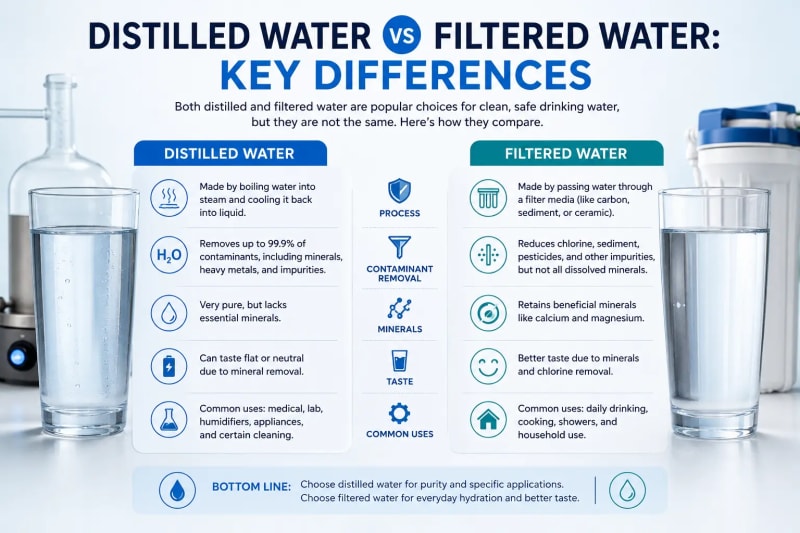
Attribute | Nanofiltration | Distillation |
Separation principle | Pressure driven membrane filtration | Thermal phase change |
Dissolved solids | Partial removal, favors divalent ions | Removes most dissolved solids |
Energy source | Pump pressure | Heat |
Typical use | Selective softening, partial demineralization | Desalination, high purity water production |
These two methods differ fundamentally in mechanism, energy input and the characteristics of the finished water, making direct comparison useful mainly at the level of application fit rather than shared technical specifications.
How do pressure and energy needs differ across methods?
Pressure and energy needs differ across methods largely based on how tightly each process separates substances. Nanofiltration generally needs less pressure than reverse osmosis, since NF membranes are looser and do not have to overcome the same level of osmotic resistance from dissolved salts. Ultrafiltration and microfiltration typically need even lower pressure than nanofiltration, since their membranes are looser still and target larger particles rather than dissolved ions.Thermal treatment methods such as distillation rely on heat energy rather than pressure, and this energy demand can be substantial depending on the scale of treatment and the source of heat used.
Actual pressure and energy requirements depend on several variable factors, including feed water chemistry, membrane type, water temperature and target recovery rate. WHO, EPA and manufacturer technical data all confirm this variability, so no single pressure or energy number applies universally across every nanofiltration or reverse osmosis system.
How does water recovery differ between treatment methods?
Water recovery differs between treatment methods based on system design, membrane type and how much concentrate the process produces. Membrane systems, including nanofiltration and reverse osmosis, produce two output streams, permeate and concentrate. Permeate is the treated water that passes through the membrane, while concentrate carries the rejected substances at a higher concentration than the original feed water.Recovery rate refers to the percentage of feed water that becomes usable permeate rather than concentrate. This rate is not fixed by the technology alone, since system design choices directly affect how much water becomes usable output versus reject stream.
Recovery matters for two practical reasons. First, lower recovery means more raw water input is needed to produce the same amount of treated water. Second, the concentrate stream requires proper management, since it carries a higher load of rejected contaminants than the original source water.
EPA technical guidance confirms that recovery is a design dependent factor across membrane treatment systems, not a fixed characteristic of nanofiltration or reverse osmosis as technologies.
What maintenance challenges affect nanofiltration performance?
Maintenance challenges affecting nanofiltration performance center mainly on fouling and scaling, both of which reduce membrane efficiency over time.
Fouling occurs when particles, organic matter or biological material build up on the membrane surface, restricting water flow through the pores. Scaling occurs when dissolved minerals, particularly calcium and magnesium compounds, precipitate onto the membrane surface as their concentration rises in the reject stream.
Common maintenance considerations for nanofiltration systems:
Pretreatment: Removing larger particles and adjusting water chemistry before it reaches the membrane reduces fouling risk.
Cleaning schedules: Regular cleaning cycles help maintain membrane flow rate and rejection performance.
Feed water monitoring: Tracking changes in feed water chemistry helps anticipate scaling or fouling risk before performance drops.
Performance tracking: Monitoring flow rate and rejection over time reveals gradual membrane decline that a single test might miss.
Research identifies fouling as a significant limitation across both nanofiltration and reverse osmosis systems, and EPA guidance notes that pretreatment is frequently required to protect membrane performance and extend membrane lifespan.
How should nanofiltration performance be measured?
Nanofiltration performance should be measured using rejection rate, permeate quality, recovery and flux together, rather than relying on any single number in isolation.Rejection rate describes the percentage of a specific substance blocked by the membrane. Permeate quality describes the actual measured quality of the treated water output. Recovery describes the percentage of feed water converted into usable permeate. Flux describes the rate of water flow through the membrane surface.
Checklist for interpreting nanofiltration performance data:
Check the test salt used. Rejection figures based on one salt type do not automatically apply to a different dissolved substance.
Check the test pressure. Rejection changes with operating pressure, so a figure from one pressure setting may not transfer to another.
Check the test temperature. Membrane performance shifts with water temperature.
Check the recovery rate used in testing. A test run at low recovery may show different rejection than the same membrane run at higher recovery.
Compare figures only from matching test conditions. Never compare two rejection percentages unless the underlying test conditions are the same.
DuPont technical data illustrates why test conditions matter so much, showing that membrane type, test salt, pressure, temperature and recovery all shift the resulting rejection figures for the same general membrane category.
Which water quality goals fit nanofiltration best?
Water quality goals that fit nanofiltration best are hardness reduction, selected dissolved organic removal, color reduction, partial salt reduction and situations where retaining some minerals in the finished water is acceptable or desired.
The table below maps common water quality goals to nanofiltration suitability:
Water Quality Goal | NF Suitability | Reason | Alternative to Consider |
Hardness reduction | Strong fit | Effectively rejects calcium and magnesium | Ion exchange for pure softening |
Selected dissolved organics | Strong fit | Reduces many organic compounds and color | Activated carbon for taste and odor issues |
Full demineralization | Weak fit | Monovalent ions pass through NF membranes | Reverse osmosis |
Desalination | Weak fit | Requires stronger rejection of dissolved salts | Reverse osmosis or distillation |
Mineral retention with partial treatment | Strong fit | NF removes select contaminants while keeping some minerals | Conventional treatment for basic clarity only |
Bacteria and virus removal only | Moderate fit | Some reduction occurs, but NF is not a dedicated disinfection method | Ultrafiltration or disinfection specific methods |
This mapping shows that nanofiltration is not universally the best choice. It fits certain goals well and fits others poorly, which is exactly why the underlying water quality objective must guide the technology choice rather than any single technology being labeled the best overall.
What should you know about your water before choosing?
Before choosing between nanofiltration and any other method, you should know the specific problem in your water, not just a single number such as total dissolved solids. Technology selection should follow the actual feed water issue rather than one broad measurement.
Checklist of information to gather before selecting a treatment method:
Water source: Know whether your water comes from a private well, a municipal supply or another source, since each carries different typical contaminant profiles.
Hardness level: Know your calcium and magnesium levels if hardness is a concern.
Total dissolved solids: Know your overall TDS reading, while remembering it alone does not identify the specific substances present.
Specific contaminants: Identify any known specific contaminants relevant to your area or water source.
pH level: Know your water pH, since it can affect both contamination behavior and treatment performance.
Microbial test results: Know whether bacteria or other microorganisms have been detected.
Intended use: Clarify whether the treated water is for drinking, cooking, industrial use or another specific purpose.
The CDC specifically recommends checking the filter label for the exact contaminants a given filter is certified to reduce, rather than assuming a general category of filter handles every possible water quality issue. This checklist is a starting point for choosing a treatment method, not a complete water testing guide on its own.
What is nanofiltration and how does it work?
Nanofiltration is a pressure driven membrane filtration process that separates dissolved substances from water based on molecular size and ionic charge. Water is forced through a membrane with very small pores under pressure, and the membrane allows smaller monovalent ions to pass while rejecting larger dissolved organic molecules and divalent ions such as calcium and magnesium. For a complete explanation of the process, see What Is Nanofiltration?
What contaminants does reverse osmosis remove?
Reverse osmosis removes a broad range of dissolved contaminants, including most dissolved salts, due to its tighter membrane compared to nanofiltration. For a full contaminant by contaminant breakdown, see What Does Reverse Osmosis Remove?
Can nanofiltration remove hard water minerals?
Nanofiltration can remove hard water minerals effectively, since calcium and magnesium are divalent ions that NF membranes reject well. Actual performance varies depending on the specific membrane and the feed water chemistry involved. For guidance on hard water treatment options, see Best Water Filters for Hard Water.
Does nanofiltration remove PFAS from water?
Nanofiltration can be effective for removing certain PFAS compounds from water, though performance varies significantly by specific PFAS compound and membrane type. No blanket removal percentage applies across every situation. For complete guidance on PFAS treatment, see Best Water Filters for PFAS.
How should you test water before choosing a filter?
Water should be tested before choosing a filter by identifying the actual water quality problem present, rather than relying only on a total dissolved solids reading. Hardness testing and contaminant specific testing both help narrow down which treatment method actually addresses your situation. For the full testing process, see How to Test Your Water Quality.
What is the difference between water softening and filtration?
The difference between water softening and filtration is that softening specifically targets hardness minerals through ion exchange, while filtration physically separates a broader range of contaminants using a membrane or filter media. For a complete comparison, see Water Softener vs Water Filter.
Conclusion
Nanofiltration occupies a specific place between ultrafiltration and reverse osmosis, removing hardness ions and selecting dissolved organic matter while allowing many monovalent salts to pass through. It uses less pressure and energy than reverse osmosis and often achieves higher water recovery, but it does not match RO for full demineralization or desalination. Choosing the right method always starts with understanding your actual water quality goal, whether that goal is hardness reduction, color removal, full demineralization or targeted contaminant treatment. Test your water first, match the result to the correct technology, and confirm ongoing performance through proper monitoring rather than assuming any single method solves every water quality problem.