A water softener and a water filter solve two different problems. A water softener is built specifically to address water hardness, caused by dissolved calcium and magnesium, through a process called ion exchange. A water filter is a broader category, and what it removes depends entirely on the specific filtration technology inside it, such as activated carbon, sediment filtration, reverse osmosis, or UV. This article compares treatment purpose, mechanism, target substances, household outcomes, installation scope, and maintenance for both systems, and explains when a home actually needs one, the other, or both.
How does a water softener differ from a water filter in treatment purpose?
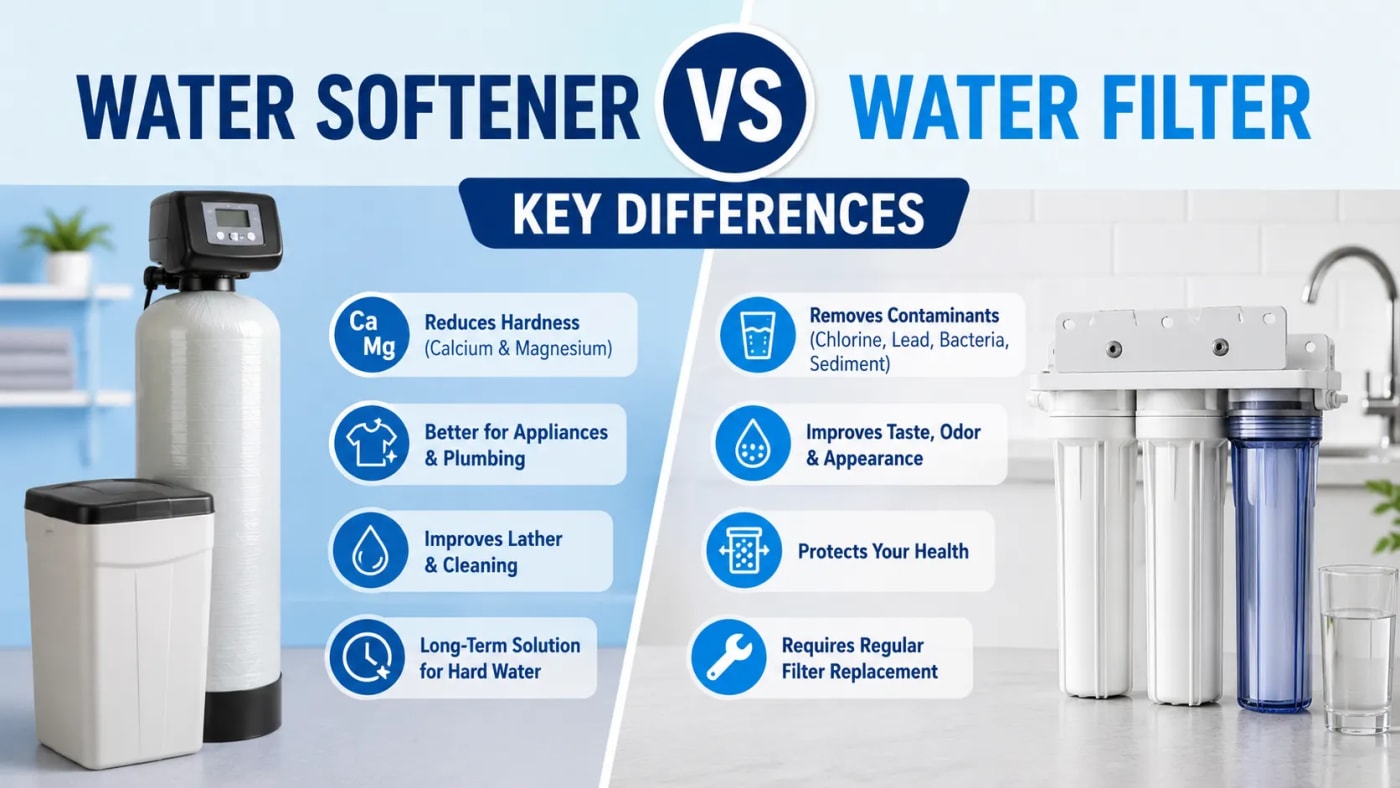
A water softener differs from a water filter in treatment purpose because a softener is built around one specific problem, water hardness, while a water filter is a general term for devices that treat different substances depending on their technology.
A softener always addresses the same target: dissolved calcium and magnesium in the water supply. A water filter does not have one fixed target. Depending on the technology inside it, a filter might reduce chlorine taste, sediment, lead, PFAS, or microorganisms, but no single filter addresses all of these at once. This distinction matters because "water filter" alone does not tell you what a specific product actually removes.
How does a water softener remove hardness from water?
A water softener removes hardness from water through a process called ion exchange, using resin beads to swap hardness minerals for sodium or potassium.
The softening process generally follows these steps:
Hard water enters the tank: Water containing dissolved calcium and magnesium flows into the softener's resin tank.
Water passes through resin: The resin beads are coated with sodium or potassium ions.
Ion exchange occurs: Calcium and magnesium ions attach to the resin, while sodium or potassium ions release into the water.
Softened water exits: Water leaves the tank with hardness minerals replaced by sodium or potassium.
Regeneration restores the resin: Once the resin's exchange capacity is used up, a brine solution flushes the tank, replacing the trapped calcium and magnesium with fresh sodium or potassium ions, so the resin can continue working.
This mechanism is specific to hardness minerals. It does not involve carbon filtration, membrane treatment, or UV disinfection, since those are entirely separate technologies used in filtration rather than softening.
How does water filtration remove different contaminants?
Water filtration removes different contaminants depending on which treatment technology a specific filter uses, since filtration is not one single mechanism.
Common filtration technologies and their general approach:
Activated carbon: Adsorbs certain chemicals, chlorine, and substances that affect taste and odor.
Sediment filtration: Physically traps particles such as dirt, sand, and rust.
Reverse osmosis: Forces water through a membrane that reduces a broad range of dissolved solids.
KDF media: Uses a chemical process to reduce certain contaminants, often paired with carbon.
UV treatment: Uses ultraviolet light to inactivate certain microorganisms.
No single filter type removes every contaminant. NSF certification is the most reliable way to confirm what a specific filtration product is actually designed and tested to reduce, rather than relying on general category names like "water filter."
Which substances does a water softener target compared with a water filter?
A water softener targets calcium and magnesium specifically, while a water filter targets whatever substances its particular technology is designed and certified to address.
The table below compares typical target substances for each system:
System | Primary Target Substances |
Water softener | Calcium and magnesium, the minerals responsible for hardness |
Water filter | Depends on technology: sediment, chlorine, lead, PFAS, VOCs, or microorganisms, only where the specific product is designed or certified for that substance |
"Water filter" is not a single removal specification. Two filters can look similar but address completely different substances depending on the media and certification behind them.
What household problems does a water softener solve that filtration does not?
A water softener solves household problems that trace directly back to hardness, which ordinary filtration does not address.
Common problems linked to water hardness:
Scale buildup: Mineral deposits form inside pipes, water heaters, and appliances, reducing efficiency over time.
Hard-water deposits: Visible white or chalky residue appears on fixtures, glassware, and shower doors.
Reduced soap performance: Soap and detergent lather less effectively in hard water, often requiring more product for the same result.
Spotting on dishes and surfaces: Mineral residue leaves spots on dishes, glassware, and freshly cleaned surfaces.
Strain on plumbing and appliances: Scale buildup can shorten the lifespan of water heaters, washing machines, and other water-using appliances.
These outcomes are directly connected to hardness minerals, and ordinary filtration technologies are not designed to resolve them.
What water-quality problems can filtration solve that softening does not?
Filtration solves water-quality problems related to taste, odor, sediment, and specific contaminants, which a water softener does not address.
Common problems addressed by filtration, depending on the technology used:
Chlorine taste and odor: Activated carbon filtration commonly reduces the taste and smell associated with chlorine treatment.
Sediment and cloudiness: Sediment filtration removes particles such as dirt, sand, and rust that cause cloudy water.
Specific certified contaminants: Filters certified for substances like lead or certain organic chemicals address those specific concerns when the product's certification confirms it.
The exact result always depends on the filter's technology and its certification. A softener's benefits around scale and hardness are separate from these outcomes and do not overlap with them.
How do water softener and water filter installation scopes differ?
Water softener and water filter installation scopes differ mainly in where each system is typically placed and how much of the household supply it covers.
The table below compares typical installation scope:
System | Typical Installation | Coverage |
Water softener | Whole-house, point-of-entry | Treats water for the entire household supply |
Water filter | Whole-house or point-of-use | Depends on whether the goal is treating all household water or just drinking water |
The right installation location depends on the treatment objective. Hardness affects the entire household supply, including water heaters and appliances, so softeners are almost always installed at the point of entry. Filtration needs vary. Some households want whole-house filtration for chlorine reduction, while others only need a point-of-use filter at the kitchen tap for drinking water.
How do maintenance and operating requirements differ between the two systems?
Maintenance and operating requirements differ significantly between a water softener and a water filter, since each relies on a different ongoing process.
The table below compares typical ownership requirements:
Requirement | Water Softener | Water Filter |
Consumable | Salt or potassium pellets for brine regeneration | Replacement cartridges or media, depending on technology |
Water use | Uses water during the regeneration cycle | Generally does not use extra water, except reverse osmosis systems, which produce some wastewater |
Regeneration or replacement cycle | Periodic regeneration, based on usage and hardness level | Cartridge or media replacement, based on usage and manufacturer guidance |
Technology-specific needs | Resin tank monitoring | Varies by filter type, such as membrane care for reverse osmosis or lamp replacement for UV systems |
Cation-exchange softeners consume both water and salt during the regeneration cycle, which is a distinct operating cost separate from filter cartridge replacement.
Can a water filter replace a water softener for hard water?
A water filter generally cannot replace a water softener for hard water, since ordinary sediment or carbon filtration does not provide conventional hardness removal.
Sediment filters trap physical particles, and carbon filters adsorb specific chemicals, but neither technology performs ion exchange, so neither removes calcium and magnesium in the way a softener does. Reverse osmosis is an exception worth understanding separately. It can reduce dissolved hardness minerals as part of its broader dissolved-solids reduction, but this is a different treatment approach and scope from a conventional whole-house softener, since RO systems are typically installed at a single point of use rather than treating the entire household supply. It is also worth distinguishing a true water softener from a salt-free scale conditioner, which alters mineral behavior to reduce scale buildup without actually removing hardness minerals from the water, unlike true ion-exchange softening.
Can a water softener replace a filter for contaminant removal?
A water softener generally cannot replace a filter for contaminant removal, since conventional softening is built specifically around hardness ions rather than general contaminants.
A softener's ion-exchange process targets calcium and magnesium. It is not designed to address chlorine taste, sediment, lead, or other contaminants that filtration technologies handle. Presenting a softener as a general contaminant-removal system is a common misunderstanding, since its resin-based process simply does not interact with those substances the way carbon adsorption or membrane filtration does. Treatment claims are always technology-specific, so the presence of a softener in a home says nothing about whether chlorine, sediment, or lead concerns are being addressed.
When can a home need both a water softener and a water filter?
A home can need both a water softener and a water filter when it has measurable hardness along with a separately identified filtration concern, since the two systems solve independent problems.
Common scenarios where both systems apply:
Scale plus chlorine taste: Hardness is causing scale buildup, while chlorine taste or odor is also present, calling for a softener and a carbon filter.
Hardness plus sediment: Hardness is confirmed through testing, while sediment or cloudiness also affects the water supply, calling for a softener and a sediment filter.
Hardness plus a certified contaminant concern: Hardness is present alongside a specific contaminant, such as lead, that requires a filter certified for that exact substance.
Not every home needs both systems. The right combination depends entirely on what your specific water testing and water-quality report actually show, rather than assuming both are always necessary.
How should water testing determine whether you need a softener or filter?
Water testing should determine whether you need a softener or filter by identifying the exact substances present in your water, since visible symptoms alone do not reveal every water-quality issue.
Follow this process to match testing results to the right treatment:
Identify your water source: Confirm whether your water comes from a municipal supplier or a private well.
Review the water-quality report: Municipal customers can check their local Consumer Confidence Report for reported hardness and contaminant levels.
Test relevant parameters: Measure hardness directly, and test for any contaminants you suspect, especially for private well water, which is not covered by municipal reporting.
Match the treatment to the result: Confirmed hardness points toward a softener, while a specific contaminant, taste issue, or sediment concern points toward a filtration technology suited to that substance.
Verify the product's certification: Check that any filter you choose carries a certification that matches the exact contaminant identified in your testing.
How do water treatment needs translate into choosing the right system?
Water treatment needs translate into choosing the right system through one of three outcomes: a softener only, a filter only, or both, depending entirely on what your testing shows.
The table below summarizes the decision:
Testing Result | Recommended System |
Only hardness confirmed | Water softener |
Only a specific contaminant, taste, or sediment issue confirmed | Water filter matched to that issue |
Both hardness and a separate filtration concern confirmed | Water softener and water filter together |
This decision should always follow from actual testing results rather than assumptions, since hardness and contaminant concerns are independent water-quality issues that call for different treatment technologies.
What is hard water and how is water hardness measured?
Hard water contains dissolved calcium and magnesium, and hardness is generally measured in grains per gallon or milligrams per liter, with water classified into ranges from soft to very hard. For a complete guide covering causes, hardness levels, testing methods, and treatment options, see: Water Hardness: Causes, Levels, Testing and Treatment.
How does a whole-house water filter differ from a point-of-use filter?
A whole-house water filter treats water for the entire household supply at the point of entry, while a point-of-use filter treats water only at a specific tap, such as the kitchen sink. For a full comparison of coverage, installation, and use cases, see: Whole-House vs Point-of-Use Water Filters.
What types of water filters remove specific contaminants?
Different filter types remove different contaminants: activated carbon targets taste and odor related substances, reverse osmosis reduces a broad range of dissolved solids, and UV targets certain microorganisms, each with its own certified capabilities. For a complete breakdown of filter types and what each one removes, see: Types of Water Filters and What They Remove.
How does a water softener work during regeneration?
A water softener works during regeneration by flushing the resin tank with a salt or potassium brine solution, which replaces the trapped calcium and magnesium with fresh sodium or potassium ions so the resin can continue softening water. For the complete mechanism, see: How Does a Water Softener Work?
Does reverse osmosis remove hard water minerals?
Reverse osmosis does reduce dissolved hardness minerals as part of its broader dissolved-solids reduction, but this is a different treatment approach from a conventional whole-house softener, since RO is typically installed at a single point of use. For a complete explanation, see: Reverse Osmosis Water Filtration.
How should a water filter be chosen for a specific contaminant?
A water filter should be chosen for a specific contaminant by starting with the exact substance identified through testing, then selecting a filter technology and certification that specifically addresses it. For a complete selection guide, see: How to Choose a Water Filter for Specific Contaminants.
Conclusion
A water softener and a water filter are not interchangeable, since each is built to solve a different problem. A softener uses ion exchange to remove calcium and magnesium, resolving scale, spotting, and reduced soap performance caused by hardness. A water filter covers a wide range of technologies, and what it removes depends entirely on the specific product and its certification. Start with water testing and your local water-quality report to identify exactly what your water contains, then match that result to a softener, a filter, or both. This approach gives a far more reliable outcome than assuming one system can handle every water-quality concern on its own.