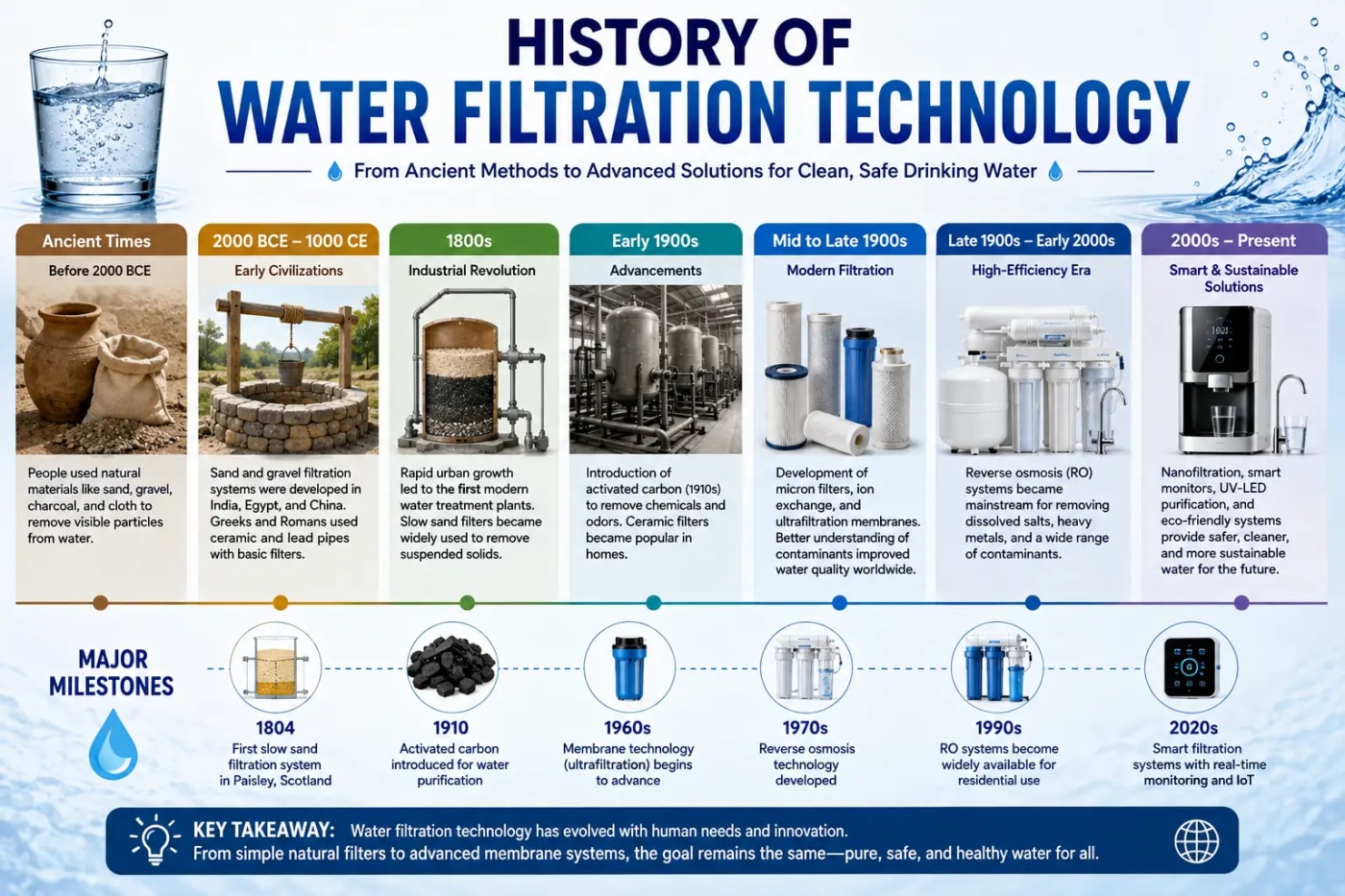
Water filtration technology developed over thousands of years, moving from simple ancient practices into the engineered treatment systems used today. Early humans relied on charcoal, sand, cloth and sunlight to improve taste and appearance, long before anyone understood microorganisms. Scientific discoveries, especially microscopy and germ theory, later shifted the goal from sensory cleanliness to microbiological safety. Municipal sand filtration, chlorination, drinking water regulation, activated carbon and membrane technology each arrived in response to a new problem that earlier methods could not solve. This article walks through that full timeline, from ancient filtration materials through modern treatment trains, explaining why each major shift happened and what problem it solved.
When did humans first treat drinking water?
Humans first treated drinking water mainly to improve its taste, smell and appearance, long before anyone understood microbiological safety. Early treatment was based entirely on what people could sense directly. If water looked clear, smelled acceptable and tasted normal, it was generally considered safe, even though this judgment had no connection to microorganisms that could not be seen.
Early treatment practices used by ancient people:
Charcoal: Used to absorb odors and improve the taste of water.
Sunlight exposure: Used as a simple method believed to improve water quality.
Boiling: Used in various cultures, primarily to change taste and appearance rather than for a known safety purpose.
Straining: Used to remove visible particles using cloth or other simple materials.
Early filtration: Used basic materials to physically separate larger particles from water before drinking.
The EPA's historical record on water treatment confirms that these early practices were rooted in sensory judgment rather than any scientific understanding of contamination.
How did ancient civilizations filter and purify water?
Ancient civilizations filtered and purified water using different combinations of methods, depending on their region and available materials, though several approaches appear across multiple cultures.
The table below summarizes documented ancient water treatment approaches:
Civilization | Documented Practice | Purpose |
Ancient Egypt | Sedimentation and basic filtration materials | Removing visible particles and clarifying water |
Ancient India | Boiling and sunlight exposure | Improving taste and appearance |
Ancient Greece | Filtration through cloth or porous materials | Straining out particles |
Ancient Rome | Sedimentation and engineered water supply systems | Delivering clearer water to population centers |
Not every ancient civilization used the same combination of methods, and evidence for specific practices varies by region and historical record. According to the EPA's historical overview, this variation reflects the resources and knowledge available in each setting rather than a single universal ancient method.
Which materials were used in early water filters?
Materials used in early water filters were chosen mainly for their physical ability to trap particles or absorb impurities, using whatever was locally available.
The table below shows historically documented filter materials, their period of use and their purpose:
Material | Historical Period | Purpose |
Sand | Ancient through modern eras | Trapping suspended particles as water passes through |
Gravel | Ancient through modern eras | Supporting filter layers and aiding water flow |
Charcoal | Ancient through modern eras | Absorbing odors and improving taste |
Cloth | Ancient civilizations | Straining out larger visible particles |
Ceramic | Various historical periods | Filtering water through small pores in fired clay |
Each material contributed a specific physical function rather than a complete treatment solution on its own, which is why many historical filters combined several materials in layers.
Why did early water filtration focus on taste and appearance?
Early water filtration focused on taste and appearance because that was the only information available to the people using it. Ancient users could observe turbidity, notice unpleasant smells and taste unusual flavors, but they had no way to detect microorganisms, since the tools needed to see them did not yet exist.
This sensory based definition of clean water shaped treatment practices for a very long period of history. Water that appeared clear and tasted normal was treated as safe, even when it carried microorganisms capable of causing illness. The EPA's historical record identifies this sensory limitation as the defining characteristic of water treatment before the era of scientific discovery.
How did scientific discovery change water filtration?
Scientific discovery changed water filtration by revealing that water could carry invisible threats, shifting the entire goal of treatment from sensory cleanliness toward microbiological safety.This shift did not happen instantly. It developed gradually as new scientific tools and theories emerged, each one adding to the growing understanding that clean looking water could still be dangerous.
How did microscopy change the understanding of water quality?
Microscopy changed the understanding of water quality by making microorganisms visible for the first time, revealing that water could contain living organisms invisible to the naked eye.This discovery directly challenged the older sensory definition of clean water. Once microorganisms could be observed under a microscope, the idea that appearance alone determined safety no longer held up. This observation set the stage for germ theory and the broader scientific shift that followed, connecting specific microorganisms to disease.
How did germ theory influence water treatment?
Germ theory influenced water treatment by connecting specific microorganisms to specific diseases, transforming the treatment goal from general cleanliness into targeted microbiological safety.Louis Pasteur's work on germ theory contributed significantly to this scientific shift, though he did not single handedly invent water treatment. His research, alongside the work of other scientists during this period, built the foundation for understanding that contaminated water could transmit disease through specific, identifiable organisms. According to the EPA's historical overview, this broader shift in scientific understanding directly influenced how water treatment was approached going forward.
Who developed the first patented water filter?
The first patented water filter was developed by Joseph Amy, marking a distinct technological milestone in the history of water treatment. The EPA linked historical record identifies a patent date of 1746, with market introduction following in 1750.Some secondary sources report different dates for this development, so the distinction between the patent date and the date the filter reached the market matters when reviewing historical claims. This early patented filter represented a shift toward engineered filtration devices, separate from the informal historical methods used before it.
How did sand filtration become a municipal technology?
Sand filtration became a municipal technology as population growth and urbanization created a demand for treating water at a much larger scale than individual households could manage. Polluted water sources near growing cities made informal, small scale treatment methods insufficient for public health needs.John Gibb played a significant role in this transition, introducing an early large scale filtration system that demonstrated sand filtration could function beyond individual or small scale use.
The table below shows key milestones in the development of municipal sand filtration:
Year | Development | Location |
1804 | John Gibb's filtration system | Paisley, Scotland |
1829 | James Simpson's slow sand filtration improvements | Chelsea Waterworks, London |
These milestones, documented by the American Water Works Association, mark the beginning of filtration as a technology built for entire communities rather than individual use.
What did John Gibb's 1804 filter change?
John Gibb's 1804 filter changed water treatment by demonstrating that sand filtration could operate at a scale large enough to serve a broader population, not just individual households. His system, built in Paisley, Scotland, represented an early and significant step toward large scale municipal water filtration.This development mattered because it proved that a technology previously used at small scale could be adapted to meet growing urban demand, setting a precedent that later municipal systems would build upon.
How did James Simpson improve slow sand filtration?
James Simpson improved slow sand filtration through his 1829 development at Chelsea Waterworks in London, helping establish slow sand filtration as a major municipal treatment technology.Slow sand filtration works by passing water slowly through a bed of sand, where a biological layer forms on the surface over time. This layer, along with the sand itself, helps trap particles and some microorganisms as water passes through. According to the American Water Works Association, Simpson's work at Chelsea Waterworks became an important reference point for the broader adoption of slow sand filtration in municipal systems.
How did cholera change the history of water treatment?
Cholera changed the history of water treatment by exposing the serious limitations of judging water safety by appearance alone. Outbreaks of cholera linked to contaminated water sources demonstrated that clear looking water could still carry a deadly disease, forcing a reconsideration of how water safety should be evaluated.John Snow's work during this period provided direct evidence connecting a specific water source to disease transmission, marking a major turning point in public health understanding.
What did John Snow prove about contaminated water?
John Snow proved that contaminated water could directly transmit cholera through his 1855 investigation linking a cholera outbreak in London to a specific contaminated water source.His work used epidemiological evidence, tracing illness patterns back to a shared water source, rather than relying on sensory judgments about water quality. This evidence had a lasting impact on how waterborne disease was understood, reinforcing the need for treatment methods that addressed microbiological safety directly rather than relying on appearance.
Why was slow sand filtration not enough for cities?
Slow sand filtration was not enough for cities because it could not keep pace with the filtration rate, land requirements and treatment demand created by rapidly growing urban populations.
Key limitations of slow sand filtration for large cities:
Filtration rate: Slow sand filtration processes water gradually, limiting how much water a system can treat within a given time.
Land requirements: This method requires large surface areas for the sand beds, which becomes difficult in dense urban environments.
Growing urban demand: Expanding populations required treatment capacity that slow sand filtration alone struggled to provide.
Additional treatment needs: Some contaminants required more than filtration alone could address, pointing toward the need for combined treatment stages.
These limitations created pressure for a faster, higher capacity filtration approach, which led directly to the development of rapid sand filtration.
How did rapid sand filtration replace slow filtration?
Rapid sand filtration replaced slow filtration by combining several treatment steps, coagulation, flocculation, clarification, rapid filtration and backwashing, into a faster and higher capacity process suited to growing urban demand.This combination of steps allowed treatment plants to process much larger volumes of water than slow sand filtration alone could manage, while still achieving effective particle removal. According to the EPA's historical overview, this evolution toward combined treatment steps became a defining feature of modern municipal water treatment.
How did coagulation improve rapid sand filtration?
Coagulation improved rapid sand filtration by helping small particles clump together into larger particles called flocs, which settle out more easily and filter more effectively than smaller, individual particles.
The process typically works through the following sequence.
Coagulation and rapid filtration process sequence:
Coagulant addition. A coagulant, such as alum, is added to the water, causing small particles to begin clumping together.
Flocculation. Gentle mixing encourages these small clumps to form larger flocs.
Clarification. The larger flocs settle out of the water through sedimentation.
Rapid filtration. The remaining water passes through a sand filter at a much faster rate than slow sand filtration allows.
Backwashing. The filter is periodically flushed in reverse to remove accumulated particles and restore filtration performance.
The EPA's treatment process diagram describes this sequence of coagulation and floc formation as a foundational part of how rapid sand filtration prepares water for effective particle removal.
How did chlorination transform drinking water safety?
Chlorination transformed drinking water safety by directly targeting microorganisms that mechanical filtration alone could not reliably eliminate. Filtration removes physical particles effectively, but it does not guarantee the destruction of harmful microorganisms remaining in the treated water.The introduction of chlorination in Jersey City in 1908 marked a major milestone in drinking water safety, according to the EPA's historical record. This development represented a shift toward actively disinfecting water rather than relying on filtration and sedimentation alone to achieve safety.
Why did filtration and disinfection become combined?
Filtration and disinfection became combined because each technology addresses a different aspect of water quality, and together they cover a broader range of contaminants than either one alone.Filtration primarily improves physical water quality by removing particles, sediment and some microorganisms through physical separation. Disinfection, particularly chlorination, specifically targets microorganisms that filtration alone might not fully eliminate. Combining the two created a more complete treatment approach, with each technology complementing the other rather than competing to solve the same problem.
How did drinking water regulation drive filtration technology?
Drinking water regulation drove filtration technology by establishing water quality standards that treatment systems needed to meet, pushing continued technological development beyond what voluntary practice alone would have achieved.
The table below shows key regulatory milestones connected to filtration technology development:
Year | Regulatory Development | Significance |
1914 | US Public Health Service standards | Early formal water quality standards in the United States |
1974 | Safe Drinking Water Act | Established federal oversight and broader contaminant control |
1986 | Safe Drinking Water Act amendments | Expanded regulatory requirements |
1996 | Safe Drinking Water Act amendments | Further expanded regulatory requirements |
According to the EPA's historical overview, this regulatory progression consistently pushed treatment technology to address a wider range of contaminants over time, rather than remaining focused only on the concerns understood at any single point in history.
How did the Safe Drinking Water Act change treatment?
The Safe Drinking Water Act changed treatment by shifting regulatory focus beyond microbial concerns alone toward broader contaminant control and consistent federal oversight across the country.The original 1974 Act established this broader framework, and later amendments in 1986 and 1996 continued to expand regulatory requirements as scientific understanding of contaminants grew. This regulatory progression, documented by the EPA, pushed water treatment technology to keep developing new capabilities to meet expanding safety standards.
How did chemical pollution expand filtration technology?
Chemical pollution expanded filtration technology by shifting treatment focus beyond pathogens alone toward addressing industrial and agricultural chemical contaminants entering water supplies.As industrial and agricultural activity expanded, new types of chemical contamination became a growing concern for water treatment systems. The EPA's historical record directly connects this industrial and agricultural development to the emergence of new chemical contamination concerns that earlier treatment methods were not designed to address.
Technologies developed in response to chemical contamination concerns:
Granular activated carbon: Developed to address organic contaminants that earlier filtration methods could not effectively remove.
Aeration: Introduced to address certain volatile contaminants through direct exposure to air.
Advanced organic contaminant treatment: Developed as chemical contamination concerns grew alongside industrial and agricultural expansion.
How did activated carbon evolve into modern filtration?
Activated carbon evolved into modern filtration by building on the older historical practice of using charcoal, developing into granular activated carbon specifically designed to target organic contaminants.While ancient charcoal use focused mainly on improving taste and odor, modern granular activated carbon represents a more advanced application of the same underlying adsorption principle. The EPA distinguishes granular activated carbon as a modern treatment technology, separate from historical charcoal use, even though both rely on the same basic adsorption mechanism.
How did membrane filtration change water treatment?
Membrane filtration changed water treatment by introducing a method capable of addressing contaminants that conventional filtration methods could not easily remove, marking a major technological shift in the late twentieth century.Reverse osmosis stands as the major historical example of this shift. The EPA identifies significant reverse osmosis membrane development occurring during the 1970s and 1980s, representing a new category of treatment technology built around pressure driven membrane separation rather than physical filtration alone.
How did reverse osmosis become a major filtration technology?
Reverse osmosis became a major filtration technology through the historical development of pressure driven membrane separation, which expanded steadily in water treatment use during the late twentieth century.This transition allowed treatment systems to address dissolved contaminants that earlier filtration methods, including sand filtration and activated carbon, could not effectively remove. Actual contaminant removal performance for any specific reverse osmosis system depends on the exact contaminant and system design involved, so general historical development should not be interpreted as a guarantee of specific removal percentages for every application.
How did water filtration evolve into modern treatment systems?
Water filtration evolved into modern treatment systems by progressing from single physical methods into combined treatment trains that layer multiple technologies together to address different contaminant classes.
The table below summarizes this overall technological progression:
Era | Primary Approach | Main Focus |
Ancient practices | Charcoal, sunlight, boiling, straining | Taste, odor and appearance |
Early municipal filtration | Slow sand filtration | Physical particle removal at community scale |
Public health turning point | Epidemiological evidence, early disinfection concepts | Connecting water to disease transmission |
Rapid filtration era | Coagulation, flocculation, rapid sand filtration, backwashing | Higher capacity treatment for growing cities |
Disinfection era | Chlorination | Microorganism destruction |
Regulatory era | Federal water quality standards | Broader contaminant control and oversight |
Chemical contamination era | Granular activated carbon, aeration | Industrial and agricultural chemical contaminants |
Membrane era | Reverse osmosis and related membrane technologies | Dissolved contaminants beyond conventional filtration |
Modern treatment systems typically combine several of these approaches into a single treatment train, layering coagulation, sedimentation, filtration, adsorption, membrane separation and disinfection together, rather than relying on any single historical method alone.
What can the history of water filtration explain today?
The history of water filtration explains today's treatment landscape by showing that modern systems developed as a series of responses to specific contaminant classes and public health problems, rather than emerging all at once as a complete solution.
Each major historical shift, from ancient sensory based treatment through scientific discovery, municipal sand filtration, disinfection, regulation, chemical contamination response and membrane technology, addressed a specific limitation that the previous approach could not solve. Understanding this progression helps explain why modern water treatment relies on combined technologies rather than a single universal method, and why choosing a treatment approach today still depends on identifying the specific contaminant problem present, much as it always has throughout this history.
How do modern water filtration methods differ?
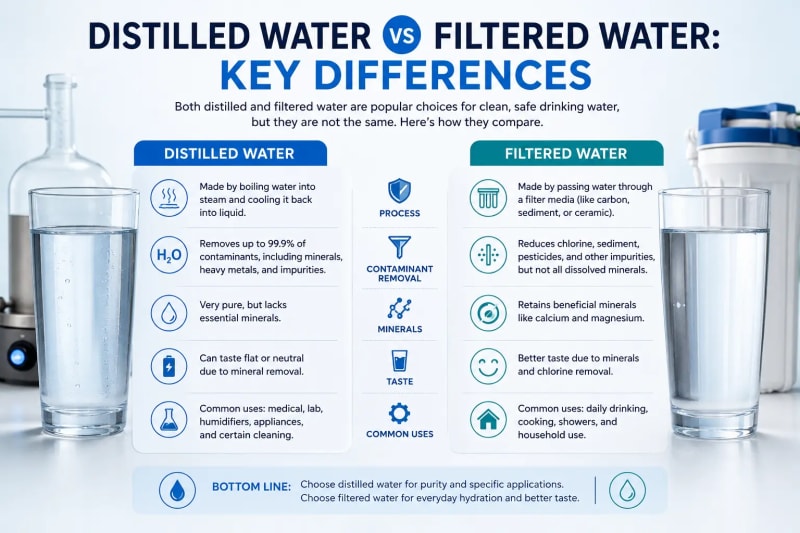
Modern water filtration methods differ mainly in the specific contaminant classes each one targets, including sediment filtration, activated carbon, ion exchange, membrane filtration and ultraviolet disinfection. For a complete comparison of these modern methods, see Modern Water Filtration Methods.
How does activated carbon filtration work?
Activated carbon filtration works through adsorption, where contaminants stick to the surface of the carbon material as water passes through it. This method is commonly used to address taste, odor, chlorine and certain organic contaminants. For a complete explanation, see Activated Carbon Water Filters.
How does reverse osmosis filtration work?
Reverse osmosis filtration works by pushing water through a semi permeable membrane under pressure, separating dissolved contaminants from the water that passes through. It plays a significant role in modern treatment systems addressing dissolved contaminants beyond what conventional filtration removes. For a complete explanation, see Reverse Osmosis Water Filtration.
How does slow sand filtration work today?
Slow sand filtration today still relies on a sand bed and a biological layer that forms on its surface, trapping particles and some microorganisms as water passes through slowly. For a complete explanation of this process, see Slow Sand Filtration.
How does water purification differ from filtration?
Water purification differs from filtration in scope, since filtration is one specific treatment mechanism, while purification can include filtration alongside disinfection and other treatment processes. For a complete comparison, see Water Filtration vs Water Purification.
Conclusion
The history of water filtration shows a steady progression from ancient sensory based treatment toward today's engineered, multi stage systems. Each major development, scientific discovery, municipal sand filtration, chlorination, regulation, chemical contamination response and membrane technology, arrived because an earlier method could not fully solve a new problem. Modern treatment systems now combine many of these historical technologies into a single process, addressing physical particles, microorganisms and dissolved contaminants together. Understanding this history makes it clear why no single method has ever solved every water quality problem alone, and why combined, purpose built treatment remains the standard today.