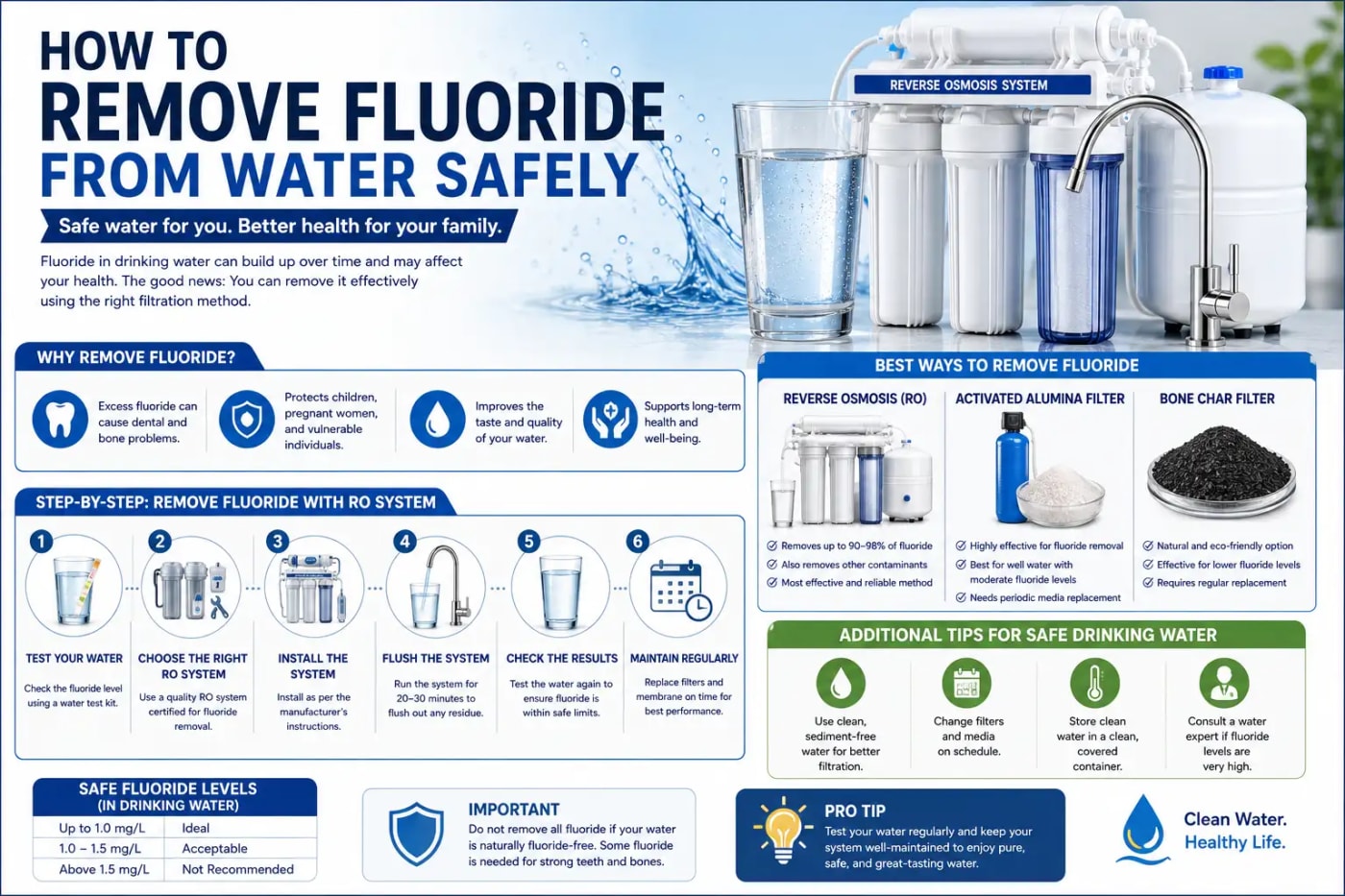
To remove fluoride from water safely, use a treatment method built specifically for dissolved ions, such as reverse osmosis, activated alumina, distillation, ion exchange, or bone char filtration. Fluoride is a dissolved ion, not a particle, so ordinary sediment or carbon filtration does not remove it. This guide compares the main fluoride removal technologies, explains how each one works, and helps you match a method to your water source, your fluoride level, and your household needs. It also covers testing, certification, maintenance, and common mistakes people make when trying to reduce fluoride in their drinking water.
Which Methods Can Remove Fluoride From Water?
Several treatment technologies can reduce fluoride in drinking water, and they fall into two broad groups: household-level systems and larger treatment-plant technologies. Reverse osmosis, activated alumina, distillation, ion exchange, and bone char filtration are the main methods used at the household level, while some centralized water systems use advanced coagulation or specialized treatment steps to reduce fluoride before water reaches homes.
The table below compares the main fluoride removal methods at a glance:
Method | How it works | Common setting |
Reverse osmosis | Pushes water through a semi-permeable membrane that rejects dissolved ions | Household, under-sink or whole-home |
Activated alumina | Adsorbs fluoride onto a porous aluminum oxide media | Household, point-of-use or point-of-entry |
Distillation | Evaporates water and condenses the vapor, leaving fluoride behind | Household, countertop units |
Ion exchange | Swaps fluoride ions for other ions using a resin bed | Household and centralized systems |
Bone char | Adsorbs fluoride onto a calcium-phosphate-based media | Household, specialty filters |
Ordinary sediment filters, standard carbon filters, and simple pitcher filters are not included in this list, since they are not designed to capture dissolved fluoride ions.
How Does Reverse Osmosis Remove Fluoride?
Reverse osmosis removes fluoride by forcing water through a semi-permeable membrane that blocks dissolved ions, including fluoride, from passing through. The system separates incoming water into two streams: purified water, called permeate, passes through the membrane, while a concentrated stream, called reject or reject water, carries away the fluoride and other dissolved substances that were filtered out.
Reverse osmosis is useful when fluoride exists alongside other dissolved contaminants, since the membrane rejects a broad range of dissolved substances at once rather than targeting fluoride alone. NSF/ANSI 58 is the certification standard that covers fluoride reduction claims for reverse osmosis systems, and it requires systems to demonstrate a defined level of fluoride reduction through independent testing. Actual performance still depends on the specific system, water pressure, and operating conditions, so avoid assuming every reverse osmosis unit removes fluoride at the same rate.
How Does Activated Alumina Remove Fluoride?
Activated alumina removes fluoride through adsorption, a process where fluoride ions bind to the surface of the porous aluminum oxide media as water passes through it. This is sometimes described as a ligand exchange process, since fluoride ions displace other ions already attached to the alumina surface.
Operating factors that affect activated alumina performance:
Water pH: Activated alumina generally performs best within a specific pH range, and performance can decline outside that range.
Media exhaustion: The alumina has a limited capacity to bind fluoride before it becomes saturated.
Capacity: Higher fluoride concentrations use up media capacity faster.
Regeneration: Some activated alumina systems can be regenerated with specific chemical solutions, while others use replaceable cartridges.
Activated alumina is a distinct treatment approach from general carbon filtration. Carbon media targets taste, odor, and certain organic compounds, while activated alumina specifically targets fluoride and similar dissolved ions.
How Does Distillation Remove Fluoride?
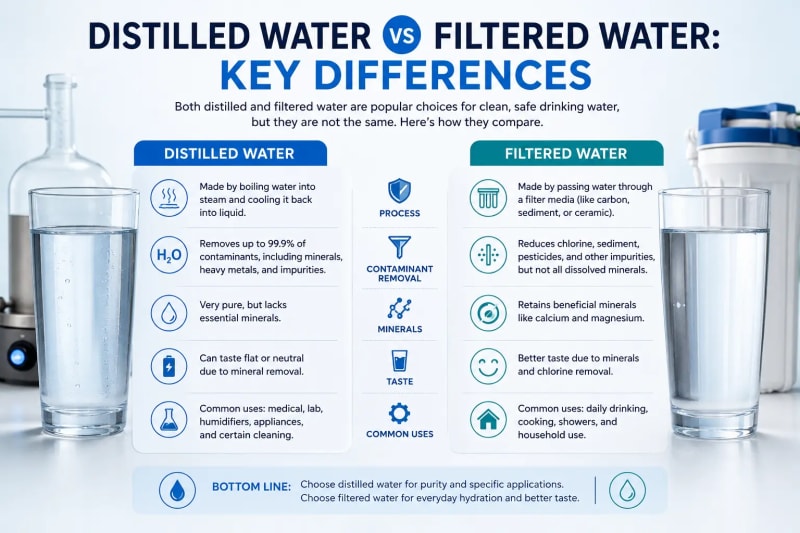
Distillation removes fluoride by evaporating water into vapor and then condensing that vapor back into liquid water, leaving fluoride and other dissolved minerals behind in the original container. This is different from simply boiling water on a stove, since boiling alone does not separate and remove the vapor from the dissolved substances left behind.
How the distillation process works:
Water is heated until it evaporates into steam.
The steam rises, leaving fluoride and other dissolved minerals behind in the boiling chamber.
The steam travels through a cooling section, where it condenses back into liquid water.
The condensed water is collected as purified output, largely free of the minerals left behind.
Household distillation units typically produce water at a slower rate than other treatment methods and use more energy per gallon produced, since the process requires heating water to the point of evaporation. This makes distillation a practical choice for smaller volumes of drinking water rather than whole-house treatment.
How Do Ion Exchange Systems Reduce Fluoride?
Ion exchange systems reduce fluoride by passing water through a resin bed that swaps fluoride ions for other ions, typically chloride or hydroxide, depending on the resin type. This is a different mechanism from reverse osmosis, which physically blocks ions with a membrane, and from activated alumina, which relies on adsorption onto a media surface.
The table below highlights the core difference between these three mechanisms:
Method | Core mechanism | Depends heavily on |
Ion exchange | Swaps fluoride ions for other ions in a resin bed | Resin type, competing ions in the water |
Reverse osmosis | Physically blocks dissolved ions with a membrane | Membrane condition, water pressure |
Activated alumina | Adsorbs fluoride onto a porous media surface | Water pH, media capacity |
Ion exchange performance depends on resin selection and the presence of competing ions in the water, since other dissolved substances can compete with fluoride for the same exchange sites on the resin. This method appears in both centralized water treatment plants and some household systems, though the scale and resin type differ between the two applications. Ion exchange should not be treated as universally superior to reverse osmosis or activated alumina, since the right choice depends on the specific water being treated.
How Does Bone Char Reduce Fluoride?
Bone char reduces fluoride through adsorption onto a calcium-phosphate, or apatite-based, media made from processed animal bone. Fluoride ions bind to the surface of the bone char material as water passes through it, similar in principle to activated alumina but using a different base material.
Bone char is a distinct medium from ordinary activated carbon, even though both are sometimes referred to informally as "char." Ordinary activated carbon is generally not effective at removing fluoride, while bone char is specifically valued for its fluoride adsorption properties. Availability and personal preference, including concerns some people have about using an animal-derived product, are practical considerations when choosing bone char over other fluoride removal methods.
Which Fluoride Removal Method Fits Your Water?
The right fluoride removal method depends on several conditions specific to your water and household, not a single universal recommendation.
The table below maps common conditions to suitable technology categories:
Condition | Technology to consider |
Fluoride present alongside other dissolved contaminants | Reverse osmosis |
Need for a compact, cartridge-based system | Activated alumina or bone char |
Small daily drinking water volume needed | Distillation |
Centralized or whole-house treatment goals | Ion exchange or reverse osmosis, depending on scale |
Water with unusual pH or high competing ion levels | Evaluate activated alumina and ion exchange carefully, since both are sensitive to water chemistry |
Consider your starting fluoride concentration, water source, other contaminants present, the volume of water you need treated, how much installation you are willing to take on, ongoing maintenance requirements, your water's chemistry, and your desired outcome before settling on a method.
How Should You Test Fluoride Before Filtration?
Testing your water for fluoride before choosing a treatment system tells you the actual starting concentration, which is necessary for selecting an appropriately sized and rated system.
Steps to test fluoride before filtration:
If you are on a municipal water supply, contact your local water provider for your area's fluoride data, since public systems often publish this information in an annual water quality report.
If you rely on a private well, arrange laboratory analysis of your well water, since well water fluoride levels are not tracked by a public utility.
Record your baseline fluoride concentration before installing any treatment system.
After installation, test the treated water again to confirm the system is actually reducing fluoride as expected.
The CDC recommends contacting your local water provider for municipal fluoride information and using laboratory analysis for private well water, since these are the two most reliable ways to know your starting fluoride level.
How Does Water Chemistry Affect Fluoride Removal?
Water chemistry variables can significantly affect how well a treatment system performs, independent of the technology itself.
The table below shows key water chemistry variables and their effect on treatment performance:
Variable | Effect on treatment | Most relevant technology |
pH | Can shift adsorption efficiency higher or lower | Activated alumina |
Total dissolved solids (TDS) | High TDS can affect membrane performance and ion competition | Reverse osmosis, ion exchange |
Competing ions | Other ions can compete with fluoride for exchange or adsorption sites | Ion exchange, activated alumina |
Hardness | Can affect scaling and system maintenance needs | Reverse osmosis, ion exchange |
Influent water quality overall | Sets the baseline the system has to work against | All methods |
Treatment performance is system-specific and water-specific. A method that performs well in one household's water may perform differently in water with a different pH or mineral content, so testing your actual water conditions matters more than relying on general performance figures.
What Should You Check Before Buying a Fluoride Filter?
Validate any fluoride removal claim carefully before purchasing a system, since a generic "water filter" label does not guarantee fluoride reduction.
Buyer checklist for fluoride filtration systems:
Exact model number: Confirm you are looking at the specific model, not a general product line.
Stated fluoride reduction claim: Check whether fluoride reduction is explicitly listed, not just implied.
Certification: Look for a recognized certification, such as NSF/ANSI 58 for reverse osmosis systems with a fluoride reduction claim.
Rated capacity: Confirm how much water or how long the system is rated to perform before maintenance is needed.
Operating conditions: Check the pH, pressure, and temperature range the system is designed for.
Replacement requirements: Understand what parts need periodic replacement and how often.
Intended installation: Confirm whether the system is meant for point-of-use or whole-house installation.
NSF/ANSI 58 includes fluoride reduction as an optional claim specifically for reverse osmosis systems, meaning not every certified RO system automatically carries a fluoride claim. Always confirm the fluoride claim is explicitly listed for the exact model you are considering.
Should You Use Point-of-Use or Whole-House Filtration?
Point-of-use and whole-house filtration differ in scope, not in the underlying fluoride removal technology.
The table below compares these two treatment scopes:
Scope | What it covers | Common examples |
Point-of-use | Treats water at a single tap or appliance | Under-sink reverse osmosis, refrigerator or ice-maker filters |
Point-of-entry (whole-house) | Treats all water entering the home | Whole-house ion exchange or larger treatment systems |
Point-of-use treatment makes sense when drinking and cooking water are the main concern, since it treats only the water you consume. Whole-house, or point-of-entry, treatment addresses all water entering the home, which matters more if fluoride exposure through bathing or other uses is a concern, or if a household wants consistent water quality at every tap.
How Do Fluoride Filters Affect Other Water Minerals?
Fluoride removal technologies differ in how selectively they target fluoride versus other dissolved minerals. Reverse osmosis removes a broad range of dissolved ions alongside fluoride, including many beneficial minerals, since the membrane does not distinguish between fluoride and other similarly sized dissolved substances. Selective media, such as activated alumina or ion exchange resin, may target fluoride somewhat differently depending on the specific media and water chemistry, though some co-removal of other ions is common across most methods.
Because broad-spectrum methods like reverse osmosis reduce overall mineral content along with fluoride, some households choose to remineralize treated water afterward. This is a management step to consider after treatment, not a separate fluoride removal method in itself.
How Should You Maintain a Fluoride Removal System?
Ongoing maintenance keeps a fluoride removal system performing at its rated level, and the details vary significantly by technology and manufacturer.
Fluoride removal system maintenance checklist:
Follow the manufacturer's service interval: Replace filters, membranes, or media according to the specific schedule provided for your system, not a generic assumption.
Monitor performance over time: Periodically test treated water to confirm fluoride reduction remains consistent.
Maintain membranes properly: For reverse osmosis systems, follow manufacturer guidance on membrane cleaning or replacement.
Regenerate or replace media as needed: Activated alumina systems may require regeneration or cartridge replacement once media capacity is exhausted.
Activated alumina exhaustion and regeneration are well documented processes, and following the manufacturer's exact guidance is more reliable than assuming a universal replacement schedule applies across different systems.
What Happens to Fluoride After Water Treatment?
Fluoride does not disappear during treatment. It ends up in a waste stream or spent media, depending on the technology used.
The table below shows where fluoride ends up for each major technology:
Technology | Fluoride destination |
Reverse osmosis | Concentrated in the reject water stream, which is typically drained away |
Activated alumina | Captured on the media until it is exhausted, then released during regeneration or discarded with the spent media |
Distillation | Left behind as residue in the boiling chamber |
Ion exchange | Captured on the resin, then released into a regeneration waste stream when the resin is regenerated |
Bone char | Captured on the media until the media reaches capacity and is replaced |
Some technologies, particularly reverse osmosis and activated alumina regeneration, create a concentrated fluoride waste stream that needs to be managed, rather than simply eliminating fluoride from the overall water cycle.
What Should You Avoid When Removing Fluoride?
A few common misconceptions lead people toward methods that do not actually reduce fluoride.
Misconception versus reality:
Misconception: Boiling water removes fluoride. Reality: boiling does not remove fluoride, since fluoride is not eliminated by heat alone and remains in the water as it evaporates and reduces in volume.
Misconception: Any water filter removes fluoride. Reality: standard carbon filtration, including standard Brita cartridges, is not designed to remove fluoride, since activated carbon does not effectively bind fluoride ions.
Misconception: A "water purifier" label guarantees fluoride removal. Reality: only systems specifically certified or designed for fluoride reduction, such as reverse osmosis, activated alumina, distillation, ion exchange, or bone char, reliably reduce fluoride.
Checking the specific technology and certification behind a product avoids the disappointment of buying a filter that was never designed to address fluoride in the first place.
How Can You Verify Fluoride Was Actually Reduced?
Confirm that a fluoride removal system is actually working by comparing water quality before and after treatment, rather than assuming the system performs as advertised.
Steps to verify fluoride reduction after treatment:
Compare your recorded pre-treatment fluoride level with a post-treatment test result.
Confirm the specific model you installed carries a certified fluoride reduction claim, such as an NSF/ANSI 58 listing for reverse osmosis systems.
Retest periodically, especially as filters or media approach their rated service life, since performance can decline as media becomes exhausted.
Certification documentation for your exact model is the clearest way to confirm the system's claimed fluoride reduction matches your actual treatment goal, rather than relying on general marketing claims alone.
What Should You Consider After Choosing Fluoride Filtration?
Once you understand the treatment technologies and how to select one, the next practical questions usually involve specific products, installation details, and water-quality-specific decisions. The sections below connect this treatment overview to more detailed guides on individual products and related questions people commonly ask.
Does Reverse Osmosis Remove Fluoride?
Yes, reverse osmosis can reduce fluoride, though the exact performance depends on the specific system and membrane condition. Check for a certified fluoride reduction claim, such as an NSF/ANSI 58 listing, on the exact model you are considering. For a full explanation of how reverse osmosis systems work, see our guide on reverse osmosis water filters.
Does Brita Remove Fluoride?
No, standard Brita cartridges are not designed to remove fluoride. Brita filters use activated carbon, which is effective at reducing chlorine taste and odor but does not bind fluoride ions. For a full breakdown of what Brita filters do and do not remove, see our guide on whether water filters remove fluoride.
Does Boiling Water Remove Fluoride?
No, boiling water does not remove fluoride. Boiling is a disinfection method for certain biological contaminants, not a fluoride-removal treatment, and fluoride remains in the water as it boils. For a more detailed explanation, see our guide on whether boiling water removes fluoride.
What Water Filters Remove Fluoride?
Reverse osmosis systems, activated alumina filters, distillation units, ion exchange systems, and bone char filters can all reduce fluoride when properly certified or designed for that purpose. For detailed product and system recommendations, see our guide on the best water filters for fluoride removal.
How Do You Test Fluoride in Well Water?
Private well fluoride levels should be determined through laboratory analysis, since well water is not covered by the fluoride reporting that applies to municipal water systems. For the complete testing process, see our guide on how to test well water for fluoride.
What Is the Best Fluoride Filter for a Home?
The best fluoride filter for your home depends on matching the system to your fluoride concentration, water chemistry, the volume of water you need treated, and a verified fluoride-reduction performance claim. For a detailed product comparison, see our guide on the best fluoride water filters.
Conclusion
Removing fluoride from water safely requires a treatment method specifically built for dissolved ions, since fluoride passes through ordinary sediment and carbon filtration untouched. Reverse osmosis, activated alumina, distillation, ion exchange, and bone char each work differently, and the right choice depends on your fluoride level, water chemistry, and how much water you need treated. Test your water before and after treatment, confirm any fluoride reduction claim is backed by real certification, and follow the manufacturer's maintenance schedule to keep your system performing as expected.