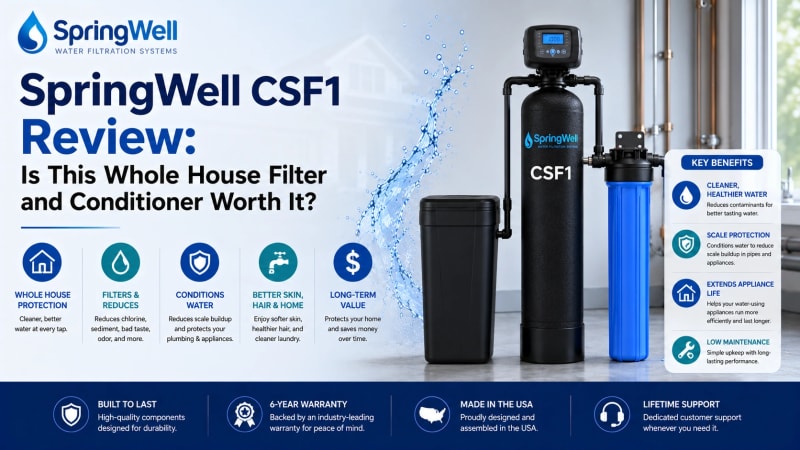
APEC Water Filters are residential and whole-house water treatment systems produced by APEC Water Systems. The APEC portfolio includes reverse osmosis systems, under-sink and countertop systems, whole-house filtration, carbon filtration, sediment filtration, UV treatment, specialty filters, and replacement components.
APEC systems treat water at two main locations: point of use and point of entry. Point-of-use systems treat water at a specific fixture, such as a kitchen faucet. Point-of-entry systems treat water before it enters the home's distribution system.
This guide explains the APEC water filtration product range, filtration technologies, contaminant relationships, water-source applications, major product families, certification standards, maintenance requirements, and model-selection criteria.
What Is APEC Water Systems?
APEC Water Systems is a water filtration company that produces residential reverse osmosis and water filtration systems. Its current product range includes drinking-water RO systems, countertop systems, tankless systems, whole-house filtration, replacement filters, and specialty treatment products.
APEC organizes its products around different water-treatment requirements rather than one universal filtration technology.
The main product categories are:
Reverse osmosis systems
Under-sink water filters
Countertop RO systems
Tankless RO systems
Whole-house water filters
Carbon filtration
Sediment filtration
UV treatment
Alkaline remineralization
Specialty filtration
Replacement filters and membranes
These categories create the basic APEC product taxonomy.
What Types of Water Filters Does APEC Make?
APEC makes several types of water filtration systems, and each type uses a different treatment process. The current APEC catalog includes multiple residential RO configurations and separate whole-house filtration products.
What Are APEC Reverse Osmosis Systems?
APEC reverse osmosis systems use pressure to force water through a semipermeable membrane. The membrane separates treated water from a concentrated reject-water stream. EPA defines point-of-use RO systems as systems connected to a single fixture, such as a kitchen sink.
APEC's current RO range includes systems such as:
ROES-50
ROES-PH75
ROES-PHUV75
ROES-100
RO-90
RO-PH90
RO-Hi
RO-PERM
ROTL-AIO
ROCT-PLUS
APEC also lists additional RO configurations and replacement membranes for specific models.
What Are APEC Whole-House Water Filters?
APEC whole-house water filters treat incoming household water before it reaches multiple fixtures. These systems serve a different treatment location from an under-sink RO system.
Whole-house filtration can address problems such as sediment, chlorine, taste, odor, iron, hydrogen sulfide, and other contaminants depending on the filtration media and system configuration.
The treatment objective therefore determines whether point-of-use or whole-house filtration is appropriate.
What Are APEC Carbon Filters?
APEC carbon filters use carbon media to reduce chlorine, taste, odor, and selected organic compounds. Carbon filtration commonly operates as a pretreatment or polishing stage within multi-stage water filtration systems.
APEC uses carbon filtration in its RO systems, including the ROES-50 and ROES-PH75.
What Are APEC Sediment Filters?
APEC sediment filters reduce suspended particles such as dirt, sand, silt, and rust. Sediment filtration commonly appears before carbon and reverse osmosis stages because suspended particles can interfere with downstream filtration components.
What Are APEC UV Water Filters?
APEC UV systems add ultraviolet treatment to selected filtration configurations. APEC's current product range includes UV-equipped RO systems such as the ROES-PHUV75 and ROES-UV75.
UV treatment serves a different function from RO and carbon filtration. It therefore belongs to a separate treatment layer within the filtration sequence.
What Are APEC Alkaline RO Systems?
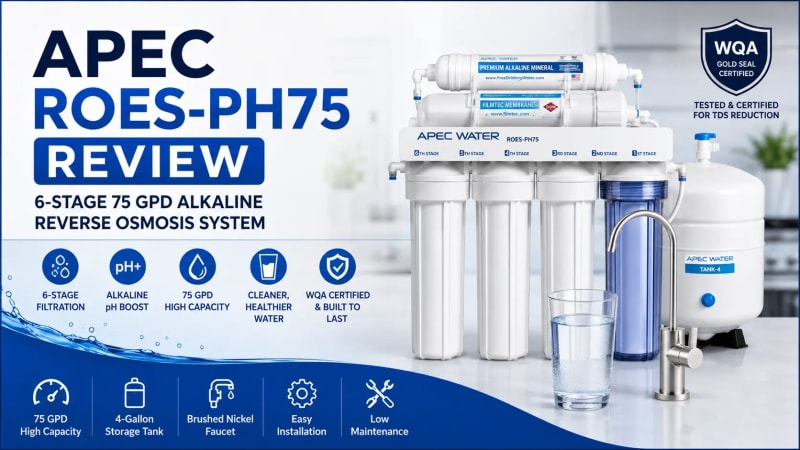
APEC alkaline RO systems add a remineralization stage after reverse osmosis. The ROES-PH75, for example, uses a calcium-based stage after the RO membrane. APEC specifies calcium carbonate as the mineral used for its pHPlus stage.
The remineralization stage changes the treated-water chemistry after the RO process. It does not replace the RO membrane.
How Do APEC Water Filtration Technologies Work?
APEC filtration technologies work through different physical or chemical treatment mechanisms, including membrane separation, adsorption, particle filtration, ultraviolet treatment, and mineral addition.
How Does APEC Reverse Osmosis Work?
Reverse osmosis uses pressure to move water through a semipermeable membrane. The process produces a treated-water stream called permeate and a reject-water stream called concentrate or brine.
EPA identifies RO as a technology that can potentially reduce contaminants including lead, VOCs, PFAS, arsenic, bacteria, and viruses when the system is designed and tested for those claims.
APEC's ROES-50 uses a TFC RO membrane and specifies a 50-gallon-per-day capacity at 60 psi and 77°F. APEC specifies a 40–85 psi feed-water pressure range and a maximum feed-water TDS of 2,000 ppm for the model.
How Does APEC Carbon Filtration Work?
Carbon filtration uses adsorption to capture selected compounds on the surface of carbon media. APEC uses activated carbon stages to reduce chlorine, tastes, odors, and selected chemicals in its RO configurations.
Carbon filtration therefore complements RO rather than performing the same function.
How Does APEC Sediment Filtration Work?
Sediment filtration physically retains suspended particles before they reach downstream treatment stages. The target particles include materials such as dirt, sand, silt, and rust.
Sediment filtration is therefore primarily a particle-removal stage rather than a dissolved-contaminant treatment process.
How Does APEC UV Treatment Work?
UV treatment exposes water to ultraviolet energy as a microbial treatment step. APEC combines UV with selected RO configurations rather than using UV as a replacement for the RO membrane.
How Does APEC Remineralization Work?
APEC remineralization adds calcium carbonate after reverse osmosis. The ROES-PH75 places its calcium-based pHPlus stage after the post-carbon stage.
This sequence matters because remineralization modifies treated water after the primary RO separation process.
What Contaminants Do APEC Water Filters Remove?
APEC water filters address different contaminants according to the specific filtration technology and model. A brand-level contaminant claim is therefore less precise than a model-specific performance or certification claim.
Common treatment targets across APEC technologies include:
Lead
Fluoride
Arsenic
Nitrate
Chromium
Radium
Chlorine
VOCs
Sediment
Iron
Hydrogen sulfide
Total dissolved solids
Selected microorganisms
Does APEC Remove Lead?
Certain APEC RO systems are designed to reduce lead. Lead reduction is a model-specific claim and should be verified against the certification or performance documentation for the exact system.
NSF/ANSI 58 includes lead reduction as an optional contaminant-reduction claim for RO systems.
Does APEC Remove Fluoride?
Certain APEC RO systems are designed to reduce fluoride. Fluoride reduction is an optional performance claim under NSF/ANSI 58, so the exact model and certification determine the applicable claim.
Does APEC Remove Arsenic?
Certain RO systems can reduce arsenic when tested and certified for the applicable arsenic claim. NSF/ANSI 58 includes arsenic reduction among its optional RO performance claims.
Does APEC Remove Chlorine?
APEC carbon filtration reduces chlorine in systems that use carbon stages for that purpose. The ROES-50 and ROES-PH75 both use carbon filtration stages before and after the RO membrane.
Does APEC Remove Total Dissolved Solids?
APEC reverse osmosis systems reduce total dissolved solids through the RO membrane. NSF/ANSI 58 includes TDS reduction as a required performance area for covered RO systems.
Does APEC Remove Sediment?
APEC sediment filters reduce suspended particles such as dirt, sand, silt, and rust. Sediment filtration is primarily a physical filtration process.
Does APEC Remove Iron and Hydrogen Sulfide?
APEC offers whole-house and specialty filtration configurations for specific well-water conditions including iron and hydrogen sulfide. The appropriate treatment depends on the measured concentration and chemical form of the contaminant.
A well-water treatment system therefore requires water testing before model selection.
Which APEC Water Filter Is Right for City Water?
An APEC filter for city water depends on the contaminant and treatment objective identified in the local water supply.
A city-water application can require different treatment approaches:
Chlorine → carbon filtration
Taste and odor → carbon filtration
Dissolved contaminants → reverse osmosis
Sediment → sediment filtration
Drinking-water treatment → point-of-use RO
Whole-home chlorine reduction → whole-house carbon filtration
EPA states that additional household treatment is not automatically necessary for every public-water supply and that treatment selection depends on the water-quality problem.
The correct APEC system therefore starts with the water-quality data rather than the product name.
Which APEC Water Filter Is Right for Well Water?
An APEC well-water system depends on the contaminants measured in the groundwater.
Common well-water treatment conditions include:
Sediment
Iron
Hydrogen sulfide
Manganese
Hardness
Low or high pH
Microbial contamination
Dissolved contaminants
A sediment problem requires particle filtration. Iron and hydrogen sulfide require treatment media designed for those contaminants. Drinking water with dissolved contaminants can require point-of-use RO.
This distinction is important because well water is a source category, not a single contaminant condition.
What APEC Water Filter Models Are Available?
APEC's current product range contains multiple RO and whole-house configurations that differ in capacity, treatment stages, installation format, and additional technologies.
Which APEC Reverse Osmosis Models Are Available?
APEC's current RO range includes:
APEC model | Primary configuration |
|---|---|
ROES-50 | 5-stage, 50 GPD RO |
ROES-PH75 | 6-stage, 75 GPD alkaline RO |
ROES-PHUV75 | 7-stage alkaline RO with UV |
ROES-100 | 5-stage, 100 GPD RO |
RO-90 | 5-stage, 90 GPD RO |
RO-PH90 | 6-stage, 90 GPD alkaline RO |
RO-Hi | High-output RO |
RO-PERM | RO with permeate-pump configuration |
ROTL-AIO | Tankless RO |
ROCT-PLUS | Countertop RO |
APEC's current catalog contains additional configurations and replacement components beyond these examples.
What Is the APEC ROES-50?
APEC ROES-50
199
The APEC ROES-50 is a 5-stage, 50 GPD under-sink reverse osmosis system. APEC specifies a 4-gallon storage tank, 40–85 psi feed-water pressure, and 2,000 ppm maximum TDS for the model. APEC also identifies the ROES-50 as WQA Gold Seal Certified.
The detailed ROES-50 review covers its filtration stages, performance, costs, maintenance, and real-world considerations.
What Is the APEC ROES-PH75?
The APEC ROES-PH75 is a 6-stage, 75 GPD alkaline mineral reverse osmosis system. Its sixth stage uses calcium carbonate to add minerals and increase alkalinity after RO treatment. APEC identifies the model as WQA Gold Seal Certified.
The detailed ROES-PH75 review covers its performance, remineralization stage, maintenance, costs, and use cases.
What Is the APEC ROES-PHUV75?
The APEC ROES-PHUV75 combines reverse osmosis, alkaline remineralization, and UV treatment in a 7-stage configuration. APEC lists it within the Essence RO product family.
Its additional treatment stages distinguish it from the standard ROES-50 and alkaline ROES-PH75 configurations.
How Do You Choose an APEC Water Filter?
Choose an APEC water filter according to water source, contaminants, treatment location, filtration technology, water demand, certification, and maintenance requirements.
Use this selection sequence:
Test the water source.
Identify the contaminants.
Define the treatment location.
Select the filtration technology.
Determine the required flow or production rate.
Check model-specific certification.
Check replacement-filter requirements.
Compare total ownership requirements.
The treatment location creates the first major distinction.
Requirement | Relevant APEC category |
|---|---|
Drinking water at one faucet | Point-of-use RO |
Whole-home treatment | Whole-house filtration |
Chlorine and taste | Carbon filtration |
Sediment | Sediment filtration |
Dissolved contaminants | Reverse osmosis |
Mineral addition after RO | Alkaline RO |
UV treatment | UV-equipped system |
Well-water contaminants | Specialty or whole-house treatment |
Lower-pressure RO application | Permeate-pump RO |
Limited installation space | Countertop or tankless RO |
This selection framework connects the water problem to the appropriate APEC product category before a specific model is evaluated.
What Certifications Apply to APEC Water Filters?
APEC certifications apply to specific products and specific performance claims, not automatically to the entire APEC brand.
NSF/ANSI 58 covers point-of-use reverse osmosis drinking-water treatment systems. The standard addresses material safety, structural integrity, TDS reduction, efficiency, recovery, contaminant reduction, and end-user information.
NSF/ANSI 58 includes optional testing for contaminants such as:
Arsenic
Lead
Fluoride
Nitrate/nitrite
Chromium
Cadmium
Barium
Copper
VOCs
Radium
Selenium
APEC identifies models such as the ROES-50 and ROES-PH75 as WQA Gold Seal Certified.
Certification should therefore be evaluated using the exact model number and exact contaminant claim.
How Much Water Does an APEC Reverse Osmosis System Waste?
Reverse osmosis produces reject water because the membrane separates treated water from a concentrated stream. EPA states that a typical point-of-use RO system can send 5 gallons or more of water down the drain for every gallon of treated water produced. Less-efficient systems can reach 10 gallons or more per gallon of treated water.
EPA's WaterSense specification sets a maximum of 2.3 gallons of reject water per gallon of treated water for labeled point-of-use RO systems.
RO efficiency therefore forms part of the system-selection process alongside contaminant reduction.
How Often Do APEC Water Filters Need Replacement?
APEC filter replacement depends on the filter type, model, water quality, and water consumption. APEC states that RO replacement filters should be replaced at least every 12 months and provides model-specific replacement schedules.
APEC maintains separate replacement-filter catalogs for its RO systems, including ROES-50, ROES-75, ROES-PH75, ROES-PHUV75, RO-90, RO-PH90, RO-PERM, and other models.
A replacement schedule therefore belongs to the specific APEC model and filter set, rather than the brand as a whole.
How Does APEC Compare With Other Water Filter Brands?
APEC comparisons depend on the product category and treatment technology being compared. APEC competes with different brands across residential RO, whole-house filtration, countertop systems, and specialty treatment.
Relevant comparison relationships include:
APEC vs. iSpring → residential RO and drinking-water systems
APEC vs. Waterdrop → residential and tankless RO systems
APEC vs. SpringWell → whole-house and water-treatment systems
APEC vs. Aquasana → residential and whole-house filtration
A brand comparison becomes meaningful only after the treatment technology, water source, contaminant target, capacity, certification, and ownership requirements are defined.
The detailed comparisons belong on dedicated pages rather than this APEC hub.
Which APEC Water Filter Should You Explore?
The correct APEC page depends on the specific water-treatment question.
Explore the APEC ROES-50 page for its 5-stage, 50 GPD RO configuration.
Explore the APEC ROES-PH75 page for its 6-stage, 75 GPD alkaline RO configuration.
Explore the APEC ROES-PHUV75 page for its combination of RO, alkaline remineralization, and UV treatment.
Explore the APEC Green Carbon 10 page for whole-house carbon filtration.
Explore the APEC vs. iSpring page for a brand-level or model-level comparison.
Explore the APEC vs. Waterdrop page for residential RO and tankless-system comparisons.
Explore the Best APEC Water Filters for Well Water page when the primary context is groundwater treatment.
These pages provide deeper information for individual APEC products, comparisons, and water-source applications.
What Should You Know About APEC Water Filters?
APEC Water Filters represent a product ecosystem rather than a single filtration technology. The portfolio includes reverse osmosis, carbon filtration, sediment filtration, UV treatment, alkaline remineralization, whole-house filtration, specialty treatment, and replacement components.
Reverse osmosis addresses dissolved contaminants through membrane separation. Carbon filtration addresses chlorine, taste, odor, and selected organic compounds. Sediment filtration addresses suspended particles. UV treatment provides a separate microbial-treatment stage. Whole-house systems treat incoming household water across multiple fixtures.
The correct APEC system therefore follows a defined relationship:
Water source → contaminant → treatment objective → filtration technology → system configuration → model → certification → maintenance.
This relationship defines the APEC Water Filters product ecosystem and connects the brand hub to individual APEC models, reviews, comparisons, water-source guides, contaminant guides, and maintenance pages.